Multi-tenant Architecture Before the First Build: A Decision Guide
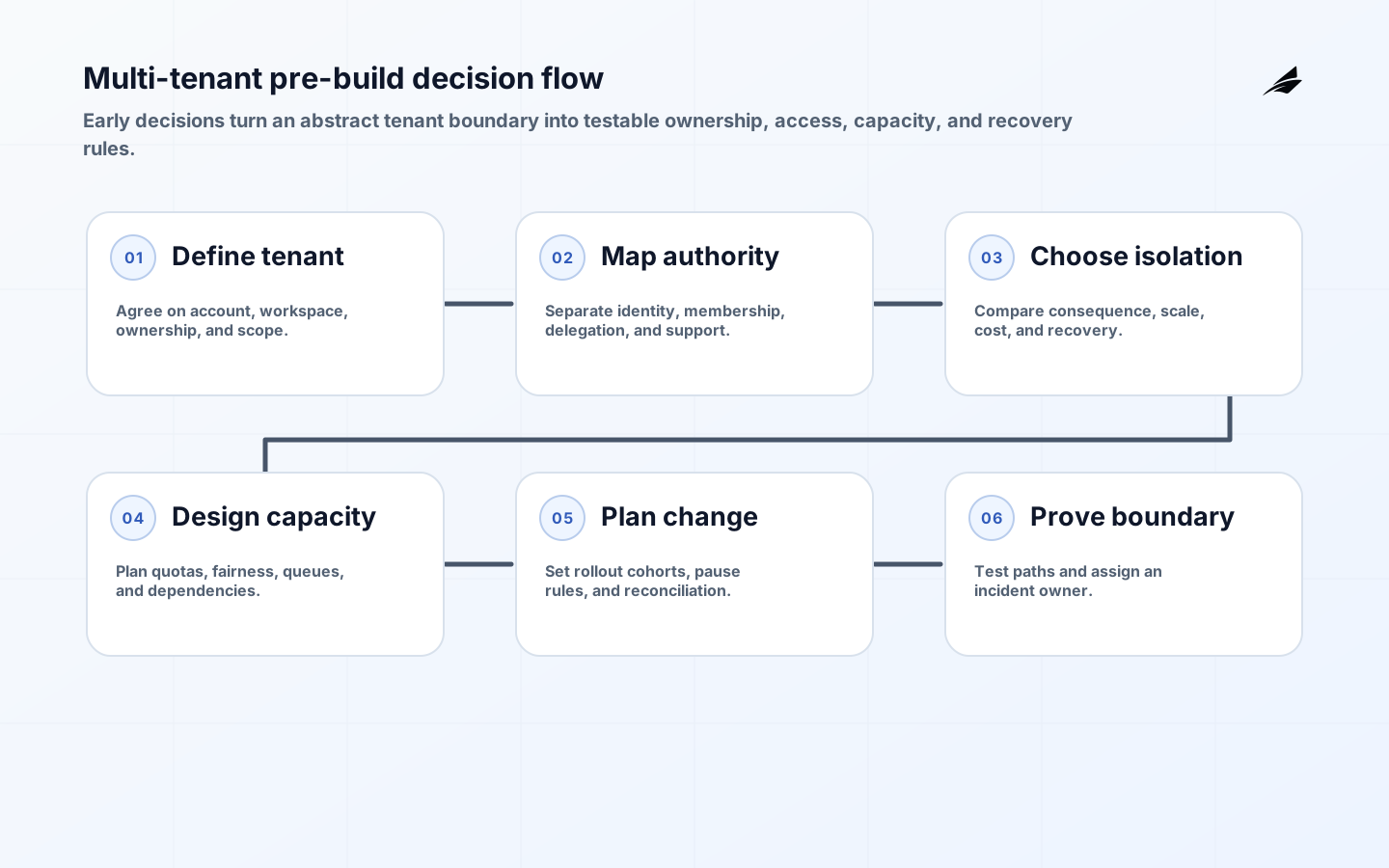
The cheapest time to make multi-tenant architecture decisions is before the first build, when the team can still change the domain model without migrating years of customer data. Operations leaders do not need a perfect forecast; they need explicit choices about ownership, isolation, capacity, support, and evidence. A tenant is not merely a filter added to a query. It is a boundary that affects identity, files, queues, integrations, analytics, billing, and recovery. The AWS SaaS tenant-isolation guidance provides a useful official vocabulary for thinking about shared services and tenant-aware operations.
Answer the first question: what is a tenant?
Write a tenant definition that a product manager, support lead, engineer, and finance owner can use consistently. Is it a customer account, a legal entity, a workspace, or a subscription? Can it contain multiple workspaces? Can a user belong to multiple tenants? Does a partner operate on behalf of a customer? These answers shape identifiers, access checks, URLs, exports, and billing. The PostgreSQL row security policies provide a useful prompt to connect scope checks to enforceable predicates. If the domain concept is ambiguous, technical teams will encode different assumptions in different services.
Map ownership before storage
List the records and actions owned by the tenant, shared by the platform, or delegated to another organization. A customer may own a dashboard definition but not the raw source system. A platform may own a global template while the tenant owns its configuration. A support team may be allowed to inspect a record but not change it. Put these distinctions into an ownership map before choosing database placement. The map is more durable than a diagram of today's tables because it tells the team which business promises must survive a refactor.
| Question | Decision artifact | Why it matters before build |
|---|---|---|
| What belongs to a tenant? | Ownership map for records, files, jobs, and integrations. | Prevents inconsistent scope assumptions. |
| Who may act? | Membership and delegated-authority model. | Keeps identity separate from access. |
| What is shared? | Platform versus tenant resource list. | Clarifies isolation and cost boundaries. |
| What can be exported? | Tenant export and deletion contract. | Makes retention and recovery testable. |
| What changes at scale? | Capacity and migration assumptions. | Avoids architecture choices with no operating plan. |
Choose the isolation model by consequence
Compare shared rows, shared schemas, separate schemas, separate databases, and dedicated deployments against consequence, recovery, scale, customer commitments, and team capability. A highly isolated pattern can still fail if exports or support tools bypass it. A shared pattern can be appropriate when authorization, testing, and operational controls are strong. Decide which risks are reduced, which costs are introduced, and which evidence will prove the choice. Avoid using “enterprise isolation” as a sales phrase unless the team can describe its technical and operational meaning.

- Which cross-tenant failure would be unacceptable, and how would it be detected?
- Where will tenant context be stored and validated for synchronous and asynchronous work?
- How will a restore, replay, export, or migration prove separation?
- Which shared dependencies can create noisy-neighbor impact?
- What support access is required, and how is it limited and audited?
- What scale or customer commitment would justify moving a tenant to a different boundary?
Design access as a relationship
A user identity, tenant membership, role, record scope, and action permission should be distinct concepts. Resolve the active tenant from an authenticated request and validate it against membership and resource ownership. Do not trust a hidden field, path segment, or front-end selection. For service accounts and integrations, define which tenant they represent and which records they may touch. A support workflow should create a separate, time-bound access event rather than granting a permanent administrator role. This model gives operations leaders something concrete to review when customers ask who can see or change their data.
Design shared capacity before traffic arrives
Identify the resources that can become scarce: request workers, database connections, queue slots, storage, search capacity, third-party API quotas, and human support time. Decide whether capacity is shared fairly, reserved by plan, or isolated by tenant. Add a safe response for imports, reports, file processing, and scheduled jobs that exceed a threshold. OpenTelemetry semantic conventions can guide consistent signals for latency and errors; make them useful by connecting them to tenant, workload class, and owner under a controlled cardinality policy. Pair service contracts with the OpenAPI Specification so shared dependencies expose stable boundaries.
| Resource | Pre-build choice | Operational proof |
|---|---|---|
| Database | Shared pool, reserved capacity, or dedicated boundary. | Connection, latency, and saturation behavior. |
| Jobs | Fair queue, per-tenant quota, or priority class. | Age, retries, and starvation checks. |
| Files | Object namespace, size limits, and retention. | Path isolation and lifecycle verification. |
| Third party | Shared quota with backpressure or separate accounts. | Usage, rejection, and fallback behavior. |
| Support | Self-service, pooled, or named tenant coverage. | Response time and escalation ownership. |
Connect plans, usage, and access carefully
Subscription and usage logic can change a tenant's access, so it belongs in the architecture conversation. Define the source of truth for plan, entitlements, limits, billing status, and grace periods. Keep a payment provider's account identifier separate from the internal tenant identity, and reconcile changes rather than assuming every webhook arrives once and in order. Stripe subscription documentation is useful official guidance for explicit billing objects and API behavior. The product should state what happens when payment is late, a plan changes, usage is disputed, or billing data is unavailable.
Make change safe for every tenant
Before the first build, decide how features, migrations, data backfills, and infrastructure changes will reach tenants. Feature flags should be tenant-scoped, visible to operators, and removable. Database changes should support mixed application versions where a rolling deployment requires it. A migration needs a pause signal, a progress record, and an answer for partial completion. Vercel deployment documentation offers useful context for deployment environments; combine it with the OAuth 2.0 authorization framework when defining delegated rollout authority, and name cohort, owner, evidence, and rollback or forward-fix strategy.
Example: a collaboration product
Suppose a new collaboration product serves agencies that manage projects for multiple clients. The agency is the billing tenant, while each client project is a workspace with its own members and data. A user can belong to several agencies and projects. The architecture must prevent a project invitation from creating membership in the wrong agency, keep client exports scoped, and let a support agent access one project for a defined period. Usage is attributed to the agency and project separately. Writing these relationships before building screens prevents a later “workspace” model from carrying three different meanings.
Make isolation testable from day one
Create fixtures for small and large tenants, multiple memberships, removed users, support sessions, pending invitations, and asynchronous jobs. Test reads, writes, search, caches, webhooks, exports, notifications, analytics, billing events, and deletion. Include adversarial cases where identifiers are swapped or a job runs after membership removal. Keep the test names tied to the business boundary so they survive a storage refactor. The goal is not a single isolation test; it is a matrix of paths that would be dangerous if tenant context were lost.
Name the failure and the owner
Before implementation, document the response to a cross-tenant read, a noisy-neighbor event, an incomplete migration, a billing mismatch, a lost export, or a compromised support session. The first move may be to disable a feature, pause a queue, revoke access, or isolate a tenant. The next moves are evidence preservation, affected-scope identification, communication, correction, and a prevention test. Operations leaders should reject architecture decisions that describe happy-path capability without a response owner and stop condition.
- A tenant definition is written in business language and reflected in the domain model.
- Membership, delegated access, support access, and service identity are separate concepts.
- Isolation and capacity choices include the jobs, caches, files, exports, and integrations around the database.
- Plans and usage have a source of truth, reconciliation rule, and grace-period behavior.
- Migrations, feature flags, and backfills have scope, progress, pause, and recovery evidence.
- The first release has a test matrix for scope safety and a named incident owner.
Choose measures before launch
Set a baseline for scope-related defects, authorization denials, p95 and p99 latency by tenant cohort, queue starvation, storage growth, support access, migration completion, export success, and unallocated cost. Add a business measure such as time to onboard a new tenant, time to resolve a dispute, or percentage of work completed without support intervention. Metrics should trigger decisions: raise capacity, tighten a policy, split a workload, change a plan, or improve the support path. If the team cannot state the action, the measure is not yet ready.
Pre-build tenancy decisions to retain
- Define the tenant and its relationships before selecting tables or deployment patterns.
- Evaluate isolation by consequence, recovery, scale, and evidence rather than labels.
- Carry tenant context across every synchronous and asynchronous boundary.
- Plan shared-capacity fairness and cost attribution before customers create load.
- Make billing, entitlements, migrations, and support access part of the architecture.
- Choose launch measures that lead to a named operational decision.
Pre-build tenancy questions
What should be decided before writing the first schema?
Define tenant ownership, membership, resource scope, shared services, support authority, export and deletion behavior, capacity assumptions, and the evidence required to prove isolation.
Can a small startup use shared tables?
Yes, if the team makes scope checks hard to omit, tests all data paths, limits shared capacity, and has a recovery plan. A shared pattern is a choice, not an excuse for implicit boundaries.
What should operations leaders review?
Review customer impact, support access, migration controls, noisy-neighbor behavior, billing and entitlement reconciliation, evidence quality, and the actions available when the boundary is threatened.
Conclusion: decide the boundary while it is cheap
Before coding, decide what the tenant owns, where authority is checked, how shared capacity is rationed, and what evidence proves a migration stayed in scope. Those decisions are cheaper while the domain model is still flexible. The workspace models guide, usage reporting guide, and onboarding flows guide provide adjacent examples. A pre-build choice is valuable when product, support, engineering, and finance can apply it the same way under pressure.