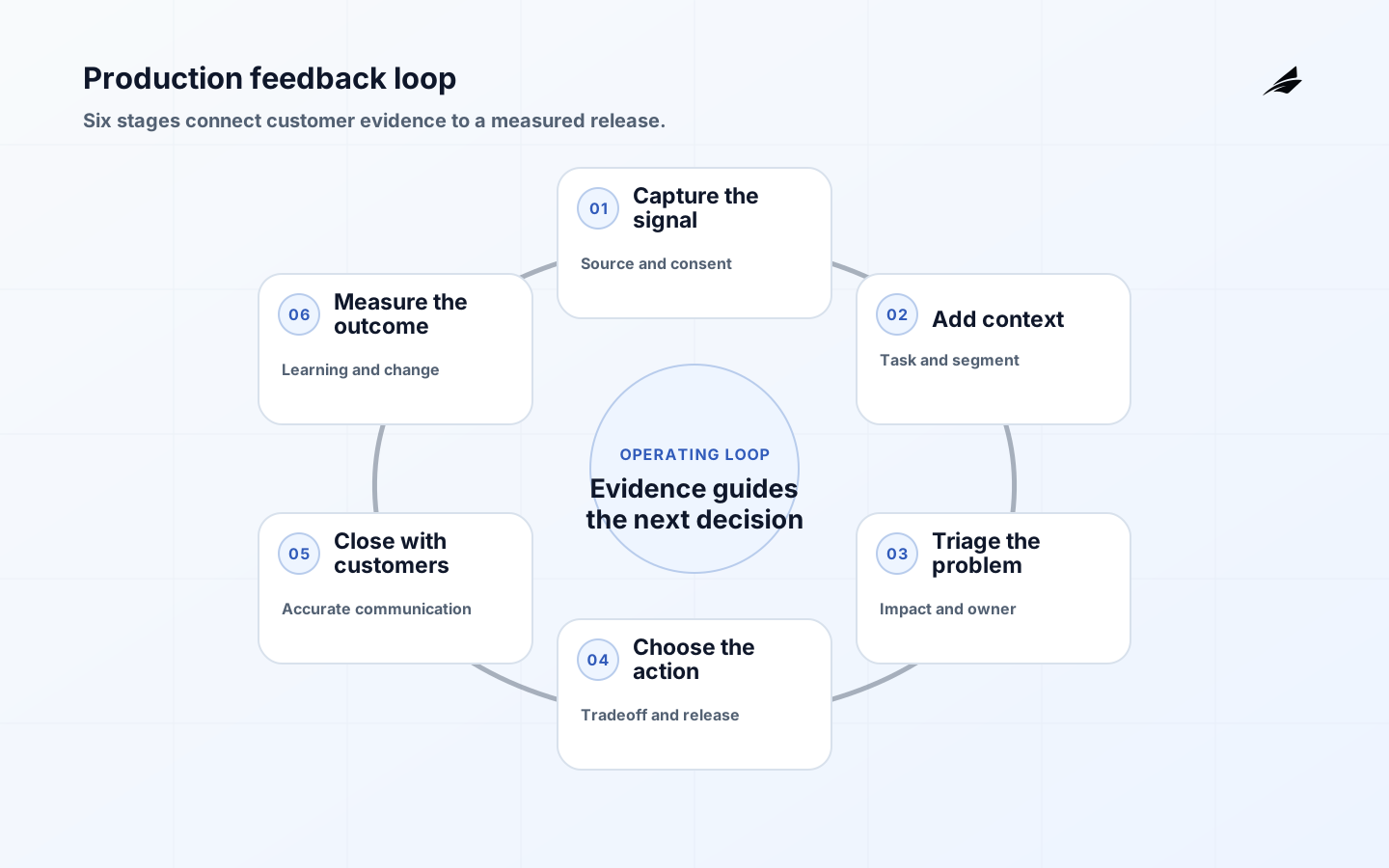
Customer feedback loops in production are no longer a collection of conversations waiting for a product meeting. They become an operating system for evidence: a customer or user creates a signal, the system captures context and permission, a team triages it, a decision owner chooses an action, delivery changes the product, and the customer can see or feel the result. Atlassian’s product management guidance is a useful reference for connecting customer problems to product decisions. Production adds identity, reliability, privacy, prioritisation, and a measurable closure path.
Define the feedback signal
Feedback may be a request, complaint, usability observation, support escalation, usage pattern, cancellation reason, or direct interview note. Give each signal a type, source, customer or account context, product area, consent status where relevant, timestamp, and confidence. Separate what the customer said from the team’s interpretation. A request for a feature is evidence of a problem or desired outcome, not automatically a specification. Make the signal searchable without exposing more customer information than the reviewer needs. The loop becomes useful when a product manager can compare related signals without flattening important differences.
| Feedback field | Decision it supports | Control |
|---|---|---|
| Source and time | Is the signal current and representative? | Capture context and timestamp |
| Account or segment | Who experiences the problem? | Scope access and consent |
| Problem statement | What outcome is sought? | Keep quote separate from interpretation |
| Status and owner | What happens next? | Visible state and due date |
Connect feedback to product context
A feedback record without product context is hard to act on. Link it to a release, feature, workflow, account tier, environment, device, and relevant support or incident record where policy permits. Capture the customer’s task, not only the page where a complaint occurred. Use stable identifiers and a plain-language summary so the engineering team can reproduce the issue. Consistent naming matters for events and telemetry; OpenTelemetry semantic conventions provide a useful model for shared vocabulary. The feedback service should preserve the original signal even when the product taxonomy changes.
Build reliable ingestion
Production feedback arrives through forms, support systems, interviews, in-product prompts, email integrations, and usage telemetry. Define which system owns the record and how duplicates are linked. If events cross services, use an idempotency key, record delivery status, and make retry behaviour visible. Stripe’s webhook signature guidance is a helpful official reference for verifying event origin, handling duplicate delivery, and responding quickly while processing asynchronously. Feedback should not disappear because a downstream endpoint was unavailable. Hold failed deliveries in a bounded queue with an owner and a recovery runbook.
Triage for action, not volume
Triage should ask what customer outcome is affected, how many people face it, how severe the consequence is, how confident the evidence is, and whether the team can learn more cheaply before building. Keep duplicate signals connected to a canonical problem, but do not let a popular request automatically outrank a high-severity issue with fewer reporters. Define states such as new, needs context, validated, planned, in progress, released, measuring, and closed. A state must carry an owner and next action. The point is to reduce ambiguity, not to create an elaborate queue no one maintains.
When feedback turns into a release decision, make the decision traceable: problem, evidence, intended outcome, tradeoff, owner, target release, and measure. Compare this with customer feedback loop decisions before the first build, a field guide for growing teams, and SaaS reliability decisions. Those related topics are useful only when production adds the operational details that let a team revisit whether the decision worked.
Close the loop with customers
A release is not closure. Confirm whether the change addressed the original job, whether the workaround became unnecessary, and whether a new problem appeared. Decide what can be communicated to which customer and when. Avoid promising a date from an intake record that has no delivery commitment. Provide a reason when declining or deferring a signal, and invite the right next evidence. For high-value accounts, connect the feedback owner to customer success or support; for broad patterns, use release notes or in-product messaging. Closure should be respectful, accurate, and tied to an outcome rather than a ticket status.
| Failure mode | Control | Measure |
|---|---|---|
| Duplicate signals fragment evidence | Link to a canonical problem | Duplicate rate and merge age |
| Feedback has no owner | Require accountable triage state | Unassigned age |
| Release is called success too early | Add post-release outcome check | Outcome confirmation rate |
| Sensitive comment spreads | Role, consent, and redaction rules | Access exceptions |
Observe the loop in production
Monitor ingestion failures, queue age, duplicate rate, time to first human response, time to triage, status ageing, release linkage, and outcome confirmation. Segment by source and customer segment to detect blind spots. Vercel’s observability documentation reinforces the value of production visibility across requests and runtime behaviour; apply the same discipline to feedback operations. Alert on broken collection and unowned high-severity signals, not on every increase in volume. A healthy loop can produce more feedback after a successful launch because customers trust that the team listens.
Close the production feedback loop
A production feedback service needs a deliberate review of signal quality. Sample records across support, sales, and in-product channels; check that the problem, segment, owner, and next customer communication are unambiguous. Check time to acknowledgement, time to triage, and whether urgent issues bypass the normal cadence safely. Look for customer groups that are overrepresented because they submit often and groups whose friction stays invisible because no channel reaches them. This protects the loop from becoming a popularity counter.
When a change ships, define how the team will learn whether it worked. Combine adoption, task completion, support contacts, customer follow-up, and qualitative evidence, then record the result against the original problem. The customer feedback field guide is useful for growing the rhythm without creating a large process burden. Keep the loop humane: customers should not have to repeat a story simply because the internal system changed.
- Sample signals by segment and source, not only by volume.
- Review unowned and stale records with the responsible team.
- Link every release claim to an outcome check.
- Retire fields and states that do not improve a decision.
The first production version should include an owner for failed intake and a visible way to tell customers that a signal was received but is not yet a commitment.
Treat a failed delivery as a customer-impacting reliability event when it can hide a meaningful signal. The product should retain the original context, expose the delay to the responsible team, and make recovery safe to repeat.
A feedback record also needs a definition of done. That definition may be a customer reply, a product decision, a shipped change, a documented decline, or a measured outcome. State which one applies so a closed queue reflects real learning rather than clerical completion.
A clear contract also tells customers what feedback will not do. It can inform a decision without creating a promise, and that distinction is part of trustworthy communication.
Keep a record of the customer-facing explanation when the loop is delayed so future triage can improve the message as well as the system.
The production contract
Before launch, verify that every feedback source has a canonical identifier, an owner, a retry or recovery path, a privacy rule, and a status that someone can explain. Test duplicate delivery and a downstream outage. A failed intake should become visible to the team, not disappear into a log. Review whether customer-visible communication is accurate when a signal is still being investigated, deferred, or grouped with another problem.
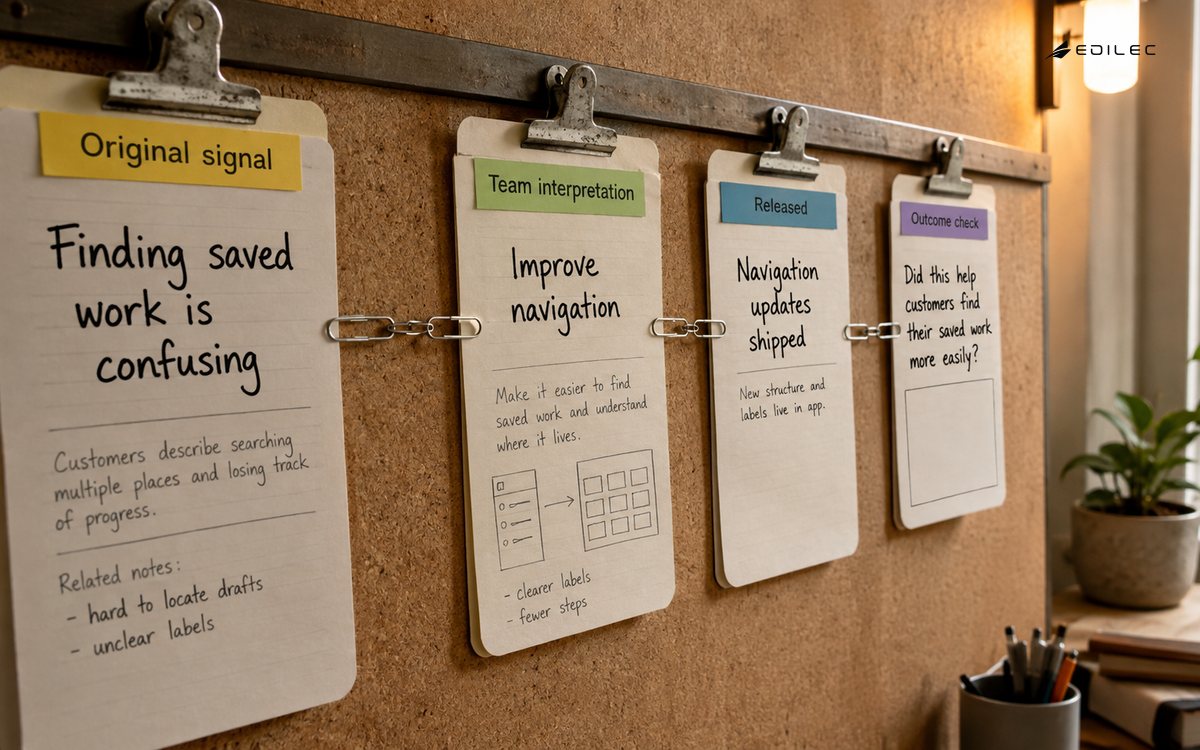
The loop should also show what happens after the product changes. Tie a release to the problem, preserve the original evidence, record the expected outcome, and schedule a review. Customer feedback loop decisions before the first build is a useful companion for checking that production reliability has not displaced discovery quality.
- Test collection, duplicate linking, triage, communication, and closure as one path.
- Monitor failed deliveries and unowned high-severity signals.
- Keep customer-visible and internal notes separate.
- Measure whether the original problem changed after release.
Govern feedback in a multi-tenant product
Tenant boundaries matter even when feedback is internally reviewed. Enforce account scope, separate customer-visible notes from internal analysis, and define retention for attachments and conversation transcripts. A product manager may need aggregate evidence without opening a customer’s full support history. For a SaaS product, decide which feedback data is part of the tenant record, which is an internal operational record, and which may be used for product analytics. The AWS SaaS Lens is a useful reminder to design tenant isolation and operational ownership deliberately.
Key takeaways
- Treat feedback as evidence with source, context, permission, and an owner.
- Separate customer language from product interpretation.
- Make ingestion idempotent and recoverable.
- Triage by outcome, impact, confidence, and learning value rather than volume alone.
- Close the loop by measuring the customer problem after release.
Frequently asked questions
Should the most-requested feature always win?
No. Frequency is one signal. Consider severity, affected segment, strategic fit, confidence, operational cost, and the value of learning before committing to a build.
When is feedback actually closed?
When the team has recorded the decision, delivered or declined the action, communicated appropriately, and checked whether the original customer outcome changed. A release date alone is not closure.
How should customer privacy affect the loop?
Capture only the context needed, separate customer-visible and internal notes, limit access by tenant and role, honour consent and retention rules, and redact before broad analysis.
Conclusion
In production, a customer feedback loop is a dependable evidence path from signal to decision to measured outcome. Give feedback context, reliable delivery, accountable triage, safe access, and respectful closure. The loop becomes a product advantage when customers can see that their reality changes what the team builds and improves.