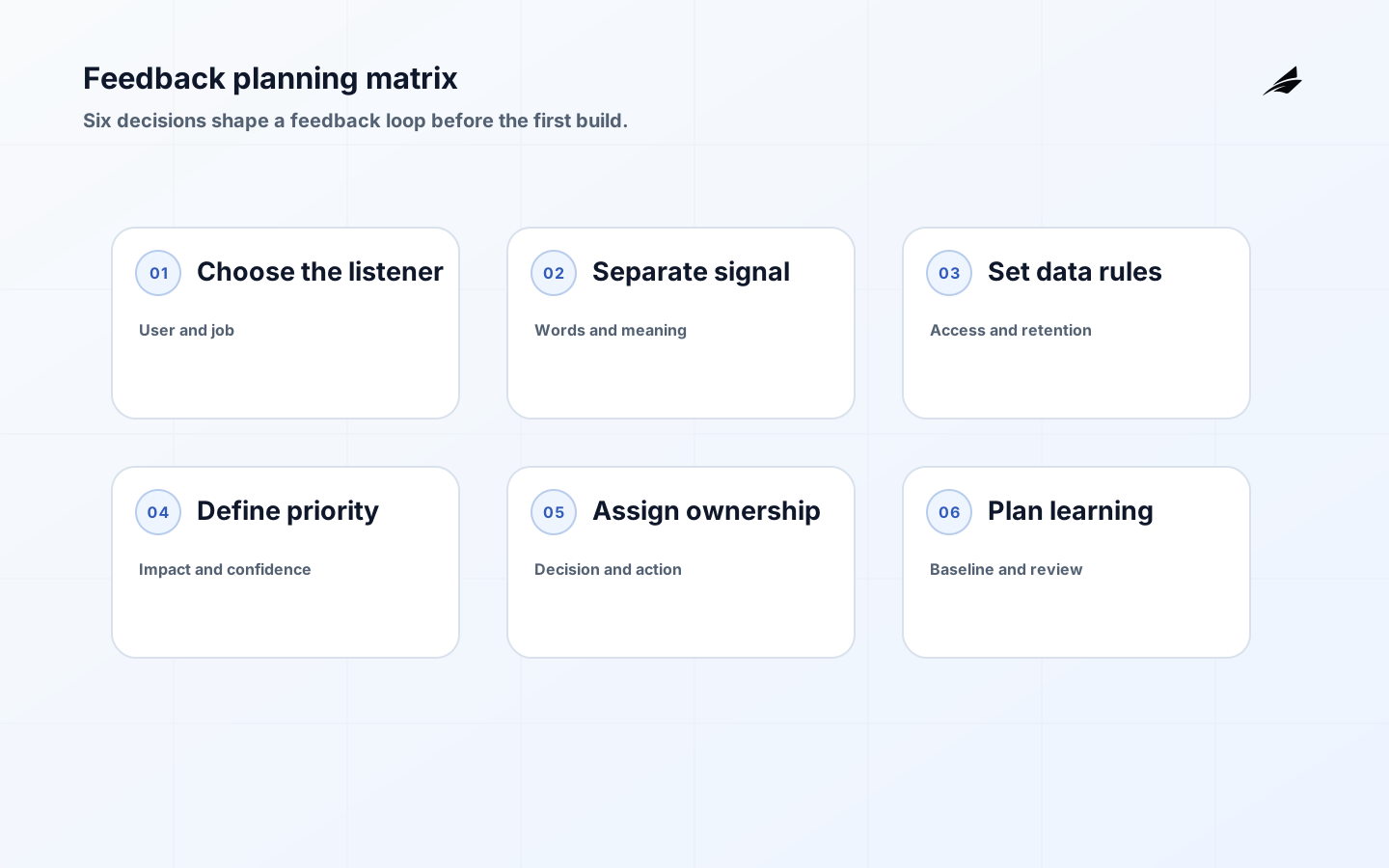
Customer feedback loops before development are worth building when they improve a product decision, not simply when a team wants more requests. Before the first build, decide whose experience you need to understand, which evidence is trustworthy, how feedback becomes a problem statement, who can prioritise, and how the team will check the outcome. Atlassian’s customer feedback guidance is a useful reference for connecting customer problems to product choices. The design should be small enough to operate and rich enough to preserve context, so a later roadmap conversation can distinguish a loud request from a widespread or consequential problem.
Choose the listener and the job
Name the customer segment, user role, workflow, and decision the loop will support. A founder may need evidence about demand, a product manager may need evidence about usability, and an engineer may need reproducible failure context. One intake form rarely serves all three well. Choose the smallest set of sources that reveals the problem: interviews, support conversations, in-product prompts, usage events, or account reviews. Record what is excluded. If the loop captures every comment without a purpose, the team will optimise for collection and later complain that the evidence is noisy.
| Planning choice | Example | Acceptance evidence |
|---|---|---|
| Audience | Operations leads using a recurring workflow | Five representative conversations |
| Decision | Whether to simplify the handoff | Named metric and owner |
| Input | Interview plus support context | Consent and source fields |
| Cadence | Weekly synthesis with urgent escalation | Review calendar and state owner |
Separate the signal from its meaning
Store the customer’s words, the observed task, the context, and the team’s interpretation as separate fields. A request such as “add a bulk export” may mean that the existing report is slow, incomplete, or impossible to share. Preserving the original signal lets the team revisit its interpretation when new evidence arrives. Capture source, timestamp, account or segment, product area, severity, consent, and a confidence note. Use stable terms for event and workflow names; OpenTelemetry semantic conventions offer a useful reminder that shared vocabulary makes evidence easier to compare.
Decide the feedback data contract
Define required and optional fields before designing the intake surface. Required fields should be the smallest set needed to route and interpret the signal. Decide how attachments, transcripts, screenshots, and customer identifiers are stored; who may see them; how long they are retained; and how a customer can request correction or deletion. If the loop integrates with another system, assign an authority for status and deduplication. The data contract should make a blank field meaningful. “Unknown” is different from “not asked,” and “not applicable” is different from missing evidence.
Choose prioritisation rules
Write a decision rubric before a backlog fills. Combine customer impact, affected population, strategic fit, urgency, confidence, implementation effort, operational risk, and learning value. Decide when a high-severity signal can bypass normal review and who has that authority. Use evidence to raise a question, not to manufacture false precision. A score can support comparison, but it should not hide the tradeoff. Make the owner, next review date, and reason for a decision visible. If the team defers a problem, preserve why so the same conversation does not restart from zero.
Plan the event path
Before implementation, map how a signal enters, is validated, linked, routed, reviewed, and closed. If service events are delivered asynchronously, use a stable identifier and design for duplicate delivery. Stripe’s webhook signature documentation provides a concrete reference for verifying event origin before processing. Your system also needs a dead-letter or review path, because a feedback record must not disappear when a destination is unavailable. Define what the customer sees during a failure and who can recover it. A small reliable path is better than many channels that no one can reconcile.
Create a scenario matrix with a normal signal, duplicate signal, anonymous signal, sensitive signal, urgent signal, unsupported request, and post-release follow-up. Walk each scenario from capture to decision. Compare the plan with what changes when feedback loops move into production, the field guide for growing teams, and multi-tenant architecture decisions to spot decisions that sound good in discovery but lack operating ownership.
Evidence review before the first feedback loop
Before building the loop, run a scenario review with a direct request, an ambiguous observation, a duplicate, a sensitive report, an urgent issue, a request the team will decline, and a post-release follow-up. For each feedback scenario, record the owner, evidence, permission, next action, communication, and measure. This exposes missing fields and unclear authority while the cost of change is low. It gives support, product, engineering, and customer success a shared vocabulary for deciding what belongs in the first loop.
Treat the first release as a learning instrument. Choose one problem area, one or two sources, and a review cadence. Avoid building a universal taxonomy before the team has seen real records. The production feedback loop guide can inform the next stage, while this pre-build scope should make the first end-to-end decision observable and reversible.
- Name the problem and customer job the first loop will support.
- Test the data contract with real examples before designing every field.
- Record who can prioritise, escalate, communicate, and close.
- Define the post-release evidence that would change the roadmap.
Keep the first taxonomy deliberately small. A team can add a useful category after seeing real evidence; it is harder to remove a category that people use to avoid a decision.
A useful first-build record can be reviewed by someone who did not attend the original customer conversation. Preserve enough context to explain the decision without preserving unnecessary sensitive detail.
The loop should leave room for learning before commitment. When confidence is low, the next action may be another interview, a prototype, a support observation, or a small experiment. Record that choice as deliberately as a feature decision.
Make the first review date visible to the team so evidence has a chance to change the plan instead of being archived immediately.
A clear first-build boundary protects both customer trust and engineering focus. It gives the team a reason to defer a request without losing the evidence that may change the decision later.
Keep the first review date visible so evidence has a chance to change the plan instead of being archived as background research.
The first-build contract
A pre-build loop should be small enough to run manually while still proving the important boundaries. Take one real customer signal through capture, clarification, grouping, decision, communication, and follow-up. Include a duplicate and a sensitive record. Ask who can see each field, who can change the state, and what evidence remains when the team declines the request. This rehearsal is often more valuable than a broad wireframe because it exposes missing ownership and confusing language.
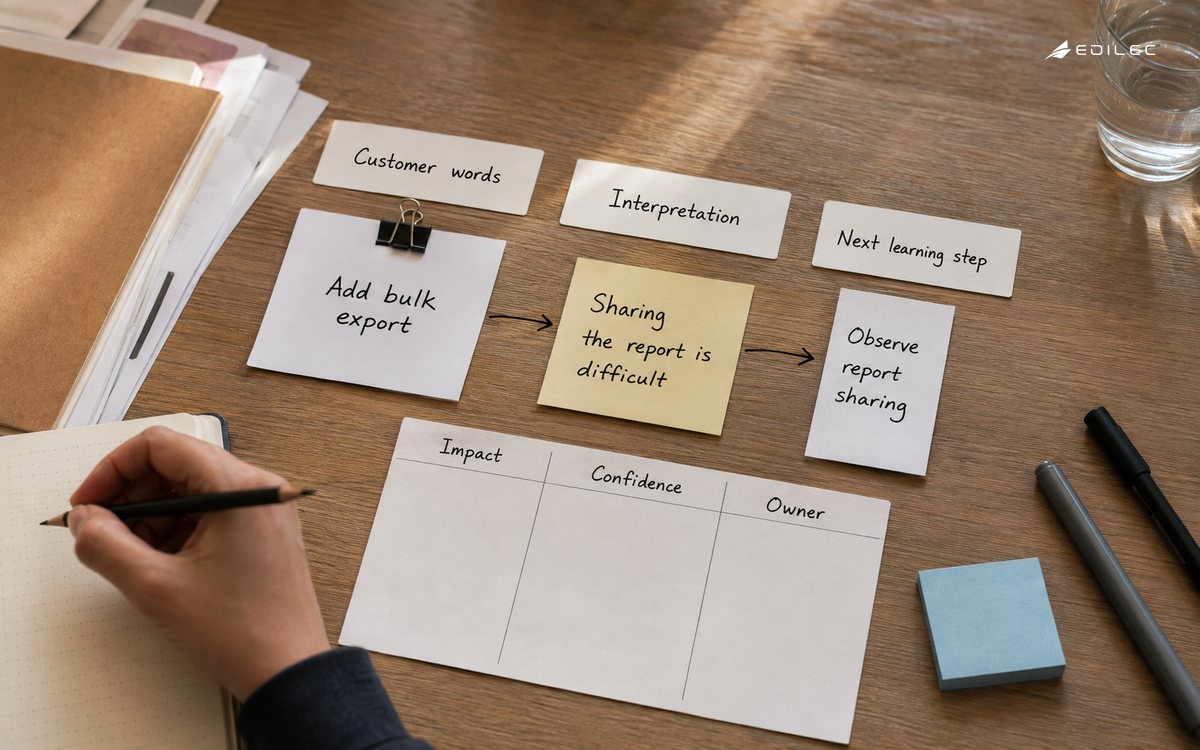
Choose a first problem area where the team can observe a result within a reasonable review window. Define the baseline, target behaviour, customer segment, and decision owner. If learning is the goal, make the experiment reversible and record what would change the next decision. The field guide for growing teams provides a useful operating reference once the first loop is working.
- Validate the minimum data contract with real records.
- Test urgent, duplicate, sensitive, and declined signals.
- Assign communication and outcome ownership separately when needed.
- Write the first review date before the build begins.
Assign ownership and boundaries
Name the person who owns intake health, the person who synthesises evidence, the person who approves product action, and the person who measures the result. These may be different roles. Define what support can change, what product can classify, what engineering can close, and what requires customer consent or security review. For a multi-tenant SaaS product, decide whether a record is customer-visible, internal, or aggregate. The AWS SaaS Lens is useful when feedback must be isolated by tenant while still informing shared product learning.
| Owner | Accountability | Evidence |
|---|---|---|
| Intake owner | Collection, validation, and recovery | Queue health and failed deliveries |
| Product owner | Problem framing and priority | Decision note and rubric |
| Engineering owner | Reproduction and release linkage | Change and test evidence |
| Outcome owner | Post-release customer result | Measure and follow-up |
Define the learning loop
A pre-build feedback system should already know how learning will happen after delivery. Choose a baseline, a target behaviour, a review window, and a segment to observe. Decide how qualitative evidence and product telemetry will be combined without treating one as proof of the other. Vercel’s observability documentation provides a useful production mindset: visibility should help teams find and explain behaviour, not merely display activity. Measure time to first response, time to validated problem, decision age, release linkage, outcome confirmation, and repeated unresolved signals.
Key takeaways
- Build the loop around a named decision and customer job.
- Preserve customer language separately from interpretation.
- Define a minimal data, privacy, ownership, and event contract.
- Write prioritisation and escalation rules before volume arrives.
- Specify the post-release measure that closes the learning loop.
Frequently asked questions
Which feedback source should a small team start with?
Start where the relevant customer job is already discussed reliably, often support conversations or targeted interviews. Add in-product collection only when the team knows how it will interpret and act on the extra volume.
Do we need a complex scoring model?
No. A small rubric with impact, confidence, urgency, fit, effort, and learning value is easier to explain and improve than false precision. Record the reason behind the decision.
What should the first build include?
Capture, context, permission, ownership, status, duplicate linking, recovery, and one outcome measure. A narrow end-to-end loop is more useful than a broad intake form without closure.
Conclusion
The best customer feedback loops begin with decisions, not collection. Choose the job, preserve evidence, establish boundaries, assign owners, and define what learning looks like after release. Those choices make the first build smaller and the resulting roadmap more trustworthy.