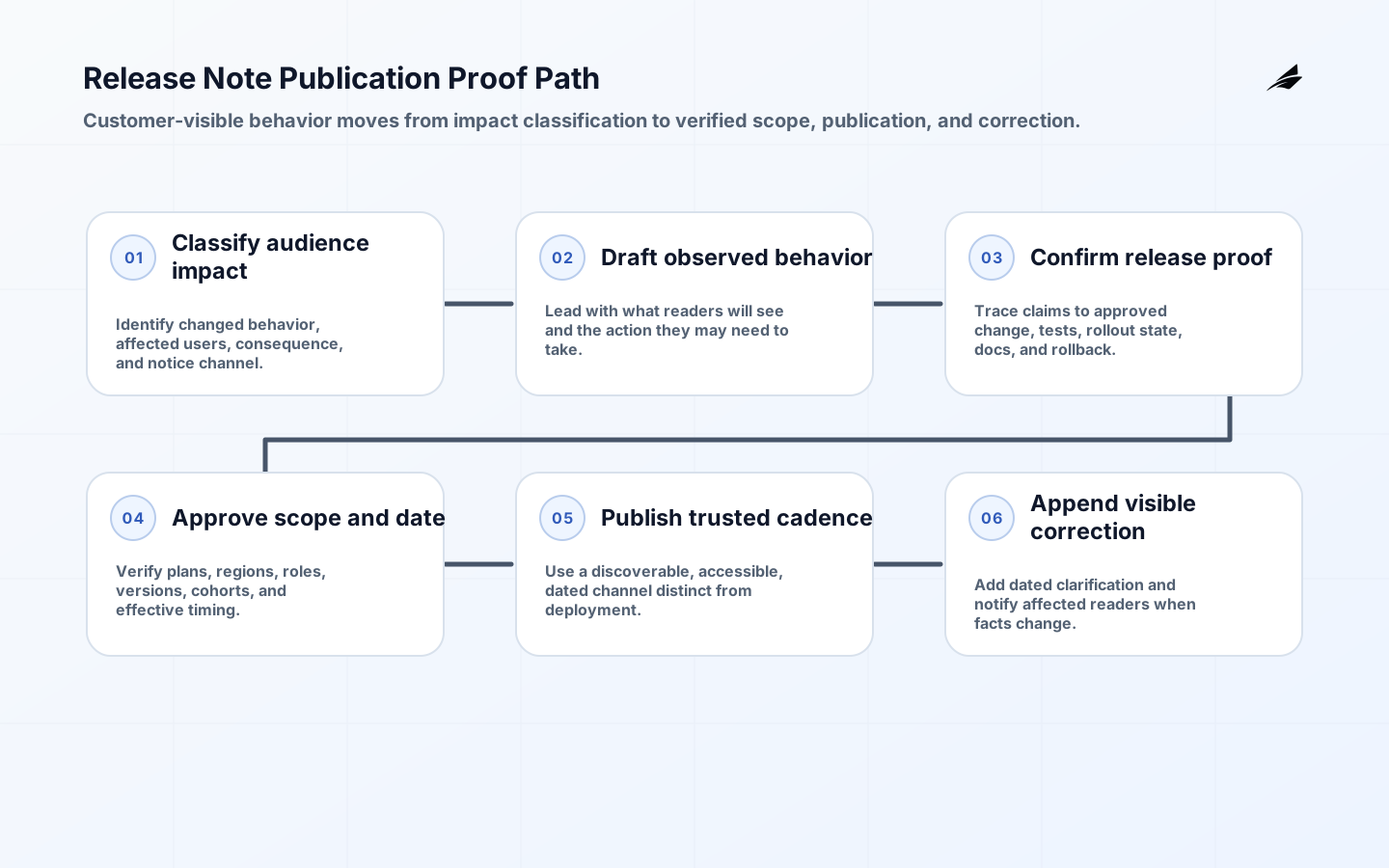
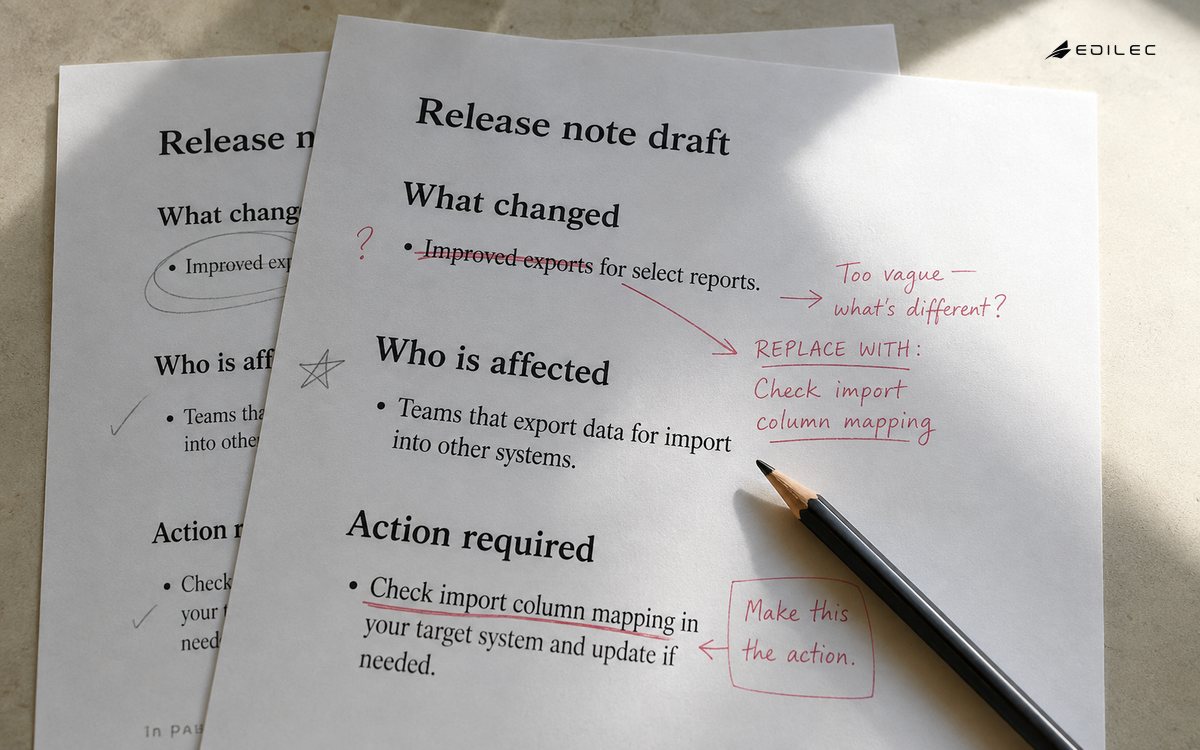
Release notes are part of the product interface. They tell customers, administrators, partners, and internal teams what has changed in a system they depend on. The common mistake is treating them as a cleaned-up commit list. Commit messages explain implementation history; a useful note explains changed behavior, affected audience, timing, action required, limitations, and where to get help. A small wording omission can be costly: saying “improved exports” hides a changed column name that breaks a scheduled import, while saying “security update” can create needless alarm without an action path. Build release notes from a repeatable decision process, not from someone’s memory at the end of a sprint. The process should let a reader decide whether to act now, prepare later, or safely ignore the change.
Classify the change before writing release notes
Every deployable change does not merit the same audience or level of detail. Classify changes by customer-visible behavior and operational consequence: new capability, changed workflow, defect correction, deprecation, security action, performance change, or internal-only work. Then ask who is affected: end user, workspace administrator, API consumer, partner, support agent, or nobody outside the engineering team. A change can belong in several places. An API-breaking field rename needs a developer note with dates and examples, while a new setting needs a customer-facing explanation and an administrator migration step. Record the classification alongside the change while it is being developed. That keeps release communication from becoming a late-stage guessing game and helps reviewers find the releases with a higher need for testing, rollback planning, and direct outreach.
| Change class | Reader needs | Minimum note |
|---|---|---|
| New capability | Whether it is available and how to begin. | Audience, outcome, availability conditions, link to instructions. |
| Behavior change | What will work differently and when. | Before/after description, impact, action, rollout timing. |
| Deprecation | Time to plan a migration. | Replacement, affected version or endpoint, sunset date. |
| Security action | A calm, safe response. | Scope, required action, support route, advisory reference when appropriate. |
Write each note for a real reader decision
Lead with the change a reader will observe, not the internal component name. “Administrators can now require SSO for new members” is clearer than “updated auth middleware.” Follow it with the scope and condition: which plans, regions, roles, versions, or rollout cohorts are included? Then name the action, if any, and the path to more detail. Use specific dates rather than “soon,” and distinguish a feature that is available from one that has only been announced. Avoid adjectives such as seamless, robust, or improved unless the note explains the measurable behavior. A good edit asks: could an administrator use this to prepare a team? Could an API maintainer identify whether a test will fail? Could a support agent answer the first follow-up without inventing details? Those questions produce brief notes with useful information density.
Put release evidence behind the published note
The person publishing notes should be able to trace every material claim to release evidence: the approved change, test result, rollout state, documentation update, and rollback decision. This does not mean exposing internal work items to customers. It means the editorial summary is anchored to facts that can be checked. For gradual rollout, say that availability is expanding and provide the criterion for inclusion if it matters. For a resolved defect, describe the customer symptom and the version or deployment after which the fix applies; do not promise that every historical consequence has been repaired unless that work was completed. Link to a maintained guide rather than duplicating a long procedure. The SaaS product development FAQ is a sensible internal-link destination when readers need broader delivery context.
| Review question | Evidence to check | Reason |
|---|---|---|
| Is the change live? | Rollout or release status. | Prevents publishing future behavior as present fact. |
| Who is affected? | Role, plan, region, version, or API contract. | Stops broad wording from surprising narrow cohorts. |
| What should they do? | Approved migration or support instruction. | Turns information into an actionable next step. |
| Can we recover? | Rollback or incident communication plan. | Keeps a bad rollout from becoming a silent one. |
Operate a release notes cadence that readers can trust
Set a dependable rhythm and distinguish it from the deployment schedule. Daily deployments may still produce a weekly customer digest, while urgent fixes need a faster path. Make the publication channel discoverable, filterable, and accessible. Headings should describe the feature or action, links should have meaningful names, and visual indicators should not be the sole carrier of urgency. Archive notes by date and product area so support can answer “when did this change?” without searching chat history. Measure subscriptions, documentation clicks, release-related tickets, rollback rate, and repeated confusion about a note. A release note that triggers many clarifying questions is valuable feedback about the product’s mental model as much as its wording. Review those cases with the people who shipped the change.
- Classify each change by customer-visible consequence before release day.
- Name the affected reader and the decision they need to make.
- State scope, timing, action, and limitations in concrete terms.
- Publish only claims supported by rollout and test evidence.
- Use reader questions and support cases to improve future notes.
Handle corrections and retrospective clarity
Release notes occasionally need correction: a rollout may pause, a limitation may emerge, or an item may have been described too broadly. Correct the record visibly rather than silently rewriting history. Add a dated clarification that says what changed in the note and what readers should do now. For material errors, notify the affected audience through the same channel used for the original notice and give support a short approved response. This protects trust because customers can see that the team is willing to distinguish a changed plan from a changed fact. Keep internal release evidence linked to the published item so a future investigator can understand why a statement was made at the time.
Use a lightweight editorial review for changes with wider consequences. One reviewer should verify technical accuracy and another should challenge the reader perspective, especially where a note affects migration, access, pricing, or security. Confirm that links resolve, dates use the correct timezone, terminology matches the product, and the note does not promise support behavior the team cannot deliver. For global services, consider whether the announcement needs regional availability detail or translated material. That review is not a publishing bottleneck when it is planned alongside release readiness; it is a way to prevent a deployment detail from becoming a customer surprise.
Keep a release-note source map for material changes. It can be a simple record that links the public note to the approved requirement, technical owner, rollout evidence, support guidance, and any customer documentation. This is especially useful months later, when a support question or compliance review asks why an administrator was told to take a particular action. The map should not force a customer-facing note to expose internal project detail. It gives the publishing owner a defensible route back to the facts, and it makes corrections faster when the scope of a release changes after the first announcement.
Separate the publication date from the effective date whenever they differ. A note can be published before a staged release reaches every account, and a deprecation can be announced months before enforcement. Label both dates clearly and provide an easy way for a reader to determine whether their workspace or API integration is in scope. For a change that needs customer preparation, include an example of the affected behavior and a direct link to a tested migration path. For a change that does not need action, say that plainly. This precision reduces unnecessary tickets and helps customers schedule their own work. It also prevents release notes from becoming a vague archive where people cannot tell whether a statement is history, current behavior, or a future plan.
- Describe observable behavior before naming internal implementation details.
- Name the audience and availability conditions for every material change.
- Use an exact effective date when a reader must prepare.
- Link action instructions to maintained documentation, not an informal thread.
- Check rollout status before saying a feature is available.
- Publish a dated clarification when later facts change the original note.
Before publication, read the note as the customer who will receive it, not as the engineer who shipped it. That final perspective catches hidden assumptions, unexplained acronyms, and missing action steps.
Key takeaways
- Release notes are a product communication, not a commit log.
- The most useful notes describe changed behavior and a reader action.
- Security notes should be calm, specific, and responsible.
- Evidence and rollout state keep publication claims trustworthy.
- A steady cadence creates an operational record customers can use.
Frequently asked questions
Should every deployment have a public note?
No. Publish when a customer, administrator, partner, or developer needs to know about a changed behavior, availability, action, or risk. Keep internal deployment evidence for the rest so that support and engineering still have a complete record.
Can release notes be generated automatically?
Automation can assemble candidate changes, but a responsible owner must verify audience, scope, timing, and customer language. Source code rarely contains enough context to decide whether a behavior change needs notice or how it should be explained.
Conclusion: publish an honest operating record
Trustworthy release notes respect the reader’s time because they explain the change that matters, the action to take, and the boundary of what is known. Classify work early, write from observed behavior, verify claims against release evidence, and learn from the questions that follow. That turns a routine publication task into a durable part of reliable product delivery.