A SaaS MVP is not a deliberately careless first version. It is the smallest service that lets a defined customer complete a valuable outcome and lets the team learn whether that outcome matters enough to continue. The word “minimum” refers to scope, not to honesty about security, accessibility, data handling, or operational ownership. If a service accepts customer data, charges money, sends messages, or grants access, the MVP has responsibilities from its first user. The practical challenge is to select a narrow, complete path instead of an impressive feature list with no reliable journey. Engineering teams are well placed to sharpen that choice because they can expose the hidden work behind an apparently simple promise: identity, permissions, validation, failure states, support, and instrumentation.
Define the smallest testable customer outcome
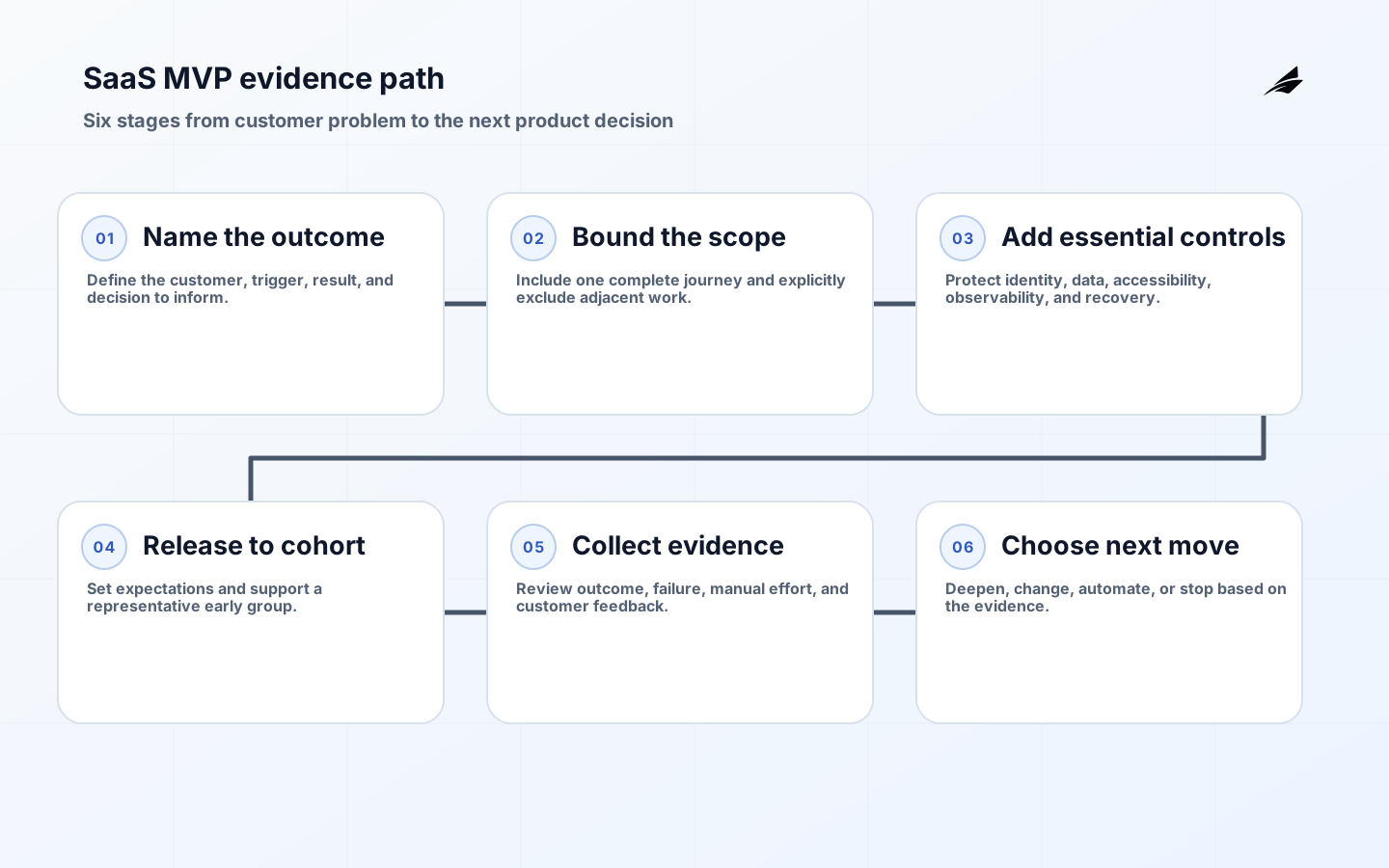
State the outcome as a customer can observe it. “A property manager receives a reconciled maintenance summary each week” is more testable than “build a dashboard.” Name the customer role, triggering situation, input, completed result, and evidence that the result helped. Then identify the decision the MVP is meant to inform: willingness to pay, frequency of use, operational feasibility, integration demand, or suitability for a specific segment. This prevents the team from treating every requested feature as required validation. Interview prospective users with concrete examples and include the exceptions that make the work real. If the customer cannot describe how they would use the result, the problem may need more discovery before it needs more code. A useful MVP has a deliberately chosen boundary that people can challenge.

| Scope question | Good MVP answer | Scope creep signal |
|---|---|---|
| Who is it for? | A named role with a repeatable problem. | “Anyone who needs better visibility.” |
| What is completed? | One observable result with acceptance criteria. | A collection of screens with no end state. |
| What is excluded? | Adjacent workflows with a planned manual bridge. | Every exception is being automated before first use. |
| What will we learn? | A decision tied to evidence and a review date. | Success is defined only as launching. |
Draw a complete operating boundary
For the chosen journey, map each required capability from entry to recovery. Who creates an account or grants access? What data is accepted and validated? Which system is authoritative? What happens when a request is duplicated, a dependency is slow, or a user lacks permission? Who can support the case and how will they see the evidence? Some of these answers may be manual at first, and that is fine when the manual step is explicit, safe, and sustainable for the test population. What is not fine is leaving the step unnamed so a founder or engineer improvises in production. Define a service owner, contact route, basic audit events, backup expectation, and customer communication path proportional to the risk. The SaaS MVP implementation plan offers a useful way to organize this complete-but-small boundary.
Build the controls that protect learning
An MVP needs controls that prevent a bad experiment from harming customers or producing meaningless evidence. Authenticate users appropriately, authorize sensitive actions on the server, validate inputs, protect secrets, minimise collected data, and record material events. Make core workflows usable with keyboard and assistive technologies; an inaccessible product cannot claim to have tested the whole target market. Add basic observability around the success event and the known failure paths so the team can distinguish “nobody wanted it” from “the background job failed.” Establish a change path with code review, tested deployment, and rollback for the parts that can affect customer data or access. These are not enterprise ceremony. They are the minimum conditions for trusting the results you collect from early users.
| MVP control | Why it belongs early | Lean implementation |
|---|---|---|
| Authentication and roles | Protects the customer and clarifies who is using the service. | Use a managed identity flow and a small role model. |
| Input validation | Stops malformed or harmful data from defining the experience. | Validate at the boundary and show actionable errors. |
| Audit and telemetry | Makes outcome and failure visible. | Record structured events around core state changes. |
| Recovery path | Limits harm when something goes wrong. | Document owner, rollback, and customer contact for the first release. |
Release to learn with evidence and a next decision
Choose a small cohort that resembles the intended customer and set expectations about the product’s maturity. Observe their real behavior with consent-aware instrumentation, direct feedback, and support conversations. Track the promised outcome, time to reach it, failure reasons, repeated manual work, and whether people return or recommend the service. Avoid interpreting a polite compliment as validation; ask what work changed, what they would pay to keep, and what prevented them from using the product again. Review evidence at a scheduled decision point. The next step might be to deepen the workflow, improve reliability, change the target segment, remove an assumption, or stop. The MVP readiness checklist helps ensure that a narrow release still has the evidence needed for that decision.
- Define one customer outcome and the decision it is meant to inform.
- Exclude adjacent workflows explicitly instead of quietly building them.
- Map identity, data, failure, support, and recovery for the chosen path.
- Keep essential security, accessibility, and observation controls in scope.
- Release to a representative cohort and decide from evidence, not launch excitement.
Budget for what the MVP is likely to reveal
Before release, list the likely follow-on work if the premise is confirmed: higher-volume imports, more roles, integrations, billing, reporting, regional needs, or an operational handoff. This is not permission to pre-build it. It is a way to avoid choosing a first implementation that makes the most plausible next step prohibitively expensive. Prefer stable identifiers, clear service boundaries, and data models that can evolve without committing to a large platform. Write down the shortcuts taken, why they are safe for the cohort, and what evidence would trigger their replacement. That record lets the team distinguish intentional MVP debt from an accident that nobody remembers.
Price the experiment honestly as well. Count manual reviews, support time, cloud usage, vendor commitments, and the opportunity cost of delayed learning. A feature can appear viable when engineering effort is hidden in a founder’s inbox or a spreadsheet maintained nightly. Put those costs beside customer outcome evidence at the review. If the MVP requires expensive private work to function, that may be the most important result of the test. The next decision can then address automation, target segment, pricing, or a smaller promise with eyes open.
Choose the MVP technology stack for the learning horizon, not for imagined scale alone. Managed services and established components can reduce operational distraction when they meet the required controls, while a custom component may be justified if it is the core uncertainty being tested. Prefer boring interfaces, clear deployment steps, and reversible data decisions over clever architecture that the early team cannot support. Capture a small architecture decision record for choices that shape cost, security, or future migration. That makes it easier to explain why a constraint exists and to revisit it when evidence, not optimism, says the product has earned more investment.
Make the learning agenda visible to the whole delivery team. For each MVP release, list the assumptions being tested, the evidence source, the minimum sample or time window, and the decision owner who will interpret the result. Engineering can then build instrumentation around meaningful questions instead of collecting every possible click, while design and support can prepare the feedback they need. Review negative evidence with the same seriousness as positive feedback. A customer who abandons after a successful setup, or an account that needs a manual correction every week, may reveal more about the product than a small number of enthusiastic early adopters. Clear questions make the MVP less prone to confirmation bias.
- Name the customer outcome and decision before building the first screen.
- Exclude adjacent workflows explicitly and document any manual bridge.
- Keep identity, authorization, validation, and recovery in the initial boundary.
- Use accessible interaction and consent-aware evidence collection from first release.
- Release to customers who resemble the intended segment, not only friendly testers.
- Review hidden operating cost beside customer value before deciding to expand.
When results are inconclusive, narrow the next question rather than adding broad features. A focused follow-up usually produces better evidence with less customer risk.
Key takeaways
- An MVP is minimum scope, not minimum responsibility.
- A complete customer outcome is better evidence than a large feature catalogue.
- Explicit manual steps are acceptable; hidden ones distort the experiment.
- Early controls make customer learning safer and more trustworthy.
- The MVP has succeeded when it supports a clear next product decision.
Frequently asked questions
Can security work wait until after MVP validation?
Not when the MVP handles identity, customer data, payments, or consequential actions. Apply controls proportionate to the risk from the first release. Defer broad automation and low-risk polish, not the safeguards that make participation safe.
How many features should an MVP include?
Enough to complete one valuable journey for a defined customer. Feature count is a misleading measure because one small capability may require several supporting controls, while a dozen screens may still fail to produce a useful outcome.
Conclusion: make the smallest promise you can keep
Good SaaS MVP engineering is an exercise in disciplined truthfulness: promise a specific outcome, build the whole path needed to deliver it safely, and observe what happens with real customers. Keep the scope narrow but the operating responsibility intact. That gives the team evidence worth acting on and gives early users a service worth trusting.