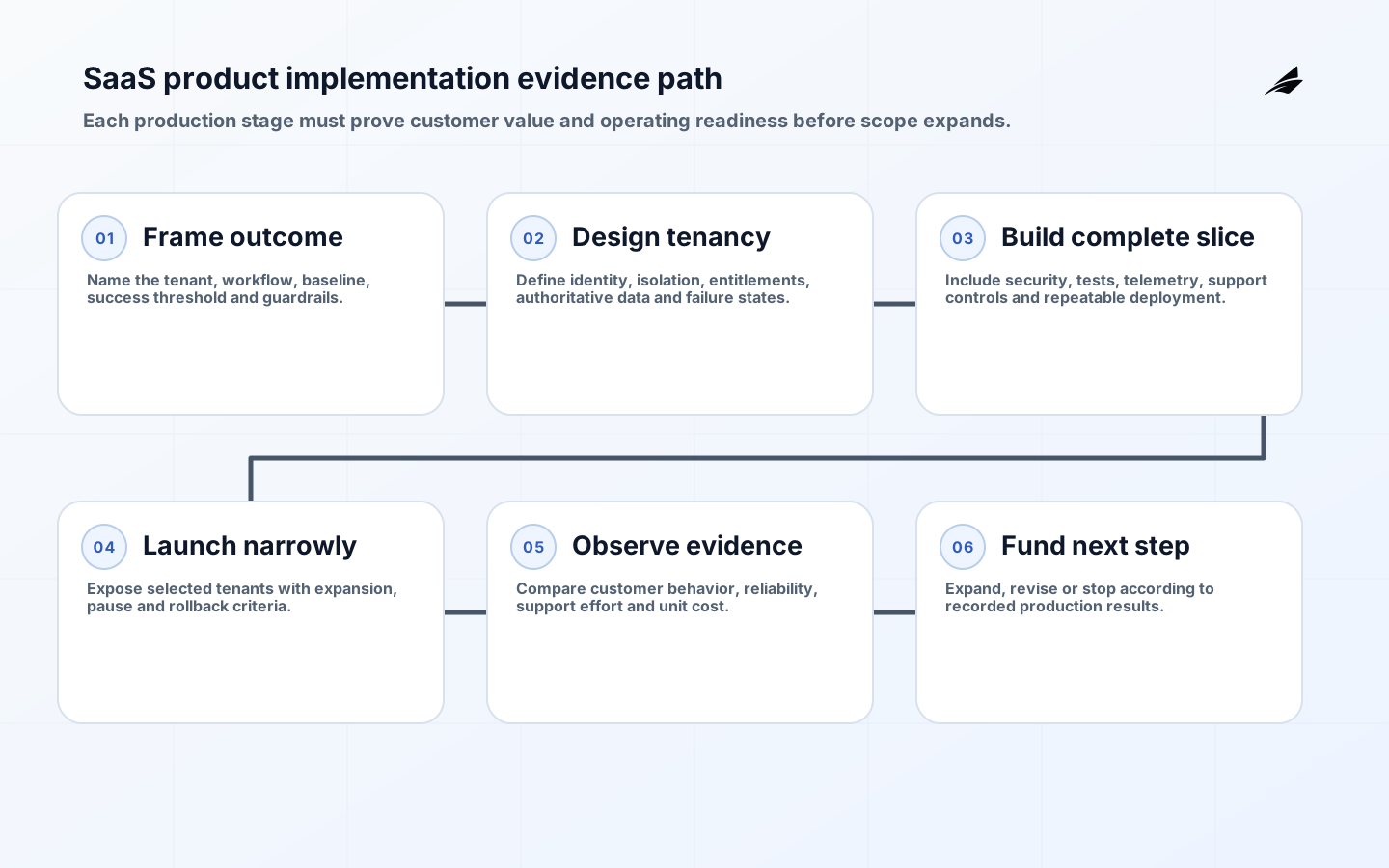
A SaaS product development implementation succeeds when a repeatable service delivers a measurable outcome across tenants and the operating team can change it safely. Building screens is only one part. Identity, tenant isolation, onboarding, entitlements, billing, data, support, release automation and tenant-aware observability turn an application into a SaaS product. This FAQ answers the decisions that should be settled before and during implementation.
Use the answers with the SaaS implementation scope and delivery plan and readiness checklist. Teams preparing launch should also review the SaaS launch planning checklist so commercial, support and technical readiness stay connected.
Where should SaaS implementation start?
Start with one tenant role, one painful workflow and evidence that improving it matters. Define the present baseline, desired behavior, success threshold and guardrails. Map the whole path from account creation through value delivery and recovery. Include who corrects data, handles a failed integration and explains an entitlement decision. A prototype can test comprehension, but the first production slice should be complete enough to serve, observe and support real tenants.
Document assumptions and exclusions. Decide whether the first release proves demand, workflow usability, willingness to pay, technical feasibility or operating economics; it cannot prove everything equally. Build the riskiest coherent path rather than a broad set of shallow features. A narrow product that completes one useful job provides better evidence than a wide interface that still requires hidden manual work.
| Decision | Evidence needed | First-release proof | Defer when |
|---|---|---|---|
| Customer problem | Observed work and baseline friction | Target users complete the job | Need is only hypothetical |
| Tenant model | Data and compliance requirements | Isolation tests pass | Enterprise variants are unconfirmed |
| Commercial model | Entitlements and billing rules | Plan change reconciles correctly | Pricing is still exploratory |
| Operations | Owner and support workflow | Alert and recovery rehearsal | No real user depends on service |
| Investment | Success and stop thresholds | Production evidence supports next slice | Guardrails worsen |
How should a multi-tenant architecture be chosen?
Choose pooling, siloing or a hybrid at each layer according to isolation, scale, cost and compliance. AWS SaaS Lens notes that no single architecture fits every SaaS product and that tenant isolation is distinct from authentication. Carry validated tenant context through APIs, jobs, caches, storage and telemetry. Centralize enforcement where possible so every feature developer does not invent a new boundary. Test cross-tenant access as a negative case in CI and staging.
Prefer the simplest deployable structure the current team can operate. A modular monolith can be an excellent starting point when boundaries and data ownership are explicit. Split services when independent scale, isolation, reliability or team ownership justifies the operational cost. Use managed services deliberately; each still introduces limits, data behavior, cost and recovery responsibility. Record architecture decisions with the trigger that would cause reconsideration.
Which platform capabilities belong in the first release?
Include identity and recovery, tenant provisioning, role enforcement, essential entitlements, audit evidence, product telemetry, support lookup and a repeatable release path. Billing can begin with controlled manual operations when volume is small, but entitlement state and the authoritative subscription record must be explicit. Build safe administration instead of relying on database edits. Include data export and deletion behavior appropriate to the product's commitments.
Do not overbuild a universal internal platform before product evidence exists. Implement the smallest reusable primitives that protect correctness: tenant context, authorization, configuration, event history and idempotent jobs. Add self-service and automation where repeated manual work becomes slow or risky. The goal is repeatability, not eliminating every human step on day one.
| Capability | Minimum viable control | Acceptance test | Scale signal |
|---|---|---|---|
| Onboarding | Idempotent tenant creation | Retry creates no duplicate | Provisioning queue grows |
| Authorization | Server-side role and tenant checks | Cross-tenant requests fail | Role matrix expands |
| Entitlements | Versioned plan-to-capability mapping | Upgrade and downgrade reconcile | Custom exceptions multiply |
| Operations | Tenant-aware logs and health | Support traces one workflow | Global averages hide impact |
| Data lifecycle | Backup, restore, export, deletion | Representative restore succeeds | Retention duties diverge |
How much security and quality are enough for launch?
Risk determines depth, but production never means “security later.” Classify data and trust boundaries, use least privilege, protect secrets and repositories, validate input, enforce authorization on the server and keep dependencies reviewable. NIST SSDF structures secure development responsibilities; OWASP ASVS supplies verifiable application requirements. Select a justified control set and retain evidence. A penetration test does not replace secure design, normal testing or vulnerability response.
Test business rules, tenant boundaries, integrations, migrations and essential end-to-end flows. Rehearse backup restoration and failed dependency behavior. Include accessibility in design and acceptance, especially labels, keyboard operation, focus, errors and status messages. Performance tests should use skewed tenant data and noisy-neighbor scenarios, not only average traffic. Quality is the confidence to release and recover, not a target percentage of automated lines.
What drives SaaS development cost and timeline?
Cost follows workflow breadth, experience complexity, data migration, integrations, tenant model, compliance, availability, scale, platform maturity and team access to users. Design, testing, security, observability and transition are production work, not optional overhead. Estimates should show assumptions and ranges. A low quote that excludes migration reconciliation, operator tools or post-launch responsibility is not comparable with a production-capable plan.
Organize delivery around evidence checkpoints. A discovery and architecture slice reduces uncertainty; a production slice proves the workflow and operating path; a bounded launch reveals actual behavior. Set continuation criteria at each stage. Calendar promises become more credible after the team has tested the riskiest integration and migration path. Keep a contingency for unknown legacy data and external approval, but do not use uncertainty to fund an undefined backlog.
How should release and product operation work?
- Trace a prioritized change to an outcome, risk or support need.
- Review design, tenant boundary, data change and recovery behavior.
- Build with unit, integration, contract and critical-path tests.
- Create an immutable artifact and run automated security and quality checks.
- Deploy separately from feature exposure where risk merits a controlled cohort.
- Observe tenant-aware health, product behavior and support signals.
- Rollback or repair according to predefined data-safe criteria.
- Review evidence and feed one prioritized improvement into the next cycle.
DORA's delivery measures are useful as a balanced trend for one service: change lead time, deployment frequency, failed-deployment recovery time, change fail rate and deployment rework rate. Pair them with activation, retention, task success, support contacts, availability and cost per active tenant. Do not reward deployment volume independent of customer impact, or reliability independent of the ability to improve.
What must be ready at launch and handover?
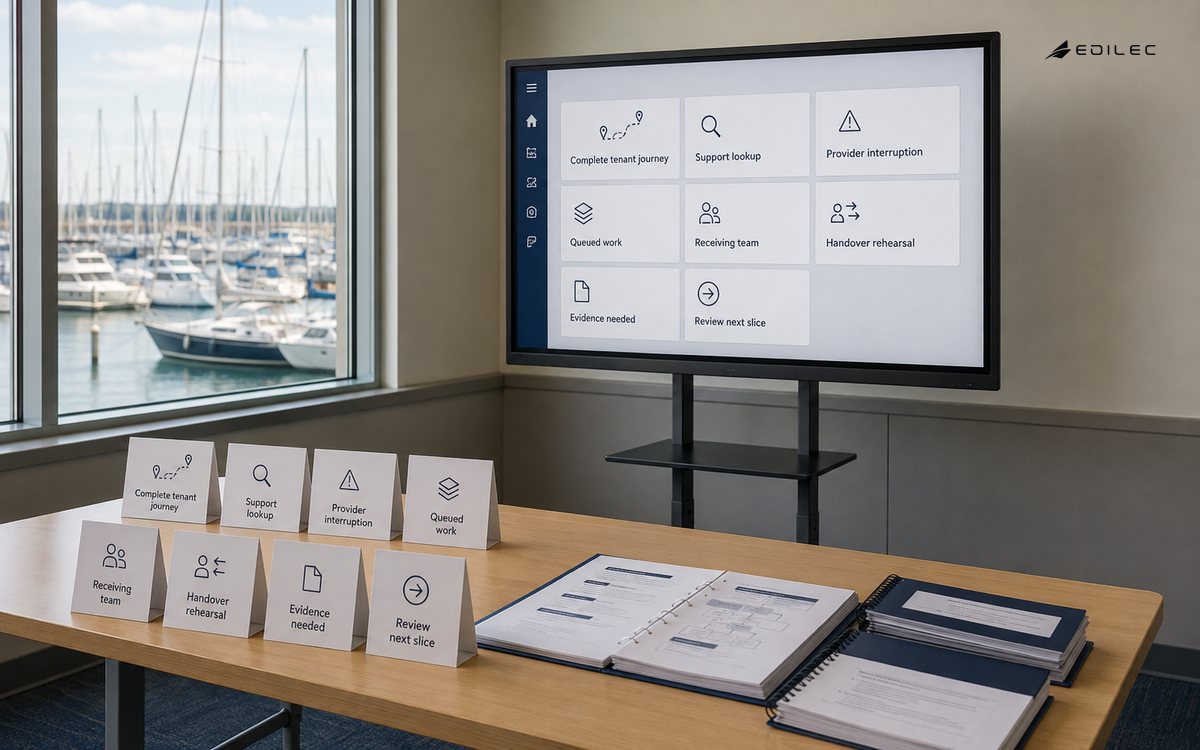
Launch readiness covers production access, domains, backups, restore evidence, dashboards, actionable alerts, incident roles, support scripts, customer communication, privacy notices, dependency contacts, billing reconciliation and rollback. Run a rehearsal that includes a failed integration and a support lookup. Verify rate and quota headroom. Decide who can pause onboarding or a risky feature and how queued work is preserved.
Handover includes source history, infrastructure definitions, architecture decisions, schemas, API contracts, test evidence, dependency inventory, credentials under customer control, runbooks, costs and known risks. Pair throughout delivery, then have the receiving team deploy a change and respond to a simulated alert. Documentation is evidence of shared understanding only when another person can execute it.
Example: launch a shared approval workflow
A small B2B approval product might begin with requester, approver and administrator roles. The complete slice creates a tenant, invites users, submits a request, applies a versioned threshold, records approval or rejection, notifies the requester and exposes history to support. The server validates tenant and role on every transition. Duplicate submissions use an idempotency key, and a failed notification does not erase the committed decision.
The first cohort should exercise plan limits, expired invitations, denied actions and a provider outage as well as the happy path. Product evidence includes time from submission to decision and repeat tenant use. Operating evidence includes cross-tenant test results, queue age, alert response, restore rehearsal and support lookup. Only after those are stable should the team add custom approval graphs or enterprise identity.
Key takeaways
- Prove one complete tenant outcome before funding broad scope.
- Treat tenant isolation as an end-to-end enforced property.
- Build only the platform primitives needed for repeatable, safe operation.
- Estimate migration, security, support and transition as product work.
- Use bounded launch evidence to decide the next investment.
Frequently asked questions
Does SaaS require microservices?
No. SaaS describes a delivery and operating model, not a service count. A modular monolith can support strong tenant isolation and repeatable delivery. Introduce separate services for a measured need such as independent scale, isolation, reliability or ownership.
Should billing be automated in the MVP?
Automate when volume, self-service or correctness requires it. Early controlled billing can be manual, but plan, entitlement, invoice and payment states need authoritative records and reconciliation. Never make an unverified client callback the only proof of payment.
How many customers should join the first launch?
Use the smallest cohort that exercises representative behavior and produces useful evidence without exceeding support capacity. Select tenants deliberately, communicate limitations and define expansion, pause and rollback criteria before invitations begin.
Maintain a launch decision log that records every temporary manual step, special tenant exception and deferred control. Give each an owner, cost, risk and removal trigger. This prevents pilot accommodations from quietly becoming permanent architecture and helps the team decide whether automation or product simplification is the better next investment. Review the log before accepting new tenants because cohort growth can turn a tolerable manual exception into a reliability or margin problem.
Conclusion
SaaS implementation is the construction of a repeatable product and operating system. Begin with a complete customer outcome, enforce tenant context, build essential platform controls and observe a bounded launch. The implementation is ready to scale when both customers and the owning team can depend on it.