SCADA Integrations in Production: Control Boundaries and Recovery
SCADA integration becomes a production responsibility when data exchange can influence a physical process, not merely when a connector has passed a technical test. SCADA integrations move into production when they stop being a technical option and become an operating commitment. The question for product teams is not whether the technology can be demonstrated; it is whether supervisory control, business, and analytics systems can support the exchange of useful operational information without blurring control authority, process context, or failure ownership through ordinary change, failure, and handoff. A credible plan makes the outcome, authority, evidence, and recovery route explicit. It also gives operators a way to challenge a misleading result without needing the original implementation team. This guide focuses on those production decisions: define the useful boundary, make the architecture inspectable, put controls around consequential actions, and learn from the cases that do not behave as planned.
Define the SCADA integrations production scope
SCADA integrations need a contract for each exchanged signal or command: source and destination, semantics, unit, timestamp, quality, refresh expectation, ownership, and permitted use. Start with a business or operating decision, such as maintenance prioritisation or production reconciliation, rather than exporting every available tag. A large raw feed can create privacy, performance, and interpretation problems while still failing to answer the decision that justified the integration.
For SCADA integrations, the scope statement should include an owner, a measurable outcome, the systems it touches, the constraints it cannot violate, and a condition for stopping or escalating. That discipline keeps a connected-operations initiative from absorbing every adjacent problem. It also gives procurement, security, and site teams a concrete basis for review: they can inspect the stated behaviour rather than infer it from a product diagram. Before approval, compare the proposed control boundary with NIST SP 800-82 Rev. 3: Guide to Operational Technology Security and OPC UA overview; these sources frame capabilities and constraints, while local process and safety requirements still decide the final control.
| Decision area | Question to settle | Evidence before release |
|---|---|---|
| Outcome | What decision does SCADA integrations improve? | Named user, action, timing, and success measure |
| Authority | Who may change, approve, or override it? | Role, approval path, and retained decision record |
| Data | What source is authoritative? | Identifier, time basis, quality rule, and owner |
| Failure | What happens when a dependency is unavailable? | Safe state, escalation route, and recovery test |
Expose every SCADA exchange boundary
Use a boundary that protects control networks and decouples their availability from business consumers. A gateway, historian, broker, or replicated data service may expose selected information without granting broad access to supervisory systems. Preserve asset hierarchy and quality data through transformation; a temperature with no sensor, unit, or time context is not operationally meaningful. OPC UA's information-model approach and NIST operational-technology guidance are useful references for explicit semantics and guarded integration boundaries.
In a SCADA integrations design, make interfaces readable by people who must support them. Each boundary should expose a stable identifier, the relevant time, a quality or delivery state, and a correlation reference that ties one component's record to the next. Do not make a SCADA command safe merely by adding another retry. A retry is only safe when repeating the operation cannot create a second business or operational effect. NIST SP 800-92: Guide to Computer Security Log Management is a useful reference for planning the collection and retention of the evidence needed to reconstruct an important event.
Constrain commands by consequence
Default to one-way or read-only data movement unless a remote control use case has a separately approved safety, authority, and recovery design. Validate schema changes and quality codes at the boundary, maintain service identities, and log administrative changes. A cloud or enterprise application should not gain implicit authority over a control function simply because it can display the value. Keep interfaces versioned and deprecate consumers with evidence rather than surprise.
| Control | Why it matters | Practical test |
|---|---|---|
| Identity and access | Limits who or what may act. | Attempt an unauthorised request and confirm it is denied and recorded. |
| Change management | Makes altered behaviour reviewable. | Trace a production change to an owner, reason, and approval. |
| Integrity check | Prevents silent corruption or substitution. | Send malformed, stale, or unexpected input through the boundary. |
| Recovery path | Prevents improvised high-risk fixes. | Rehearse rollback or isolation with the responsible operational role. |
Turn plant evidence into operating signals
Monitor source freshness, tag rejection, transformation errors, missing quality codes, queue age, consumer lag, boundary connection attempts, and reconciliation differences between the source and receiving system. Tie technical signals to production context. For example, a delayed batch-completion event may affect planning, while a stale safety-related indication requires a different escalation.
For SCADA integrations, a metric is useful when it changes a decision. Agree which person reviews each signal, how often, what range is normal, and what action follows an exception. Pair technical measures with a sample of real cases so that apparent improvement is not masking a new manual workaround. Use NIST SP 800-61 Rev. 2: Computer Security Incident Handling Guide to anchor the response loop in analysis, containment, restoration, and learning; recovery is a coordinated operational process, not a dashboard state.
Release under operator observation
Begin with read-only replication for a narrow asset group and compare records against the supervisory source through normal shifts. Prove that units, timestamps, quality, and asset identifiers survive the route. Test source outage, consumer outage, duplicated event, changed tag definition, and network separation. Expand only after the operators who own the source agree the integration neither impairs their system nor misrepresents its state.
For this SCADA integrations rollout, before broad release, document the acceptance evidence for the bounded path: expected inputs, expected outputs, access constraints, known limitations, support contact, and rollback trigger. Keep the first rollout small enough that people can inspect individual outcomes. This makes the next expansion a decision based on observed behaviour rather than confidence in a presentation or a single test environment.
Isolate, restore, and reconcile safely
When data diverges, identify the first boundary where meaning changed: capture, mapping, transport, storage, or presentation. Mark affected records as suspect rather than quietly backfilling a dashboard. If a control command is involved, stop and use the approved process rather than attempting an automated compensating write. The recovery record should include the source evidence and the business effect of the discrepancy.
For SCADA integrations, make the recovery procedure proportionate to consequence. Lower-risk cases may be automatically retried with a cap and a visible reason; higher-consequence cases should pause, preserve evidence, and call a responsible person. The key is to preserve a trustworthy history of what was observed and what was decided. That record supports users in the moment and lets the team improve the boundary, not merely close the ticket.
Walk one process value end to end
A SCADA integration review should use a real source value and follow it through each mapping, queue, store, and consuming view. Verify unit, asset identity, timestamp, and quality at every step, then introduce a changed tag definition or a source outage. Invite the people who own the supervisory system to decide whether the consumer's interpretation remains safe. This practice prevents a business integration from quietly becoming an unowned dependency on a control environment.
Maintain a tested mapping register for every exchanged signal, including source tag, target field, conversion, quality treatment, and contract version. When a discrepancy appears, this register makes semantic review possible without relying on informal knowledge of the integration.
Include source-system maintenance in the consumer's change calendar. This lets product teams distinguish planned data gaps from integration failures and communicate expected limitations before users infer a process problem.
Key takeaways
- Design each integration around a defined operational decision.
- Preserve asset, unit, timestamp, and quality semantics end to end.
- Use guarded boundaries and default to read-only exchange.
- Give remote control its own safety and authority review.
- Reconcile source and receiving records routinely.
- Treat semantic drift as an operational issue, not merely a mapping defect.
SCADA integration FAQ
Should a SCADA system connect directly to a cloud application? The answer depends on architecture and risk, but a guarded intermediary or replicated boundary is usually easier to secure and operate.
What data belongs in the first integration? Start with the smallest verified set that supports a named decision and preserve its context.
How are tag changes handled? Version the contract, notify consumers, test transformations, and retain evidence of when semantics changed.
Read the integration in its plant context
For plant-context reading, use What Changes When Network Observability Moves into Production, What Changes When Connected Operations Moves into Production, and MQTT Brokers: Architecture Guide for Connected Products. Together, these guides help teams connect the immediate implementation choice to the surrounding data, security, and service responsibilities.
SCADA integrations connects to edge gateways in production, IoT telemetry for connected systems, and device identity for connected systems. These routes place SCADA exchange decisions alongside gateway authority, telemetry quality, and device trust so plant safety remains the governing context.
Draw the SCADA integration control boundary
For SCADA integrations, use NIST SP 800-82 Rev. 3: Guide to Operational Technology Security to frame the control boundary, OPC UA Overview to define interoperability assumptions, NIST SP 800-92: Guide to Computer Security Log Management to specify evidence, and NIST SP 800-61 Rev. 2: Computer Security Incident Handling Guide to shape incident recovery; together they test whether a control is both operable and explainable.
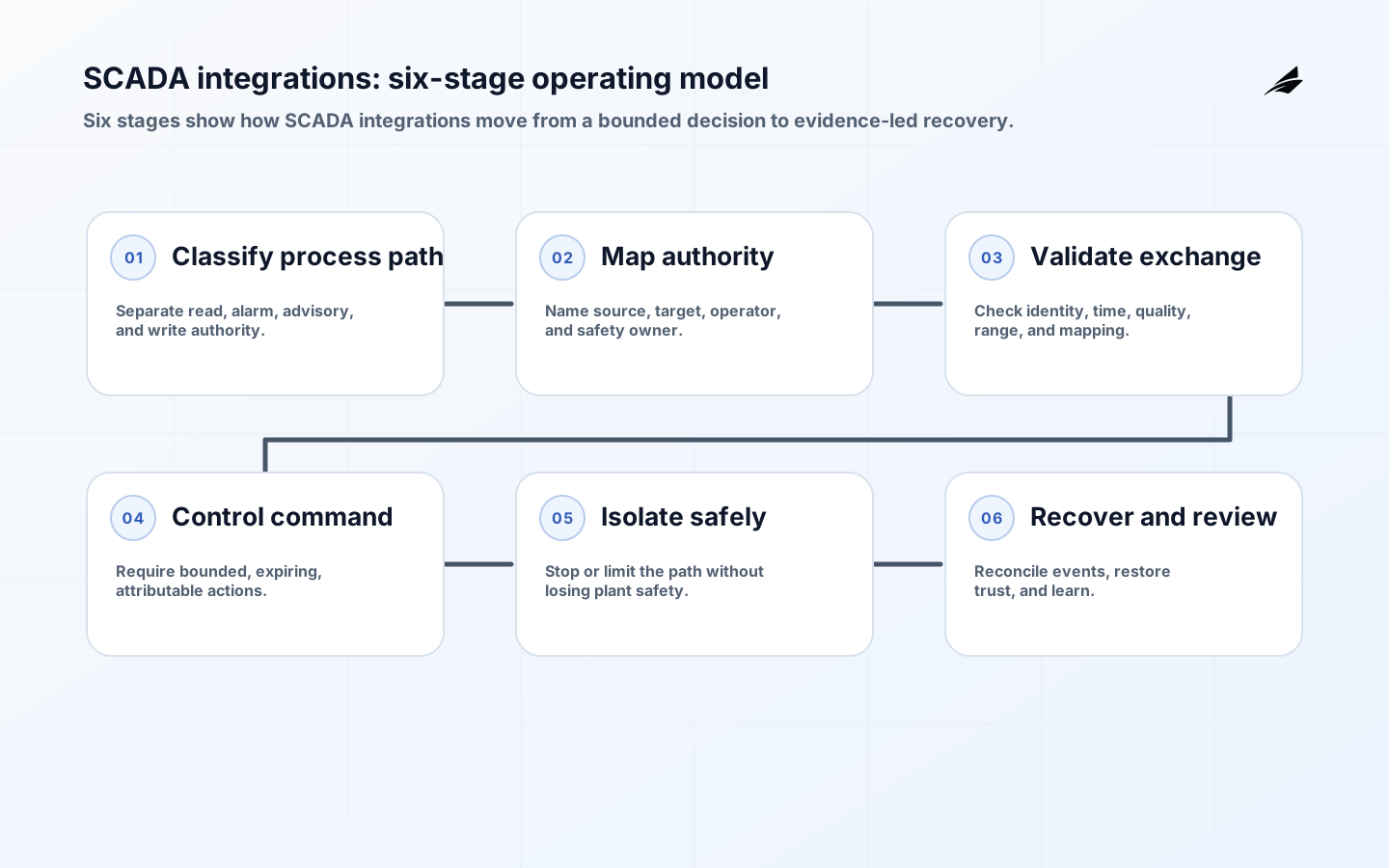
Start with the process consequence of an incorrect read, write, acknowledgement, or timestamp. Classify each integration path as observation, advisory, supervisory command, or control action, then assign the approval and safety expectations to that class. A historian feed and a write path should not inherit the same trust assumptions. The boundary should also show which system is authoritative for asset identity, setpoints, alarms, time, and operator acknowledgement.
Separate observation from command authority
Use different credentials, routes, and review expectations for reading process data and issuing commands. A connector that can browse tags should not automatically be able to write them. Require command context such as operator, reason, target, expected range, and expiry where the process permits. If a command cannot be safely replayed, make retries explicit and avoid generic middleware behavior that may repeat a physical action.
Plan incident response with plant operators
Technical responders need a plant-aware path for isolating an integration without creating a worse condition. Decide whether the safe response is to stop writes, keep reads, switch to local control, or hold the last approved setpoint. Preserve enough event context to reconstruct the sequence without exposing sensitive operational details broadly. Exercise the plan with a stale credential, unexpected write, clock mismatch, and loss of the integration host.
| Integration surface | Decision to make | Control evidence |
|---|---|---|
| Historian or telemetry read | What data is trusted for which use? | Source, tag mapping, time, and quality state |
| Alarm exchange | Who owns acknowledgement and escalation? | Event identity, actor, status, and handoff |
| Supervisory write | What commands are allowed and under what limits? | Target, range, approver, expiry, and result |
| Remote maintenance | When may access be enabled? | Window, role, path, monitoring, and closure |
Use consequence-based handling for SCADA failures
A connector error is not a single category. Classify the effect, choose the safe state, and make the person who can authorize recovery part of the design.
| Condition | Safe response | Evidence to review |
|---|---|---|
| Read-only data delayed | Mark stale and keep control local | Age, source, and operator notice |
| Unexpected command request | Reject and alert; do not retry blindly | Requester, target, policy, and reason |
| Integration host compromised | Isolate the path and preserve plant safety | Isolation event and plant handoff |
| Clock or mapping mismatch | Hold affected automation until reconciled | Time source, mapping version, and approval |
SCADA integration practices to carry forward
- Classify every path as observation, advisory, supervisory, or control.
- Separate read and write authority, and make retries and expiry explicit.
- Practice isolation and recovery with plant operators, not only technical staff.
Test commands, isolation, and restoration
Test a real process value through mapping, storage, display, and alarm paths, then introduce a changed tag definition, duplicate command, source outage, and revoked operator authority. Have plant operations decide when the integration is isolated, when read-only service remains safe, and what evidence permits restoration.
SCADA control and recovery questions
Is a SCADA integration ready when values match? No. It must also handle stale data, rejected commands, identity, time, alarms, isolation, and recovery. Matching values prove only one normal path.
Should IT or operations own the integration? Both need named responsibilities. Operations owns process safety and safe state; IT or engineering owns the service, access, updates, and evidence. The handoff must be explicit.
How should write commands be tested? Use a non-production or controlled test target, verify bounds and expiry, test duplicate delivery, and confirm that the plant can continue safely when the integration is isolated.
Conclusion
SCADA integrations earn their place in connected operations when the team can explain the outcome, boundary, trust model, operating signals, and recovery route in plain language. Start with one consequential path, retain evidence at each handoff, and let real operating results determine the next investment. That approach leaves product teams with something more durable than a feature: a system people can run and improve under pressure.