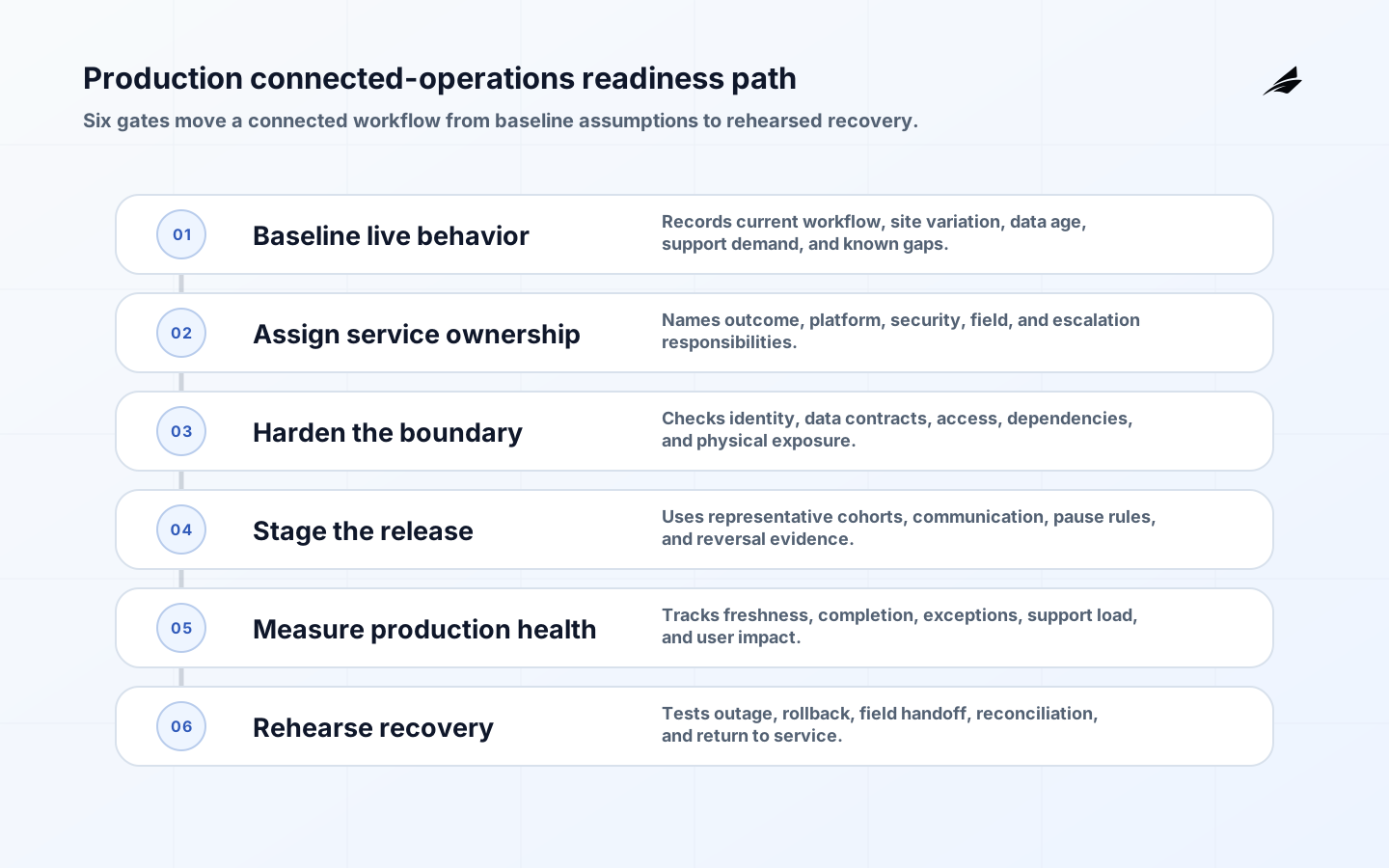
Moving connected operations into production changes the question from “can the device path work?” to “can people rely on it under pressure, partial failure, and change?” A prototype may tolerate manual enrollment, a shared credential, missing history, and one engineer who knows recovery. Production cannot. It needs bounded ownership, evidence, safe defaults, and a way to communicate uncertainty. NIST's OT security guidance reminds teams that connected systems interact with physical processes and availability constraints, so release readiness must include operational reality.
Establish a production baseline
Record what the prototype assumes: devices, versions, network dependencies, credentials, rates, storage, roles, field procedures, and manual workarounds. Mark each assumption confirmed, unconfirmed, or accepted. A production baseline is not a perfect inventory; it is a truthful statement of current behavior and the evidence needed to detect drift.
Use one representative site and one difficult site. Look for weak coverage, intermittent power, old firmware, shared accounts, unusual time zones, and local procedures the prototype never saw. Name what must be standardized and what may remain site-specific. This makes production a controlled change rather than a larger demo.
Turn component ownership into service ownership
Incidents cross component boundaries. A device team may see healthy hardware while operations sees stale work; a platform team may see successful ingestion while a customer sees an unfulfilled action. Define service-level responsibility for freshness, availability, security, correctness, field support, and communication. Create a RACI at workflow handoffs, not only at infrastructure layers.
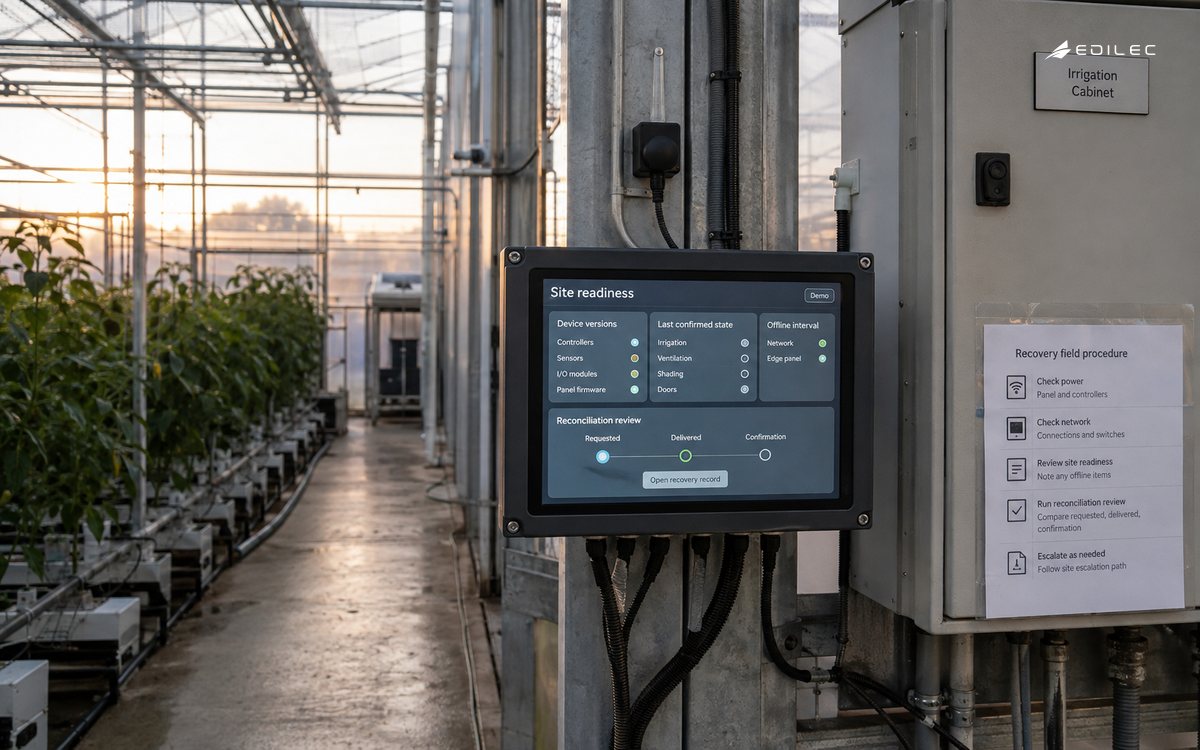
The owner must have authority to pause rollout, quarantine data, revoke credentials, and communicate degraded status. Support needs a bounded view of device state, pending work, last confirmed result, and relevant changes. This avoids a failure where every team owns a component but nobody owns the customer or operator outcome.
| Production concern | Minimum decision | Evidence |
|---|---|---|
| Ownership | Who owns the user or field outcome? | Named service owner and escalation |
| Compatibility | Which versions and sites are supported? | Test matrix and canary result |
| Security | Who may enroll, command, change, investigate? | Role map, logs, review cadence |
| Recovery | How are state, queues, gaps, and communication reconciled? | Game-day record and runbook |
Harden the production architecture
Production architecture needs isolation between device ingress, management, data processing, commands, and user access. Use least-privilege identities, explicit site boundaries, bounded queues, idempotent processing, and a clear source of truth. NIST's IoT baseline provides a starting set of capabilities, including unique identification, protected data, software update, and state awareness.
Preserve source evidence when transforming data. Keep device identity, observed time, received time, quality, software version, and rule version with the normalized record. For commands, record requester, policy decision, target, expiry, delivery, execution, and confirmation separately. This gives responders context to determine whether a failure is in device, network, service, or human workflow.
Make production security operational
Security becomes daily work after launch. Rotate and revoke credentials, review access to device and site data, limit vendor support, and monitor unusual enrollment, command, or configuration activity. Do not assume a secure channel makes a command safe; authorization still depends on target, purpose, current state, and responsibility. NIST's IoT catalog helps turn broad goals into device questions.
Threat modeling should include lost devices, cloned IDs, stale credentials, compromised gateways, malicious commands, poisoned telemetry, exposed debug ports, and unsafe update paths. For each, define prevention, detection, containment, and recovery. Retain enough evidence to investigate without giving every responder unrestricted production access.
Build a release path that includes field reality
A production release should move one reviewed artifact through compatibility checks, staged deployment, operator communication, and reversal. Test an old device version, weak network, offline interval, and site-specific configuration. Confirm a new schema or firmware version can be identified and isolated. Avoid rollout assumptions that all devices are reachable at once.
Define release gates in terms of outcome: ingestion stays within freshness bounds, commands remain safe, dashboards label versions, and support can explain failure. A canary fleet should expose device diversity but contain impact. Keep a stop rule and person authorized to use it. A staged release is valuable only if it can actually pause.
| Prototype assumption | Production replacement | Why it matters |
|---|---|---|
| One engineer knows the fix | Runbook with on-call route | Reduces key-person risk |
| All devices are reachable | Staged rollout and offline handling | Limits fleet-wide impact |
| A command means success | Separate request, execution, confirmation | Prevents unsafe status claims |
| Logs are enough | Structured evidence with identity and time | Makes incidents explainable |
Choose production signals and objectives
Track availability, freshness, quality, command confirmation, enrollment success, fleet version, queue age, exception backlog, support volume, and recovery time. OpenTelemetry's documentation helps with service traces, metrics, and logs, then add domain fields for identity and physical outcome. A single uptime number cannot show whether a connected workflow is trustworthy.
Set objectives around user experience. 99.9% receipt may be meaningless if the missed 0.1% is the cold-chain exception; a freshness objective by critical class may be better. Define measurement during maintenance and site outages. Review misses as decisions: change architecture, workflow, runbook, or scope.
Rehearse production recovery
Run a game day for cloud loss, broker failure, bad firmware, compromised credential, corrupt data, and unreachable site. Include operations, support, security, field service, and communications. Test whether people can identify impact, contain unsafe actions, preserve evidence, continue limited work, and verify recovery.
Recovery is not complete when servers are green. Reconcile device state, queued commands, missing events, customer records, and notifications. Record uncertainty explicitly. If an interval cannot be reconstructed, say so and define follow-up. Retire temporary access and update ownership after the exercise. A rehearsed recovery demonstrates that connected operations can be supported as a service rather than left as a prototype.
Govern change without freezing delivery
Production changes: device models, thresholds, vendors, networks, and site ownership. Classify changes by impact. A label may need lightweight review; firmware, command, identity, or contract changes need compatibility evidence and rollback. Link changes to affected devices and operating owners.
Keep a versioned record of material changes and reasons. When a rule changes, preserve prior interpretation for historical data; do not rewrite the past silently. When a site changes owner, update identity and access without changing historical device identity. This lets teams deliver steadily while retaining a credible production record.
A production readiness scenario
Create a production readiness record for each critical workflow. Include supported device classes, ownership, freshness objective, security boundary, change route, recovery target, and known exclusions. Treat exclusions as useful scope, not an embarrassment. A workflow that explicitly does not support a legacy device is safer than one that presents the same status while silently applying different rules.
Production support needs a version-aware investigation path. When an operator reports stale data, support should see the device version, gateway version, contract version, last successful handoff, and recent changes. Keep those facts searchable without exposing credentials. The goal is to shorten diagnosis while preserving least privilege and a clear route to the team that can act.
Use release cohorts that reflect risk, not only geography. A small cohort can include one old hardware revision, one weak-network site, one high-value customer, and one device with a known edge condition. Define how those representatives are monitored and who may stop the rollout. A cohort that looks statistically large but misses rare risk is not a useful production control.
Production data corrections need customer and operator language. Explain whether a value was missing, late, transformed, or corrected, and whether a decision was affected. Preserve the original event and correction reason. A transparent correction can be investigated; a silent dashboard rewrite creates a second incident when users compare records later.
Measure manual work as a production signal. Count tickets caused by enrollment, stale telemetry, command ambiguity, device replacement, and missing evidence. Trends show where the operating model is weak even when technical uptime looks good. Use the count to decide whether to improve product flow, automate a bounded task, or change the support boundary.
Set an explicit expansion gate after the first production period. Require stable freshness, bounded exceptions, rehearsed recovery, supported versions, and evidence that operators can complete work without specialist intervention. If a gate fails, narrow scope or fix the boundary before adding sites. This is how a production move preserves delivery speed without making uncertainty invisible.
Use a support escalation contract that names the first responder, service owner, and decision authority for customer impact. Include the evidence threshold for declaring a site degraded and the communication path for a partial outage. This prevents a production incident from waiting on a debate about which team owns the boundary.
Production readiness should include a retirement path for data, devices, credentials, dashboards, and support routes. When a site leaves the service, remove authority without deleting evidence needed for review. Treat the exit as a change with an owner and verification, not as administrative cleanup after the real work is finished.
Review production assumptions quarterly or after a material incident. Check whether supported versions, freshness targets, exception rates, and recovery steps still describe reality. An operating model becomes unsafe when its documentation remains accurate only for the system that existed at launch.
Use the connected operations checklist, production telemetry guide, and device provisioning guide as adjacent review points when production ownership crosses workflow, data, and enrollment boundaries.
Key production connected-operations takeaways
- Inventory prototype assumptions before scaling the fleet.
- Assign ownership to the outcome, not only to components.
- Make identity, compatibility, freshness, and command state explicit.
- Use staged releases with a real stop and rollback decision.
- Reconcile physical, digital, and customer state after recovery.
Frequently asked production questions
What is the biggest production change?
Accountability becomes visible. A prototype can depend on informal knowledge; production needs named owners, support paths, evidence, change control, and recovery another person can execute.
How do I know connected operations is ready?
Run a representative workflow through normal operation, degraded connectivity, rejected action, update, data gap, and recovery. Readiness means the team can contain impact, explain uncertainty, and verify final state.
Conclusion: production connected operations in practice
In production, connected operations become a service boundary with real users, sites, devices, and consequences. Make ownership, compatibility, security, signals, and recovery explicit before scale turns small assumptions into fleet-wide risk.