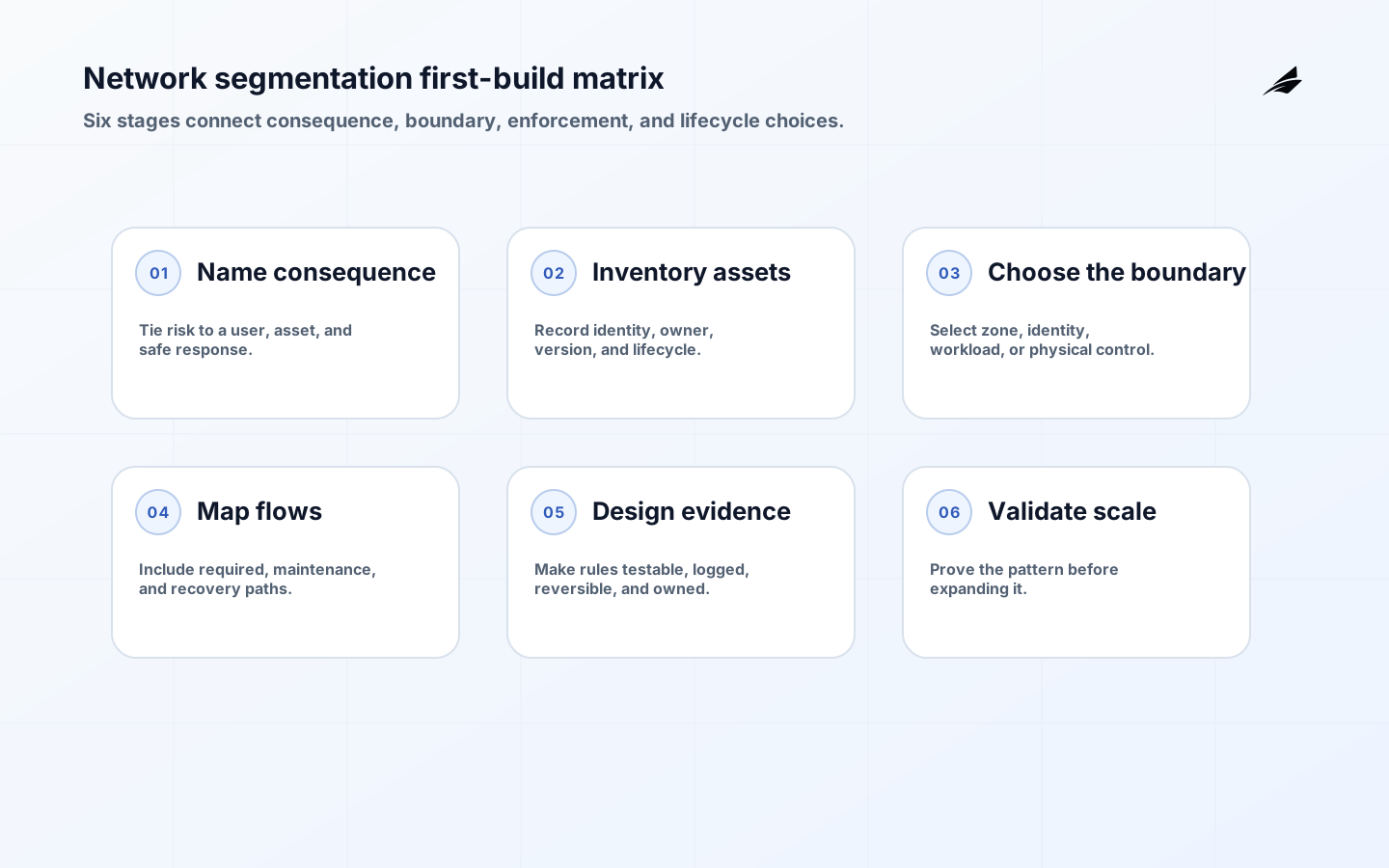
The best time to make network segmentation decisions is before a first build turns convenient reachability into an invisible dependency. Early teams often place devices, gateways, services, support tools, and analytics in one reachable environment because it makes integration quick. Later, a controller expects an undocumented route, a vendor tool has a shared credential, monitoring cannot cross the new boundary, and nobody knows which flows are needed during recovery. Decisions should begin with consequence and ownership, then move through assets, flows, identities, enforcement, and evidence. The goal is not the most detailed topology; it is the smallest defensible boundary the team can operate and evolve.
Start with consequence, not subnet size
List what could happen if a path is misused, unavailable, delayed, or corrupted. A temperature feed may affect service scheduling; a controller may affect access or comfort; a machine command may affect safety or production; an identity outage may affect operators and recovery. Put consequence beside owner and response. NIST SP 800-82 highlights performance, reliability, and safety in OT security. NIST SP 800-207 adds that network location should not be implicit trust. Use segmentation to reduce reachable paths, but keep authorization and current-state checks at the resource and application boundary. What changes in production segmentation shows how these early decisions behave under real operations.
| Decision | Option A | Option B | Choose based on |
|---|---|---|---|
| Primary boundary | Site or function zone | Service or identity boundary | Consequence and support ability |
| Telemetry | Broker through DMZ | Direct service route | Latency, inspection, resilience |
| Vendor access | Time-bound proxy | Dedicated jump path | Evidence and expiry |
| Control path | Isolated or one-way | Authenticated route | Safety and response time |
| Policy | Default deny | Narrow allow with exceptions | Known flows and maturity |
Inventory assets, identities, and owners
Create an inventory useful during change and incident. Include device, gateway, service, operator, vendor, management, identity, logging, backup, and time sources. Give each durable identifier, owner, scope, version, lifecycle state, and recovery contact. Record which identity authenticates and which role approves change. A display name or IP can change; asset and purpose should not disappear. NIST’s IoT baseline prompts device identification, configuration, data protection, software update, and cybersecurity state. If nobody can say who owns a path, it is not ready for production segmentation.
Choose the boundary model deliberately
Common choices include site or plant zones, Purdue-style levels, cloud account boundaries, workload policies, identity-aware proxies, and physical or one-way controls. They can coexist. The decision is where policy is enforced and who changes it. Zones help teams reason about function and consequence; identity and application controls refine access inside or across zones. A DMZ can control exchange, but needs direction, protocol, inspection, and failure policy. Host policy can reduce workload reachability, but must be tested on the deployed platform. Prefer a model with understandable rules, clear evidence, and a migration route for assets that cannot yet comply.
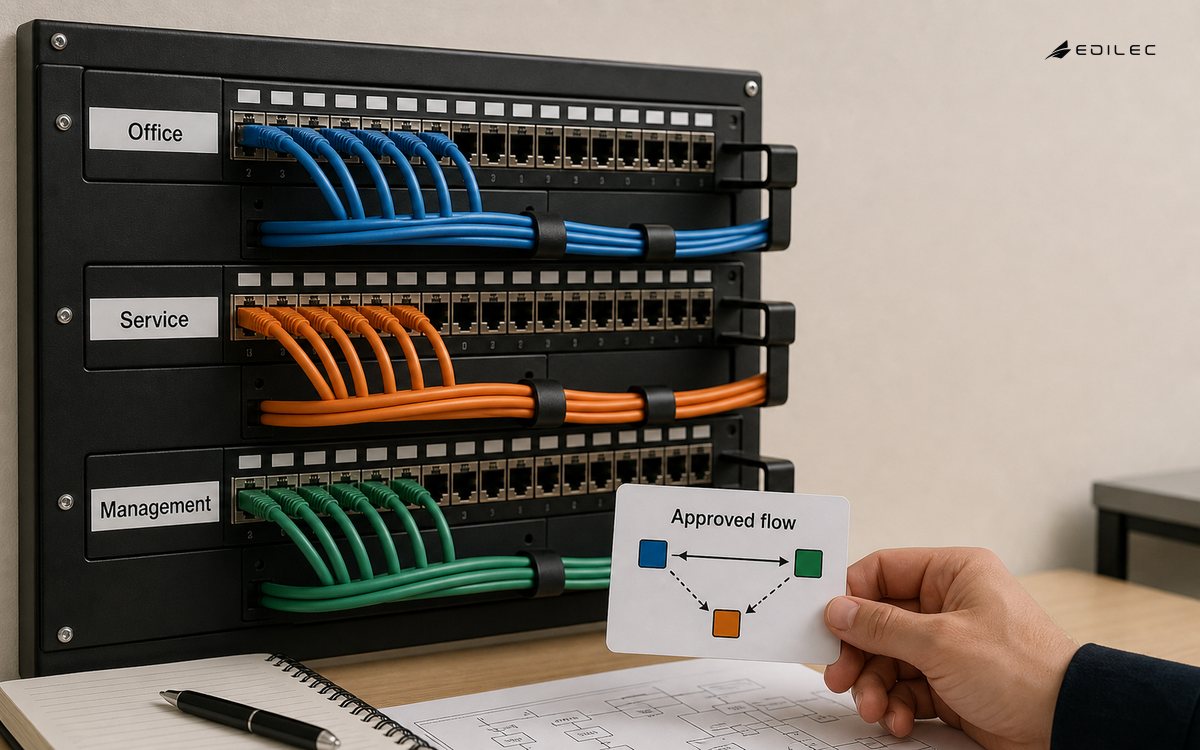
| Model | Strength | Trade-off | Good first question |
|---|---|---|---|
| Zone and conduit | Readable for site and OT teams | Broad implied trust | Which functions share consequence? |
| Microsegmentation | Narrow workload communication | Policy complexity | Can the team operate rules? |
| Identity-aware access | Explicit user and service decisions | Needs strong identity | What resource is protected? |
| One-way or physical | Strong high-consequence isolation | Limited flexibility | What must never be reverse reachable? |
Map required and recovery flows
For each workflow, document source, destination, protocol, direction, frequency, payload, timing, identity, dependency, and owner. Add commissioning, patching, certificate rotation, time, backup, monitoring, log export, remote support, replacement, and emergency isolation. Ask the people who perform the work to review the map. A scanner shows what exists; it cannot tell you which path is needed during a safe restart or replacement. Mark uncertain flows for observation and time-box discovery. Never solve an unknown by allowing an entire zone to reach another indefinitely.
Design enforcement and evidence together
A rule is a control only if the system enforces it and the team proves its effect. Choose firewall, router, proxy, host, service mesh, broker, or physical enforcement according to path and consequence. Define allowed and denied logging, policy version, approval, and rollback. A control-plane log is not always proof the data plane applied the rule. Test real source and destination, return path, DNS, time, and identity dependencies. Keep evidence useful without collecting unnecessary payloads. CISA’s ICS practices help connect architecture to practical protection and response. Pair this design with network observability so failures remain explainable.
Plan exceptions and lifecycle changes
The first build meets assets that cannot use the ideal control: old controller, vendor appliance, constrained gateway, or undocumented dependency. Design containment rather than an indefinite exception. Give it compensating control, owner, expiry, monitoring, and migration plan. Include replacement, decommissioning, credential revocation, updates, and site moves in the lifecycle. The boundary should change when an asset changes, but every change should leave an understandable record. Review whether an exception still protects the original consequence; a temporary path that becomes normal may deserve a new architecture decision.
Validate before scaling the pattern
Build a representative test path and exercise normal, denied, degraded, and recovery journeys. Confirm a device can report, a user can perform permitted work, a vendor path expires, a revoked identity is blocked, a dependency outage produces a safe state, and rollback restores the intended path without a bypass. Measure time to diagnose, time to recover, false blocks, unresolved exceptions, and manual work. The first build should produce a reusable pattern and acceptance record. Do not scale a boundary only its original designer can explain.
A practical first-build sequence
- Describe consequence, owner, safe state, and recovery action for each important path.
- Inventory assets, identities, versions, locations, dependencies, and lifecycle.
- Choose boundary model and name enforcement, policy, and evidence owners.
- Map normal, maintenance, update, monitoring, backup, replacement, and emergency flows.
- Test allowed and denied paths with identities, failures, and rollback.
- Scale only after operators and support can explain the pattern without its author.
Turn the first build into a reusable decision record
For the first representative path, keep a decision record with consequence, assets, identities, required flows, denied flows, enforcement point, policy owner, evidence source, safe state, exception route, and rollback. Attach tests for normal traffic, failed dependencies, unauthorized access, replacement, and recovery. This explains why the boundary exists and which assumptions can change. Revisit it when a service, device, vendor, or owner changes. The network segmentation production guide shows why maintenance and recovery assumptions matter after deployment.
Use the record to compare alternative designs honestly. A zone model may be easiest for site operators but broad inside the zone; microsegmentation may reduce reachability but require dependency discovery; identity-aware access may clarify remote work but depend on an identity service with its own recovery. There is no universal best model. Choose the one whose risks, operating cost, evidence, and migration path the team can state. Retire rules that serve no current consequence and promote recurring exceptions into deliberate architecture. That is how a first build becomes a foundation rather than inherited allowances.
Make the first build legible to the people who will inherit it. Give the operations team a compact inventory, a flow table, a policy change path, and a recovery exercise they can repeat without the architect. Give security a view of identities, exceptions, logs, and revocation. Give support a way to identify the affected asset and communicate the safe next step. Revisit the decision after the first real incident or replacement, because those events reveal assumptions that a clean lab cannot. A design that needs a permanent exception may still be valid, but the exception must be visible, bounded, and owned. Use network observability to make the evidence explainable when several boundaries participate in one workflow.
Do not treat the first-build record as static architecture. Use it to decide what may change without a full review and what requires an operational or safety owner. A new telemetry consumer may need a narrow read path; a command consumer may need a separate trust decision and end-to-end confirmation test. A device replacement may preserve the asset relationship while changing identity and certificate. A vendor integration may need a temporary conduit with visible expiry. Capture these patterns so the next build inherits deliberate rules rather than copied exceptions. When a boundary is hard to explain, reduce assumptions before adding technology. The production segmentation guide tests whether the proposed design remains operable after launch.
Keep the first boundary understandable to a person on call. Use stable names for zones, conduits, assets, and policy versions. Show whether a path is intentionally denied, temporarily unavailable, or not yet mapped. Give responders a safe diagnostic route that does not require disabling the control. Review allowed traffic as well as denied traffic because an overly broad allow can hide risk. When an exception recurs, move it into the architecture and update the flow map. This is the difference between segmentation as a diagram and segmentation as a maintained control: the team knows what the rule means, what evidence proves it, and what action is safe when reality differs.
The decision record should also state what is deliberately out of scope. A first build may protect telemetry while leaving command authority for a later phase, or it may isolate a site without yet solving every vendor workflow. Naming that boundary keeps stakeholders from treating an unbuilt control as an implicit promise. Revisit non-goals when the consequence, owner, or dependency changes.
For connected systems, the first-build boundary should state how event delivery, telemetry quality, and support access interact. The event streaming guide is a useful companion when the same segmentation decision affects producer, consumer, replay, and command paths. A clear boundary protects the build from growing a hidden exception just because one event path was not modelled early.
Use NIST SP 800-82 Rev. 3 for OT topology and safety, NIST SP 800-207 for explicit resource access, the NIST IoT device baseline for lifecycle capability, and CISA ICS recommended practices for practical control planning.
Key takeaways
- Make segmentation decisions from consequence and ownership.
- Use zones to organize risk and identity or application policy to refine trust.
- Map recovery and maintenance flows before enforcing default deny.
- Design enforcement, evidence, exceptions, and lifecycle as one capability.
- A first build is ready when the boundary is testable, reversible, and supportable.
Frequently asked questions
Is putting devices on separate subnets enough?
No. Subnets organize address space; enforcement decides which traffic crosses, and application policy decides which actor may act. Verify effective controls and test the paths that matter.
Does zero trust make segmentation unnecessary?
No. Zero trust shifts attention toward explicit resource, user, and device decisions. Segmentation still reduces reachable paths and provides isolation around OT and high-consequence systems.
What should a small team do first?
Choose one workflow, map its assets and dependencies, define an explicit boundary, and test normal and recovery. A small understood pattern is more valuable than a broad design with unknown flows.
Conclusion
Network segmentation decisions made before the first build become the operating grammar of a connected system. Start with consequence, map the work, choose a boundary the team can enforce, and preserve evidence for change and recovery. That foundation keeps security, reliability, and support aligned as the environment grows.