MQTT Brokers in Production: A Practical Operations Guide
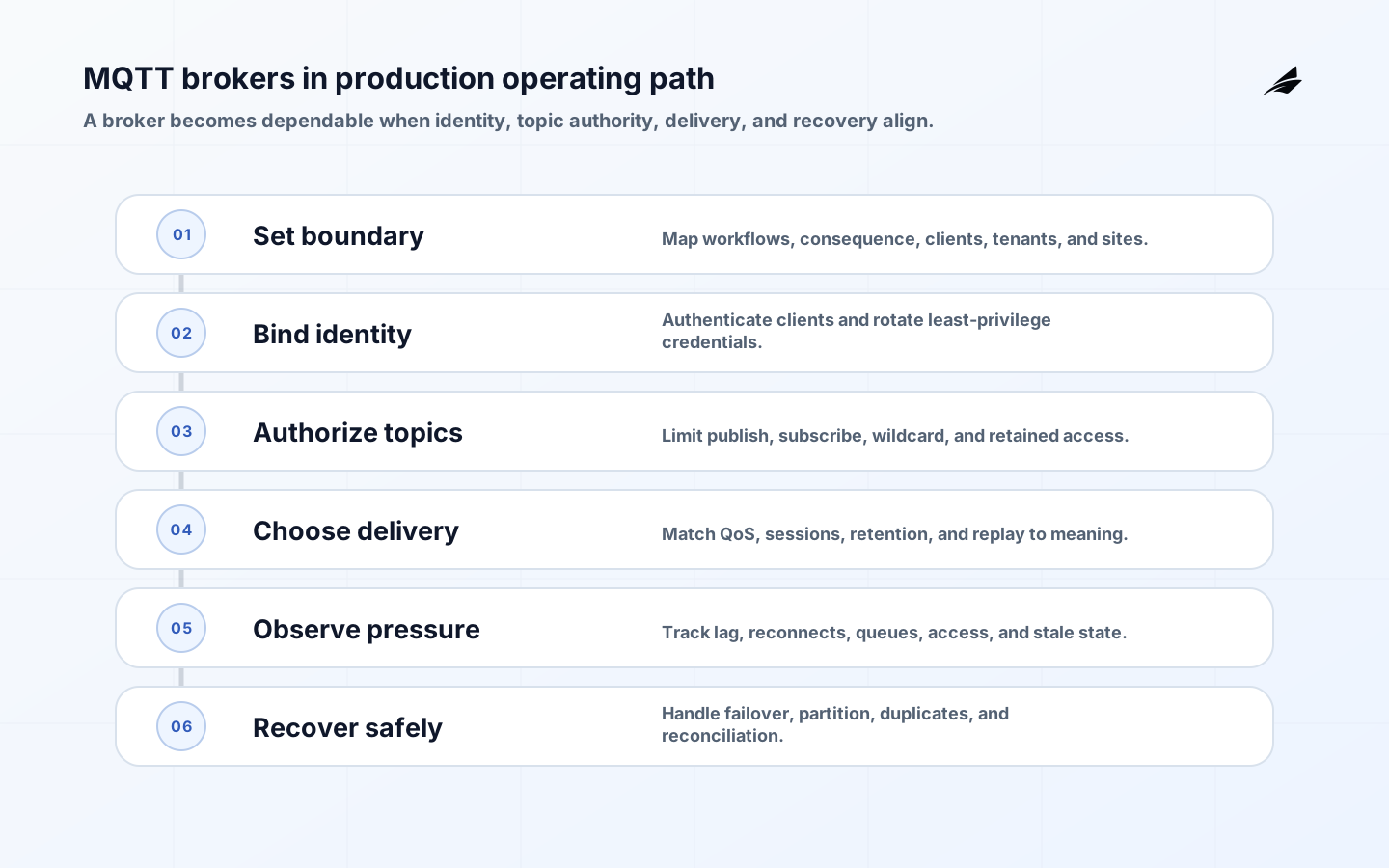
MQTT brokers in production are easy to demonstrate and demanding to operate. A development broker can accept broad credentials, permissive topics, short-lived clients, and a restart that nobody notices. In production, the broker becomes a shared control point for device identity, message routing, retained state, session continuity, operational safety, and customer data. Moving it into production means proving who may connect, what each client may publish or subscribe to, how messages behave during interruption, and how operators recover without guessing about the last known state.
Map broker responsibility to business workflows
Start by listing the workflows that depend on the broker and the consequence of delay, duplication, loss, or stale data in each one. Telemetry for a dashboard can tolerate different behavior from a command that changes a machine state. Map devices, gateways, applications, tenants, sites, and operators. Record which paths are safety-relevant, which messages are private, and which consumers need replay. A broker is an infrastructure component, but its production boundary is set by the workflows that trust it.
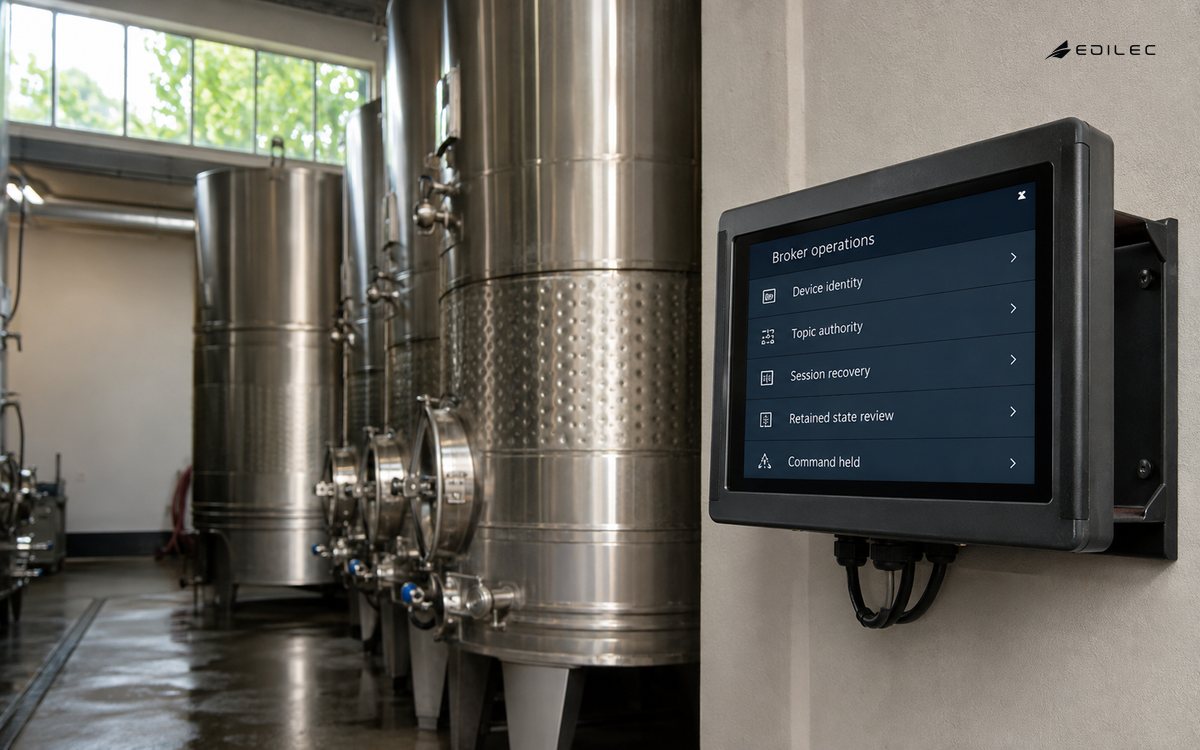
The OASIS MQTT 5.0 specification defines a lightweight publish/subscribe protocol for constrained environments, but the specification does not choose your retention, topic ownership, or operational controls. Those are architecture decisions. Write them down before load testing so performance results are measured against an intended service rather than an accidental one.
| Production decision | Question | Evidence |
|---|---|---|
| Client identity | How is each device or service authenticated and rotated? | Credential inventory and rotation test |
| Topic authority | Which client may publish or subscribe to each namespace? | ACL matrix and denied-request tests |
| Delivery | What do loss, duplication, ordering, and replay mean here? | Message contract and consumer behavior |
| Availability | What can operate locally when the broker is unavailable? | Degraded-mode runbook and rehearsal |
Make topic names carry scope and authority
Topic names are not just labels; they are part of the access boundary. Use a stable hierarchy that reflects tenant, site, asset, device, data kind, and direction only when those dimensions have clear ownership. Avoid putting secrets or mutable display names in topics. Decide whether a client may publish telemetry, receive commands, subscribe to status, or access retained state. A gateway that can publish to every site has a larger failure radius than one limited to its assigned assets.
Test wildcards deliberately. A subscription that looks convenient in development can expose cross-tenant data or allow a consumer to receive commands intended for another device class. Keep the ACL source of truth versioned and review changes as security-sensitive code. NIST's IoT baseline is useful for connecting logical access, data protection, device identification, and cybersecurity state awareness to the MQTT client lifecycle.
Control client identity from onboarding to revocation
Use protected transport, strong client identity, least-privilege authorization, and a rotation plan that does not require an emergency fleet outage. TLS protects a connection, but it does not decide whether a client is allowed to publish a command or read another tenant's data. Bind identity to a device or service record, keep certificate or token status visible, and remove access when ownership changes. Handle clock skew, expired credentials, and reconnect storms as normal operating cases.
The TLS 1.3 specification provides the transport foundation; production design still needs certificate issuance, trust-store updates, revocation or expiry handling, and device-side failure behavior. Do not hard-code a single shared password across a fleet when a compromised client would then impersonate every device. If a constrained device cannot support the preferred method, document the compensating control and retirement plan.
Select QoS and retention by message meaning
MQTT offers delivery choices, but the right setting depends on the meaning of the message. At-most-once may be acceptable for frequent telemetry where the next sample supersedes the prior one. At-least-once can protect important observations but requires consumers to handle duplicates. Retained messages can help a new subscriber learn the latest state, but stale retained commands are dangerous. Persistent sessions can preserve progress, but they create storage and lifecycle obligations.
Write a message contract that states whether the payload is a fact, desired state, command, acknowledgement, or event. Include a stable message identifier, source time, schema version, quality, and correlation to the workflow. Consumers should be idempotent when a duplicate can repeat a side effect. A broker can deliver a message correctly while the end-to-end operation still fails because the consumer posted the same work order twice.
| Message type | Typical choice | Required consumer control |
|---|---|---|
| Frequent telemetry | Loss may be acceptable within a freshness window. | Freshness, sequence, and gap monitoring |
| Device state | Retained or durable latest value with expiry rules. | Version and stale-state handling |
| Command | Protected delivery with explicit acknowledgement. | Idempotency, authorization, and timeout |
| Alarm | Durable delivery with escalation policy. | Deduplication, ownership, and closure |
| Audit event | Durable history with controlled retention. | Integrity, access, and replay-safe readers |
Watch queue pressure and stale commands
Monitor active connections, authentication failures, publish and subscribe rates, queue depth, delivery latency, retained-message age, session storage, network saturation, reconnect storms, and consumer lag. Segment these signals by client, site, topic family, tenant, and broker node. A green broker process can hide a growing consumer backlog or a single gateway retrying thousands of messages. Use thresholds that trigger an action: throttle, isolate, scale, contact a site, or fail over.
Protect logs and evidence. NIST's computer security log management guide supports treating logs as managed records with collection, protection, review, and retention. Capture connection identity, authorization decision, reason code, topic metadata, correlation ID, and outcome where useful; avoid retaining sensitive payloads by default. The goal is to reconstruct a material event without creating a second uncontrolled data store.
Reconcile sessions, duplicates, and failover
Define what happens when one node fails, the network partitions, a client loses credentials, a consumer falls behind, or retained state is corrupted. Decide whether devices buffer locally, retry with backoff, switch endpoints, or enter a safe local mode. A recovery plan must also address duplicate commands after reconnection and the reconciliation of device state with the system of record. Test the failure path with representative traffic, not only an empty broker.
NIST's OT security guidance puts availability and safety ahead of convenience when software touches physical processes. A broker failover that reconnects clients but loses the context needed to prevent a stale command is not complete. Define the operator decision for degraded mode and keep the local procedure available when central services are unavailable.
Promote broker changes with observable gates
Use a representative test population and validate identity, topic ACLs, message semantics, reconnect behavior, capacity, and recovery. Start with read-only telemetry where possible, then add bounded commands after the evidence is sound. Keep a production-like environment with real certificates, schemas, consumer versions, and network constraints. Define a stop condition for unauthorized access, unbounded backlog, unexpected retained data, command duplication, or loss of required safety signals.
Connect the MQTT brokers in production guide to a broader operating context with IoT telemetry explained, the SCADA integration production guide, and the field service portal production guide. These adjacent paths help test whether broker data actually supports a complete operational outcome.
Keep a clear distinction between broker responsibility and consumer responsibility. The broker can authenticate a client, enforce topic access, and report delivery state. The consumer must validate payload meaning, handle duplicates, apply business authorization, and reconcile external effects. Write that boundary into the message contract. Otherwise teams may treat a successful publish as proof that a command succeeded when the receiving application rejected or misapplied it.
Use tenant and site boundaries that match operational ownership. A shared broker may be efficient, but a single administrator, wildcard subscription, or retained namespace can create a broad blast radius. Consider separate credentials, topic roots, quotas, and monitoring views for material boundaries. Review whether a gateway can be isolated without taking unrelated customers or sites offline.
Plan schema evolution as an operating process. Add a version, define compatibility, keep consumers tolerant of new fields, and retire old forms with evidence. A topic can remain available while its meaning changes, which is more dangerous than a visible outage. Test a mixed-version population and make the consumer's fallback explicit when a field is missing or invalid.
Run capacity tests with realistic reconnect and replay behavior. A broker that handles steady traffic may fail when thousands of devices reconnect after a power event, when consumers replay a retained history, or when a certificate rotation causes a fleet retry. Measure time to recover, not only peak messages per second. Backoff, quotas, and local buffering should protect the workflow while the broker returns to service.
Keep broker configuration, client identity, topic ACLs, schemas, retention, and consumer versions under one release view. A client can reconnect successfully while its permissions or interpretation is wrong. Review the combined change before production and retain the exact versions with a rollout record. This makes a later investigation faster and reduces the chance that a small configuration edit creates a cross-tenant or stale-command incident.
Make the degraded mode legible to people operating the connected system. Show whether data is delayed, whether commands are blocked, whether local control is active, and what reconciliation will happen after recovery. A broker is part of a wider service; its availability matters because it supports a decision, not because a process is listening on a port.
Keep a service-level view above individual broker metrics. Ask whether the connected workflow can complete, whether operators know the current state, and whether external side effects can be reconciled. This view prevents a team from declaring the broker healthy while a consumer is stuck, a device is acting on stale intent, or a site has lost the ability to operate safely. Review the end-to-end result after every major broker, client, schema, or identity change.
Make topic and client changes reviewable by the teams that own the connected workflow. A security reviewer can validate the access boundary, but an operations owner must also confirm that the new subscription, retained state, or retry behavior will not create unsafe work. Keep a test device and a representative consumer available for release checks so the broker's semantics are tested in context rather than inferred from configuration alone.
Key takeaways
- Treat the broker as a shared authorization and state boundary, not a neutral pipe.
- Design topic namespaces, client identity, and ACLs together.
- Choose delivery, retention, and session behavior by message meaning.
- Make consumers idempotent when retries or replay can repeat side effects.
- Monitor lag, reconnects, retained-state age, and access failures by operating context.
- Rehearse partition, failover, credential loss, backlog, and stale-command recovery.
Frequently asked questions
Which MQTT QoS should production use?
There is no single correct level. Select it by the consequence of loss and the consumer's ability to handle duplicates. Frequent telemetry may prioritize freshness; commands and alarms need stronger end-to-end acknowledgement, authorization, idempotency, and reconciliation than a QoS label alone can provide.
Are retained messages always safe?
Retained state can help a new consumer learn the latest value, but it needs an explicit type, freshness rule, expiry policy, and authorization boundary. Retaining a desired state or command without a clear version and age can make a newly connected device act on stale intent.
Conclusion
When an MQTT broker moves into production, the important work is no longer making messages flow. It is making identity, authority, delivery semantics, observability, and recovery agree with the workflows that depend on them. Treat the broker as an operating system for connected interactions and it can scale without hiding the risks that matter.