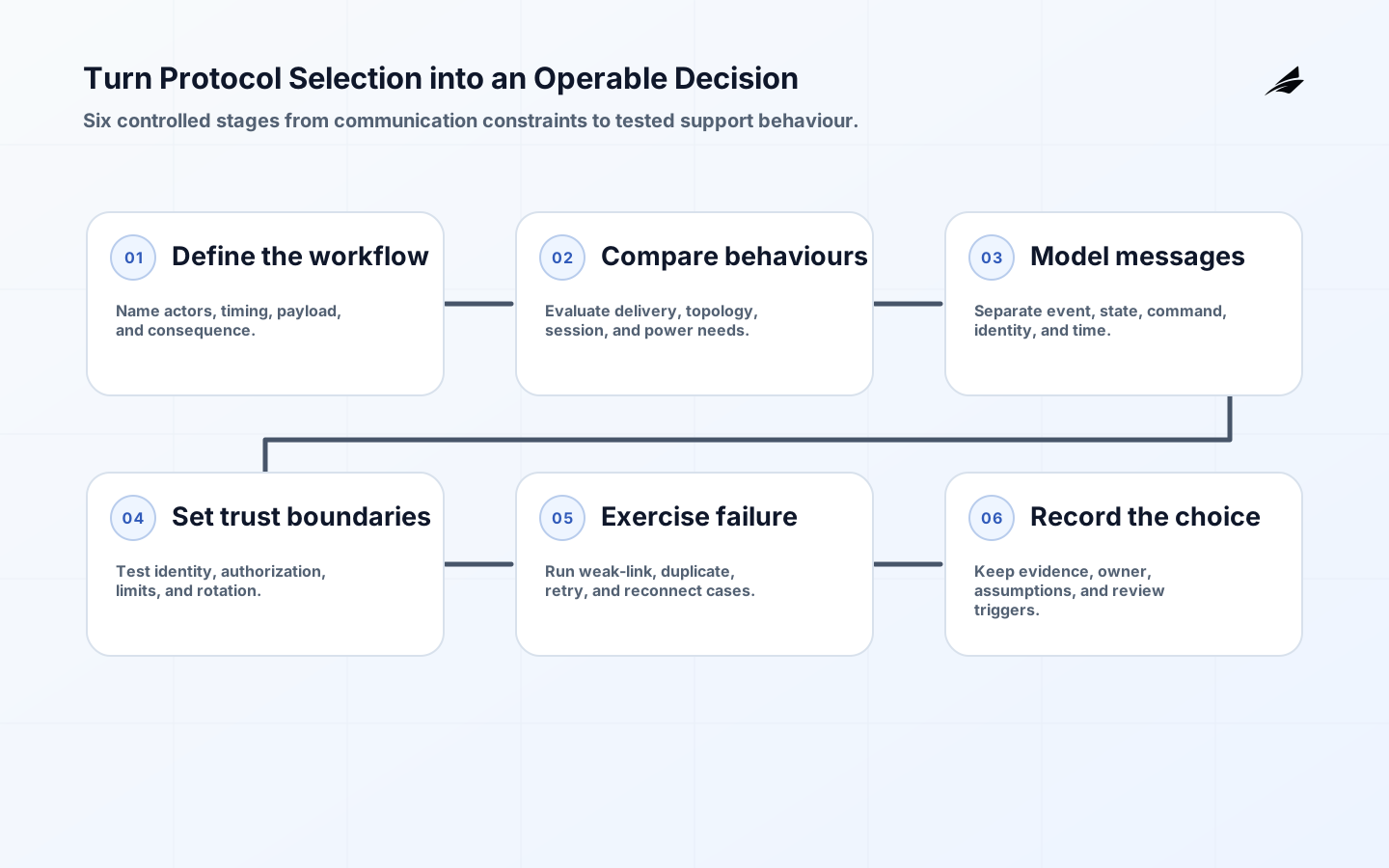
Protocol selection is a decision about communication behaviour, not a vote for a familiar product. The right choice depends on payload size, network shape, power budget, delivery expectations, ordering, discovery, security, device lifecycle, and the consequence of delay or duplication. A protocol that is excellent for one operating path can be a poor fit for another. Before the first build, write the behaviour the system must preserve when the network is slow, intermittent, crowded, or partially unavailable.
Define the protocol decision
Describe the workflow rather than starting with acronyms. A battery device reporting a periodic measurement, a gateway translating an industrial interface, and a cloud service issuing an occasional command have different constraints. Record who speaks, who listens, how often, what must be acknowledged, and what happens when a message is late. The protocol selection production guide is useful once the decision needs to be tested against release and support conditions. A written scenario keeps the comparison anchored to consequences. Production examples appear in MQTT production changes and Edge gateway decisions.
| Constraint | Question | Why it changes selection |
|---|---|---|
| Connectivity | Is the path intermittent or expensive? | Determines retry, buffering, and session needs |
| Payload | Are messages small, structured, or negotiated? | Changes encoding and overhead trade-offs |
| Delivery | Is loss acceptable, or must recovery be explicit? | Shapes acknowledgement and persistence |
| Topology | One endpoint, many subscribers, or local peers? | Changes routing and coupling |
| Lifecycle | Who updates and revokes identities? | Affects certificates, credentials, and support |
Compare behaviours, not labels
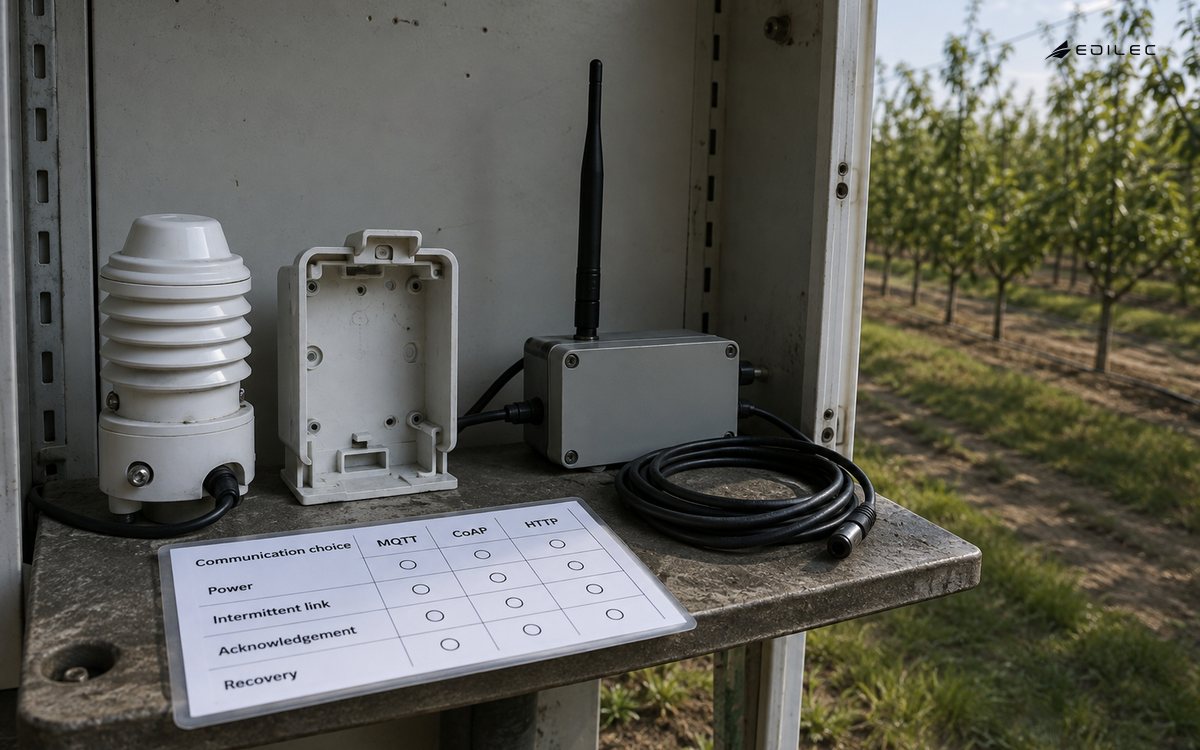
MQTT uses a brokered publish-subscribe model with topics, sessions, and quality-of-service options. CoAP is designed for constrained, REST-like interactions and can work well where request-response semantics are more natural. HTTP is widely supported and often convenient for service integration, but persistent device connections, polling, or intermittent links may change the cost and recovery profile. These are tendencies, not universal verdicts. Read the MQTT specification and CoAP specification for precise semantics, then test the selected behaviour in the actual network.
Model message and time semantics
Define whether a message represents an event, a current state, a command request, or a response. Define the identity used for deduplication, the timestamp that controls freshness, and whether order matters per device or globally. “At least once” delivery can be appropriate when consumers are idempotent; it is dangerous when a retry can create a second physical action. A protocol comparison that ignores these distinctions can appear efficient until it meets a real outage.
- State the maximum acceptable delay and the behaviour when it is exceeded.
- Keep telemetry scopes distinct from command authority.
- Define payload limits and a response for malformed or oversized messages.
- Record whether a reconnect restores state, subscriptions, or neither.
- Decide how a device proves identity during bootstrap, rotation, and retirement.
Set security and trust boundaries
Choose authentication, authorization, encryption, and lifecycle handling as part of protocol selection. A secure transport does not determine which topic or resource a device may access. A brokered design needs client identity, topic permissions, session limits, and protection against abusive publishing. A request-response design needs resource authorization, replay protection where commands matter, and rate controls. NISTIR 8259A provides a useful baseline for device capabilities; apply it to the chosen protocol path and its operational owner.
| Decision | Good question | Acceptance evidence |
|---|---|---|
| Identity | Can one device be revoked without a fleet reset? | Bootstrap, rotation, and retirement test |
| Authorization | Can telemetry and commands be separated? | Allowed and denied matrix |
| Retry | What prevents repeated side effects? | Duplicate and timeout exercise |
| Limits | What happens at the payload or rate ceiling? | Rejected input and recovery record |
| Support | Can operators diagnose a failed session? | Logs, metrics, and runbook |
Design degraded operation
A connected system should have an explicit degraded state. Decide whether the device buffers, drops, samples, or falls back to local behaviour when communication fails. Set a maximum queue age and a safe response when the queue is full. Decide whether delayed telemetry is useful for history but unsafe for current-state automation. Run a test with a weak link, a broker restart, a lost subscription, and a duplicated command. The result should tell an operator what happened and what action is safe.
Build a comparison record
A short decision record should compare two or three viable options against the same scenario. Include device footprint, network cost, message semantics, offline behaviour, security controls, observability, library maturity, upgrade path, and team capability. Avoid scoring every row with a fabricated precision. Explain the deciding constraints and the evidence that would overturn the choice. NIST SP 800-82 Rev. 3 helps keep safety, availability, segmentation, and maintenance in the discussion when the protocol crosses an operational boundary.
Test and release in bounded steps
Start with one device class and one complete workflow. Measure connection success, message latency, duplicate handling, battery or bandwidth impact, authorization failures, and operator recovery time. Add a schema change and a credential rotation before accepting the pilot. A protocol that performs well in a lab but cannot be supported by the team is not a durable selection. Use the NIST Cybersecurity Framework to structure risk conversations, then keep the release gate specific to the system’s consequence.
Test the protocol boundary
A protocol boundary is healthy when the message remains understandable on both sides of it. Send a representative observation through the device, gateway, service, and consumer, then inspect identity, event time, unit, quality, and error state at each step. Repeat with a late message and an invalid message. If one boundary turns an explicit unknown into a default value, fix the translation contract before optimising throughput.
For commands, test intent separately from completion. A request accepted by a server may still be waiting for a device, and a device acknowledgement may not prove that the physical action happened. Include an operation identifier, expiry, current state, and a way to reconcile the outcome. This distinction protects a growing product from presenting transport success as operational success.
Keep a short list of non-negotiable behaviours and let the implementation vary around them. The list might include unique identity, bounded retries, explicit expiry, tenant isolation, traceable errors, and safe offline handling. This gives a founder a practical way to evaluate a new library or managed service without re-opening every technology discussion from scratch.
A final protocol review should include the people who will pay for connectivity, maintain devices, support customers, and respond to incidents. Their constraints often reveal a hidden cost: a library that cannot rotate credentials, a gateway that cannot be patched remotely, or a retry pattern that creates duplicate work. Include those constraints in the record and make the selected behaviour visible in acceptance tests. That gives the product a choice it can operate, not merely one it can demonstrate.
Write the protocol decision record
A useful protocol decision record names the selected option, rejected alternatives, constraints, assumptions, and evidence. Include the device and service roles, traffic pattern, payload envelope, expected ordering, retry behaviour, security controls, and support tools. State which assumption would trigger a review. For example, a shift from periodic telemetry to interactive commands may change the acceptable latency and idempotency model even if the same devices remain in the fleet.
Consider the translation boundary as part of the choice. A gateway can convert a local fieldbus or constrained protocol into a service protocol, but conversion may lose timing, quality, or error semantics. Define which properties must survive translation and test them with representative messages. A translation that changes “unknown” into zero or turns a command timeout into success is more dangerous than a slower but honest integration.
Supportability deserves a score of its own. Can an operator tell whether a client is authenticated, connected, subscribed, rate-limited, or receiving stale data? Can a developer reproduce a failure without the physical site? Can the team rotate credentials without a fleet-wide interruption? A protocol can meet performance targets and still be the wrong choice if its failure state cannot be diagnosed by the people on call.
Run a small interoperability exercise before committing to a broad implementation. Use the actual device library, gateway, broker or server, network profile, and consumer. Test a normal message, a delayed message, a duplicate, an invalid payload, a reconnect, and a credential change. Record packet or application evidence only to the degree needed for diagnosis; the important result is the behaviour the product and operator can rely on.
| Decision record item | Prompt | Review trigger |
|---|---|---|
| Assumption | What must remain true for this choice? | Network, device, or tenant model changes |
| Translation | Which identity and time fields must survive? | New gateway or protocol boundary |
| Support | What can the on-call team observe? | Repeated unexplained connection failures |
| Migration | How can consumers move safely? | Contract or delivery semantics change |
Do not let the decision record become a one-time architecture exercise. Revisit it when the device mix, payload, command surface, network, tenant model, or support team changes. The most useful record is short enough to read, precise enough to test, and honest about the assumptions it makes. That gives the team a stable reference while allowing the transport or vendor implementation to change around it.
Protocol decision takeaways
- Select communication behaviour from workflow constraints and failure consequences.
- Compare delivery, ordering, session, topology, and lifecycle semantics explicitly.
- Treat authorization and identity lifecycle as protocol-adjacent design decisions.
- Test weak networks, duplicates, reconnects, malformed inputs, and credential rotation.
- Keep a decision record with evidence and a named owner for future change.
Protocol choice questions for delivery and support
Is there one best IoT protocol?
No. The best fit depends on the device, network, message semantics, operational consequence, security model, and support capability. A mixed architecture can be sensible when each boundary has a clear translation contract.
Can a team change protocol later?
Yes, if the application contract is separated from transport details and the team retains representative tests. A translation layer can reduce migration risk, but it cannot repair an ambiguous identity, time, or command model.
Conclusion: operable protocol choice
Protocol selection decisions are durable when they explain how communication behaves under normal and degraded conditions. Start with the operating path, compare precise semantics, define identity and authority, exercise failure, and keep evidence with the decision. That approach gives product teams a protocol choice they can support rather than merely deploy.