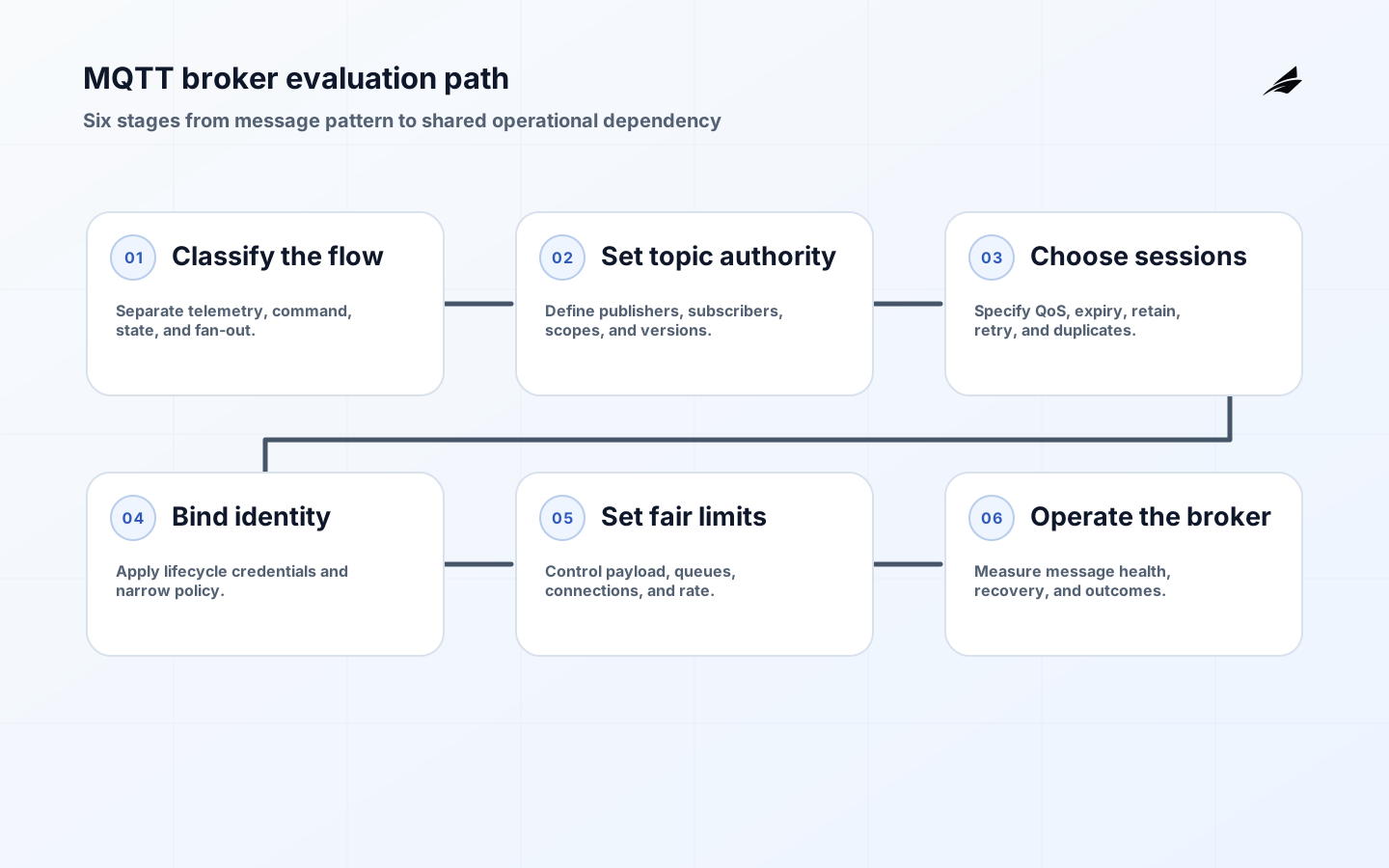
An MQTT broker is the meeting point between publishers and subscribers, but “choose a broker” is not a sufficient architecture decision. A growing team must decide who owns topics, how sessions behave, which delivery guarantees matter, how tenants are isolated, how credentials are issued, and what happens when connection count or queue depth grows. The MQTT Version 5.0 specification defines the protocol semantics; it does not choose your topic taxonomy, support model, retention policy, or incident boundary. Treat the broker as a product dependency with a contract, limits, and an owner. This field guide focuses on decisions that remain important after the first successful publish.
Start with the Interaction Pattern
Classify each flow as telemetry, command, state synchronization, request-response, or event fan-out. Telemetry often values decoupling and efficient delivery; commands need expiry, authorization, acknowledgement, and idempotency; state synchronization needs a clear source of truth. A single topic hierarchy can support several patterns only if the semantics are explicit. MQTT brokers architecture guide is useful background, while this design should name what the broker is allowed to do and what belongs in an application service. Avoid using retained messages as a substitute for a durable business database or using QoS as a substitute for an end-to-end outcome.
| Flow | Broker responsibility | Application responsibility |
|---|---|---|
| Telemetry | Route and deliver within policy. | Validate, deduplicate, interpret, and store. |
| Command | Enforce topic and identity policy. | Authorize action, expire intent, and confirm effect. |
| State | Retain or route current message when appropriate. | Separate desired from reported state. |
| Event fan-out | Distribute to subscribers with limits. | Handle replay, ordering, and downstream failure. |
Make Topic Authority Unambiguous
A topic hierarchy is an authorization surface and a discovery interface. Define who may publish each branch, who may subscribe, how tenant or site boundaries are represented, and which wildcard subscriptions are permitted. Prefer stable concepts over team names that will change. Include version or schema information where compatibility needs it, but avoid making every implementation detail part of the path. Document whether a topic is command, event, state, or observation. Test that a device cannot publish another device’s telemetry and that an operator cannot subscribe to unrelated tenants. Review topic changes like API changes, with an owner and a deprecation path.

Choose Session and Delivery Behavior
MQTT clients can connect, disconnect, resume sessions, publish at different quality-of-service levels, and use retained messages. Those features are valuable only when tied to a use case. Decide whether a reconnecting device should receive missed commands, whether old telemetry is useful, and how long queued messages may consume broker resources. At-least-once delivery means consumers must tolerate duplicates; exactly-once protocol behavior still does not make external side effects reversible. Write the client and broker settings into a contract and test clean disconnect, abrupt power loss, broker restart, and reconnect storm. Do not infer durability from a message appearing in a client log.
| Setting | Decision question | Operational risk |
|---|---|---|
| QoS | What is the cost of loss or duplication? | Retries can increase load and duplicates. |
| Session expiry | How long should state survive disconnect? | Stale subscriptions or unbounded queues. |
| Retain | Should a new subscriber see a last value? | Old state can look current without timestamp. |
| Maximum packet or queue | What happens under burst? | Memory pressure and unfair resource use. |
Connect Identity to Broker Policy
The broker should know which device or service is connecting and apply narrow permissions. AWS IoT documentation describes certificate-based device authentication, policies attached to certificates, and provisioning options; its device provisioning guide is a useful reference for lifecycle thinking. Avoid embedding a shared credential in every device when compromise of one device would expose the fleet. Define credential rotation, revocation, clock skew, and emergency access. A broker dashboard that shows connection count without identity, policy result, and client ownership gives the operations team little help during an incident.
Use State Topics Carefully
State is frequently the reason teams choose MQTT, yet state can be misunderstood. A retained message may communicate a last-known value, not a guarantee that the device is currently in that condition. AWS’s Device Shadow service separates desired and reported state and describes request and response topics for shadow actions. Use that distinction in your own topic design. Include version, timestamp, source, and quality in state payloads. Make command acknowledgement explicit, and ensure a disconnected device cannot be treated as compliant merely because a retained message remains on the broker.
Plan for Limits and Fairness
Capacity is more than concurrent connections. Model publish rate, subscription count, wildcard breadth, retained message count, inflight messages, queue size, payload size, reconnect rate, and downstream processing. Set per-device, tenant, and service limits so one noisy client cannot starve the fleet. Load-test realistic reconnect storms and subscription churn, not only a steady publish benchmark. Define what the broker does when limits are reached: reject, throttle, disconnect, or shed low-priority traffic. Record the reason so a support engineer can distinguish a policy limit from a broker failure.
Measure the Broker as a Shared Dependency
Track connection success and failure, authentication denials, authorization denials, publish and delivery latency, queue depth, inflight messages, dropped or expired messages, retained-message changes, and per-tenant resource use. Correlate broker signals with application outcomes such as stale telemetry or missing command acknowledgements. The broker is healthy only when the product path is healthy enough for its decision. IoT telemetry in production provides context for freshness and provenance. Keep runbooks for connection storms, credential rotation, policy mistakes, and downstream backpressure.
Harden the Trust Boundary
Use encrypted transport, verify server identity, protect private keys, limit administrative access, and review policy changes. AWS’s security best practices for IoT Core highlights the importance of the secure connection and certificate lifecycle; translate that guidance into tests your team owns. Keep tenant boundaries enforced in broker policy and application validation. Do not let a wildcard subscription reveal another customer’s data merely because it is convenient for troubleshooting. Audit who changed a policy, why, and when it expires. Emergency access should be narrow and reviewable.
Roll Out by Flow and Failure Mode
Start with one device family and one flow. Prove normal publish, reconnect, duplicate handling, stale state, credential rotation, and operator diagnosis. Then add a second tenant or site and deliberately create contention. Keep topic and policy changes versioned, and make a rollback possible without deleting historical evidence. A production review should ask whether the team can identify a client, trace its message, revoke its access, and restore a safe state. Scale connection count only after the service can explain limits and recovery. The related MQTT brokers in production can support that review.
When comparing brokers, ask for evidence in the shape your team will operate: connection and authorization metrics, policy testing, client compatibility, queue behavior, retained-state controls, backup or recovery design, and an escalation path. A feature matrix is useful only when each claimed feature maps to a test. Include the cost of operating the control plane, not only the cost of message transfer.
Keep the broker boundary narrow. It should route, retain, and enforce protocol-level policy where appropriate; domain services should validate business meaning, perform durable transactions, and own reconciliation. This separation reduces the temptation to encode every business rule in topic policy. It also makes migration easier because the application contract remains clearer than a collection of broker-specific settings.
A growing team should review broker assumptions when it adds commands, new tenants, or an offline gateway. Those changes can turn a low-risk telemetry system into a stateful control plane. Recheck session expiry, retained messages, authorization, observability, and recovery rather than assuming the original design still applies.
Before selecting a broker, write the smallest operating envelope that would make the service acceptable: connection scale, message rate, payload size, tenant count, queue age, recovery time, and policy-change frequency. Validate that envelope with a representative test and a named owner. This turns a comparison into a decision the team can defend and maintain.
A broker decision should include a migration assumption. Record how clients discover endpoints, how topic changes are introduced, how sessions are drained, and how retained state is cleaned up. This makes a future broker or topology change a bounded project instead of a fleet-wide surprise.
Prefer a broker test that models the customer’s busiest realistic hour over a synthetic maximum that omits reconnects, authorization, and downstream delay.
Keep a migration assumption in the broker record: how clients discover endpoints, how sessions drain, and how retained state is retired.
That record should also name the continuity path when the preferred broker is unavailable.
Practical Takeaways
- Choose a broker from interaction patterns and consequences, not from connection count alone.
- Treat topic hierarchy as both API design and authorization policy.
- Make QoS, session expiry, retain, queue, and limit behavior explicit.
- Use unique identity and scoped permissions, with a tested rotation and revocation path.
- Separate last-known, desired, reported, and confirmed state.
- Measure shared-resource fairness and connect broker signals to customer outcomes.
FAQ: MQTT Brokers
Which MQTT QoS should a growing team use?
Choose per flow. At-most-once may suit frequent replaceable telemetry; at-least-once may suit readings or commands when consumers are idempotent; exactly-once can add cost and still requires application-level handling. The right choice follows the consequence of loss, delay, duplication, and replay.
Are retained messages a database?
No. Retained messages are useful for last-known state or configuration when the contract makes freshness and authority clear. They do not replace durable history, business transactions, reconciliation, or an audit trail.
Conclusion
A well-chosen MQTT broker gives a growing team useful decoupling without hiding responsibility. Define the flows, topics, sessions, identity, limits, state semantics, and operating signals before production. Then the broker can remain a dependable shared boundary as device count, tenants, and downstream consumers grow.