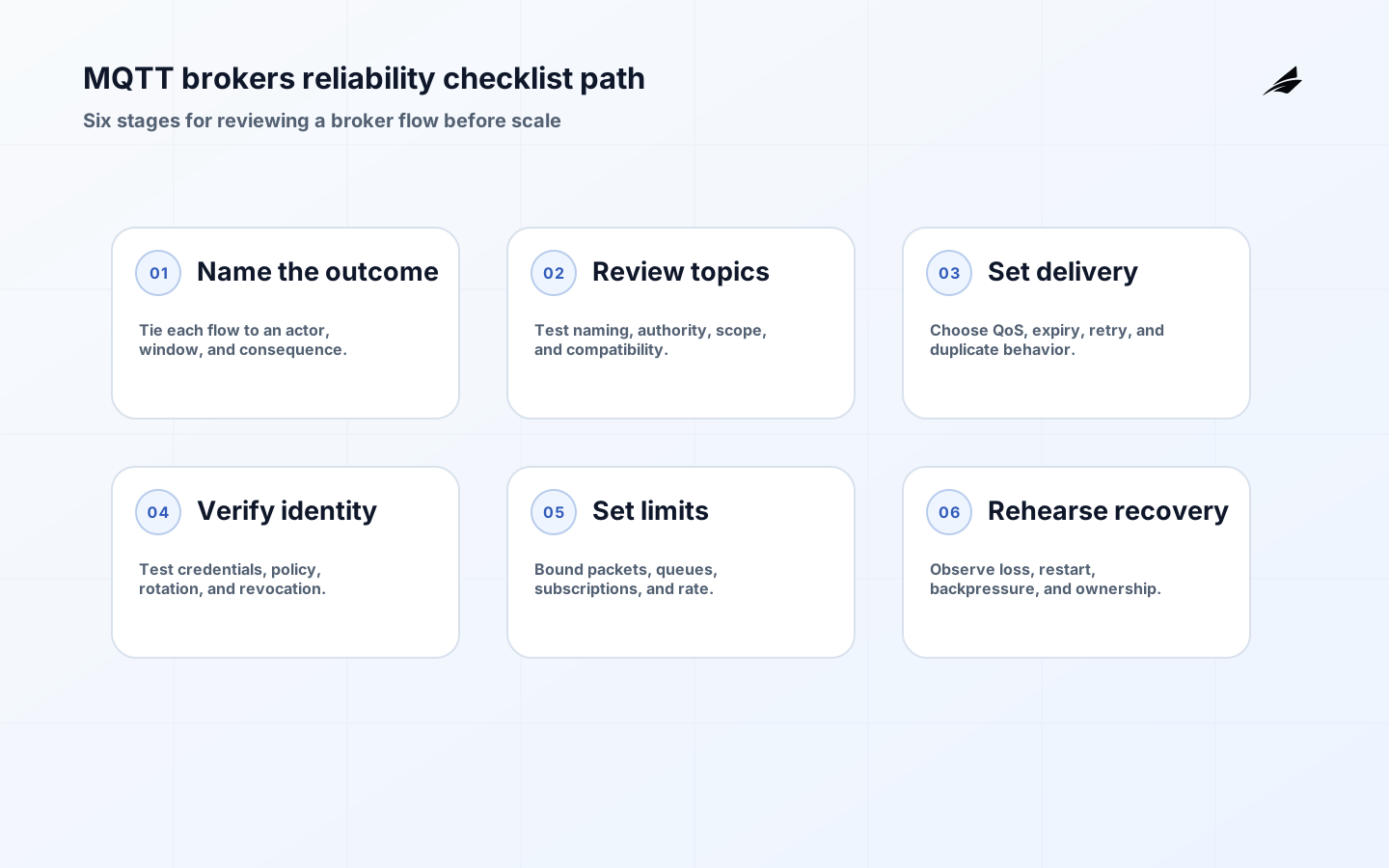
A reliable MQTT broker is less about a product name than a set of visible operating decisions. The broker may connect devices and consumers, but reliability depends on message semantics, topic authority, identity, session limits, state handling, backpressure, and recovery. Use the MQTT Version 5.0 standard to verify protocol behavior, then use this checklist to make local contracts testable. The target is not “messages are flowing.” The target is that an operator can explain what a message means, whether it was delivered, what a duplicate does, and which person owns the next safe action.
1. Name the Operational Outcome
For each MQTT flow, write the outcome in operational language. A temperature topic may support a freshness decision, a command topic may support a controlled actuator action, and a state topic may support a user interface that works while a device is disconnected. Do not make every flow look like a generic event. Link to MQTT brokers architecture guide and list the actor, time window, consequence, and expected response. If no one can say what happens when a message is late or duplicated, the flow is not ready for a reliability review.
2. Review Topic Authority
Treat topics as public contracts inside the system. Document who publishes, who subscribes, what wildcards mean, how tenant and site boundaries are encoded, and which topics are commands versus observations. Keep the hierarchy stable enough for clients to evolve, but include version or schema information where incompatible changes are possible. Test unauthorized publish, unauthorized subscribe, cross-tenant wildcard access, and a service that accidentally listens to commands. A topic review should include sample payloads, expiry behavior, quality metadata, and the owner responsible for deprecation. Convenience subscriptions are a common path around carefully designed authorization.
| Checklist area | Pass condition | Evidence |
|---|---|---|
| Naming | Topic describes stable domain and action. | Published hierarchy and examples. |
| Authority | Every publish and subscribe path has an owner. | Policy tests and approval record. |
| Compatibility | Schema or version changes are visible. | Contract and consumer inventory. |
| Scope | Wildcards cannot cross tenant or site boundary. | Negative authorization tests. |
3. Choose Delivery Semantics
Select QoS, session expiry, retry, and duplicate handling from consequence. At-most-once can fit replaceable telemetry; at-least-once needs idempotent consumers; exactly-once can be useful in narrow cases but adds cost and does not make an external side effect transactional. Define whether a message may be replayed after reconnect, how long it remains useful, and which fields identify a duplicate. Verify clean disconnect and power loss separately. A client library default is not a reliability contract. Record the chosen behavior in the flow specification and test it with real network interruption.
4. Separate Reported and Desired State
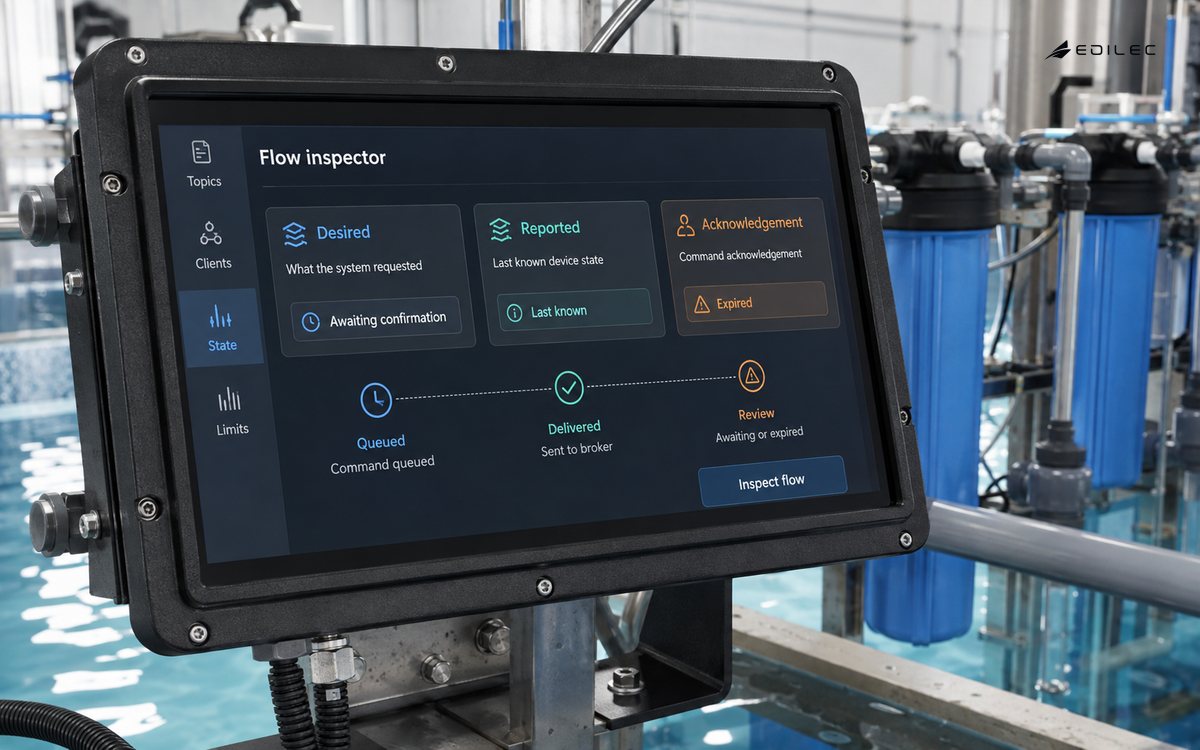
A last-known message is not proof of current device state. For any control flow, distinguish desired state, reported state, acknowledgement, and expiry. AWS’s Device Shadow service uses this separation and documents reserved request, accepted, and rejected topics. Your implementation may differ, but the reasoning should remain. Include version and event time so a stale retained message cannot silently overwrite a newer state. Decide what the UI shows while a device is offline and what command a reconnecting device may receive.
5. Verify Device Identity and Access
Every client needs a lifecycle: enrollment, authentication, authorization, rotation, suspension, replacement, and retirement. AWS’s device provisioning documentation describes unique certificates, policies, and fleet provisioning options. Use those ideas to review whether your broker can bind a credential to a device record and enforce the smallest needed permissions. Test expired credentials, a copied credential, a wrong site assignment, and a revoked client that reconnects. Keep administrative access separate from device access and audit policy changes with an owner and reason.
| Test | Expected result | Why it matters |
|---|---|---|
| Expired credential | Connection is rejected with a useful reason. | Prevents surprise outages and weak workarounds. |
| Wrong topic | Publish or subscribe is denied. | Protects device and tenant boundaries. |
| Revoked credential | Client stays blocked after reconnect. | Makes incident response effective. |
| Flooding client | Rate or resource limit applies. | Protects the shared broker. |
6. Set Limits and Backpressure
Document maximum payload, inflight messages, subscriptions, retained messages, queue depth, connection rate, and per-client or tenant throughput. Define what happens when a limit is reached and how the operator sees the event. Backpressure should preserve critical flows where possible without creating an unbounded memory problem. Load-test reconnect storms, slow subscribers, retained-message churn, and downstream storage throttling. If the product has priority classes, encode them deliberately; do not let the fastest publisher decide who receives resources. A reliable broker makes loss and throttling visible rather than allowing the system to fail mysteriously.
7. Measure Message Health
Track connection success, authentication failures, authorization denials, publish rate, delivery latency, duplicates, expired messages, dropped messages, queue age, retained-message changes, and command acknowledgements. Relate broker metrics to user outcomes such as stale dashboards or missed field actions. IoT telemetry in production explains why expected-versus-received and freshness matter more than an ingestion counter alone. Keep a diagnostic path from a message identifier to the client, topic, policy decision, and downstream result without logging secrets.
8. Protect the Connection and Control Plane
Use encrypted transport, verify endpoint identity, protect private keys, restrict broker administration, and review high-impact policy changes. AWS IoT security best practices provides an official reference for secure connection and certificate considerations. Translate it into local controls: certificate age report, key storage check, audit trail, emergency revoke, and recovery test. Ensure troubleshooting access cannot become unrestricted wildcard access. The security checklist should include data sensitivity and retention because a broker can expose patterns even when payload content seems harmless.
9. Rehearse Recovery
Rehearse broker restart, node loss, storage exhaustion, certificate authority issue, policy rollback, network partition, and downstream outage. Capture which messages are lost, queued, duplicated, or replayed, and whether the operator can tell the difference. Define the safe state for commands and the stale state for telemetry. A recovery exercise is incomplete if only infrastructure engineers participate; product and operations owners must confirm that the resulting evidence supports their decisions. Add the related offline sync checklist when devices or gateways retain work during disconnection.
10. Assign and Review Ownership
Name the owner for topic contracts, broker capacity, identity policy, client compatibility, runbooks, cost, and incident response. Review the checklist after a new device family, tenant, command flow, or broker version is introduced. Track open exceptions with an expiry date. The owner should be able to answer what changed, what evidence proves it worked, and how to reverse it. Reliability is maintained through small, repeatable reviews rather than a single launch document that no longer matches production.
Use the checklist as a release gate for each meaningful flow, not as a one-time broker audit. A new actuator command deserves a different review from another read-only telemetry topic. Record the assumptions, the tests that passed, the limits that remain, and the owner for exceptions. This makes the checklist useful during design, launch, incident review, and vendor or platform change.
Keep one end-to-end traceable test for every priority flow. Publish a representative message, verify policy, follow it through the consumer, force a duplicate or delayed delivery, and confirm the expected user-facing result. For commands, verify expiry and acknowledgement. For telemetry, verify freshness and quality. These tests are more valuable than a generic connection smoke test because they exercise the product meaning.
When a broker is shared by multiple teams, publish a resource budget and a change process. Teams should know how their connection, subscription, retained-state, and queue behavior affects others. Fair limits reduce surprise and create a basis for capacity planning before the broker becomes a hidden dependency for every operational workflow.
Keep each checklist result tied to a flow and a date. “Broker secure” is too broad to review; “the freezer command flow rejects expired credentials, expires delayed intent, and exposes acknowledgement age” is testable. Store the evidence with the flow owner, then repeat the check when the client, policy, tenant boundary, or broker version changes.
Record the evidence for a passed checklist item in a form another engineer can repeat. A screenshot of a green dashboard is weaker than a test case showing an expired credential, denied topic, bounded queue, and visible acknowledgement result. Repeatable evidence keeps the checklist meaningful after ownership changes.
A checklist item is not complete until the failure case is as clear as the success case.
For shared brokers, publish a resource budget so each team understands how connections, queues, subscriptions, and retained messages affect neighbors.
Practical Takeaways
- Start each flow with an outcome, actor, time window, and consequence.
- Treat topic hierarchy as a versioned API and authorization boundary.
- Choose delivery semantics and state handling explicitly, including duplicates and expiry.
- Bind unique identity to narrow permissions and a tested lifecycle.
- Set limits, measure queue and message health, and make loss visible.
- Rehearse recovery with product, operations, and engineering owners together.
FAQ: MQTT Broker Reliability
When is a retained message appropriate?
Use it when a new subscriber needs a last-known value and the contract includes timestamp, authority, freshness, and replacement behavior. Do not use retention as a substitute for a history store or a current-state guarantee.
What should we test before adding more devices?
Test steady load, reconnect bursts, slow subscribers, policy decisions, retained state, storage backpressure, and a broker or network interruption. Include at least one command flow and one telemetry flow so the test covers different consequences.
Conclusion
The MQTT brokers checklist is complete when every important flow has a clear meaning, authority, limit, signal, owner, and recovery path. Use the standard for protocol facts and local tests for operational truth. That combination keeps digital operations dependable as the fleet and the number of consumers grow.