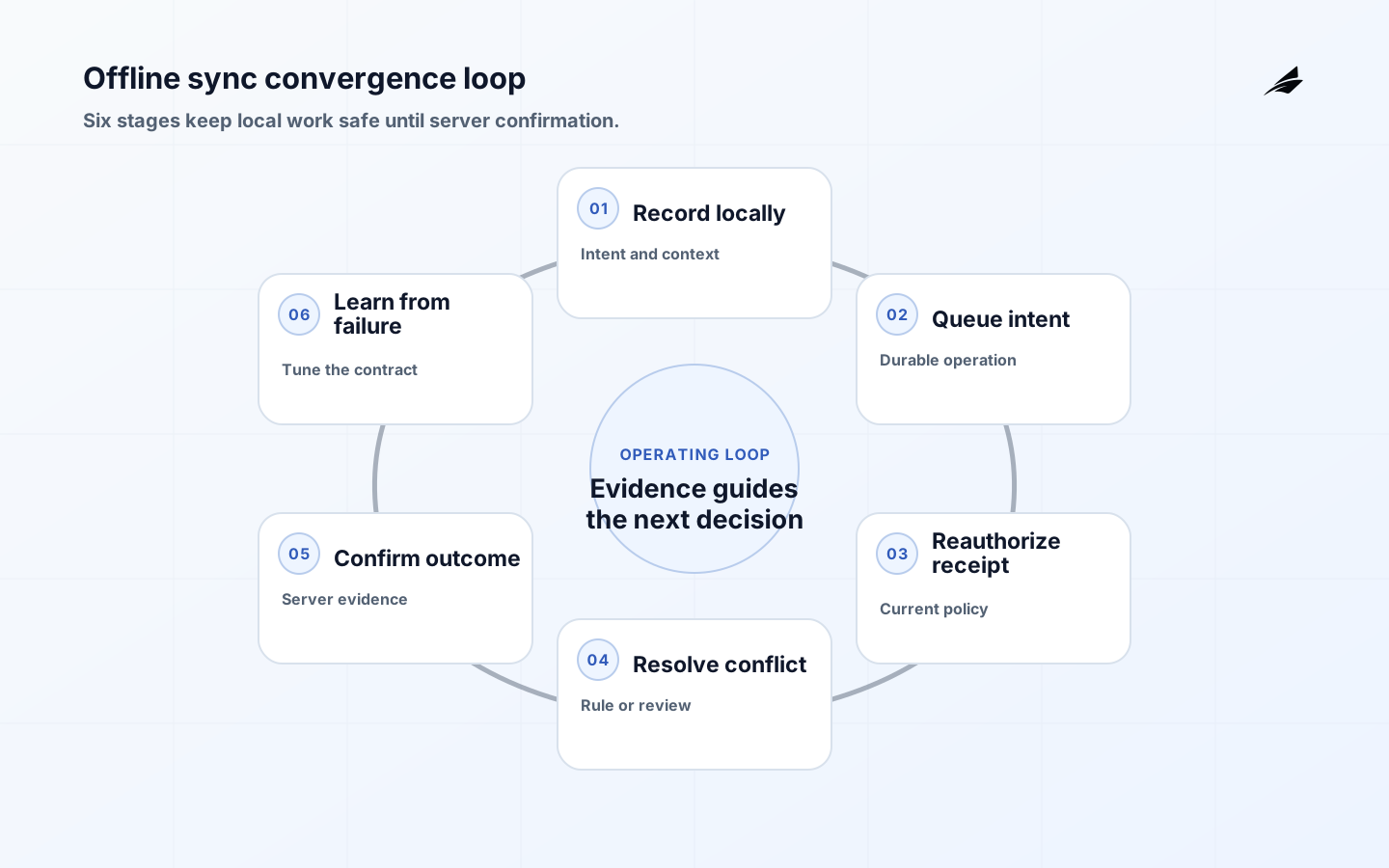
Offline sync changes the product contract because the client can accept work while the server is unavailable, and more than one place can change related state before those changes meet. A prototype can treat synchronization as a retry button. Production must define local authority, server authority, conflict policy, identity, ordering, privacy, storage limits, and support evidence. Android’s offline-first guidance emphasises a local data source and queued writes; HTTP conditional requests helps clarify validators and cache behaviour. Neither removes the business decision: what may happen offline, what must wait, and how a user learns that a result is not yet confirmed.
Change the state model before launch
A production record needs more than pending or complete. Separate local draft, queued, sent, acknowledged, rejected, conflicted, superseded, and confirmed states. Keep operation ID, actor, device, client version, local time, server time, target, precondition, and error category. The interface should expose the state that changes the next safe action. A technician can continue with an acknowledged note but should not treat an unconfirmed command as complete. State transitions need idempotent rules so reconnecting or retrying does not produce duplicate effects. Make the state machine an explicit product artefact, then test it with interrupted connectivity.
| State | Meaning | Allowed next step |
|---|---|---|
| Local draft | Not yet submitted | Edit or queue |
| Queued | Persisted for later send | Retry within policy |
| Acknowledged | Server accepted request | Wait for business result |
| Conflicted | Server and local intent differ | Review and choose |
| Confirmed | Outcome verified | Use as current state |
Define authority and conflict policy
Conflicts are not only timestamp problems. A profile edit, assignment, inventory count, or device command may have different business rules. Decide whether the server wins, the latest valid version wins, a field-level merge is safe, or a person must review. Preserve both intent and resulting state so a user can understand what changed. Use version or precondition checks when overwriting could lose work. If the product permits an automatic merge, state which fields are mergeable and how the result is audited. Link this reasoning to offline sync decisions before the first build rather than discovering policy through customer complaints.
Make local storage a real dependency
Browser and mobile storage are useful but not infinite or equally durable. The Indexed Database specification can persist structured data in a browser, yet the product still needs a quota strategy, eviction response, encryption decision, migration plan, and a way to recover when local data is cleared. Avoid caching more sensitive data than the task requires. Define retention for attachments and logs, handle clock drift, and make a full local queue visible to support without exposing secrets. A local-first design is not an excuse to skip server validation; it is a commitment to make the boundary explicit.
Respect platform scheduling and network limits
A sync loop cannot assume it will run continuously in the background. Mobile operating systems schedule background work, browsers may suspend tabs, and connectivity can flap between Wi-Fi and cellular. Background Sync and Apple’s BackgroundTasks documentation illustrate why work must be bounded and resumable. Use exponential backoff with a ceiling, classify permanent versus transient errors, batch where safe, and stop when authorization or preconditions are stale. Do not wake the device repeatedly for work that cannot succeed. The service should report queue age and last attempt so a user can choose an alternative path.
Production also changes support. A user may say the record is missing when it is present locally, rejected by policy, or waiting behind a large attachment. Search by operation ID, record ID, actor, device, client version, and server response. Give support a redacted timeline, not an instruction to ask the user to clear local storage. Compare offline sync planning, field service portals for connected systems, and device provisioning for connected systems to keep technical state tied to a real user workflow.
Secure every replay and correction
An offline queue contains actions that may be replayed after the user’s role, target state, or policy has changed. Re-authorize at the server when the operation arrives. Use an idempotency key for effects that must happen once, and make the response to a duplicate safe and explainable. Protect local data, tokens, and attachments; do not assume device possession proves current entitlement. Record what was submitted, under which policy, and what was accepted. A correction should create an auditable new event or explicit revision rather than silently rewriting history. This is where reliability and security are the same product promise: no hidden second outcome.
| Production risk | Control | Evidence |
|---|---|---|
| Duplicate effect | Idempotency key and server deduplication | One business outcome per operation |
| Stale authorization | Re-check role and target at receipt | Policy decision and rejection reason |
| Lost local work | Durable queue and migration test | Recovery count and queue age |
| Silent conflict | Explicit conflict state and review | Both versions and resolution actor |
Test the hard cases
Test airplane mode during a write, process termination during upload, device clock changes, duplicate delivery, server schema migration, revoked access, storage exhaustion, attachment corruption, and a conflict after another user edits the same record. Verify what the user sees and what support can prove. Run recovery drills with realistic queue sizes; a sync loop that works for ten records may overwhelm a device with ten thousand. Measure time to convergence, conflict frequency, rejected operation rate, oldest queue item, and manual intervention. A production-ready offline feature has a bounded failure story, not only a fast happy path.
A useful review records both the final server state and the local intent that led to it. That evidence is what lets the team improve a conflict rule instead of merely closing a support ticket.
The review should include a visible queue age and a clear escalation rule. An operation that has waited beyond the business deadline is no longer a background detail; it is an owned exception that needs a safe decision.
Keep the final state and the unresolved reason together so a later reviewer does not mistake age for completion.
Convergence review before release
Create a local write, interrupt the process, reconnect twice, deliver a duplicate, change the server version, and revoke access before the queued operation arrives. Inspect the final business state, preserved intent, and support evidence. A retry that succeeds technically but produces an ambiguous business result is not production-ready.
Production checks for convergence
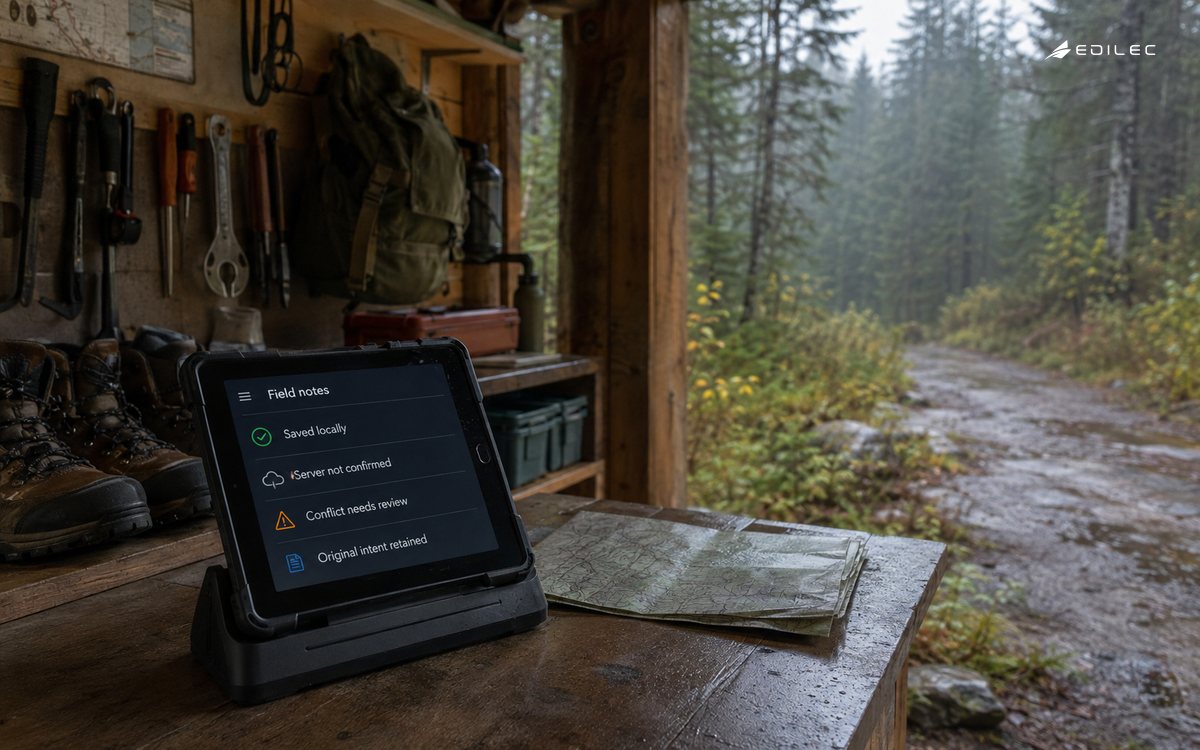
A production readiness review should demonstrate convergence rather than merely successful retries. Create a local write, interrupt the process, reconnect twice, deliver a duplicate, change the server version, and revoke the user before the queued operation arrives. Inspect the final business state, the preserved intent, and the evidence visible to support. Repeat with a queue large enough to test storage, backoff, and platform scheduling. If the team cannot predict the final state, the conflict or idempotency contract is not finished.
Also review the experience of uncertainty. A user should know whether to wait, edit, cancel, contact support, or perform a safe local alternative. A support specialist should know whether retry is harmless and whether a server response is authoritative. Make queue age, conflict age, and last successful sync visible to the right role. The offline sync planning guide is a useful companion for checking that production behaviour still matches the decisions made before implementation.
- Test duplicate delivery after a response timeout.
- Test a policy change while operations are queued.
- Test a schema migration with old client operations.
- Test storage exhaustion and a safe recovery path.
Keep the sync review cadence healthy
Keep the sync review visible and proportional as more clients and platforms arrive. Review queued operations quickly, inspect conflict patterns on a predictable cadence, and reserve deep repair work for failures that change customer outcomes. Rotate the engineer or support owner who presents evidence so the queue never depends on one specialist. Periodically sample reconciled operations to verify that server state reflects user intent. If a stage adds work without improving convergence, simplify it. Good operations make local work dependable without hiding uncertainty.
Use a small set of measures to guide convergence: oldest queue item, retry count, conflict rate, rejected operation age, local-storage failures, time to confirmed outcome, and recovery actions by client version. Inspect a device that reconnects cleanly and one that remains offline beyond the work window. The offline sync planning guide keeps these measures tied to authority, storage, and conflict choices. For field users, protect trust by making pending work and unresolved intent impossible to mistake for completion.
- Review the loop with the people who capture and act on feedback.
- Look for missing voices and repeated workarounds.
- Connect delivery claims to outcome evidence.
- Change the loop when the team’s decision needs change.
Key takeaways
- Model synchronization as explicit states with safe transitions.
- Define authority and conflict policy before users create competing edits.
- Treat local storage, scheduling, and queue size as production dependencies.
- Re-authorize and deduplicate every replayed operation.
- Measure convergence, queue age, conflicts, and recovery evidence.
Frequently asked questions
What is the safest conflict strategy?
There is no universal strategy. Use field-level merge only when the business meaning is safe; otherwise preserve both versions and require a named reviewer. The key is to avoid silent loss of intent.
Can offline apps cache all server data?
Usually not. Cache the smallest data set that supports the job, define retention and eviction behaviour, protect sensitive content, and show when the cache is old or incomplete.
How often should a sync worker retry?
Use bounded backoff and classify errors. Retry transient transport failures, stop on authorization or validation errors, and surface an owner when an operation is too old or repeatedly rejected.
Conclusion
When offline sync moves into production, local work, server work, conflict, authorization, storage, and support all become part of the product. Make states explicit, preserve intent, re-check authority, and rehearse recovery. Reliability comes from a clear convergence contract, not from a button labelled sync.