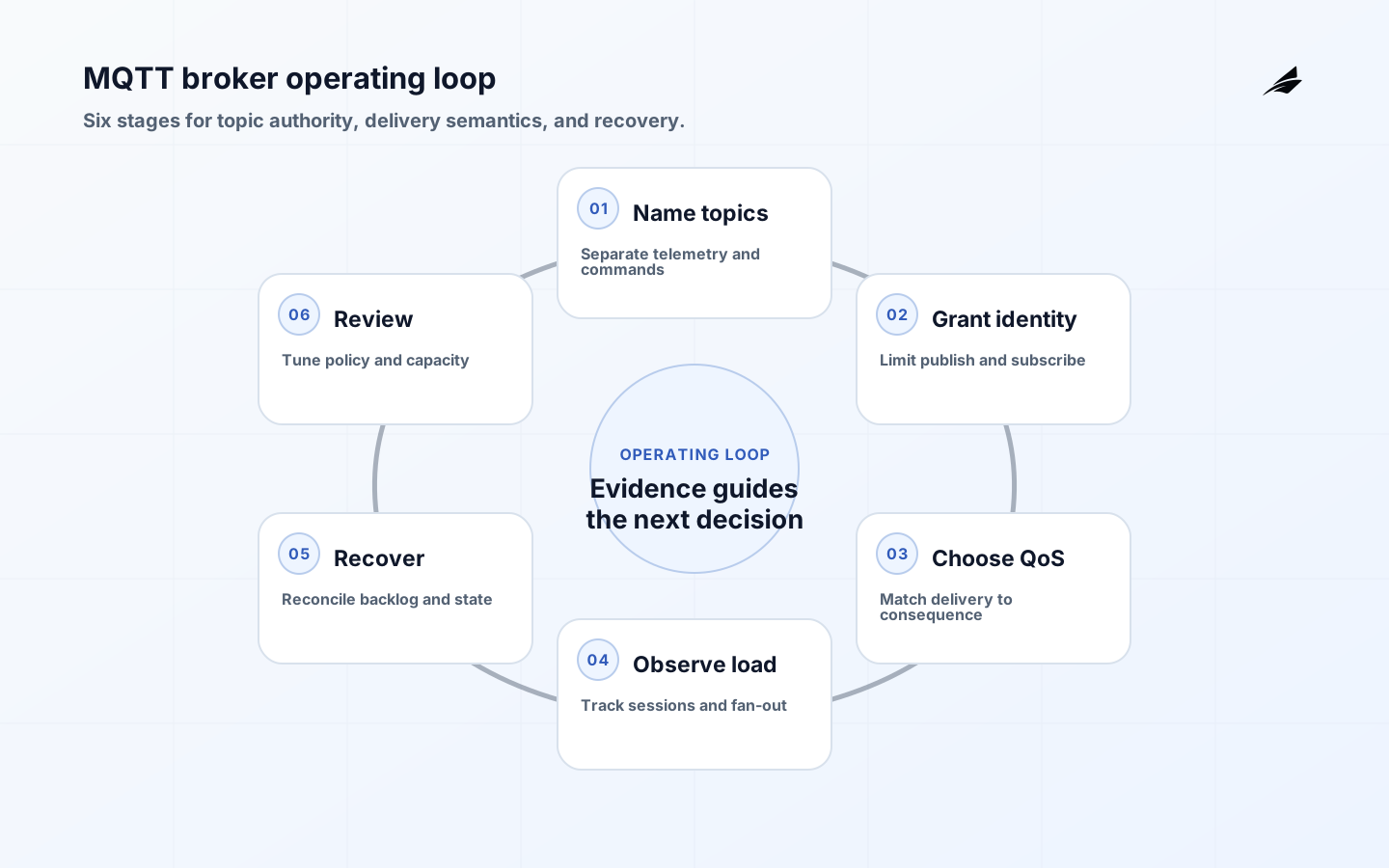
MQTT brokers are shared infrastructure for moving messages between connected clients. Their simplicity at the protocol level can conceal important operational choices: which identities connect, who owns a topic namespace, when a session persists, what quality of service is meaningful, and how commands are separated from observations. The MQTT Version 5.0 specification defines protocol behavior, but a broker does not make a product's authorization or safety decisions. Operations leaders need a model that turns protocol features into bounded, reviewable service behavior.
Separate telemetry, commands, and lifecycle events
Begin by naming the flows: device telemetry, configuration delivery, remote commands, installation events, and integration feeds should not be treated as one undifferentiated message river. For each flow, specify publisher, subscriber, tenant or site boundary, retention expectation, maximum message size, delivery importance, and action consequence. A broker may relay data efficiently, but downstream systems still need an authoritative model for current asset state. That distinction prevents retained messages or last-will signals from being mistaken for a complete operational truth.
| Message class | Broker policy | Business rule outside the broker |
|---|---|---|
| Telemetry | Scoped publish rights and bounded session behavior. | Validate schema, freshness, and measurement quality. |
| Configuration | Named target identity and versioned payload. | Confirm compatibility and record applied state. |
| Command | Separate topic and explicit acknowledgement path. | Authorize consequence and enforce idempotency. |
| Presence | Will or status convention with expiry semantics. | Decide how absence changes operational status. |
Use topic namespaces to enforce scope
A topic hierarchy should make scope clear enough to authorize: tenant, site, asset class, device, and message family are common components. Do not expose arbitrary wildcard subscriptions simply because they are convenient for debugging. Give clients the narrowest publish and subscribe rights that support their job, and keep management, command, and telemetry routes distinct. Where a gateway proxies many field devices, avoid collapsing their identities into one powerful credential if individual accountability is needed later.
Authentication answers which client connected; authorization answers which topic operations that client may perform. Both need rotation, revocation, and audit behavior. NIST's IoT cybersecurity guidance is a useful source for viewing device capabilities and support processes together. A certificate without an inventory, ownership record, and replacement process is not a complete operating control.
Match QoS and sessions to real consequences
Quality of Service and session expiry are trade-offs, not guarantees that a business action happened exactly once. At-least-once delivery can create duplicates; persistent sessions can deliver old work after a device returns; retained messages can be useful for desired state while hazardous for imperative commands. Make consumers idempotent where possible, include message IDs and expiry, and record command decisions separately from transport acknowledgements. The broker can confirm protocol-level receipt; it cannot prove a valve moved or a technician saw a notification.
Exercise reconnects, denials, and backlog
Test broker restart, certificate revocation, a client reconnecting with an old session, authorization denial, oversized payload, a slow subscriber, and a bridge failure. Confirm what the client sees and whether the operational system creates a clear exception rather than silently dropping meaning. For critical flows, run a controlled test across the broker, gateway, device, and work system. This is where a protocol configuration becomes evidence that the service behaves correctly under real disconnection and retry conditions.
| Test | Expected broker result | Operational verification |
|---|---|---|
| Revoked device | Connection or publish is denied. | Inventory and support workflow identify the unit and recovery route. |
| Duplicate command publish | Transport accepts according to policy. | Consumer creates one safe business action or explicit duplicate record. |
| Slow subscriber | Backpressure or disconnect follows documented limit. | Monitoring identifies affected flow before data age becomes harmful. |
| Expired session returns | Session policy is applied predictably. | Old messages are handled or discarded according to documented intent. |
Turn broker metrics into service signals
Monitor connection churn, authentication and authorization failures, session count, retained-message growth, subscriber lag, delivery retries, bridge status, and topic-level traffic anomalies. Correlate broker events with device and gateway identity; OpenTelemetry's data model offers a useful pattern for resource and trace context. Pair this with gateway security practice and the MQTT production guide so broker metrics answer real service questions.
- Separate telemetry, desired state, commands, and broker administration in the namespace and policy.
- Authorize by client identity and narrow topic operations, not by network location alone.
- Set message and session expiry where old information could be misleading.
- Design consumers for duplicates and distinguish acknowledgement from real-world completion.
- Review wildcard access and retained data as the fleet and teams change.
Set broker capacity against fleet behavior
An MQTT broker is a shared coordination point, so capacity is more than messages per second. Define the expected number of connected clients, connection churn, retained messages, subscription fan-out, payload size, QoS mix, session duration, and the recovery behavior that matters to operators. The MQTT Version 5.0 specification gives the protocol semantics; it does not choose your tenant boundary, certificate lifecycle, or operational budget. NIST SP 800-213 is a useful reminder to express device and system security requirements before acquisition. Write the contract so the broker team can reject an attractive integration that would make delivery or ownership ambiguous.
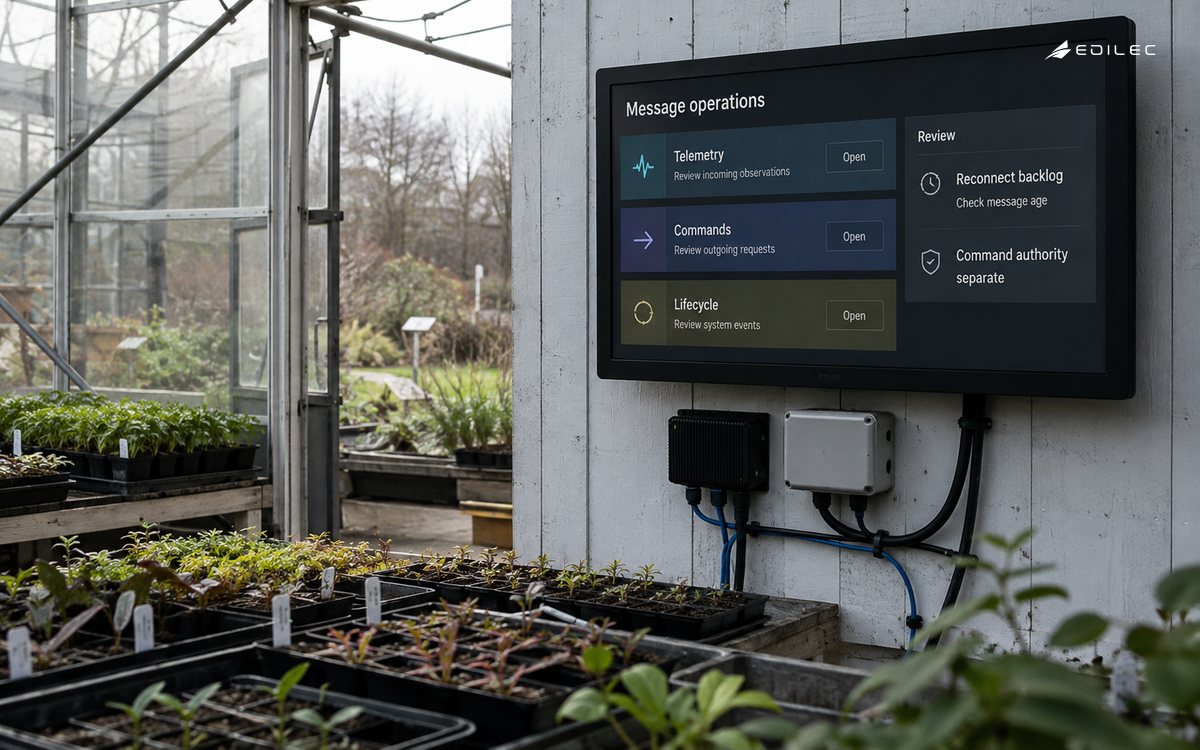
Example: fan-out without command authority
Suppose 4,000 pumps publish status while a maintenance service subscribes to a narrow site topic and an analytics service receives a delayed copy. The analytics consumer should not inherit the ability to publish commands merely because it can read status. Separate publish and subscribe grants, keep command topics distinct from telemetry topics, and require a named service identity for each bridge. If a subscriber falls behind, decide whether the broker drops old telemetry, retains the latest value, or applies backpressure. That choice belongs in the operating contract, not in a hidden client default.
| Capacity dimension | Question | Guardrail |
|---|---|---|
| Connections | How many clients and reconnects are normal at peak? | Load test steady state and burst churn separately. |
| Delivery | Which messages may be lost, duplicated, or delayed? | Choose QoS and retry behavior by business consequence. |
| Fan-out | How many consumers receive each topic? | Budget retained data, queues, and downstream latency. |
| Authority | Who may publish commands or create subscriptions? | Use least-privilege identities and review grants. |
For adjacent decisions, read What Changes When MQTT Brokers Move Into Production on production broker changes, How Product Teams Should Think About Gateway Security on gateway security, and Device Identity for Connected Systems: Credentials and Lifecycle on device identity. Together they help separate the broker’s transport responsibility from the credentials and device lifecycle that make its permissions meaningful.
For device-facing requirements, NIST IR 8259 Rev. 1 adds the manufacturer and customer perspective. If the broker forwards events into a stream processor, the Apache Kafka documentation is useful for keeping the downstream retention and delivery contract separate from MQTT session semantics.
MQTT broker takeaways
- MQTT brokers route messages; they do not replace a business-state model.
- Topic structures are security and tenancy boundaries, not merely naming conventions.
- Session, QoS, and retained-message settings have operational consequences.
- Command paths need their own authorization, expiry, and idempotency design.
- Failure tests should span broker behavior and the work it enables.
- Treat each new topic family as a small operating contract: name its producer and consumers, expected message age, sensitivity, recovery behavior, and the person who can approve a change. This modest discipline keeps a broker namespace understandable as teams, customers, and integrations multiply.
MQTT broker questions
Which QoS level should we choose?
Choose based on message importance, network reliability, client limits, and the consumer's duplicate-handling ability. The QoS setting is only one component of an end-to-end guarantee. A command requiring safe exactly-once business behavior needs an idempotent decision design even if the protocol uses a higher QoS.
Can one broker serve multiple customers?
Yes, when tenant identity and authorization are enforced in connection and topic policy, and monitoring, exports, and support tools preserve the same isolation. Test cross-tenant denial explicitly. A convenient shared hierarchy without strong policy is a common source of avoidable exposure.
Broker failure scenarios to rehearse
Imagine a gateway reconnecting after an outage with a persistent session and a backlog of old notifications. The broker may deliver according to the configured session rules, but the receiving service must decide which messages still deserve action. Include timestamps and expiry in the application contract, and test whether a customer receives obsolete notices or a technician is assigned work that was already resolved. Session recovery is a product behavior, not a broker-only tuning parameter.
Imagine a temporary troubleshooting subscription that uses a broad wildcard. The access should be time-bounded, attached to a support case, and limited to the relevant tenant or site. Log the subscription as an administrative event and review whether it is still needed. Wildcards make diagnostics convenient, but they can also turn one urgent incident into long-lived access to unrelated customer data if treated as an informal privilege.
Imagine a bridge from the broker to an analytics platform slowing down while device sessions remain healthy. Monitor the bridge separately, maintain a bounded recovery plan, and avoid allowing its backlog to consume resources needed for command or safety-related flows. Classifying message families helps the broker service protect what matters most during a partial failure. It also gives operations a meaningful explanation rather than a single opaque 'broker healthy' indicator.
Finally, rehearse a topic policy mistake that permits one tenant to subscribe to another tenant's device status. A test suite should attempt this denial with realistic client identities, and logs should make the failed request discoverable without exposing payloads. Correcting the rule is necessary; reviewing who used the route and what data was delivered is equally important. That is how authorization becomes an operating capability.
Conclusion: operate the broker as shared infrastructure
A dependable MQTT broker service makes connected communication controllable rather than merely fast. Define each message class, attach authority to every topic operation, and test the sessions and retries that will occur in production. That turns a broker from hidden plumbing into a reliable part of connected operations. Keep the broker's limits, tenancy rules, retention behavior, and incident contacts visible to the teams that depend on it. When device, platform, and support teams can all identify why a message was accepted, delayed, or refused, the service can grow without creating an invisible dependency that only specialists can repair. Broker ownership should include planned capacity, certificate rotation, policy review, and a customer-impact communication path. These basics make it possible to change the service without treating a protocol setting as an unexplained production gamble. Record this operating contract alongside the broker configuration, then revisit it after incidents, major releases, and fleet expansion. That gives teams a stable reference when the route between a message and a real-world consequence becomes complicated.