IoT telemetry matters to founders building connected products that must turn device signals into dependable decisions. In practical terms, it is measurements, events, and state reported by a connected device or gateway about physical conditions, device health, or service behaviour. That definition is more useful than a product label because it points to decisions a team can test: what the boundary is, what information is trusted, which failure conditions are acceptable, and who responds when the normal path breaks. The related concerns of time-series data, telemetry schema, device observability should be designed as part of the operating model, not appended after an initial launch.
What IoT telemetry means
IoT telemetry should be explained in the language of responsibilities and observable behaviour. Telemetry is not a synonym for every message a device sends. A temperature reading, battery percentage, firmware version, connectivity transition, and command acknowledgement have different semantics, accuracy limits, retention needs, and consumers. Treat them as named data products rather than a stream of anonymous bytes. A useful definition therefore includes the information that crosses the boundary, the actors allowed to change it, the evidence retained, and the conditions in which the system refuses to proceed. That gives practitioners a way to challenge vague requirements before they become fragile implementation assumptions.
Architecture decisions to make first
The architecture is not a diagram of components alone. It is the set of contracts that lets founders building connected products that must turn device signals into dependable decisions operate the capability repeatedly. Make the following decisions explicit before choosing a platform feature or writing an integration. Each one affects the likely failure mode, the test plan, and the people who will need evidence later.

| Decision | What to define |
|---|---|
| Decision use | State which human or automated decision each signal is intended to support. |
| Measurement semantics | Define unit, sampling method, accuracy, calibration, and whether a value is observed or derived. |
| Event identity | Include device, signal, time, sequence or message identity, and schema version. |
| Delivery behaviour | Specify latency, ordering, duplication, offline buffering, and acceptable loss for each class of signal. |
Implementation path
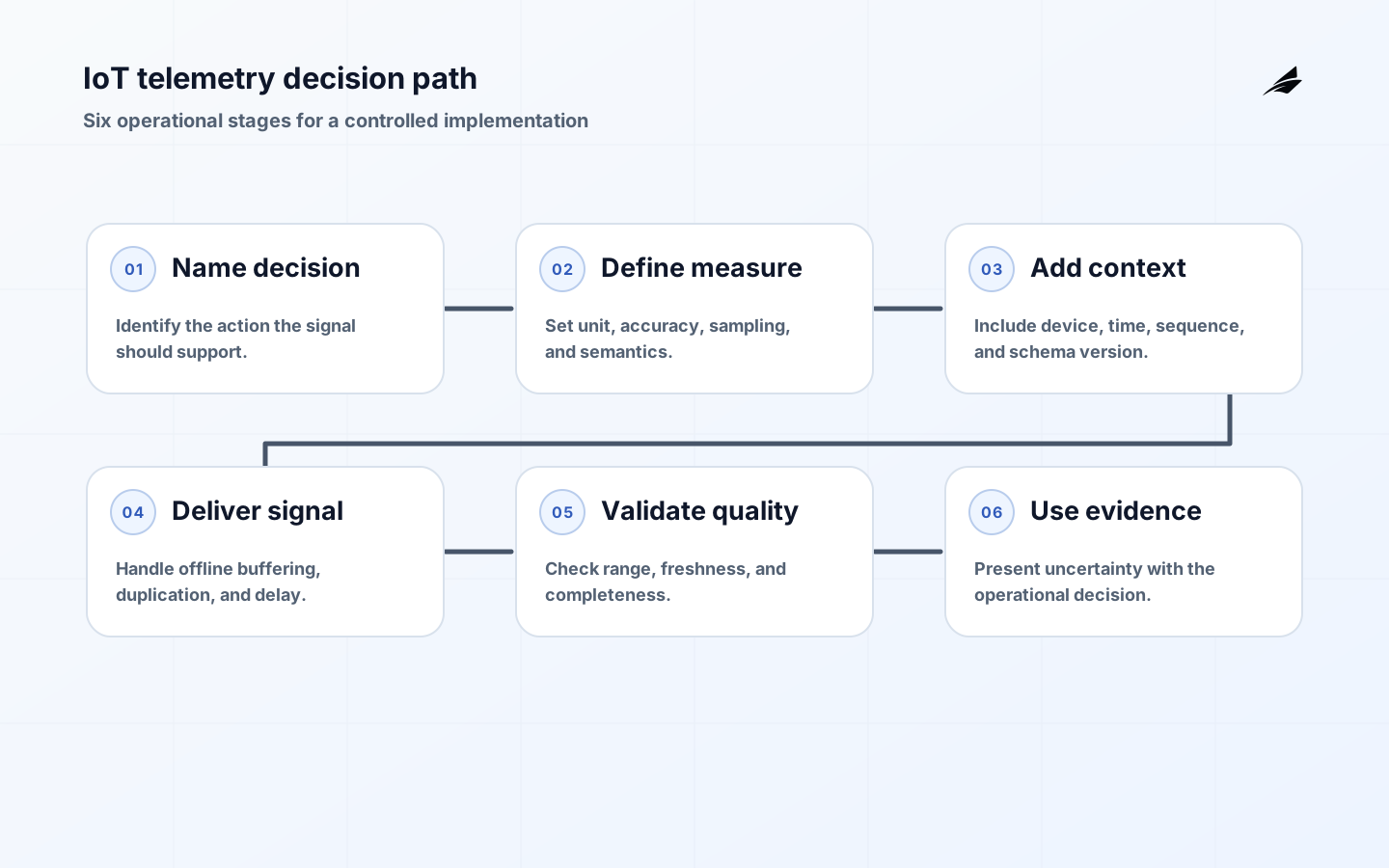
- Begin with the operating decision, not the device protocol or dashboard widget.
- Define a versioned telemetry schema with units and clear names.
- Capture both event time and ingestion time so delay can be detected.
- Attach device and deployment context without placing secrets or unnecessary personal data in messages.
- Validate range, rate of change, and sequence expectations at ingestion.
- Expose missing, delayed, duplicated, and rejected telemetry as operational signals.
Build a thin, inspectable path first. It should include the unpleasant cases as well as the demonstration case: a missing identifier, a delayed message, an expired credential, a rejected record, or an unavailable dependency. Give that path named inputs and outputs, a clear retry or escalation rule, and a way to prove what happened. This is where time-series data becomes operational rather than aspirational.
Risks and controls
A realistic telemetry system assumes imperfect clocks, intermittent networks, firmware changes, and duplicate delivery. Do not overwrite the fact that a message arrived late; retain enough timing and sequence context to distinguish a stale reading from a current one. Schema versions and units belong in the contract. A value of 18 is not useful unless the consumer knows whether it is Celsius, percent, volts, or a vendor-specific code.
| Operating signal | What it shows |
|---|---|
| Signal completeness | Expected observations received for active devices and defined intervals. |
| End-to-end latency | Difference between device event time and usable ingestion time. |
| Schema rejection rate | Messages rejected or quarantined by version, field, or producer. |
| Device observability coverage | Active devices reporting identity, software version, and health signals. |
Review and measurement
Measurement should tell the team whether IoT telemetry is still meeting its contract, not merely whether infrastructure is running. Review the signals in the table with the owner who can change the workflow. Look at trends, samples of failures, and the gap between detected and resolved issues. When a metric changes, follow the evidence back to the contract, implementation version, and real user or device behaviour before declaring a fix.
- Set a service objective for the consequence that matters, not only a technical average.
- Sample successful and failed cases to verify that telemetry schema is understandable.
- Make a named owner responsible for triaging exceptions and publishing the resolution.
- Review access, configuration, and retention choices whenever the process or fleet changes.
- Use controlled tests to rehearse recovery before an incident requires improvisation.
Operational scenario
A refrigeration device sends temperature readings every five minutes, a compressor state transition when its mode changes, and a battery or connectivity event when health degrades. These are not interchangeable points in a chart. The alerting rule may care about sustained temperature exposure, while a maintenance worker needs the last connectivity transition and firmware version. The sensor data pipelines guide shows why the device’s measurement contract must survive ingestion and transformation before any alert can be trusted.
Evidence and testing
For each important signal, keep an example payload, schema version, unit, expected cadence, time semantics, producer software version, validation result, and consumer owner. Make a device simulator emit normal, delayed, duplicate, malformed, and out-of-range messages before an integration reaches field hardware. Test the dashboard or automation against all five cases. The aim is not to make every unusual reading disappear; it is to ensure an operator can tell whether a value is current, comparable, and suitable for action.
Design review questions
During telemetry review, examine clocks, calibration, and configuration management as part of data quality. A perfect cloud pipeline cannot repair a sensor with the wrong unit or a gateway with a drifting clock. Ask where calibration metadata lives, how configuration changes are associated with observations, and how long raw readings and quality decisions remain accessible. The resulting design should separate “no reading received” from “reading received and invalid,” because their owners and remedies differ.
Practical operations
Treat every telemetry signal as a small product with a defined producer, consumer, quality expectation, and retirement plan. A device field that no dashboard or automation uses still incurs transmission, storage, privacy, and support cost. Conversely, an alert without a named measurement contract invites false confidence. Maintain a catalogue that links signal names to units, versions, device populations, and owners. When firmware changes a sampling rule or calibration process, publish that change as a data contract event so downstream thresholds and reports can be reviewed before comparisons become misleading.
Limits and tradeoffs
More telemetry is not always better telemetry. High-frequency sampling can improve diagnosis while consuming battery, bandwidth, and storage; aggregation can reduce cost while hiding short-lived conditions. Choose cadence from the phenomenon and decision, then test whether the selected signal actually changes an action. Preserve a bounded raw window when investigation needs it, publish derived values with their method, and avoid promising real-time visibility where network or device design cannot support it.
- Name the accountable owner before adding another integration or policy.
- Keep a representative failure test beside the normal acceptance test.
- Record the version of the contract, configuration, or rule in use.
- Use evidence from real operations to improve the next release.
- Make temporary exceptions visible, approved, and time-bounded.
- Review the boundary whenever the business process or fleet changes.
Adoption and change management
Device firmware rollouts, changing installation conditions, and new alerting rules are the moments when telemetry semantics need careful change control. Prepare for them with a small change record that names the proposed change, contract or policy version, expected operational effect, affected owners, test evidence, rollout window, and reversal decision. Give users and support teams a plain-language explanation of the behaviour that will change, especially where a new denial, warning, or data-quality status can be mistaken for a defect. Monitor the first production cases closely and compare them with the pre-change baseline. When an exception appears, decide whether it is a valid new requirement, a training issue, a data defect, or a control that must remain firm. This practice keeps IoT telemetry connected to the people who operate it. It also prevents a series of urgent local fixes from becoming an undocumented alternate system. Retire obsolete rules and integrations deliberately, preserve the evidence needed for a later review, and update runbooks so the next team member inherits a working explanation rather than a collection of historical assumptions.
Key takeaways
- IoT telemetry is a contract between technical components, people, and operations.
- Define boundaries and ownership before optimising a tool or interface.
- Treat telemetry schema as a first-class output, with evidence for failure and recovery.
- Make exceptional conditions testable and visible to an accountable owner.
- Revisit the contract as customers, devices, data, or regulations change.
Frequently asked questions
Is IoT telemetry only for monitoring device health?
No. Device health is one important category, but telemetry can represent environmental measurement, equipment state, location, energy use, or a business process event. The design question is always what a consumer can safely infer from a measurement and what uncertainty remains.
Why keep both event time and ingestion time?
A device can create a reading while offline and upload it later. Event time describes when the physical observation happened; ingestion time shows when the platform received it. Keeping both supports freshness checks, ordering analysis, and honest downstream decisions.
Conclusion
Useful IoT telemetry carries context, timing, and meaning with the measurement. Start from the decision a signal will support, design for intermittent delivery, and make data quality visible to the people and automations that depend on it. Review signal definitions whenever device firmware, installation practice, or the operational decision changes.