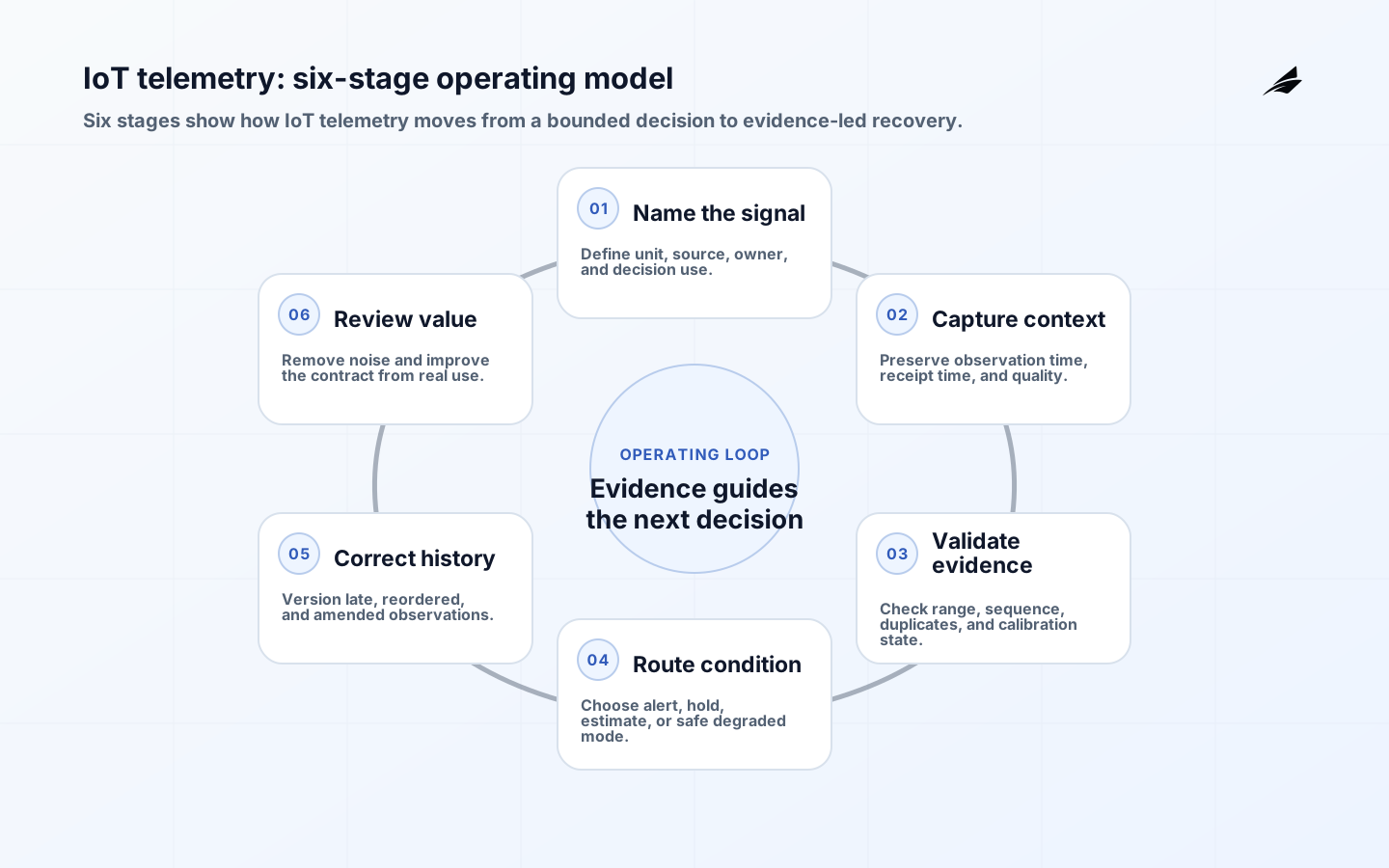
IoT telemetry is the evidence layer between a physical process and a digital decision, so a value without a unit, timestamp, quality state, or source context is not yet reliable telemetry. IoT telemetry is the structured record of what a connected device observed or did, carried into systems where people and software can make decisions from it. It is more than a stream of numbers. A useful telemetry point has an asset, a measurement or event meaning, a time, a unit or encoding, a quality context, and a path back to the source. Engineering teams get into trouble when they optimize collection volume before agreeing on those meanings. The OpenTelemetry Logs Data Model offers a sound general lesson: common fields and clear semantics make data from different sources interpretable together.
Begin with a telemetry question
Phrase the requirement as a question an operator or service must answer: Is the pump running within its expected range? Did the gateway apply the assigned configuration? Which sites lost connectivity during a storm? For each question, identify the signal, sampling or event condition, maximum acceptable age, resolution, owner, and response. This avoids collecting every available register simply because bandwidth and storage make it possible. It also makes the cost of missing, stale, or inaccurate data visible before teams wire it into alerts or automation.
| Telemetry element | Contract detail | Operational consequence |
|---|---|---|
| Asset identity | Immutable device or channel ID plus site and assignment history. | Prevents readings from being attached to a renamed or replaced asset. |
| Time | Source time, observed time, timezone or clock-quality policy. | Makes delayed delivery and historical analysis interpretable. |
| Value | Units, precision, allowed range, and encoding. | Stops a conversion or firmware change from silently changing meaning. |
| Quality | Validation, calibration, connectivity, and origin flags. | Lets consumers distinguish absence, suspicion, and normal variation. |
Create a contract at the device and platform boundary
Version the telemetry schema and publish compatibility expectations. A device firmware update that renames a field, changes units, or alters reporting behavior is a data product change, not merely an embedded change. Include message identifiers and sequence information where the protocol supports it, and make payload validation explicit at ingestion. MQTT can provide efficient publish and subscribe semantics, but the MQTT 5.0 specification does not supply your business taxonomy or data-retention policy; those need local ownership.
Capture raw or minimally transformed telemetry where it is justified, then produce derived views with transformation versions. This enables a team to correct a threshold calculation without pretending the original observation changed. It also makes backfill feasible after a parsing defect. For sensitive fields, minimize data, restrict topics and storage access, and decide how long raw material remains necessary. Telemetry can reveal location, occupancy, equipment use, or customer patterns even when it does not look like traditional personal data.
Design for imperfect transport and imperfect sensors
Connected devices disconnect, drift, reboot, retry, and sometimes report plausible but wrong values. Model absence as a state rather than allowing an old value to look current forever. Include freshness checks, range and rate-of-change validation, duplicate handling, and a dead-letter or quarantine route for messages that cannot be interpreted. A durable streaming platform can retain events for replay; the Apache Kafka documentation describes storage and processing as core capabilities. Replay is valuable only when the input contract and consumer behavior make it safe.
Test telemetry where it becomes operational
Build a thin path from one device class through ingestion, validation, storage, an operator view, and one action or alert. Test a clock reset, duplicate publish, invalid unit, firmware rollback, network partition, and a device moved to another customer or site. Confirm that alerts use the intended source time and that derived state can be reconstructed. NIST SP 800-213 is relevant here because device capabilities, supporting services, and risk controls must work together rather than being assessed in separate documents.
| Failure condition | Telemetry behavior | Expected response |
|---|---|---|
| Gateway offline | Buffer within capacity or report a clear gap. | Operations sees data age and follows a defined escalation. |
| Schema rejected | Quarantine the message with reason and source version. | Engineering can repair without corrupting downstream views. |
| Sensor out of range | Preserve original value and quality flag. | Rule engine follows the appropriate review or safety path. |
| Asset reassigned | Apply an effective-time mapping. | Historical readings remain attached to their former assignment. |
Operate telemetry as a product
Monitor active-device coverage, event age, rejected messages, missing required fields, quality-flag distribution, ingestion cost, and consumer failures. Review whether each telemetry family still supports a decision. Link contract changes to release notes and field support so a device change does not surprise analysts. The related event streaming guide and production telemetry guide can help teams connect platform reliability with the people who depend on the data.
- Define units and source-time semantics before setting alert thresholds.
- Version every material telemetry contract and transformation.
- Preserve validation failures as evidence, with access controls appropriate to the payload.
- Use stable asset IDs and effective-time assignments across replacement and relocation.
- Review sampling frequency against the decision, device power, network, and cost constraints.
Key takeaways
- IoT telemetry is useful only when its meaning and quality remain attached to the value.
- A decision question is a better starting point than a list of available sensor registers.
- Contracts need identity, time, units, quality, versioning, and ownership.
- Stale, missing, duplicate, and malformed data are first-class operating states.
- A small end-to-end test proves more than a large unconsumed data lake.
IoT telemetry FAQ
How often should a device report telemetry?
Choose the interval from the fastest meaningful change, the action window, sensor dynamics, energy budget, network cost, and tolerance for loss. Event-based reporting may be better than high-frequency polling for some conditions, but it still needs a heartbeat so absence is detectable.
Should we retain every raw reading?
Retain what is needed for safety, audit, analysis, and debugging within a defined cost and privacy boundary. Aggregate or expire lower-value data deliberately, while preserving enough source context to investigate material outcomes. Retention is part of the telemetry contract, not an afterthought in storage billing.
Telemetry scenarios to rehearse
Imagine a firmware rollout that changes a temperature field from whole degrees to tenths of a degree while preserving the same name. Without a contract version and unit declaration, analysts may mistake the change for a real physical shift. Ingestion should detect the version, apply an approved normalization rule, and retain the original field for diagnosis. Alert thresholds and historical comparisons should be tested before the cohort expands, because numerical plausibility is not proof of semantic compatibility.
Imagine a device reporting a constant healthy value for days because its sensor lead has disconnected. Range validation will not catch this; rate and cross-signal checks may help, but the operational policy still needs to state when a signal becomes suspicious. Show the quality state to consumers and create a work item when the consequence warrants it. Telemetry is strongest when it communicates uncertainty rather than forcing every value into a false binary of good or bad.
Imagine a site being reassigned to a different customer while buffered gateway data from the previous assignment is still arriving. Effective-time mapping, source timestamps, and strict tenant policy are necessary to keep historical readings with the correct owner. The platform should not re-label old evidence simply because the current asset record changed. This case joins telemetry design with access control and commercial data governance in a way that simple device demos often miss.
Finally, ask whether every field collected still pays for its collection. A telemetry review can remove redundant high-frequency data, tighten access to sensitive signals, or add missing quality flags that operators repeatedly request. Use observed decisions and incidents as evidence for these changes. The goal is a smaller, clearer, more useful contract over time, not an ever-growing payload that every downstream system must carry.
IoT telemetry connects to event streaming for operations, IoT telemetry in production, and device identity for connected systems. These references connect signal semantics to event delivery, production telemetry, and the identity context needed to interpret a reading.
Turn telemetry into a decision-ready evidence stream
For implementation context, compare OpenTelemetry Metrics Data Model, MQTT Version 5.0 Specification, NIST SP 800-92: Guide to Computer Security Log Management, and OGC SensorThings API Part 1: Sensing when choosing the boundary and its evidence.
A telemetry contract should answer what a signal measures, where it was produced, when it was observed, when it was received, how it was transformed, and who may use it. This is especially important when a gateway buffers values during an outage or when a device clock drifts. A dashboard may show a smooth line while the underlying values are old, duplicated, or associated with the wrong asset. Put quality and freshness beside the measurement so downstream consumers can choose whether to alert, estimate, hold, or ignore.
Carry observation time, receipt time, and quality together
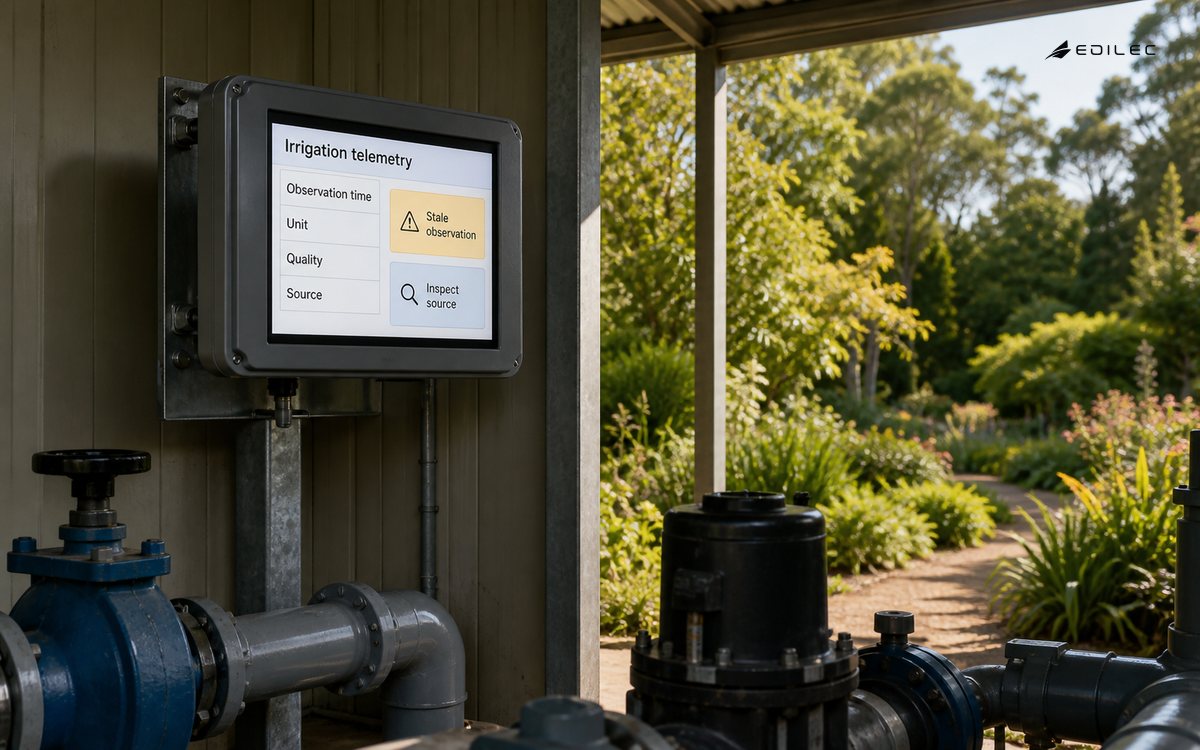
Use separate observation time and ingestion time. Preserve the source timestamp even when a gateway forwards a message later, and expose the delay rather than replacing the original time. Add explicit quality states for missing, estimated, suspect, corrected, and valid values. A repeated value can be physically plausible and still be operationally suspicious when a sensor lead has failed. The quality state is part of the contract, not a comment for the support team.
Make backfill and correction visible to consumers
Connected systems routinely receive late data, duplicate messages, calibration corrections, and reordered events. Give each observation a stable event identity or an unambiguous deduplication key. Define whether a correction replaces a previous value, creates a new version, or is retained as an adjustment. Consumers that make safety or maintenance decisions need a clear rule for whether historical corrections can reopen an alert or only update analysis.
| Telemetry field | Why it matters | Example decision |
|---|---|---|
| Measurement and unit | Prevents a plausible value from being interpreted incorrectly | Reject a temperature reported without its declared unit |
| Observation time | Preserves when the physical event occurred | Place a delayed reading in the correct operating window |
| Ingestion time | Shows pipeline delay and freshness | Mark a buffered value as late before alerting |
| Quality and provenance | Makes uncertainty and transformation visible | Suppress automation when the value is estimated or unverified |
Choose a safe response for each telemetry condition
Operations teams should agree on the default response before the first incident. The right action depends on consequence, not on whether the pipeline technically delivered a message.
| Condition | Safe default | Owner |
|---|---|---|
| Fresh, valid, expected range | Use for normal decisions | Operations or control-room owner |
| Late but attributable | Show as delayed and evaluate cautiously | Telemetry or site owner |
| Missing, suspect, or impossible | Hold automation and open an exception | Data quality and operations owners |
| Corrected after a decision | Version the value and assess impact | Product owner with domain approver |
Telemetry practices to carry forward
- Define every signal with unit, source, observation time, ingestion time, and quality.
- Handle late, duplicate, corrected, and reordered events explicitly.
- Expose uncertainty where it can change an alert or operational decision.
Rehearse telemetry gaps before launch
Rehearse a silent sensor, delayed delivery, duplicate observation, clock drift, calibration correction, and a disconnected device with operations. Check whether each case preserves observation time, receipt time, quality, ownership, and a safe decision for downstream users.
Telemetry questions after launch
How often should telemetry be sampled? Sample at the rate needed by the decision, then validate whether the signal changes that often. Higher frequency is not automatically better if it increases cost, noise, or review burden.
Is a timestamp enough to prove freshness? No. Keep both observation and ingestion times, plus a quality state and source identity. A freshness judgment depends on the declared expectation, not a single field.
What should happen when a device is offline? Preserve the last known state with its age, mark new values as unavailable, and define whether the process may continue in a safe degraded mode.
Conclusion
Good IoT telemetry makes remote reality interpretable without pretending it is perfect. Define what each signal means, carry its time and quality context, and design for gaps and change. Engineering teams that do this can use connected data to improve operations while still being able to explain the evidence behind an alert or decision. Document the contract where both device and service teams can change it deliberately, and include support and analytics owners in material revisions. This avoids the familiar split in which firmware, cloud, and operations each have a plausible but incompatible meaning for the same field. A telemetry system earns trust by making these meanings durable across releases.