How Product Teams Should Think About Device Identity
Device identity is not a serial number placed beside a device record; it is the product decision that lets a service distinguish an expected device from a copied, retired, reassigned, or compromised one. Device identity becomes useful when it improves a real operating decision. For product teams, its job is to maintain a revocable connection between a device, its owner, credentials, services, and lifecycle. A device-identity product team should name the enrolling role, trusted proof, consequence of a mistaken match, and safe fallback before choosing a registry. That framing keeps identity from becoming an inventory exercise that records devices without improving an enrollment or recovery decision. A clear boundary lets support explain a credential decision after a transfer, outage, or disputed connection.
Set the device identity operating boundary
The first device identity release should serve one repeatable workflow and one accountable operating group. Write the enrollment decision in plain language, then name the asset cohort, sites, and lifecycle states that remain outside the first release. Record the device subject, credential version, assignment time, policy version, action, and outcome for each consequential identity decision. Those fields let support reconstruct a transfer or revocation instead of turning a temporary assumption into hidden authorization behavior. A narrow device cohort gives the team evidence about enrollment and recovery before it grants trust to more hardware.
| Decision area | Question to settle | Evidence to keep |
|---|---|---|
| Purpose | Which decision does device identity improve and for which operating role? | Named owner, expected action, and success condition. |
| Scope | What is inside the first device identity cohort and what remains manual? | Asset identity, inclusion rule, and accountable team. |
| Freshness | When is a device identity input too old or incomplete to trust? | Source time, receipt time, quality state, and expiry rule. |
| Fallback | What should staff do when device identity cannot decide safely? | Escalation, manual procedure, and recovery record. |
Make the device identity contract operable
A device identity contract is more than a payload or screen. It must name the authoritative inventory or issuer, stable subject, effective time, allowed scope, and person who owns an exception. Give enrollment, rotation, and revocation events a correlation ID that a responder can follow from the registry to the relying service. Decide whether a late assignment correction creates a new lifecycle event, revises interpretation, or requires a human approval before it changes access. Those choices preserve the device history that field support and incident responders need when the original implementer is unavailable.
- Name an accountable owner for the device identity decision and exception queue.
- Store the rule or configuration version with consequential outcomes.
- Make overrides attributable, narrow, time-bounded, and routinely reviewed.
- Test normal, stale, malformed, duplicate, and corrected inputs.
- Keep a readable explanation close to each consequential action.
Build controls around device identity
The NIST SP 800-57 key-management guidance supports a disciplined approach to control ownership, while the NISTIR 8259A IoT device capability baseline gives practical capabilities to consider in connected environments. Apply them to the actual device identity path: constrain authority before a side effect, reject untrusted context, and retain enough evidence to investigate exceptions. A credential control is credible only after the team tests rotation, transfer, retry, staff handoff, and a documented manual recovery. Ordinary success alone does not show that the device identity process is safe.
| Failure mode | Preventive control | Operating signal |
|---|---|---|
| Unknown or stale context | Require trusted inputs before a device identity action takes effect. | Rejections by source, site, reason, and age. |
| Duplicate or reordered work | Use durable identities, sequence rules, and idempotent handlers. | Duplicate suppression and replay outcomes. |
| Unexplained action | Record actor, target, rule version, and correlation context. | Audit completeness and reconstruction time. |
| Unsafe exception | Use reviewed overrides with scope, expiry, and approver. | Override age and post-expiry activity. |
Implement device identity as a thin, testable path
Build device identity from one complete operational story. Follow a device from manufacture or enrollment through proof validation, authorization, service use, notification, and retirement. Keep credential material separate from ownership and assignment facts so a key change cannot erase the asset history needed for support. Make missing proof, delayed revocation, rejected scope, and support correction visible in the first identity release. That visibility is what lets a field or support team operate safely when the original identity designers are not on call.
Model identity before the enrollment screen. A device can be repaired, transferred, replaced, or temporarily disconnected, and its record must remain intelligible through each state. Credentials prove a current right; identity preserves the asset history needed for support and investigation.
Start by observing enrollment and revocation outcomes, establish a baseline, then enforce policy on one bounded device cohort. Treat a spike in identity exceptions as evidence about proof, assignment, or policy—not as a reason to weaken the control silently. Review resolved and unresolved enrollment cases with technicians, support staff, and the person who owns access policy. Their questions reveal whether device identity is providing context at the moment of decision or merely moving an existing problem into a new interface.
Review device identity in the real operating environment
Review lifecycle records for assets that have changed hands, failed claims, or gone quiet unexpectedly. These are the cases where identity design meets field reality. Verify that support can revoke a credential without erasing service history and can replace hardware without creating a duplicate customer asset. Regular review also exposes shared installer practices that may have bypassed the intended enrollment controls.
Measure device identity in operational terms
Measure device identity through timeliness, input quality, failed actions, exception age, recovery duration, manual overrides, and the operating outcome it is meant to improve. For device identity, break the data down by site, cohort, version, owner, and failure reason. The OpenTelemetry Metrics Data Model is useful for consistent technical evidence, while the OWASP Logging Cheat Sheet is a helpful reference for investigation-ready records. Pair identity signals with outcomes such as fewer duplicate assets, faster revocation, and shorter investigation time.
Recover device identity without losing history
Recovery for device identity must restore a safe operating state without erasing the story of what happened. Preserve enough context to distinguish a credential rejected at enrollment from one revoked after use, and a reassignment from a duplicate asset record. For device identity, rehearse recovery with the people who own the operational consequence. The identity rehearsal should include escalation, technician-led recovery, evidence review, and an explicit decision to restore trust. For device identity, a restart is only one technical step in that wider operating procedure.
| Review cadence | What to inspect | Decision |
|---|---|---|
| Daily or shift | New exceptions, stale inputs, and failed actions. | Route, correct, or contain before workarounds become routine. |
| Weekly | Failure reasons, repeated overrides, and unowned backlog. | Adjust the rule, ownership, or support procedure. |
| Per release | Changes, cohort effects, and recovery rehearsal results. | Expand, pause, roll back, or add a guardrail. |
| Quarterly | Assumptions, access, evidence, and dependencies. | Retire weak controls and renew the agreement. |
Key takeaways
- Device identity starts with a named operating decision, not a broad rollout.
- Keep the first cohort small enough that product teams can inspect exceptions.
- Identity, time, quality, ownership, and version make outcomes reviewable.
- A visible fallback teaches more and protects more than a silent retry.
- Use the adjacent connected-operations guides before multiplying workflows.
Frequently asked questions about device identity
What should be designed first? Start device identity with the decision and the consequence of a wrong or late result. Identify the enrolling role, trusted records, escalation threshold, and safe manual path for a device that cannot prove its identity. For device identity, technology follows those constraints; it should not erase them.
How much evidence is enough? Retain identity, source and receipt time, quality state, rule version, actor, outcome, and resolution context for important device identity events. Retention periods vary, but a reviewer should not need guesswork to reconstruct the device identity decision.
When should device identity expand? For device identity, expand after the first cohort shows reliable inputs, understandable exceptions, exercised recovery, and a measurable operational improvement. For device identity, lower error rates are insufficient if failures remain opaque or support staff quietly absorb extra work elsewhere.
Decision ownership is the practical test for device identity. Someone must be able to say which inputs are trusted today, who changes the device identity rule, who receives an exception, and who decides whether a recovered result may affect normal work again. Make those responsibilities visible in the runbook and in the device identity system state. For device identity, when evidence is incomplete, record that condition rather than inventing certainty. This habit makes later review faster, protects the people doing the work, and gives the team a reliable basis for improving device identity after each release.
Device identity connects to device identity for connected systems, IoT telemetry for connected systems, and edge gateways in production. Use these paths to connect enrollment choices to the telemetry and gateway evidence that makes a device decision supportable.
Turn device identity into a revocable product capability
For implementation context, compare NISTIR 8259A: IoT Device Cybersecurity Capability Core Baseline, NIST SP 1800-36: Trusted IoT Device Network-Layer Onboarding and Lifecycle Management, RFC 5280: Internet X.509 Public Key Infrastructure Certificate and CRL Profile, and RFC 8446: The Transport Layer Security Protocol Version 1.3 when choosing the boundary and its evidence.
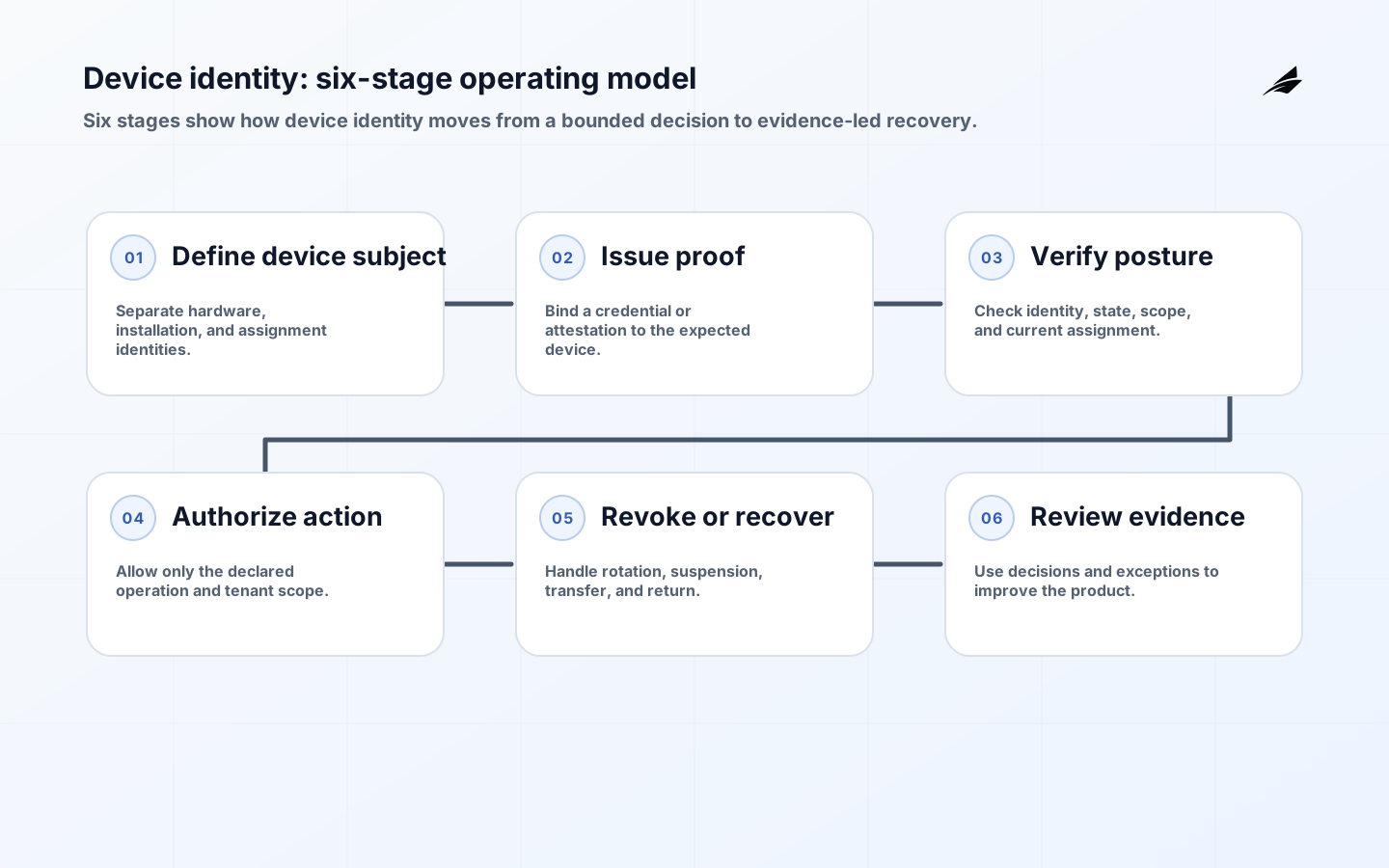
A useful contract names the device subject, the credential or attestation that proves control, the service action allowed after verification, and the evidence retained for later review. Product teams should decide whether identity is bound to hardware, software installation, customer assignment, or a combination. That choice affects provisioning, support, fleet transfer, and incident response. For example, a sensor moved between sites may keep a hardware identity while its authorization scope changes at the effective time. Treating those as one mutable field creates ambiguity during an investigation.
Separate the asset subject from assignment state
Keep a stable device identifier distinct from mutable fields such as site, customer, model, firmware, owner, and lifecycle state. The stable identifier supports correlation; the mutable fields express current authority. Record effective times for assignment changes so delayed telemetry cannot silently acquire a new owner. If a field changes the security decision, version the rule that interprets it and make the change reviewable.
Make revocation and replacement ordinary support paths
A device identity system is incomplete if it can enroll devices but cannot suspend, revoke, rotate, or recover them. Define what happens when a private key is suspected, a device is returned, a customer loses control, or a gateway is replaced. A safe response may be to deny new sessions while preserving read-only evidence and a support route. Test that path with an operator who has no access to the original provisioning console.
| Identity decision | Practical choice | Evidence to retain |
|---|---|---|
| Subject | Separate hardware, installation, and customer assignment identities | Identifier type, issuer, effective time, and owner |
| Credential | Use a device-held key or certificate with a defined trust anchor | Credential reference, issuance event, and rotation status |
| Authorization | Map verified identity to least-privilege actions | Policy version, scope, and decision result |
| Lifecycle | Represent active, suspended, retired, and recovered states | State transition, actor, reason, and timestamp |
Choose an identity response for each lifecycle signal
The matrix below gives product, security, and operations a shared way to decide whether a device should connect, remain limited, or require a person. It is more useful than a generic “trusted or untrusted” label because it preserves the reason and the next action.
| Observed condition | Default decision | Next action |
|---|---|---|
| Known identity and expected posture | Allow declared scope | Record the decision and continue normal monitoring |
| Known identity but stale or changed posture | Limit or hold | Request posture refresh and route to the owner |
| Unknown identity or failed proof | Deny new authority | Retain the attempt and investigate provisioning or misuse |
| Retired or reassigned device | Deny prior scope | Revoke old access and issue the new assignment explicitly |
Identity practices to carry forward
- Separate stable device identity from customer, site, firmware, and lifecycle attributes.
- Make enrollment, rotation, suspension, revocation, and recovery observable product paths.
- Record the policy version and effective time behind every access decision.
Test identity changes at the enrollment boundary
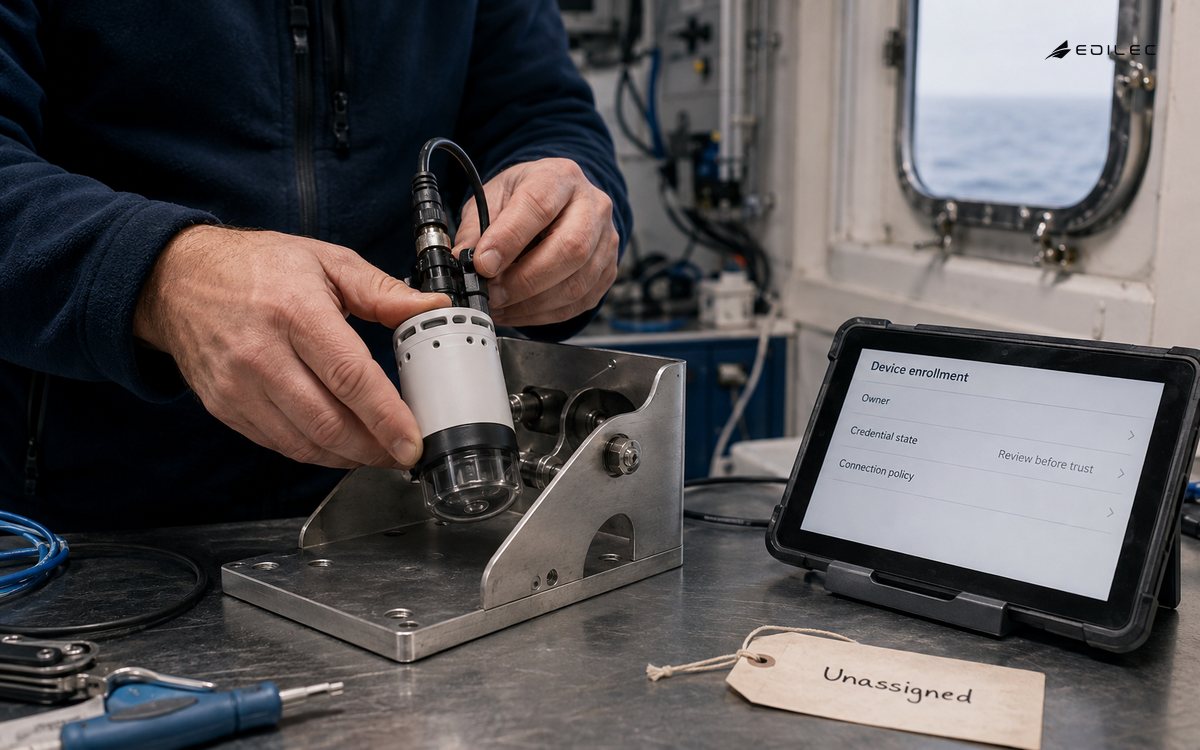
Test enrollment, credential rotation, reassignment, suspension, and recovery with the people who support devices. Inspect whether each transition preserves the subject, current authority, and evidence needed to explain a disputed connection.
Identity questions operators ask
How is device identity different from a device inventory record? Inventory says what an organization believes it owns. Device identity supplies a verifiable subject and a decision about what that subject may do now. The two should be linked, but they should not be treated as the same evidence.
Should identity follow hardware or installation? Choose based on the decision. Hardware identity helps trace a physical asset; installation identity helps isolate a compromised software instance. Keep both when replacement, transfer, or forensic reconstruction matters.
What is the first production test? Enroll a device, rotate its credential, suspend it, restore it through an approved path, and confirm that delayed data cannot regain authority without a new decision.
Conclusion: make device identity accountable
The durable form of device identity is a bounded operating capability with a clear decision, credible controls, useful measurement, and a recovery path people can execute. Start by using it to maintain a revocable connection between a device, its owner, credentials, services, and lifecycle. When ownership, evidence, and exceptions are designed together, the team can extend the device identity system without making it harder to operate.