Production IoT Telemetry: A Product Team’s Operating Guide
IoT telemetry becomes a production concern when people or automated systems use device observations to make decisions. At that point, a stream of messages is not enough. Teams need a stable identity, a meaning for every measurement, freshness expectations, quality flags, retention rules, and an owner who can respond when the signal is wrong or absent. A prototype may display temperature, vibration, or battery level; production telemetry must explain whether the value is current, comparable, authorized, and safe to act on. W3C Thing Description offers a concrete model for describing device affordances and data meaning; the product must extend that description with freshness, quality, and accountability.
State the decision telemetry supports
Begin with the action that depends on the signal. A maintenance team may use vibration data to schedule an inspection, while a safety system may use pressure to trigger a shutdown. Those cases need different latency, confidence, escalation, and fallback rules. Write what a reader should do when a value crosses a threshold and what to do when the value is stale. Avoid collecting every sensor field “for later” without a retention and access decision. The MQTT Version 5.0 specification can inform the message path, but the product contract should state the measurement unit, sampling expectation, acceptable delay, and consequence of a missing value.
Specify telemetry meaning, units, and ownership
A telemetry contract should identify the device, asset, measurement, unit, observation time, sequence or event identifier, quality status, firmware or schema version, and source context needed for interpretation. State whether a reading is cumulative, instantaneous, sampled, calibrated, estimated, or corrected. Keep raw observation and derived status separate so an operator can see how an alert was produced. The OpenTelemetry Metrics specification is useful for naming and aggregation discipline, but the product still has to define which raw observation supports which operational decision.
| Contract field | Question to answer | Production consequence |
|---|---|---|
| Identity | Which device, asset, tenant, and location produced it? | Events are not assigned to the wrong customer or machine. |
| Meaning | What does the measurement and unit represent? | Users do not compare incompatible values. |
| Time | When was it observed, received, and processed? | Late and stale data can be handled honestly. |
| Quality | Was it valid, estimated, calibrated, or missing? | Automation can avoid acting on questionable input. |
| Version | Which schema, firmware, and calibration context apply? | Historical data remains interpretable after change. |
Treat device identity as data quality
A telemetry value without trustworthy identity is an attractive liability. Maintain a durable relationship between device identity, asset identity, installation location, customer or tenant, and active configuration. Record provisioning, replacement, reassignment, and retirement events. Do not infer identity from a mutable display name or network address. When a device is moved, decide whether its history follows the device, the asset, or both. If the answer changes by use case, encode that distinction. AWS IoT Device Defender gives a concrete fleet-audit reference; use its emphasis on device behavior as a prompt to keep identity and telemetry quality linked.
- A device has a stable identifier and a controlled credential lifecycle.
- An asset relationship has an effective start and end rather than a silent overwrite.
- Replacement and reassignment preserve enough history for operators and support.
- Retired devices cannot publish accepted telemetry without an explicit reactivation.
- Unknown identifiers are quarantined with a support route, not silently dropped.
- Identity changes are visible in the audit record and explain downstream impact.
Build an observable telemetry pipeline
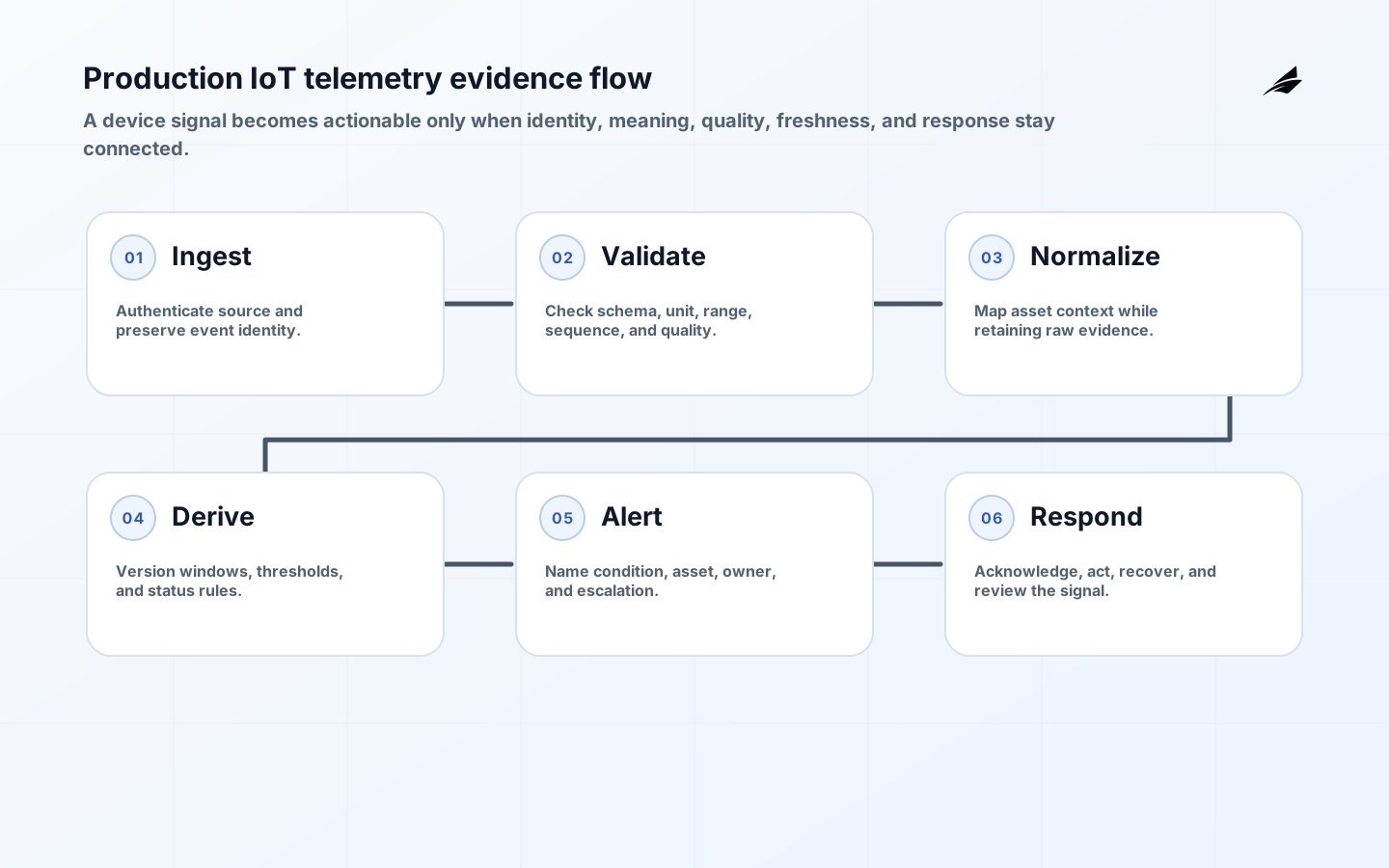
A production path normally includes ingestion, authentication, validation, normalization, storage, derivation, alerting, and delivery to users or downstream systems. Keep these boundaries explicit. Ingestion should record arrival and reject malformed envelopes. Validation should check identity, unit, range, sequence, and schema. Normalization should preserve raw evidence while creating a stable analytical form. Derivation should state the rule and version behind a status or alert. A service outage should produce a known degraded state rather than a dashboard that appears current because the last value remains on screen.

| Pipeline stage | Control | Evidence to monitor |
|---|---|---|
| Ingest | Authenticate source and preserve event identity. | Accepted, rejected, and unknown-source counts. |
| Validate | Check schema, unit, range, sequence, and quality. | Failure reason and sample under approved access. |
| Normalize | Convert units and map asset context without losing raw value. | Transformation version and lineage. |
| Derive | Version thresholds, windows, and status rules. | Rule version, input freshness, and output state. |
| Deliver | Show freshness, escalation, and recipient ownership. | Notification result, acknowledgement, and recovery. |
Define freshness and missingness
A freshness rule is not the same as frequency. A device expected to report every minute may be stale after three minutes, while a daily meter may be healthy after twenty hours. Define the expected interval, grace period, clock assumptions, and what happens when no value arrives. Distinguish no reading, invalid reading, unchanged reading, and estimated reading. A flat value may be normal or may indicate a stuck sensor. Show the last observation time and last successful ingestion time separately. This prevents operators from treating a visible number as proof of current conditions.
Make alerts actionable
An alert is useful when it names the condition, affected asset, evidence window, consequence, owner, and next action. Avoid firing on every threshold crossing when a short spike is normal; use windows, hysteresis, or a state machine where the domain supports it. Do not clear an alert merely because a later message arrived if a human acknowledgement or safety procedure is still required. The MQTT Version 5.0 specification can inform delivery, and observability conventions can improve correlation, but alert ownership and escalation are operational decisions. Every alert should have a route, a response target, and a way to record disposition.
Example: production line vibration
Suppose vibration sensors help maintenance teams identify a failing motor. The contract preserves the device and motor identity, sampling configuration, observation time, unit, quality flag, and firmware version. A derived condition compares a rolling feature to a baseline for that motor class; it does not treat one raw spike as a confirmed failure. The alert shows the evidence window, last calibration, recent maintenance, and recommended inspection. If the sensor stops reporting, the system raises a telemetry-health issue rather than leaving the last high value as if it were current. The team can then distinguish machine risk from sensor risk.
Control access and retention
Telemetry can reveal production schedules, occupancy, equipment condition, or customer behavior. Apply tenant and site boundaries, least-privilege service access, and a retention policy that matches the decision. Keep raw high-frequency data only as long as it serves a stated purpose; aggregate or delete it when detailed history no longer adds value. Protect credentials, rotate them, and record access to sensitive raw data. The portal that shows a derived status may not need to expose every reading. A smaller disclosure surface is easier to secure and explain.
Move from pilot to production deliberately
Before general release, replay representative data, including duplicates, gaps, out-of-order events, unknown versions, impossible values, and device replacement. Compare derived results with a domain expert's expected outcome. Test a broken broker, delayed storage, overloaded consumer, expired credential, and a clock that drifts. Kubernetes concepts help teams reason about deployable services and recovery, but the acceptance test must include the operational process: who receives the degraded-state signal, how the team avoids unsafe automation, and how the incident is closed.
Review the production failure modes
The most common failures are wrong identity, ambiguous units, stale dashboards, unowned alerts, silent drops, and derived rules that change without versioned evidence. Another is treating delivery success as data quality: a message can arrive intact and still be wrong because the device was miscalibrated or moved. Keep ingestion, semantic validation, and operational response distinct. When an analyst corrects a value, preserve the original and the correction reason. When a device is replaced, do not silently join incomparable histories. NISTIR 8259A reinforces that device capabilities and data protection are part of the production baseline, not after-the-fact dashboard cleanup.
- Every accepted event has a durable source, asset, tenant, unit, time, and schema context.
- Unknown devices, invalid units, and impossible ranges have visible quarantine outcomes.
- Freshness and missingness are represented separately from a numerical value.
- Alerts have owners, escalation rules, acknowledgement behavior, and a disposition record.
- Derived rules and calibration context are versioned for historical interpretation.
- Access, retention, credential rotation, and raw-data exposure are reviewed before launch.
Measure data health and decision value
Monitor accepted event rate, invalid and unknown-source rate, freshness by device cohort, out-of-order frequency, duplicate rate, storage lag, alert precision, acknowledgement time, and percentage of readings with complete quality context. Pair those with outcomes such as avoided downtime, inspection yield, false dispatches, or missed safety checks. Watch for a dashboard that becomes popular while the decision it supports remains unchanged. The useful question is whether telemetry lets someone act earlier or with greater confidence, and whether the system shows when that confidence should be withdrawn.
IoT telemetry takeaways
- Start with the decision and consequence, then define the signal needed to support it.
- Preserve source identity, asset context, units, time meanings, quality, and version.
- Separate raw observations, derived status, and alerts so each can be audited.
- Treat stale, missing, estimated, and invalid data as different conditions.
- Design alert ownership and degraded behavior before connecting automation.
- Measure data health together with the operational outcome the telemetry is meant to improve.
Production telemetry questions answered
How often should an IoT device send telemetry?
It depends on the decision, physical process, power budget, network cost, and acceptable delay. Define the expected interval and grace period from the action, not from a generic “real time” label.
Should all raw telemetry be stored forever?
Usually not. Retain detailed data when it supports safety, diagnosis, contractual evidence, or a validated analytical need. Otherwise aggregate or delete it under a documented retention policy.
What makes an alert production-ready?
It has a defined condition, evidence window, affected asset, owner, escalation, acknowledgement behavior, and a safe response when the signal is stale or uncertain.
Conclusion: make every signal accountable
Production telemetry earns trust when every value carries enough context for a person or rule to decide whether to use it. Keep identity, unit, event time, quality, freshness, and schema version attached to the observation; then give alerts an owner, evidence window, and safe degraded response. The MQTT broker guide, edge computing guide, and connected operations guide explore adjacent decisions. A signal is production-ready when the team can explain both its meaning and the consequence of ignoring it.