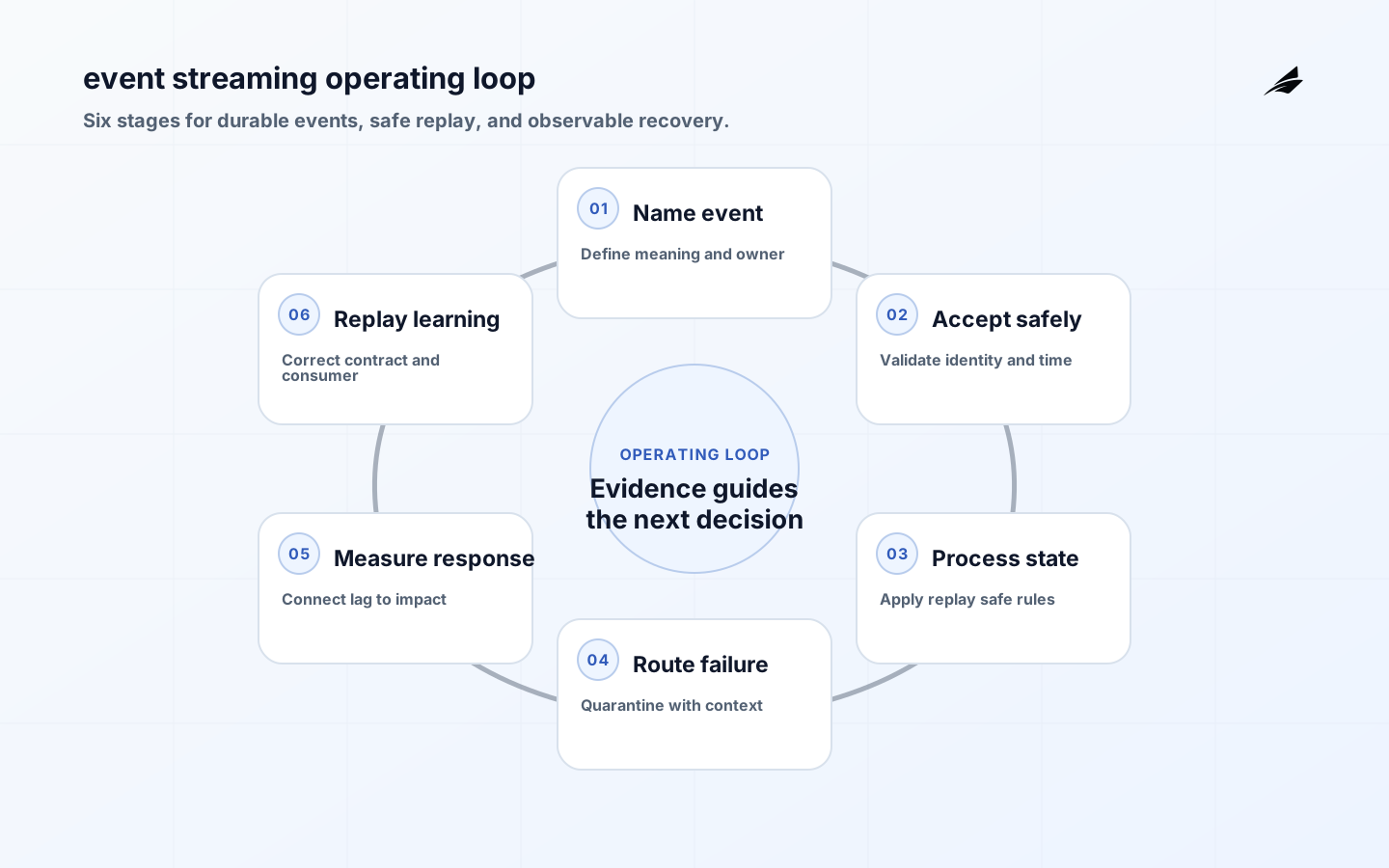
Event streaming becomes an operating capability when a team can explain what each event means, who owns it, how it may be replayed, and what happens when a consumer falls behind. Operations leaders should therefore begin with business transitions rather than a broker choice. A temperature excursion, maintenance state change, or delivery milestone needs a stable identity, event time, schema, ownership, and response rule. The platform matters, but the contract matters first: it determines whether downstream systems can reconcile history, prevent duplicate action, and tell a human what changed.
Start with an operational decision
Choose one decision whose delay or ambiguity is expensive: escalating a refrigeration alarm, reallocating a technician, or stopping a faulty batch. State the triggering event, the business clock, the accountable role, and the action that may follow. A stream that exists only because a system can emit messages soon becomes a noisy integration tax. A stream tied to a decision can be assessed for timeliness, completeness, and harm when it is wrong. This boundary also reveals whether a command, an observation, or a state change is being confused with another.
| Event question | Record in the contract | Why operations needs it |
|---|---|---|
| What happened? | Stable event name and business meaning. | Prevents consumers from inferring meaning from a payload shape. |
| When did it happen? | Source time, ingestion time, and clock policy. | Separates a late event from a recent observation. |
| Which thing? | Asset, site, tenant, and correlation identifiers. | Lets responders find the affected work without broad searches. |
| What follows? | Allowed consumers and action authority. | Stops an observation from silently becoming an unsafe command. |
Write an event contract before selecting a platform
The contract should define a versioned schema, key, identifiers, units, timestamps, producer, retention expectation, and sensitivity classification. It should also say what a consumer may assume. For example, a sensor.reading.recorded event can carry a measured value and quality flag; it should not imply that the current asset state has already changed. Consumers need an explicit idempotency key because retries, reconnections, and replay are normal operating conditions, not exceptional defects.
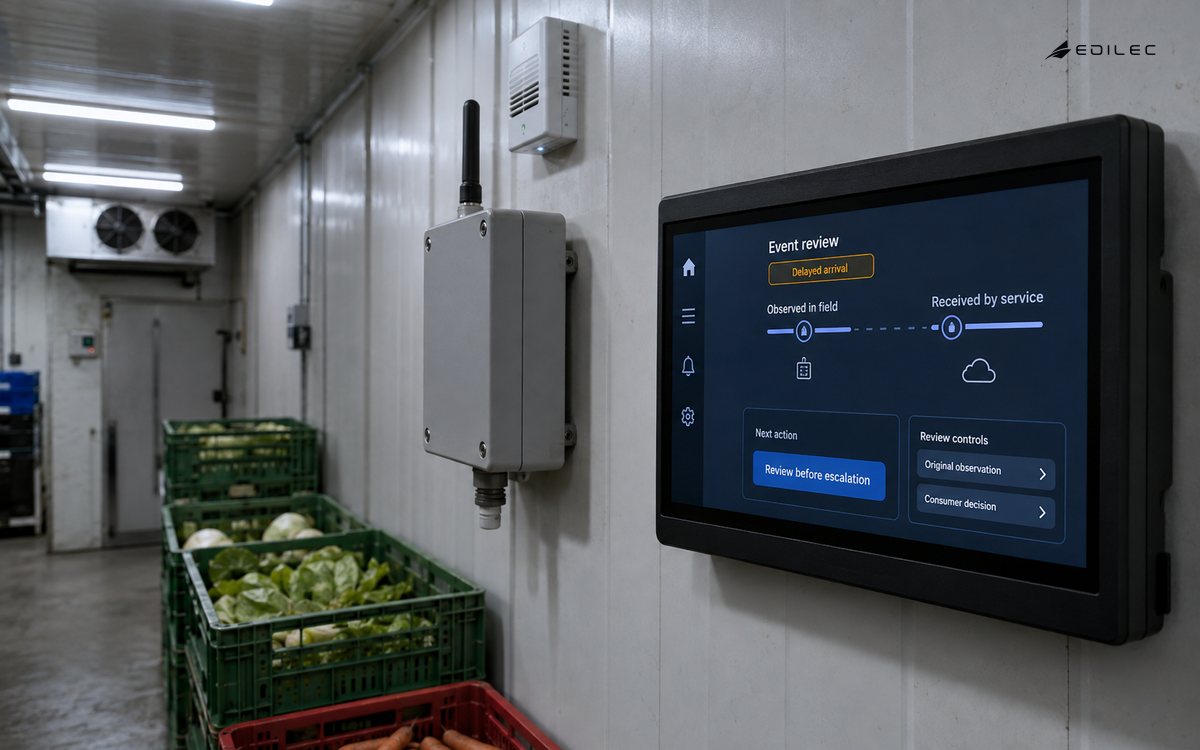
Keep business time separate from broker arrival time. A gateway may hold readings while a network is unavailable, so arrival order cannot be treated as field order. Capture both times and the source sequence where available. OpenTelemetry's log data model makes the same useful distinction between when something occurred and when a collection system observed it. That distinction turns disputed alerts into an investigation with evidence instead of a debate about dashboards.
Design processing for duplicates and delay
A production stream needs a deliberate answer for duplicate delivery, late arrival, schema evolution, poison messages, and backfill. Deduplicate where the action is material, not merely at a dashboard. Hold or route events that fail validation to a visible exception path with the original payload, reason, and owner. For a high-consequence workflow, use a human or policy gate before an event can initiate a physical action. NIST's IoT cybersecurity guidance is a helpful reminder to define device and supporting-system capabilities in the context of actual system risk.
Prove one end-to-end path
Begin with a single producer, a durable transport, one operational consumer, and one observable recovery path. Exercise a disconnected gateway, an event that arrives hours late, a duplicate, a malformed payload, and a consumer outage. The acceptance test should show what the operator sees, which records were retained, and who can correct an error. This narrow scope is more valuable than a broad topic catalogue because it tests the handoffs that determine whether a stream is dependable in the field.
| Release evidence | Test case | Acceptance signal |
|---|---|---|
| Ordering policy | Late reading follows a newer reading. | The derived status uses the documented event-time rule. |
| Idempotency | Producer retries the same event. | One material action and an auditable duplicate decision. |
| Consumer recovery | Worker restarts after a partial write. | Work resumes without silent loss or double processing. |
| Access control | Unauthorized service subscribes to a sensitive topic. | Broker or gateway denies access and records the attempt. |
Operate the stream as shared infrastructure
Measure consumer lag, validation failures, dead-letter volume, event age at processing, duplicate rate, and the age of unresolved exceptions. None is sufficient alone. A low lag metric can hide that the producer stopped sending; a healthy throughput chart can hide that the wrong schema version is active. Review a sample of end-to-end traces after releases and incidents. Connect this practice to IoT telemetry design and the more detailed event streaming deployment guide so the team keeps field evidence and platform behavior aligned.
- Assign an owner for each event family, not just the broker cluster.
- Publish a deprecation period and migration route for schema changes.
- Retain enough context to investigate a decision without retaining unnecessary personal data.
- Alert on freshness and validation quality as well as transport availability.
- Review unused topics and consumers; abandoned paths retain risk and cost.
Key takeaways
- Event streaming earns its cost when it supports a named operational decision.
- A contract needs event time, identity, versioning, and consumer assumptions.
- Duplicates and delayed delivery are expected conditions that must be tested.
- A replay-safe observation path is not automatically safe for commands or billing.
- Operational review needs traces, exceptions, and field context, not only throughput charts.
Frequently asked questions
When is event streaming the wrong first choice?
Use a direct request or scheduled extract when the work has one synchronous owner, no material replay need, and no independent consumers. Introducing a stream before the decision or data contract is understood can distribute ambiguity across more systems. Add streaming when durable history, independent processing, or reaction to field change creates a clear operational advantage.
Can a team guarantee event order?
A team can often preserve order for a chosen key within a chosen transport boundary, but field clocks, retries, partitions, and reconnects still create ambiguity. Define which order matters: source sequence, event time, ingestion time, or action time. Then make the consumer's rule visible and test the cases that challenge it.
How should teams handle late event arrivals in production?
Define source time, arrival time, and a lateness policy; route late events to a visible review or replay path so arrival order cannot silently rewrite operational history.
Operational scenarios to rehearse
Consider a cold-chain site where a gateway reconnects after six hours and uploads hundreds of readings. The stream should preserve source time, identify the gateway and sensor, and make the backlog visible. The alerting service must decide whether to generate historical exceptions, suppress them, or route them for review according to the documented business clock. A chart that simply paints the points as current gives an operator false confidence. The correct behavior comes from an explicit lateness policy, not from whichever consumer happened to process first.
Consider a new firmware version that adds a field and changes the precision of another. Producers should announce the version, consumers should accept only compatible changes, and the event owner should know which downstream teams need migration time. A schema registry or similar mechanism can help, but governance still requires a deprecation date, example payloads, and a way to identify active consumers. The operational test is whether a release can be explained and rolled back without hunting through unknown integrations.
Consider an incident in which a consumer has been down while the transport remains healthy. Recovery needs capacity planning, a bounded replay rate, idempotent side effects, and a clear rule for the order in which important work is caught up. If every event is treated as equally urgent, the recovery itself can delay safety or customer-impacting work. Classify priority in the product model and make the recovery queue observable to the operations owner.
Finally, rehearse the investigation conversation. An operator should be able to begin with an asset and time range, find the original event, see validation and processing results, identify any decision or action, and understand whether it was later corrected. That path should work without granting a broad administrator role. When it does, the platform gives support and operations the same evidence base, and event streaming becomes a practical accountability tool rather than a specialist-only system.
Make the event contract operational
A telemetry example
Consider a temperature excursion event from a cold-chain device. The event should carry a stable device identity, occurrence time, observed value and unit, location or shipment context, schema version, and an event identifier that consumers can use for deduplication. A rules consumer may create an alert, while a reporting consumer builds history; neither should silently reinterpret the event or assume arrival order equals occurrence order. Persist the original event context, the processing attempt, and the resulting decision. If the alerting service is unavailable, the event remains recoverable and the owner can see whether the operational response is pending, completed, or rejected.
Signals for Lag, Replay and Contract Drift
Track consumer lag, rejected or quarantined events, duplicate suppression, schema-version distribution, replay duration, dead-letter age, and the share of events without an accountable owner. These signals connect platform health to operational consequence. A quiet topic with a healthy broker can still mean a producer stopped sending, while a growing lag may be acceptable for a historical export but unsafe for an alarm. Set thresholds per use case and define the action: pause a release, switch to a fallback, or ask the process owner to confirm the degraded state.
- Define event identity and time before selecting retention or partitioning.
- Separate immutable observation from a downstream business decision.
- Make every consumer replay-safe and version-aware.
- Give failed events a visible owner and bounded retry policy.
- Measure the business response, not only broker throughput.
Standards for Event Semantics and Delivery
Use CloudEvents Specification 1.0.2, OpenTelemetry Logs Data Model, NIST SP 800-213: IoT Device Cybersecurity Guidance, NISTIR 8259 Series: IoT Cybersecurity as reference points for the control, data, accessibility, security, or operating semantics relevant to this decision. These references frame event semantics; the stream contract and consumer ownership decide the behavior to operate. They help the team name assumptions, choose evidence, and make a review concrete enough that another person can verify what the system is expected to do — for the event key.
Further Reading on Event Delivery
For adjacent decisions, continue with Event Streaming: Cost and Scaling Guide, IoT Telemetry for Connected Systems: Signal Quality in Practice, Event Streaming for Connected Systems: A Practical Guide, then compare the definitions, ownership boundaries, and recovery behavior before widening the implementation.
Conclusion
Reliable event streaming is an operating design, not a technology purchase. Name the decision, contract the event, separate observation from action, and make delay and duplication visible. When an operator can trace a surprising outcome from field signal through processing to the decision record, the stream is doing useful work. That is the standard worth scaling.