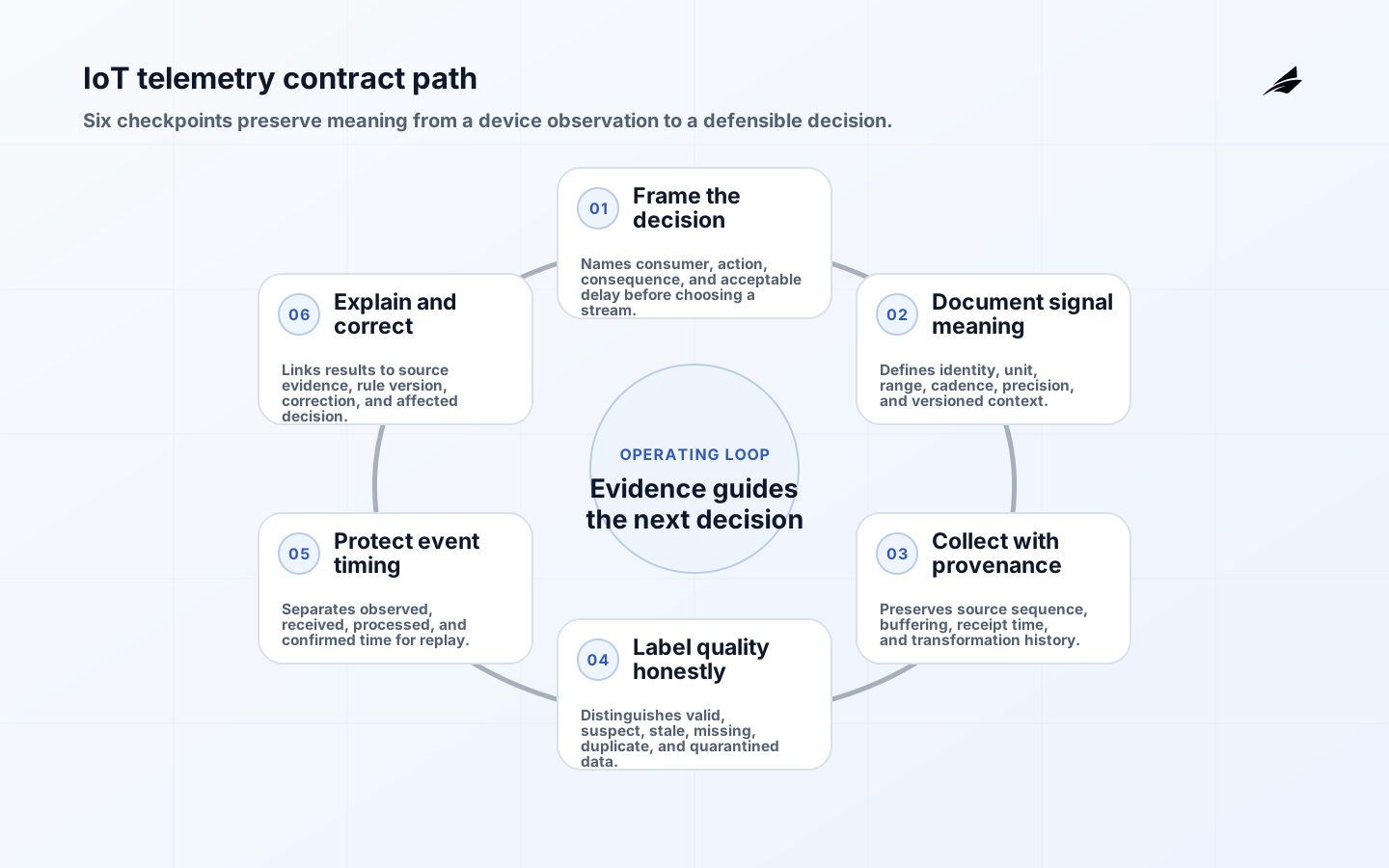
IoT telemetry earns trust when a team can identify the device, event time, quality, and decision supported by each observation. A stream of numbers without units, quality, identity, or time semantics is not a dependable data product. Start with one question—whether a freezer needs intervention or a machine is entering an unsafe range—and design backwards to the device signal. NIST's IoT baseline and OpenTelemetry's documentation provide complementary foundations for device capability and software telemetry.
Frame the telemetry decision
Name decision, consumer, action, acceptable delay, and consequence of a wrong or missing signal. A maintenance lead may need a fifteen-minute trend; a safety interlock may need a local threshold; a finance report may need daily aggregates. Those questions imply different sampling, buffering, retention, and validation. Record the decision before choosing a topic or time-series database.
Map the signal from physical phenomenon to interpretation. A temperature measurement depends on placement, unit, calibration state, sampling time, and environment. A gateway may add receipt time and quality; a service may aggregate it. Preserve transformations so a user can tell whether the result is observed, derived, estimated, or stale.
Document the signal contract
A useful contract covers device and signal identity, unit, range, precision, cadence, event time, receipt time, quality, calibration or configuration version, and retention. Include nulls, duplicates, late arrivals, and schema version. Make it readable to product, firmware, data, and operations. A contract succeeds when a new producer can implement it and a reviewer can test it without guessing.
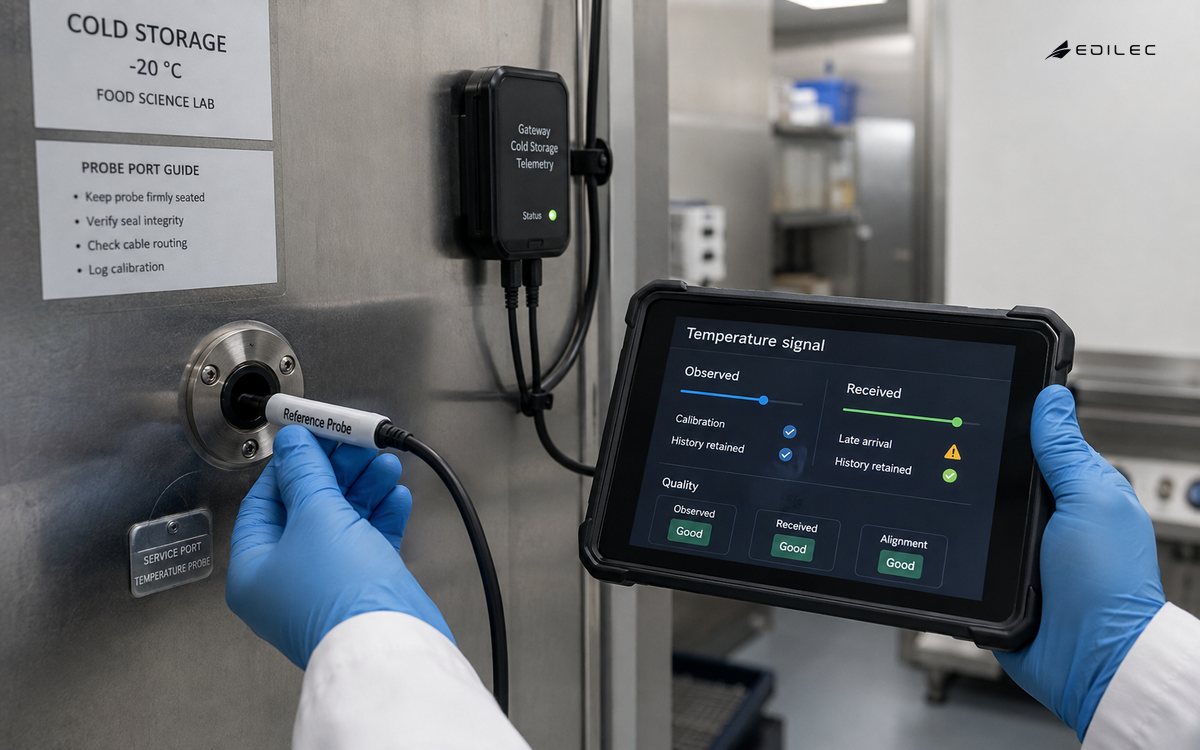
Separate descriptive metadata from measurement. Store location, model, software version, and ownership as related context with effective dates rather than copying unstable labels into every record. Keep source sequence or message ID for deduplication. If a device changes location, historical readings should stay tied to the location and configuration that applied at capture.
| Contract field | Decision | Example |
|---|---|---|
| Identity | Which asset and signal produced it? | Device ID, signal ID, effective site |
| Meaning | What does the value represent? | Unit, range, precision, calibration |
| Time | When was it observed and received? | Event time, receipt time, confidence |
| Quality | Can it support intended decision? | Valid, stale, suspect, quarantined |
Design collection for imperfect links
Devices sleep, reboot, lose coverage, fill storage, and reconnect with delayed data. Define local buffering, queue age, retry, duplicate identity, and full-queue behavior. The MQTT 5.0 standard can inform delivery semantics, but the business contract still states whether late data is accepted, flagged, or excluded.
Choose where validation occurs. Devices can reject impossible values and protect local safety; gateways can add context and buffer; services can apply cross-device rules. Do not force one layer to make every decision. Keep rejected messages with a reason where investigation needs them, while limiting sensitive payload retention.
Make quality visible
Quality is not a single score. Use states such as valid, suspect, estimated, stale, missing, out-of-range, duplicate, and quarantined. Preserve reason and rule version. A valid value may still be unfit because it is too old or comes from a sensor under maintenance. A dashboard should show those distinctions instead of presenting every number as equally authoritative.
Build checks around range, rate of change, cadence, cross-sensor relationship, battery, signal strength, and configuration. Treat a quality rule as a changeable product asset with an owner and fixtures. When a threshold changes, preserve the previous interpretation for historical analysis and explain effective time.
Protect time semantics
Use event time for when a phenomenon was observed and receipt time for when the platform received it. Keep timezone and clock-confidence rules explicit. Late data may be valuable for history but unsafe for a real-time command. If clocks drift, record drift or lower confidence instead of silently reordering events. A time contract makes replay and aggregation less surprising.
Test a device that sends events in bursts after an outage. Define whether late data updates current dashboard, historical aggregate, or review queue. Keep watermarks or cut-off logic visible. Do not report a fresh operational state solely because a delayed packet arrived.
| Telemetry problem | Safe treatment | Evidence |
|---|---|---|
| Late arrival | Keep history; mark current-state policy | Observed and receipt time |
| Duplicate | Deduplicate by stable event identity | Source sequence and rule |
| Unit change | Reject or isolate until contract update | Schema version and approval |
| Bad reading | Quarantine or flag; preserve origin | Reason and affected outputs |
Connect telemetry to a usable service
A telemetry pipeline should expose provenance, health, and lag to teams that support it. Use traces, metrics, and logs around ingestion and transformation, then add device ID, signal ID, observed time, quality, and rule version. OpenTelemetry's collector concepts help separate receiving, processing, and exporting.
Choose a source of truth for raw events, normalized readings, and business decisions. A dashboard may use a curated view, but it should retain a route to source and transformation. Define whether corrections are append-only, versioned, or reconciled. This avoids a dashboard value that cannot be explained against the original measurement.
Grow from one signal family
Pilot one signal type and one consumer. Include normal cadence, missing device, duplicate packet, unit mistake, device move, schema change, and late burst. Let firmware, platform, data, and operations review the same examples. Expand only after contract and recovery path are understood.
Measure freshness, completeness, invalid, duplicate, late-arrival, correction volume, and diagnosis time. Avoid optimizing only ingestion throughput. If the team cannot tell which device or rule produced a value, more throughput creates more ambiguity. Use the pilot to decide what to standardize.
Plan correction, replay, and retention
Correction should be explicit and attributable. Preserve original reading, correction reason, rule or calibration version, approver where needed, and affected outputs. A replay should have a bounded scope and idempotent result. If an external decision used the bad value, route impact to the responsible owner instead of quietly changing a dashboard.
Retention should follow question and sensitivity. Keep raw evidence long enough for diagnosis and contractual needs, but do not retain every payload by default. Restrict access to location, customer, or production details. Review retention and deletion when purpose or ownership changes.
Use a practical telemetry review
Before scaling, ask whether a reader can interpret one record without tribal knowledge. Check identity, unit, event time, receipt time, quality, calibration or configuration, provenance, access, correction, and failure behavior. Link to the sensor data pipelines guide and production telemetry guide when a prototype becomes a service.
Make the review repeatable by recording the expected value, the observed value, the decision owner, and the next action. A short evidence trail turns a telemetry exception into a bounded operating task rather than a debate about which screen is correct.
A telemetry contract scenario
Write examples into the telemetry contract. Show a normal reading, a late reading, a missing field, an out-of-range value, a duplicate, and a corrected result. Examples expose ambiguity faster than prose because firmware and data teams can implement them and operations can test what the user will see. Keep the examples versioned with the contract so a change has a clear review target.
Use a stable event identity even when transport retries. It may combine device identity, source sequence, and signal or capture context, but it must be defined for the source. Downstream deduplication should not rely on arrival order or a timestamp alone. When a duplicate is dropped, preserve enough evidence to show that the source event was received twice.
Telemetry lineage should be useful at the point of decision. A user investigating an abnormal trend may need the device, site, calibration status, rule version, and source event, not a full internal trace. Provide a bounded lineage view that answers why the result has its current value and quality. This makes provenance part of product design rather than a warehouse-only feature.
Different consumers need different freshness policies. A live alert may exclude a late reading from current state while a reliability report includes it in historical analysis. Make that distinction explicit in the serving layer. Do not let a single global freshness label imply that every downstream use has the same tolerance for delay.
Treat schema changes as operational changes. Add fields compatibly where possible, version meaning when necessary, and test old producers against new consumers. Communicate effective dates to people who interpret trends. If a unit or scaling rule changes, preserve the old representation and explain the transition instead of presenting a discontinuity as a real physical event.
Growth should add evidence deliberately. When a new site or sensor family arrives, compare its distribution, cadence, quality, and failure modes with the original pilot. Keep a decision log for exceptions and accepted differences. This allows the telemetry product to expand without making every consumer learn a new hidden convention.
Make the telemetry consumer part of acceptance. Ask a maintenance user to find a stale value, a data engineer to trace a correction, and a support user to explain a missing device. If each person sees a different truth, align the serving contract before expanding the pipeline. Usability is evidence that the data contract reached the decision layer.
Protect measurement context when aggregating. A daily average should state which readings were included, how stale or suspect values were treated, and whether a correction changed the result. Aggregate records need a link to their input interval and rule version so a trend can be explained without reopening every raw packet.
For a second reader, connect this field guide to IoT telemetry for connected systems when the signal contract must serve multiple device classes.
When telemetry supports a physical process, apply the boundary and availability reasoning in NIST SP 800-82 Rev. 3 alongside the data contract so a software pipeline does not hide operational consequences.
Key IoT telemetry takeaways
- Start with one decision and a named consumer.
- Put identity, unit, time, quality, and provenance in the contract.
- Design buffering and late-data behavior before connectivity fails.
- Keep corrections and replays attributable and bounded.
- Measure decision usefulness, not only message volume.
Frequently asked IoT telemetry questions
What is the minimum useful telemetry record?
At minimum, preserve stable device and signal identity, value and unit, event and receipt time, quality state, and enough version or provenance to explain transformations. Exact fields depend on decision and risk.
Should telemetry be stored raw or normalized?
Usually both are useful: raw evidence supports diagnosis and replay, normalized records support consistent decisions. Define authority and retention of each so two layers do not silently disagree.
Conclusion: IoT telemetry in practice
IoT telemetry is a dependable product when its meaning, timing, quality, identity, and correction path remain visible from device to decision. Start small, test imperfect data, and grow the contract with operating work.