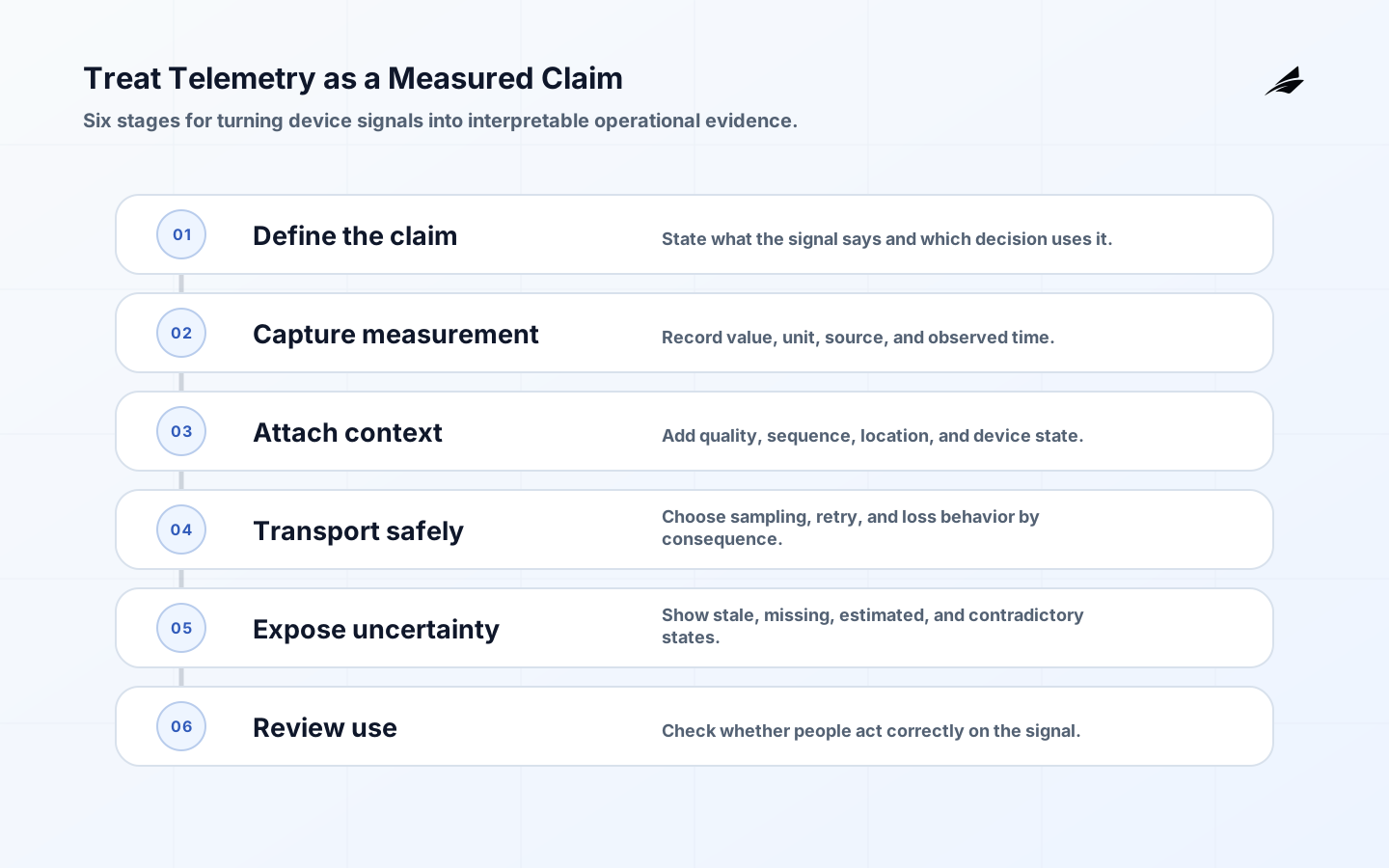
IoT telemetry is the measured or reported information a connected device sends about itself, its environment, or its work. It may include temperature, vibration, battery state, signal quality, position, configuration version, or a diagnostic counter. Its value comes from context. A reading of 37.2 is meaningless without the variable, unit, sensor identity, time, quality, and operational question. Telemetry design therefore begins with measurement intent: what condition are we observing, how accurate must it be, who will use it, and what should happen when it is absent or implausible?
Measured IoT telemetry — Define a Measurement Before You Emit It
Write a compact specification for each consequential telemetry point. State the name, physical meaning, unit, engineering range, resolution, sample rate, expected update pattern, source clock, quality behavior, and owner. This may feel slow at first, but it prevents familiar failures: Celsius and Fahrenheit mixed in the same report, a counter mistaken for a rate, an old retained value shown as live, or a device reboot interpreted as a massive process change. The specification should be understood by device engineers, data engineers, and the person making the operational decision.
Do not choose sampling solely because a device can produce more data. Sampling should match the dynamics of the condition and the decision. A slowly changing room temperature may need a periodic sample; an intermittent fault may need event capture around a threshold crossing; a high-speed control signal may never belong in a cloud telemetry path. The IoT telemetry production guide helps clarify these boundaries before storage cost or network traffic becomes the design driver.
| Telemetry attribute | Example | Why it is needed |
|---|---|---|
| Semantic name | supplyairtemperature | Prevents an ambiguous label from spreading. |
| Unit and range | degrees Celsius, -40 to 120 | Supports validation and correct display. |
| Observed time | Device clock timestamp | Separates observation from delivery. |
| Quality | good, uncertain, missing, substituted | Lets users reason about fitness for use. |
Measured IoT telemetry — Preserve Context Through the Pipeline
A gateway or ingestion service may add useful context, such as received time, network signal, software version, and route. It must not erase the original observation or conceal transformation. Keep raw values available where investigation or recalculation requires them, then create validated or normalized views for routine use. If a service converts units, filters spikes, or derives a rolling average, record the algorithm version and inputs. Derived telemetry is a separate data product with its own assumptions, not a replacement for the original signal.
Asset identity is equally important. Bind every point to a durable device and installation identity, and handle replacements as explicit events. A sensor moved to a different line may retain the same serial number but have a different operational meaning. The telemetry stream needs the effective location and configuration at the time of observation, not merely the device's latest asset record. This is where calibration status, maintenance history, and configuration events become valuable companions to raw measurements.
Measured IoT telemetry — Treat Quality as Data
Quality flags are not an apology for bad devices; they are a way to prevent misleading certainty. Define conditions for missing samples, stale data, out-of-range values, communication failure, manual entry, sensor fault, and values estimated by a model. Each consumer can then decide how to react. A trend chart may display a gap; an alert rule may suppress evaluation; a maintenance queue may create a task. Hiding the condition and forwarding a last-known value makes dashboards look calm while decisions degrade.
Validate at several layers. Devices can reject impossible local readings, gateways can check message shape and sequence, and downstream services can compare values with operating context. These controls have different tradeoffs: aggressive filtering can throw away evidence of a real fault. Preserve rejected records with a reason where they may matter, and review patterns in validation failures. Repeated invalid values often indicate an installation or configuration problem that a simple retry will not solve.
| Problem | Better behavior | What users see |
|---|---|---|
| Late transmission | Keep observed and received time. | A delayed point rather than false real-time. |
| Retained last value | Mark its age and quality. | Stale status, not an apparently live reading. |
| Unit conversion | Version the conversion rule. | Traceable normalized value. |
| Sensor fault | Preserve raw record and diagnostic flag. | Gap or warning with an investigation route. |
Measured IoT telemetry — Control Cost and Retention Intentionally
High-volume telemetry forces practical retention choices. Keep enough raw data for investigations and model validation, retain summarized views for longer-term trends, and document how aggregation changes meaning. An average can hide excursions; a maximum can exaggerate a transient; a count can miss duration. Select aggregations from the downstream question, and preserve the bucket boundaries and time zone. Cost control should reduce unnecessary collection, not silently remove the evidence needed to explain an incident.
Access controls should follow the sensitivity of telemetry and metadata. Location, occupancy patterns, production rates, and diagnostic logs may have different audiences. Grant services and people the minimum view they require, record exports, and set deletion or retention rules. Device telemetry can reveal a great deal about a site even when no individual measurement appears sensitive in isolation.
Measured IoT telemetry — Prove One Measurement End to End
Choose one point with a known operational use and trace it from the physical sensor to the final decision. Check units, timing, quality behavior, asset identity, permissions, display, alerting, and support. Deliberately disconnect the device, change a configuration value, and deliver an implausible sample in a controlled environment. The exercise finds the gaps that documentation misses. Once a point has an accepted pattern, add similar points by contract instead of by informal convention.
- Specify meaning, unit, range, timing, quality, and owner for each important point.
- Keep observed time distinct from ingestion and processing time.
- Attach configuration and asset context without erasing the raw measurement.
- Publish explicit quality states for missing, stale, or suspect values.
- Choose rate, aggregation, and retention from operational use.
- Test a physical-to-decision trace before scaling the telemetry catalog.
Measured IoT telemetry — Key Takeaways
- Telemetry becomes useful only when its measurement context remains intact.
- Sampling and aggregation should follow the decision, not a platform default.
- Quality, timing, configuration, and asset identity are first-class fields.
- Preserve raw and derived data distinctly so transformations can be explained.
- One end-to-end validated point is a better foundation than a large anonymous feed.
Telemetry contracts benefit from a catalog that engineers and operators can use. The catalog should state the consumer-facing definition and also link to the firmware field, decoder version, asset applicability, owner, change history, and examples of valid and invalid values. Treat additions and breaking changes as reviewed releases. A seemingly harmless new field can affect mobile data use, storage budgets, alert thresholds, and reporting logic. A discoverable contract avoids re-creating definitions in dashboard notes and support tickets, and lets a new engineer tell whether an unused point is a future plan or a failed experiment.
Measured IoT telemetry — FAQ
Measured IoT telemetry — Is telemetry an event stream?
Telemetry can be carried as events, but the terms answer different questions. Telemetry describes the measured content; an event stream describes how facts are retained and delivered. A telemetry sample, a calibration change, and a connection loss can all be events with different contracts.
Measured IoT telemetry — How often should a device send telemetry?
There is no universal interval. Base it on process dynamics, tolerated detection delay, communication cost, power budget, and the effect of missing data. Validate with a real operational scenario rather than choosing a round number by habit.
Measured IoT telemetry — Conclusion
IoT telemetry is an evidence system. Define what each measurement means, preserve the conditions under which it was observed, and show quality where people act on it. When those basics are explicit, a connected operation can scale data collection without scaling confusion.
Measured IoT telemetry — Authoritative References
Consult the OpenTelemetry specification for telemetry terminology, NISTIR 8259A for IoT capabilities, NIST SP 800-82 Rev. 3 for OT context, and NIST SP 800-213A for lifecycle requirements.
Measured IoT telemetry — Treat Telemetry as a Measured Claim
IoT telemetry is a claim about a physical or software state, and every claim has conditions. A temperature reading needs a source, unit, observed time, quality state, and a reasonable understanding of the instrument. A device heartbeat needs a definition of “alive” that is stronger than a successful network connection. A counter needs a reset or rollover policy. Keep these meanings in the telemetry contract so a consumer does not confuse a missing sample with a normal zero or a last-known value with a current observation.
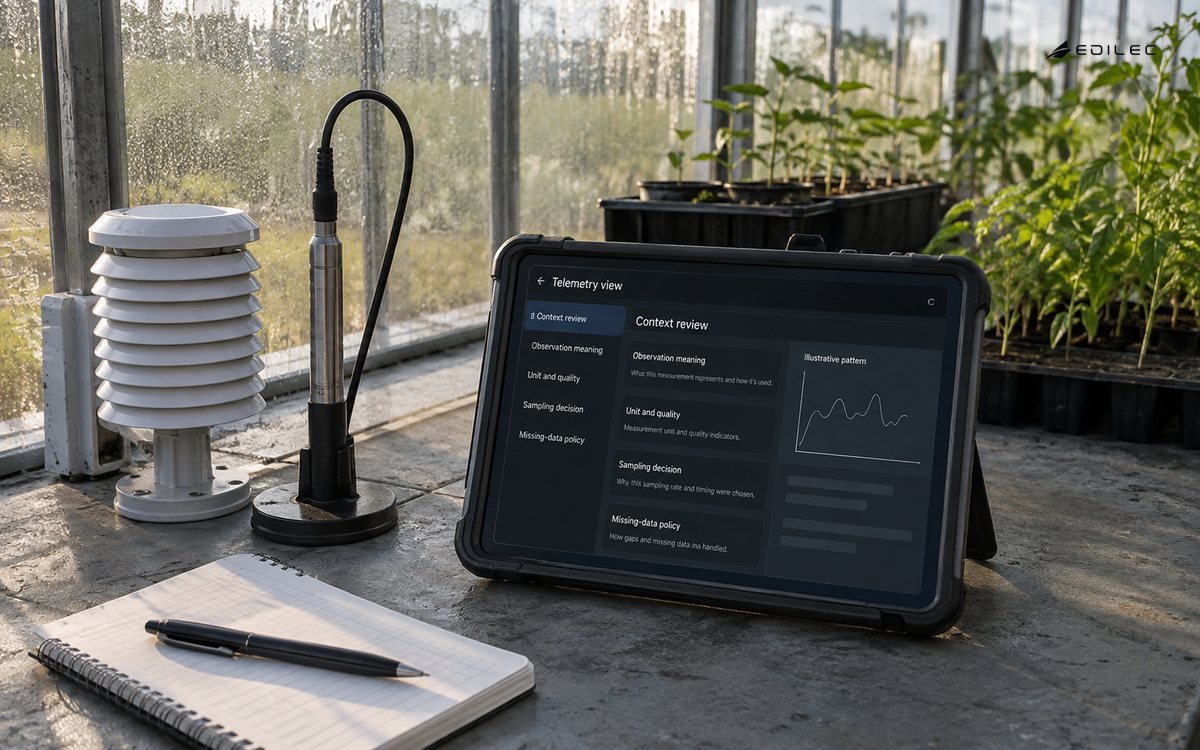
| Telemetry field | Example rule | Failure to expose |
|---|---|---|
| Value and unit | Publish a numeric value with an explicit unit. | A conversion is applied twice. |
| Observed time | Use device time plus receipt time and clock status. | Late data appears current. |
| Quality state | Carry valid, estimated, stale, or faulted state. | A dashboard hides uncertainty. |
| Event identity | Use sequence or event ID with reset behavior. | Duplicates become false incidents. |
Choose sampling and transport from the decision the telemetry supports. More messages do not automatically create better visibility; they can increase battery use, link contention, storage, and review burden. Test a representative window with normal activity, a quiet period, a device restart, delayed delivery, and a clock correction. OpenTelemetry’s specification gives useful language for signal context and correlation, while NISTIR 8259A helps connect telemetry capability to device lifecycle needs. The acceptance question is whether a person can act appropriately when telemetry is late, incomplete, or contradictory.
Selected references for this topic include OpenTelemetry specification, NISTIR 8259A, NIST SP 800-82 Rev. 3, NIST SP 800-213A. The selected publications anchor measured IoT telemetry; apply them with site procedures and deployment obligations.
For adjacent operating patterns, compare What Changes When IoT Telemetry Moves Into Production, IoT Telemetry Decisions That Matter before the First Build, Sensor Data Pipelines: Mistakes and Fixes. The neighboring references connect iot telemetry to its wider operating context.