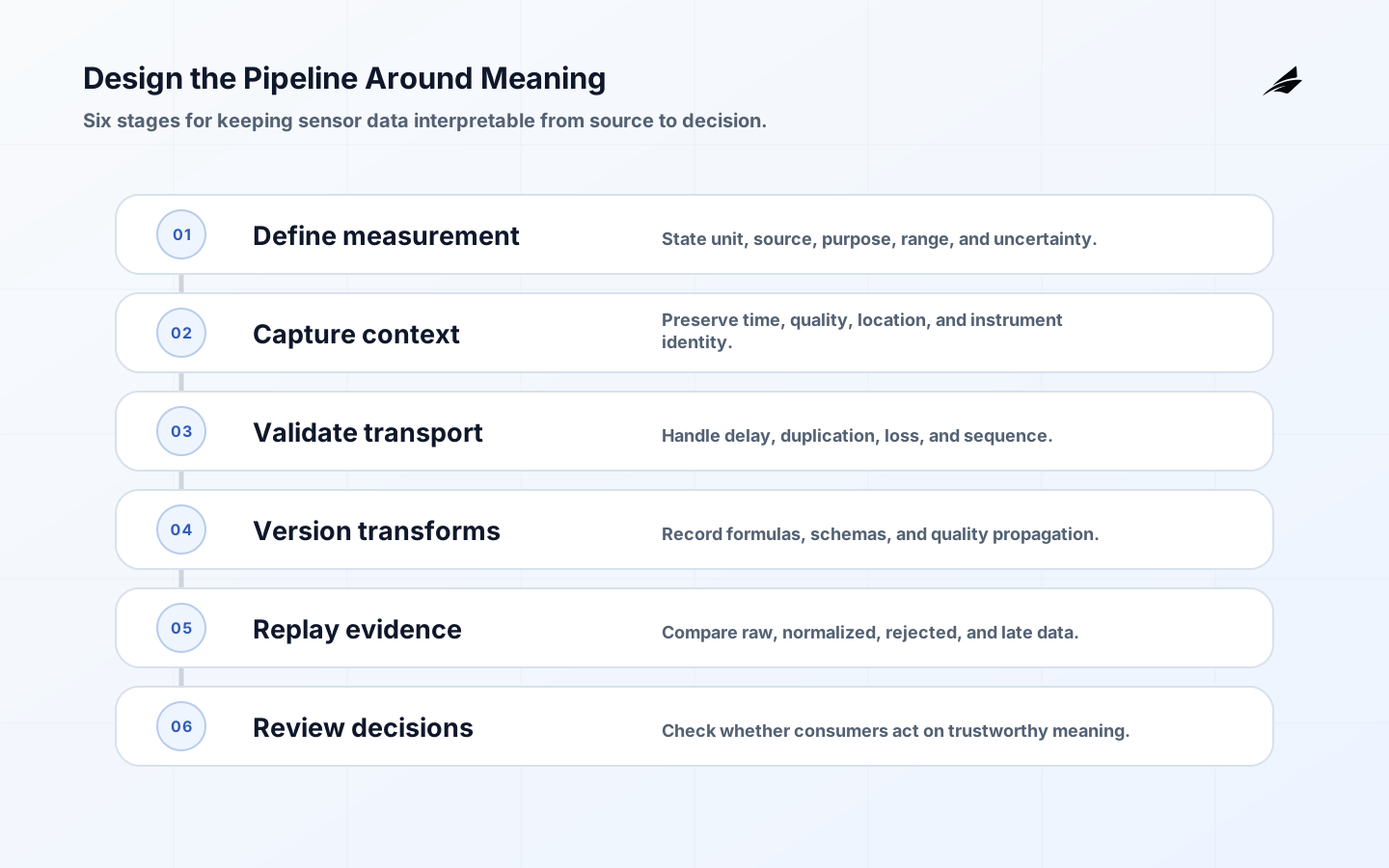
Sensor data pipelines should make a measurement more usable without stripping away the information needed to judge it. That requires more than moving data from a gateway to a warehouse. Preserve source identity, observation time, unit, quality, calibration or configuration context, and the transformation history that produced a derived value. NIST’s metrological traceability guidance emphasizes a documented chain and associated uncertainty for a measurement result. A pipeline cannot create that chain after the fact if it discarded the contextual evidence at intake.
Sensor pipeline reliability — Start with the consumption decision
Identify the users and decisions before selecting a storage pattern. A technician investigating an asset, an analyst comparing performance, and an automated alert can consume the same stream with different freshness, aggregation, access, and correction needs. Document the intended grain: one observation, one asset-hour, one work order, or one site-day. State how late data, corrections, and missing values appear to each consumer. This prevents a convenient aggregate from replacing a source record that is required for diagnosis, audit, or a later recalculation.
| Pipeline layer | Responsibility | Quality evidence |
|---|---|---|
| Intake | Accept identified, authorized source records | Schema, source identity, receipt time, and rejection reason |
| Raw retention | Preserve original observation context | Immutable record, unit, quality, and provenance |
| Transformation | Apply named calculation and version | Inputs, rule version, and output lineage |
| Serving | Expose data for a stated decision | Freshness, access policy, and known limitations |
Sensor pipeline reliability — Preserve source meaning at intake
Validate structure without silently repairing meaning. Reject or quarantine malformed records; mark plausible but questionable values with a quality state and reason. Keep observation and ingestion time separate, and preserve a producer sequence or stable event identifier where available. Normalize units through a visible conversion that records the original value and rule. When a field device changes firmware or configuration, carry that version so a later trend break can be investigated. The configuration and state-awareness capabilities in NISTIR 8259A are relevant because device state frequently explains a sudden change in data behavior.
- Retain raw observations with source identity and immutable receipt information.
- Validate schema, unit, range, time, and quality at the earliest useful boundary.
- Quarantine bad structure; do not transform it into a plausible normal value.
- Make every calculation and unit conversion versioned and reproducible.
- Attach calibration and configuration references where they affect interpretation.
- Document who may correct data and how the original remains visible.
Sensor pipeline reliability — Make transformations auditable
A transformation should have an owner, purpose, inputs, output contract, version, test cases, and a rerun policy. Summaries such as hourly averages need an explicit time zone, window boundary, treatment of gaps, and handling of outliers. Derived datasets should point back to their raw source range and transformation version. That allows a team to reproduce a report after correcting a defect instead of arguing over which spreadsheet was used. Use backfills carefully: label their scope, run them in isolation when needed, compare outputs, and publish the decision to replace or retain prior results.
Sensor pipeline reliability — Control access, retention, and change
Sensor data can expose operational throughput, location, customer behavior, and facility patterns. Apply least privilege to raw, derived, and administrative paths, and review exports as part of the pipeline’s design. NIST SP 800-82 Rev. 3 is a reminder that connected operational data has availability and safety implications, while NIST Cybersecurity Framework 2.0 offers a way to govern assets, detection, incident response, and recovery. Retention should be driven by reconstruction, legal, privacy, and cost needs, with deletion and access removal tested rather than assumed.
Sensor pipeline reliability — Detect drift and recover data trust
Operate quality checks for volume, latency, missingness, duplicate rate, schema changes, range violations, unit changes, clock shifts, and disagreement with expected patterns. Tie each check to an owner and decision: pause an automated use, annotate a dataset, open an incident, or run a controlled backfill. A successful recovery is not merely a green pipeline job. It shows which data was affected, what was corrected, whether derived outputs changed, and how users were informed. Keep the original evidence so the repair is explainable later.
| Data problem | Containment | Recovery proof |
|---|---|---|
| Schema changes without notice | Route data out of normal transformations | Contract updated and producer validated |
| Clock drift | Mark affected time window and avoid false ordering | Time source fixed and records reconciled |
| Bad conversion rule | Pause derived decisions and preserve prior output | Versioned backfill compared and approved |
| Source outage | Expose coverage gap rather than inventing continuity | Restored intake and consumer notification |
Sensor pipeline reliability — Run a pipeline acceptance exercise
Use a bounded source window to test the whole sensor pipeline: deliver valid observations, duplicate one, delay another, change a unit, introduce a schema field, and issue a corrected source record. Inspect the raw store, transformed datasets, and final operational view. Participants should trace each served value to its source identity, observation time, quality state, configuration or calibration context, transformation version, and access decision. Then rerun a calculation in an isolated target and compare counts and values with the published output. Differences should be explainable through a documented rule or known data condition, not an invisible job rerun.
Test governance at the same time. Attempt an unauthorized raw-data export, change a transformation rule, expire a source credential, and remove a device from inventory. Verify that access, lineage, and downstream communication reflect the changed state. When a quality gate fails, confirm the pipeline preserves the original record and sends a useful reason to the proper owner instead of converting it into a normal-looking aggregate. This exercise makes lineage practical: it proves a team can recover a trustworthy dataset after a defect and can tell users whether a report changed because the world changed or because processing was repaired.
Sensor pipeline reliability — Key takeaways
- Treat pipeline design as preservation of measurement meaning, not just transport.
- Keep raw facts, context, and quality evidence available for reconstruction.
- Give transformations versioned inputs, tests, owners, and reproducible outputs.
- State aggregation boundaries and missing-data behavior for each consumer.
- Protect raw, derived, and administrative paths with different access needs.
- Recover trust by explaining affected data and corrected results, not merely restarting jobs.
Sensor pipeline reliability — Frequently asked questions
- Should raw sensor data always be stored forever? No. Retention needs a documented balance of reconstruction, regulation, privacy, and cost; important context can be retained even when raw granularity changes.
- What is lineage in a sensor pipeline? It is the traceable path from a served value through transformation versions and inputs back to the originating observation and its context.
Give each high-value dataset a short data product record. Include its decision uses, owner, source populations, grain, freshness expectation, schema, quality checks, transformations, access rules, retention, correction policy, and known limitations. Publish the record where consumers plan work, and update it when a source, calculation, or access rule changes. This is not bureaucratic cataloguing. It gives analysts and operators a way to judge whether a dataset fits a new purpose without assuming an attractive table or dashboard carries its own provenance. It also makes a pipeline retirement or migration a managed communication event rather than a surprise disappearance.
Plan pipeline capacity around operational recovery as well as ordinary throughput. Estimate the source backlog after a credible outage, the time to validate and replay it, storage for raw evidence, and the impact of a backfill on serving workloads. Test these assumptions with representative data volumes. A pipeline that handles a quiet daily average but cannot recover a delayed site safely is not ready to support a time-sensitive operational decision.
Publish consumer-facing freshness and quality expectations with the dataset. A reliable pipeline does not promise that every value is current or final; it says what delays, corrections, and gaps mean. This gives operational teams the confidence to use data within its designed boundary and to recognize when they need a different source or a human review.
Give corrections a consistent consumer experience. A corrected value should identify the affected period, reason, transformation version, and whether downstream reports or alerts were recalculated. Consumers should not discover a material data repair by noticing a changed chart. Clear correction notices help operational teams decide whether to revisit a prior action.
Finally, make quality ownership visible in the products consumers use. A short status note and a named route for questions often prevent a questionable dataset from becoming an unexamined operational assumption.
Sensor pipeline reliability — Conclusion
A sensor pipeline becomes trustworthy when a downstream number can be traced to its source, context, and transformation choices. Read How Operations Leaders Should Think About Sensor Data Pipelines, Sensor Data Pipelines for Connected Systems, and What Changes When Sensor Data Pipelines Move into Production.
Sensor pipeline reliability — Design the Pipeline Around Meaning
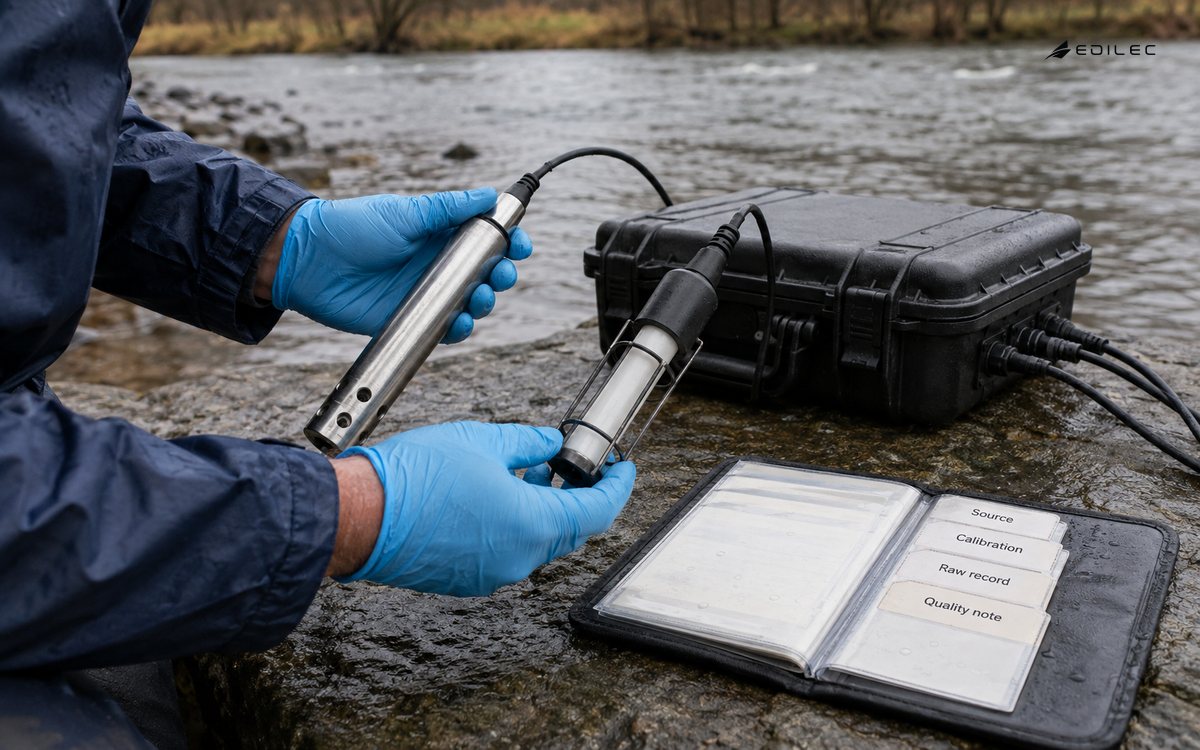
A sensor data pipeline is trustworthy only when a later consumer can tell what a value meant at the moment it was observed. Keep measurement time separate from gateway receipt time, processing time, and publication time. Preserve unit, calibration or instrument identity, quality state, sequence, location, and source version. If a transformation converts a raw voltage into a pressure estimate, record the formula or version that made the conversion. Without that lineage, a polished dashboard can hide a broken assumption while the original evidence is already gone.
| Pipeline contract | Required detail | Review question |
|---|---|---|
| Measurement | Unit, range, source, calibration, and observed time. | Can an operator interpret the number? |
| Transport | Receipt time, sequence, retry, and duplicate behavior. | Can delay or replay be reconstructed? |
| Transformation | Formula, version, quality propagation, and owner. | What changed the value? |
| Consumption | Decision, freshness limit, and recovery path. | What happens when evidence is missing? |
Build a small replayable slice before scaling ingestion. Choose one device class, one operating window, one known interruption, and one downstream decision. Compare raw records with normalized output, late arrivals, duplicate handling, and rejected data. NIST’s metrological traceability guidance is a useful reminder that a result needs an unbroken chain of comparisons and stated uncertainty; NISTIR 8259A helps teams account for device capability and lifecycle concerns. The pipeline should make uncertainty visible instead of forcing every consumer to guess whether a value is current, estimated, or incomplete.
Selected references for this topic include NIST Metrological Traceability: Frequently Asked Questions and NIST Policy, NIST Cybersecurity Framework 2.0, NIST SP 800-82 Rev. 3: Guide to Operational Technology Security, NISTIR 8259A: IoT Device Cybersecurity Capability Core Baseline. The selected publications anchor sensor pipeline reliability; apply them with site procedures and deployment obligations.
For adjacent operating patterns, compare How Operations Leaders Should Think About Sensor Data Pipelines, Sensor Data Pipelines for Connected Systems: a Practical Guide, What Changes When Sensor Data Pipelines Move Into Production. The neighboring references connect a field guide to sensor data pipelines for growing teams to its wider operating context.