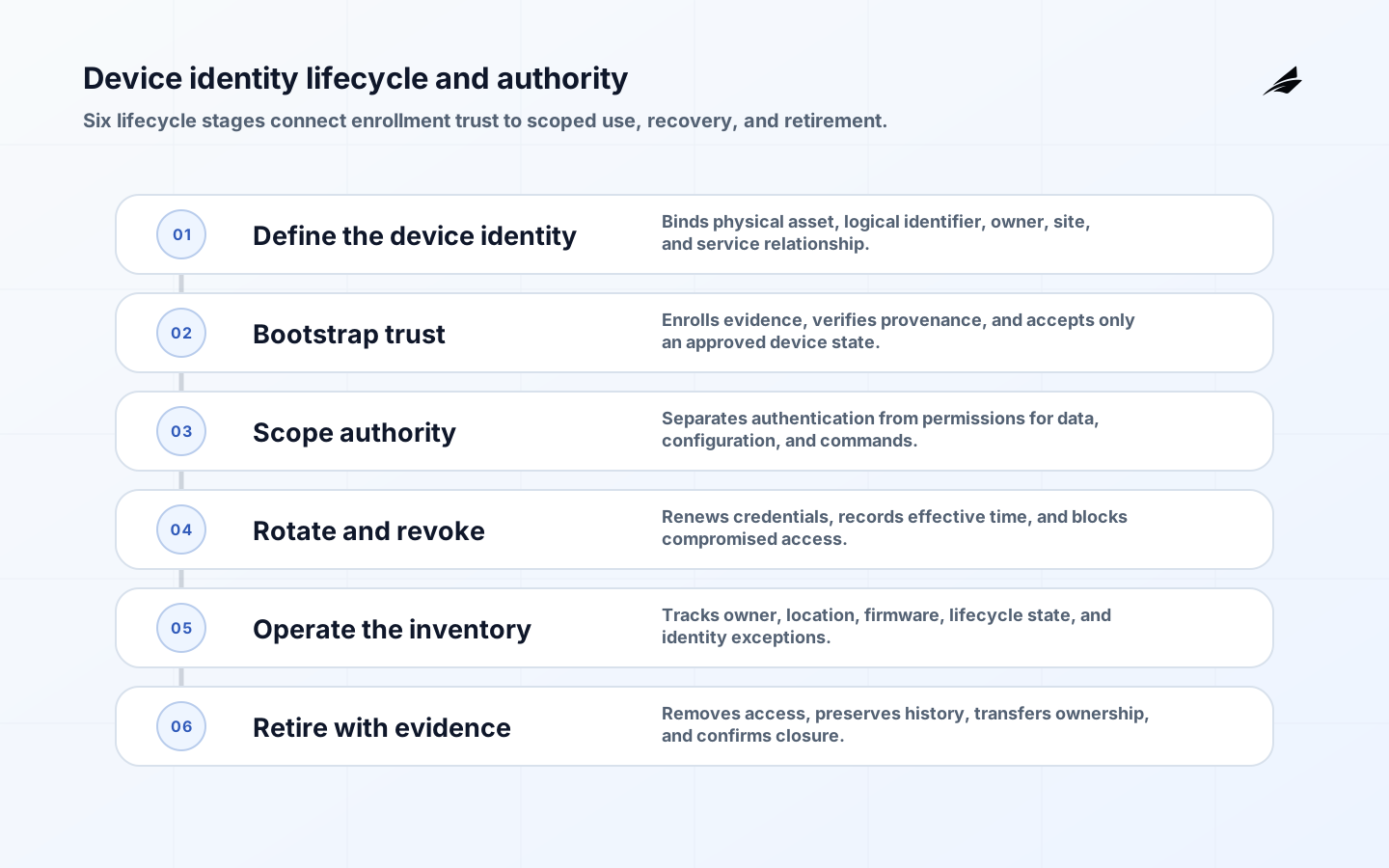
Device identity answers “which device is this, who owns it, and what may it do here?” A serial number in a database is not automatically authenticated identity, and authenticated identity is not automatically authorized for every site or command. NIST's device identity guidance separates unique identification, actions based on identity, and authentication support. Use those distinctions to design enrollment, operation, transfer, replacement, and retirement as one lifecycle.
Define what identity must prove
Decide whether the system needs to distinguish a physical unit, logical endpoint, software instance, site assignment, or all four. A device may have factory, local network, and service-facing identifiers. Preserve their relationship without treating a mutable label as root of trust. Write which identity is used for authentication, authorization, telemetry attribution, support, and inventory.
Identity has a privacy boundary. A manufacturer identifier may reveal product or ownership details a local operator does not need. Minimize what crosses service boundaries, protect lookups, and define who may link a device to a person, customer, location, or shipment. This matters when devices move between sites or owners.
Choose a root of trust and enrollment path
Enrollment should establish that a device is genuine enough for the domain, assign it to correct owner or site, and provision needed credentials. RFC 8995 BRSKI describes automated bootstrap using manufacturer-installed identity and an authorizing service, but constrained devices may need another protocol or assisted process. The key decision is mutual authentication, authorization, and auditable acceptance.
Plan factory, warehouse, installation, replacement, reset, transfer, and recovery. Record requester, evidence checked, policy decision, credential issued, and expiry. Do not let a device enroll merely because it can reach the registrar. Keep an explicit allowlist, ownership record, or provisioning approval where risk requires.
| Lifecycle stage | Identity decision | Evidence |
|---|---|---|
| Enrollment | How is device authenticated and accepted? | Factory identity, approval, credential |
| Operation | Which resources and actions are allowed? | Policy, scope, audit event |
| Transfer | How does owner or site change? | Effective date and authority |
| Retirement | How is access removed and history kept? | Revocation, inventory, closure |
Separate identity from authorization
Identity answers who is speaking. Authorization answers whether that identity may publish, join a site, receive an update, or execute a command now. Use least privilege by resource, action, tenant, site, and time. A sensor may publish temperature but should not change a threshold; a gateway may relay traffic but should not impersonate every child device.
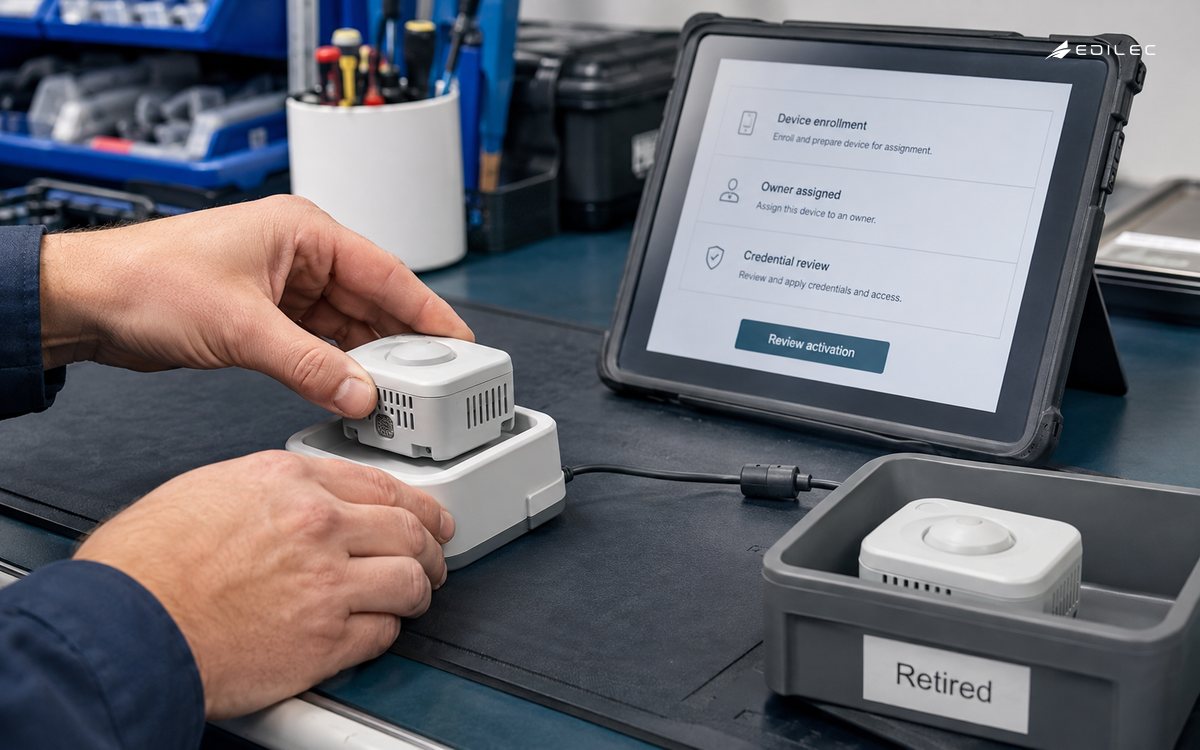
Keep policy decisions at the service boundary and derive target context from trusted records. When a device moves, update authorization with effective time rather than rewriting historical ownership. Review vendor and support access separately from device access. A valid identity should not carry more authority than its operating role needs.
Manage credentials across the lifecycle
Choose credential type, storage, rotation, revocation, renewal, and recovery before deployment. Hardware-backed keys help where supported, but the design still needs a path for expired certificates, lost connectivity, factory reset, clock error, and replacement. Protect bootstrap credentials from becoming permanent production credentials.
Make expiration safe. A device with expired credential may continue limited local function, buffer data, or request renewal, but it should not silently fall back to unauthenticated identity. Record renewal attempts and reasons. Test key rotation with old and new trust anchors during staged transition.
Make identity observable
Inventory should show stable identity, model, hardware and software versions, owner, site, credential state, last contact, and lifecycle status. Distinguish never enrolled, active, stale, quarantined, transferred, retired, and unknown. NIST's IoT baseline connects unique identification to access management, vulnerability management, and detection; use that as a reason to keep inventory accurate.
A support user needs a safe view of identity evidence without secret material. Responders need to find unusual enrollments, duplicate identifiers, impossible movement, failed renewals, and commands from retired devices. Keep events append-only or versioned so ownership transfer does not erase earlier history.
| Identity failure | Containment | Recovery proof |
|---|---|---|
| Unknown device | Quarantine or read-only | Reason and approval |
| Duplicate identifier | Stop conflicting authority | Resolved mapping |
| Expired credential | Limit access; renew trusted path | New credential and test |
| Lost device | Suspend, revoke, assess impact | Inventory and command reconciliation |
Build identity into data and command paths
Every telemetry record and command should carry verifiable device or workload identity plus authoritative mapping to site, tenant, and capability. Gateways need a clear rule for whether they authenticate themselves, child devices, or both. Avoid designs where a gateway rewrites child identity without evidence.
Use identity at enforcement. A broker can authenticate a connection, but the service still checks topic, resource, tenant, action, and lifecycle state. Distinguish authentication failure, authorization denial, stale credential, unknown device, and suspended state so operators can respond correctly.
Pilot enrollment and retirement together
A pilot is incomplete if it proves only first enrollment. Include replacement, transfer, reset, renewal, duplicate ID, lost device, revoked credential, and retirement. Use real support staff with least privilege. Measure time to enroll, failure reasons, manual exceptions, duplicate detection, and time to remove access after retirement.
Choose cohorts with different manufacturers, firmware, connectivity, and ownership paths. Make policy visible. If a device cannot prove identity, safe outcome may be quarantine or read-only operation rather than silently continuing. Keep manual recovery with approver and expiry.
Design incident and recovery actions
When a key is suspected compromised, identify device, suspend or narrow authority, preserve evidence, rotate or revoke, and determine whether historical data or commands are affected. The process must work while device is offline. Revocation at service does not instantly change a disconnected device; define local safeguards and re-enrollment.
After recovery reconcile inventory, ownership, credentials, software, telemetry attribution, and pending commands. Record what could not be verified. Link to the device identity production guide and firmware updates checklist when identity and update authority are coupled.
Use a lifecycle identity checklist
Review unique identification, authentication, authorization, secret protection, enrollment approval, expiry, rotation, revocation, transfer, replacement, retirement, privacy, audit, and support. For each item name owner and evidence. Test wrong model, wrong site, stale credential, duplicate ID, offline renewal, and factory reset.
A sound design lets an operator answer which device produced a value, which policy allowed an action, who owns it now, what authority it has, and how to contain it. If answers require a spreadsheet or engineer memory, the identity boundary is not ready to scale.
A device enrollment scenario
Make the identity registry authoritative for lifecycle state but not for every operational detail. It should answer whether a device is known, owned, enrolled, suspended, transferred, or retired, while telemetry and command services retain their own event evidence. Link the records by stable identity and effective time. This avoids one mutable inventory row becoming a substitute for history.
Enrollment should be observable from both sides. The device needs a reason for rejection or renewal failure that does not disclose secrets, and the registrar needs evidence of presented identity, policy decision, and resulting credential. A support operator can then distinguish an unknown shipment, wrong site, expired credential, and network problem without retrying blindly.
Plan ownership transfer as a security operation. Reassign site and policy, rotate credentials where required, review cached commands, and preserve the old owner's access boundary. Do not merely change a customer field in inventory. Verify that telemetry, support views, update targets, and alert routing use the new authority while historical records remain explainable.
Retirement is complete only when the device cannot create new trusted work. Revoke or expire credentials, remove it from command targets, close support routes, and record final contact. If the hardware may be reused, define a controlled reset and re-enrollment process. If it may be destroyed, define data and key handling. Keep the historical identity for investigation.
Identity failures should produce differentiated states. Unknown, duplicated, suspended, expired, revoked, and quarantined each require different owners and actions. A generic authentication error forces operators to guess and can encourage unsafe continuation. Make the states searchable and include the last policy or lifecycle event that caused the transition.
Review identity evidence during incident response. A device that appears to have moved impossibly, enrolled twice, or issued commands after retirement may indicate inventory error, credential compromise, or a real asset transfer. Preserve the timeline and correlate it with firmware, network, and telemetry changes. The registry is most valuable when it helps explain a sequence, not just a current label.
Choose identity recovery paths that match physical reality. A field technician may need to replace a unit without access to private keys, while security may need to suspend it immediately. Separate those powers, require evidence for replacement, and make final activation visible to both teams.
Test privacy and inventory queries with transferred and retired devices. A user should see only identities and site relationships their role permits, while authorized investigators can reconstruct prior ownership. This protects customers without sacrificing the timeline needed to understand a command or telemetry event.
Record the reason for every lifecycle transition, not only the resulting state. Enrollment, suspension, transfer, renewal, and retirement should link to an actor, policy, evidence, and time. Those records make identity review useful during both ordinary support and a security investigation.
Use the device identity checklist when turning these lifecycle decisions into a release or procurement review.
Where device identity controls access to physical or safety-sensitive systems, use NIST SP 800-82 Rev. 3 to review availability, segmentation, and recovery constraints with the identity lifecycle.
Key device-identity takeaways
- Define physical, logical, service, and ownership identities separately.
- Use authenticated identity as input to authorization, not authorization itself.
- Design enrollment, transfer, rotation, recovery, and retirement together.
- Keep identity evidence visible without exposing secrets.
- Test offline and exceptional lifecycle paths.
Frequently asked device-identity questions
Is a serial number enough for device identity?
A serial number is useful inventory evidence, but it does not prove that a connected endpoint possesses or controls that identity. Pair stable identification with authenticated credentials and a current authorization record.
What should happen when a device cannot authenticate?
Use quarantine, read-only local operation, or a renewal path. Avoid silent unauthenticated continuation, especially for commands or sensitive telemetry.
Conclusion: device identity in practice
Device identity is a lifecycle control, not a field in an inventory table. Give every identity a trust basis, scoped authority, owner, expiry, recovery path, and retirement record so connected operations remain accountable.