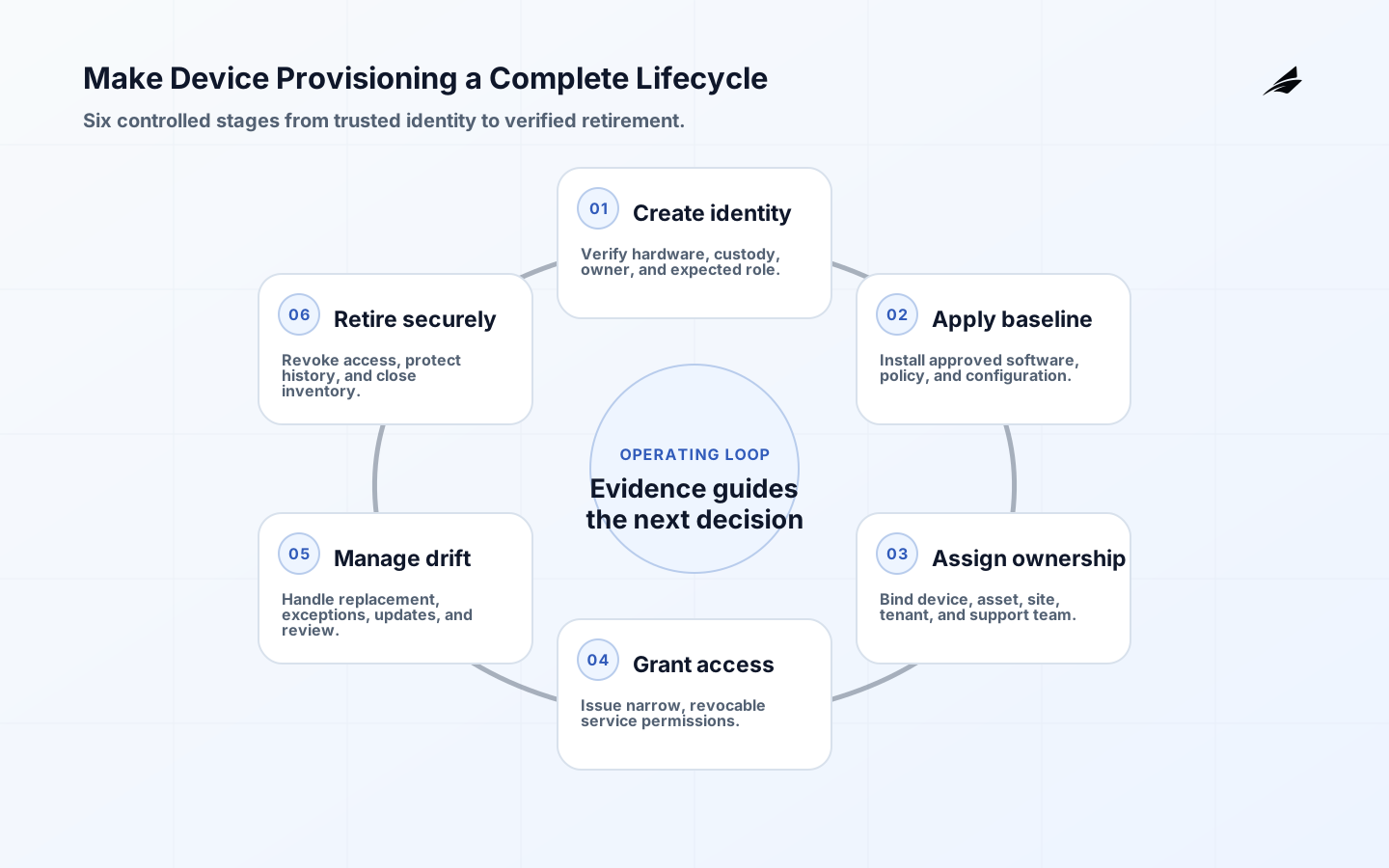
Device provisioning is the lifecycle that turns hardware into an accountable participant in a connected system. It includes more than installing firmware or copying a Wi-Fi password: the team must establish identity, apply a known baseline, assign ownership, grant only required access, handle replacement, and retire the device without leaving credentials behind. Growing teams need a repeatable path because manual exceptions multiply faster than the fleet and make it difficult to tell which devices are trustworthy.
Define the provisioning outcome
A provisioned device should have a stable record, verified hardware identity, approved configuration, named owner, site or asset relationship, current lifecycle state, and a path to revoke access. Start with the operating decision: is the device measuring, controlling, locating, or supporting another service? Device identity for connected systems helps separate device identity from the business asset it serves. Define what “ready” means for the operator who receives the device, not only for the engineer who enrolls it. Lifecycle context continues in Product provisioning context and Provisioning production changes.
| Provisioning record | Decision | Evidence |
|---|---|---|
| Identity | What proves this physical unit is the expected one? | Hardware identifier, certificate, attestation or custody record |
| Baseline | Which software and policy are approved? | Version, configuration hash, exception record |
| Ownership | Who supports it and what asset does it serve? | Team, site, asset relationship |
| Access | Which services may it reach? | Scoped credentials and authorization result |
| Lifecycle | How is replacement or retirement handled? | State transition and revocation record |
Establish a durable provisioning record
Create the record before the device joins production. Keep a hardware identity, device identity, asset identity, model, firmware baseline, intended site, owner, enrollment date, and lifecycle status. Do not rely on a mutable label or a technician’s memory. Record custody when a device moves through a warehouse or installer. The record should answer whether the unit is expected, where it is allowed to connect, and what action is safe if it disappears. NIST SP 800-213 is useful when converting device capabilities into procurement and acceptance requirements.
Secure enrollment and configuration
Enrollment should establish trust without putting a long-lived shared secret on every unit. Use a controlled bootstrap, verify the expected hardware, issue a unique credential, and limit what the device can do before its final assignment is approved. Apply a known software and configuration baseline, then record the result. TLS 1.3 protects transport, but encryption does not replace identity verification or authorization. Test failed enrollment, duplicate identity, expired credential, and an attempt to connect from an unapproved site.
- Keep bootstrap permissions narrower than production permissions.
- Separate device identity from the asset, tenant, and installation record.
- Make firmware, configuration, and policy versions visible to support staff.
- Require an explicit approval when a device deviates from the baseline.
- Make replacement and retirement first-class lifecycle transitions.
Assign ownership and least-privilege access
A device is not ready because it is online. Name the team accountable for its health, the person or system that may change its configuration, and the services it may reach. Keep telemetry permissions separate from command permissions and restrict both by device role, site, or tenant. NIST SP 800-207 frames access as an explicit, continually evaluated decision; that principle is valuable for fleets where device location and ownership change. Log access decisions so a support person can explain why a connection was accepted or refused.
| Lifecycle moment | Control | Test |
|---|---|---|
| Bootstrap | Short-lived, scoped enrollment authority | Unknown unit cannot receive production access |
| Assignment | Bind identity to approved asset and site | Move requires explicit reassignment |
| Operation | Least-privilege service access | Telemetry cannot issue commands |
| Replacement | Revoke old unit and preserve history | Old credential fails after cutover |
| Retirement | Remove access and protect residual data | Inventory, broker, and secrets agree |
Handle replacement, drift, and exceptions
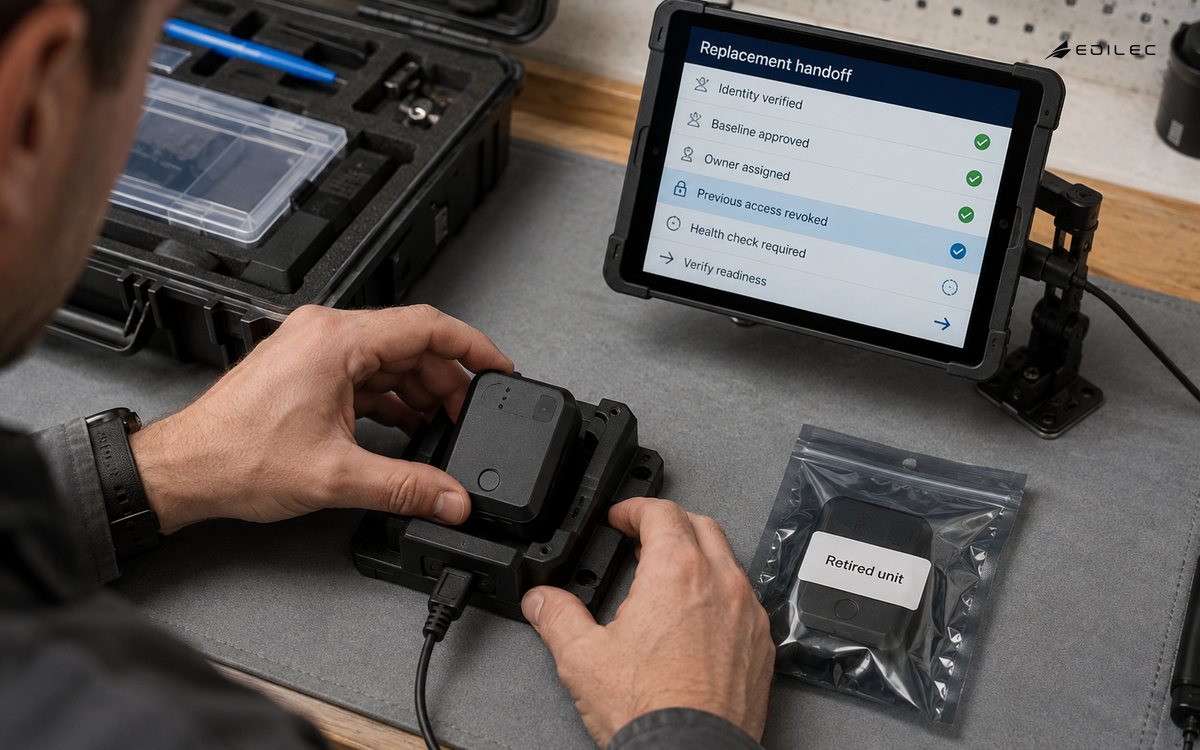
Plan for a device to fail, change hands, miss updates, or arrive with the wrong baseline. A replacement may take over an asset relationship while the retired unit remains valuable evidence in historical records. A drifted unit should have a visible state and a defined remediation path, not an invisible exception. Decide when the system quarantines, limits, or disconnects a device and who may restore it. Preserve the reason and approving authority so the team does not repeatedly rediscover the same exception during an incident.
Operate provisioning as a service
Monitor enrollment success, time to assignment, failed authentication, baseline drift, credential age, missing heartbeats, and retirement completion. A dashboard should distinguish a device that is offline from one that is online but not authorised. Review exceptions by age and owner. NISTIR 8259A offers a useful capability baseline for device cybersecurity; adapt it to the fleet’s actual risks and support model. Provisioning deserves a runbook because its failures often appear first as missing telemetry or unexplained access.
Accept a real fleet slice
Pilot with enough variety to expose lifecycle gaps: one new device, one replacement, one temporary exception, and one retirement. Verify identity, baseline, authorization, site assignment, telemetry, update handling, and removal. Simulate a lost device and an expired credential. Ask an operator to find the current owner and safe next step without contacting the original installer. Acceptance is complete when the record, device behaviour, and support workflow agree.
Add a post-enrollment health check
After enrollment, verify more than connectivity. Confirm that the device reports the expected identity, publishes the required telemetry, receives only the intended configuration, shows a current software baseline, and appears in the operator view with the right owner and site. If the device cannot complete the health check, keep it in a constrained state and preserve the failure evidence. This prevents a technically online unit from being mistaken for an operationally ready one.
Make the check repeatable after replacement or reassignment. A device that moves from one asset to another may keep its hardware identity while its permissions and reporting context change. Verify that historical records remain associated with the original relationship and that new data uses the new assignment. Re-run authorization and alert tests after the change rather than assuming the previous state still applies.
Provisioning should leave a device easier to support than it was before enrollment. The record should expose the current lifecycle state, owner, baseline, credential status, last contact, and open exception without requiring a database join that only engineering understands. When the field team can answer those questions at the handoff, incidents are shorter and replacements are less likely to create a second identity problem.
Make exceptions part of the lifecycle
A mature provisioning path treats exceptions as states with owners rather than as informal bypasses. A device may need a temporary network allowance during installation, a delayed firmware update because of a service window, or a replacement credential while a unit is being recovered. Record the reason, scope, approving authority, start time, expiry, and remediation step. A support person should be able to see whether the exception is still safe. If the same exception appears repeatedly, change the baseline or workflow instead of extending it indefinitely.
Inventory reconciliation is an important control. Compare the provisioning record with the fleet’s observed connections, physical inventory, asset system, and broker or gateway identities. Investigate a device that reports from an unexpected site, an identity that has never connected, and a record that remains active after retirement. Reconciliation does not require a perfect real-time mirror; it requires a known cadence, clear discrepancy classes, and a person or service responsible for closing them.
Updates should preserve the link between identity and baseline. Before applying firmware or configuration, verify the target, eligibility, package integrity, rollback path, and expected post-update state. Afterward, record the result and keep a device visibly pending if the new state cannot be verified. A successful transfer is not the same as a successful update. The NIST IoT device baseline is useful for keeping update and configuration capability in the lifecycle discussion.
Design the handoff between engineering, operations, and field service. Engineering may own the enrollment mechanism, operations may own access and monitoring, and a field technician may own physical custody. Define what each role can see and change, which evidence must be attached to a ticket, and when a device can move from pending to active. Clear handoffs reduce the temptation to share credentials or mark a record active simply to make a dashboard look complete.
| Exception or check | Visible state | Required follow-up |
|---|---|---|
| Temporary access | Approved with expiry | Remove or renew with authority |
| Baseline drift | Quarantined or constrained | Remediate and verify |
| Inventory mismatch | Reconciliation discrepancy | Confirm custody and assignment |
| Update uncertain | Pending verification | Check version and rollback |
| Role handoff | Owner transition recorded | Confirm permissions and runbook |
The checklist should also state what evidence is sufficient to reopen a quarantined device. Re-enrollment may require a fresh identity proof, approved baseline, owner confirmation, and a successful health check; a simple switch from disabled to active is not enough. Make recovery as deliberate as enrollment, and record who approved it. This prevents an urgent field repair from quietly bypassing the controls the checklist was meant to establish.
Provisioning lifecycle takeaways
- Provisioning creates a durable relationship between hardware, identity, asset, owner, and policy.
- Use unique, revocable credentials and keep bootstrap authority narrow.
- Make baseline, drift, replacement, and retirement visible to operators.
- Separate telemetry access from command authority.
- Test the full lifecycle with real fleet variation before standardising it.
Provisioning lifecycle questions
Can a small team provision devices manually?
It can begin manually if every step is recorded, repeatable, and reviewable. Automate the identity, baseline, and revocation steps as soon as volume or consequence makes memory an unsafe control.
Why separate device identity from asset identity?
Hardware can be replaced while an asset or service relationship continues. Separating the identities preserves history and makes replacement, reassignment, and retirement unambiguous.
Conclusion: a supportable fleet
A growing fleet needs device provisioning that remains understandable after the original installer has moved on. Establish identity and ownership, apply a tested baseline, grant narrow access, record exceptions, and rehearse replacement and retirement. The result is a connected fleet that can grow without turning every new device into a new trust decision.