How Operations Leaders Should Think About Sensor Data Pipelines
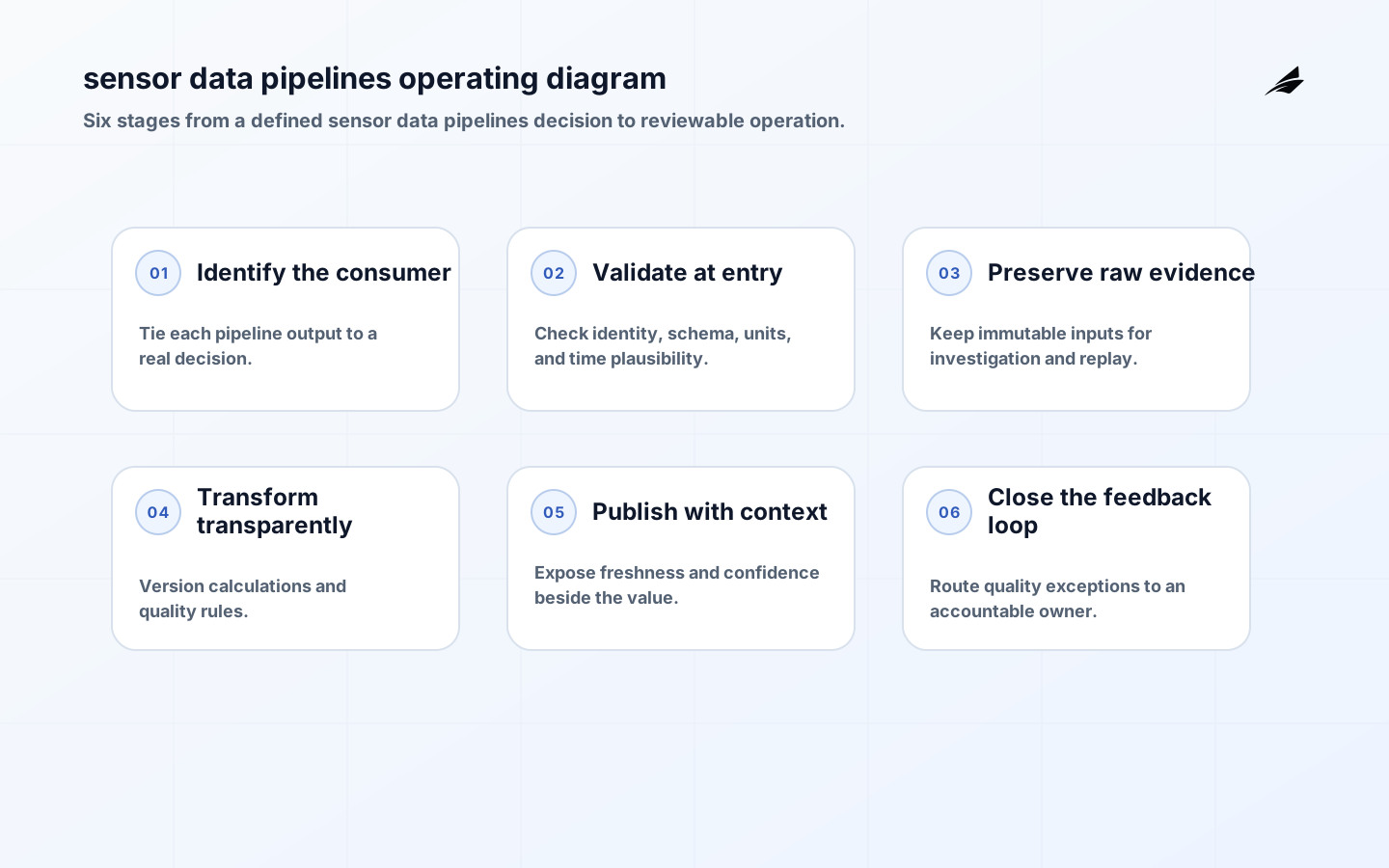
Sensor data pipelines are not merely a technical capability; it is the point where a field signal, software decision, and operating responsibility meet. For operations leaders accountable for reliable data-driven work, the useful question is whether a pipeline is an operational product whose quality gates must make stale, malformed, and implausible data visible before action. That question forces a concrete design conversation about the event, the owner, the evidence, the cost of being wrong, and the recovery path. This guide treats sensor data pipelines as an operating capability: define what must be true, make the system explain its result, and keep enough evidence to improve it after real work begins.
Set the sensor data pipelines operating boundary
Start with the route from ingestion through validation to a named consumer and feedback channel. The first release should serve turn device readings into trusted operational inputs with traceable quality checks and accountable exception handling. Write down an incoming reading that feeds a dashboard, maintenance rule, customer report, or safety review, who is allowed to act on it, and the consequence when the signal is absent, delayed, or disputed. This prevents architecture from becoming a catalogue of services. A boundary is useful only when it names what the team will deliberately not automate yet, the manual fallback that remains safe, and the evidence that shows whether the workflow created a better result. The Apache Kafka design documentation is a useful reference for framing capabilities as support for controls and decisions rather than as disconnected features.

| Decision | Question to settle | Evidence to keep |
|---|---|---|
| Purpose | Which decision does sensor data pipelines improve? | Named decision owner, expected action, and success condition. |
| Scope | What asset, site, customer, or time window is in the first release? | Stable identifiers, lifecycle state, and accountable team. |
| Freshness | How old can information be before it is unsafe or merely less useful? | Source time, receipt time, and a visible freshness rule. |
| Fallback | What should people do when the system cannot decide safely? | User explanation, escalation route, and recovery record. |
Write a sensor data pipelines contract people can operate
The contract is more than a payload or screen specification. It should state which facts are authoritative, what they mean, how change is represented, and how exceptions are handled. For sensor data pipelines, retain source device, timestamp, unit, schema version, calibration state, quality result, transformation version, and destination. Give each change a correlation identifier and a reason that a responder can follow without reconstructing the story from several tools. Where devices or services exchange messages, the OpenTelemetry documentation provides a disciplined vocabulary for identity, session, delivery, and protocol behavior. That vocabulary helps teams separate a transient transport failure from a domain outcome that needs human review.
- Name one accountable owner for the sensor data pipelines decision, its data contract, and its exception queue.
- Version rules and schemas so a later investigation can reproduce the context that led to an action.
- Give operators a concise reason, not a silent failure or an unexplained confidence score.
- Make every manual override narrow, time-bounded, attributable, and easy to review.
Build controls around sensor data pipelines
Design for the ordinary path and the uncomfortable one. The important failure is mixing late and current readings, hiding validation drops, or allowing a dashboard to imply certainty the data does not have. Preventive controls should constrain authority before the side effect, while detective controls should preserve enough context to diagnose the result. The NIST calibration services explains why delivery and state semantics need deliberate choices; the OWASP Logging Cheat Sheet is valuable for connecting logs, traces, and metrics across the path. Together, they support a practical rule: do not claim reliability from a single component. Prove how the decision survives retry, restart, handoff, and a person correcting an exception.
| Failure mode | Preventive control | Operating signal |
|---|---|---|
| Unknown or stale context | Require a trusted identity and reject ambiguous input. | Rejected requests by reason, source, and site. |
| Duplicate or reordered work | Use durable identifiers, sequence rules, and idempotent handlers. | Duplicate suppression, replay outcomes, and sequence gaps. |
| Unexplained action | Record actor, rule or policy version, target, and correlation ID. | Audit completeness and investigation time. |
| Unsafe exception | Use reviewed, narrowly scoped overrides with expiry. | Override age, approver coverage, and post-expiry activity. |
Implement sensor data pipelines as a thin, testable path
For sensor data pipelines, build the first path from a real example rather than a diagram of every possible future integration. Create a fixture for normal input, delayed input, malformed input, duplicate input, and a legitimate human correction. Test the policy boundary where a change can cause effect, then test again through background jobs, caches, mobile clients, and support tools. Keep configuration and credentials separate from business data so changes can be reviewed and rolled back. The implementation artefact worth keeping is a short map from every input and side effect to its owner, validation rule, and observable result.
Release in slices. Begin with observation where it is safe, establish a baseline, enforce on a small cohort, and widen only when the team can explain denials and recovery outcomes. A sudden rise in exceptions may reveal an integration defect, a new operating condition, or an overly narrow rule. It is evidence to investigate, not a reason to silently disable the control. This approach also creates a useful conversation with adjacent teams working on event streaming, sensor calibration data, connected operations: shared identity, time, and asset records should be coordinated before workflows multiply.
Measure sensor data pipelines in operational terms
Measure sensor data pipelines through freshness percentile, validation failure rate, late-arrival rate, lineage coverage, pipeline recovery time, and unresolved data exceptions. Pair reliability measures with an outcome measure that matters to the operating team, such as avoided repeat work, reduced time to make a safe decision, or better completion evidence. Break dashboards down by site, device cohort, software version, and failure reason; averages hide the exact edge conditions that create support burden. Review a small sample of resolved and unresolved exceptions each week. The goal is not a perfect dashboard. It is a feedback loop that shows whether the system made work more trustworthy.
Recover sensor data pipelines without losing the history
For sensor data pipelines, recovery should restore a safe operating state and preserve the reason the system reached it. Define who can pause processing, isolate an affected asset or cohort, correct a trusted record, and authorize replay or reactivation. Do not substitute a default identity, discard a failed message, or merge conflicting records merely to make a queue look healthy. The recovery runbook should include the decision boundary, customer or operator communication, evidence retention, and a post-incident test that proves the same condition will be visible next time.
| Review cadence | What to inspect | Decision |
|---|---|---|
| Each shift or day | Open exceptions, stale inputs, and blocked work. | Escalate items that exceed the operating window. |
| Each release | Policy, schema, configuration, and recovery changes. | Approve, roll back, or add a targeted guardrail. |
| Each month | Metric trend, support evidence, and manual overrides. | Retire noise, tune thresholds, or improve training. |
| After an incident | Timeline, owner handoffs, and missing evidence. | Strengthen the contract or runbook before scaling. |
Key takeaways
- Sensor data pipelines need a bounded operating decision before it needs more platform surface area.
- Identity, time, ownership, and exception evidence should travel with every consequential action.
- Test replay, degraded connectivity, and human correction as first-class product paths.
- Use measured exceptions to improve the rule instead of masking them with manual workarounds.
- Scale only after the team can explain the cost, recovery path, and outcome for the first workflow.
Frequently asked questions about sensor data pipelines
What should be designed first? Start with the operating decision and the smallest verifiable path to it. For sensor data pipelines, that means defining an incoming reading that feeds a dashboard, maintenance rule, customer report, or safety review, the trusted source, the accountable owner, and the safe behavior when information is incomplete. A technology selection made before those facts are clear often optimizes for a benchmark instead of the work people actually need to do.
How much evidence is enough for sensor data pipelines? Keep the identifiers, timestamps, policy or configuration version, actor or service, and outcome needed to answer a reasonable incident or support question. The right amount depends on impact and retention obligations, but it should be possible to distinguish a bad input, a denied action, a delivery failure, and a human override without guessing. Protect that evidence with access controls and retention rules rather than collecting every possible detail.
When should sensor data pipelines scope expand? Expand after the first cohort has stable ownership, understandable failure signals, and a tested recovery path. A low exception count by itself is not enough: it may mean that failures are invisible or being corrected outside the system. Look for consistent input quality, manageable support demand, and evidence that the outcome improved before adding another site, device type, or integration.
Conclusion: make sensor data pipelines accountable
The durable version of sensor data pipelines is a system that can explain what it knew, why it acted, who owns the next step, and how it recovers when reality disagrees. Keep the first workflow narrow, instrument its weak points, and let the operating evidence decide what to build next. That is how connected work becomes easier to run rather than simply more connected.