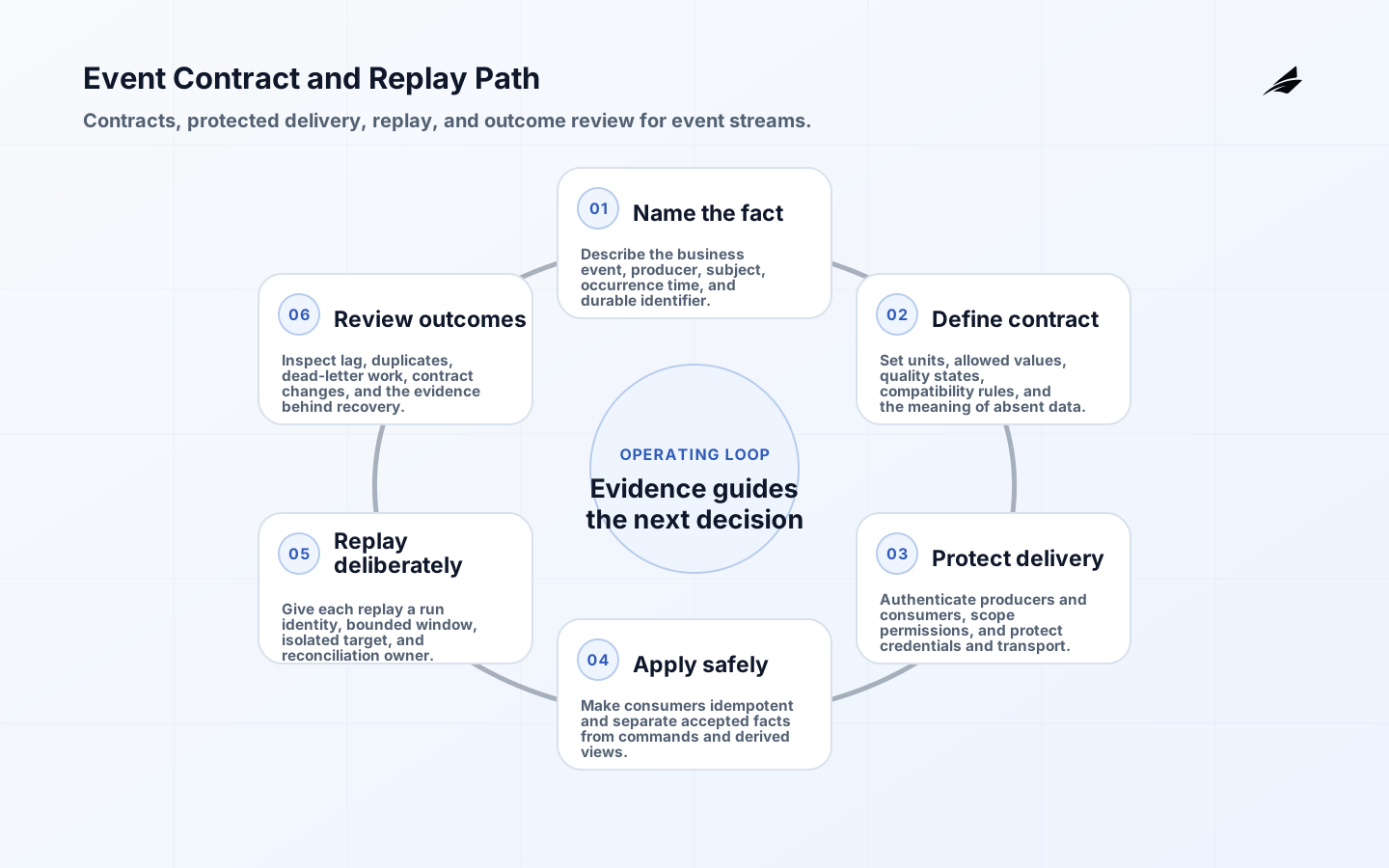
Event Streaming Before the First Build is a practical event streaming guide for teams that need a trustworthy operating path. A practical guide to event streaming for connected operations: define event contracts, preserve evidence, and make replay and recovery safe contract. The decision is not whether a component can connect or move data; it is whether people can explain identity, authority, state, evidence, and recovery when normal conditions change replay.
Start with the event streaming decision
Write one sentence that names the actor, decision, authoritative input, and consequence of a wrong result. “A maintenance planner sees a confirmed high-temperature event and opens a review” is much clearer than “send telemetry to the platform.” Separate observations from commands and keep a command acknowledgement distinct from a later observation that proves the physical change occurred. For each event, specify who owns the producing system, who may consume it, retention needs, and whether the event is a notification, a state transition, or an audit record consumer. This prevents a convenient integration feed from quietly becoming the only evidence for a consequential operating decision runbook.
| Contract field | Why it matters | Practical check |
|---|---|---|
| Event identifier | Lets consumers recognize a retry or replay | Reprocess the same record without creating a second work order |
| Event and ingest time | Separates when a condition happened from when it arrived | Show both times in troubleshooting views |
| Schema version | Makes change explicit rather than implicit | Reject or route unknown versions deliberately |
| Producer identity | Connects a fact to an accountable source | Record the device, gateway, or service principal |
Design event contracts that survive change
A contract is an agreement about meaning, not simply a JSON shape lag. Give fields units, allowed values, null rules, quality states, and a compatibility policy owner. A temperature without a unit, sensor identity, calibration context, or quality flag cannot support the same decision as a verified measurement contract. Add new optional data before retiring old data; do not repurpose a field because it is available replay. Contract tests should cover producer and consumer expectations, including malformed input and a producer one version ahead consumer. The configuration and cybersecurity-state capabilities described by NISTIR 8259A reinforce the same discipline: connected devices need identifiable configuration and observable security state throughout operation.
- Name the business or operational owner for each consequential topic.
- Publish examples for normal, delayed, duplicate, and rejected events.
- Treat unit, time basis, and quality as contract data, not comments.
- Version schemas and preserve a documented compatibility decision.
- Give consumers an explicit rule for unknown values and unknown versions.
- Keep command requests separate from evidence that a command took effect.
Handle ordering, retries, and idempotency honestly
Global ordering is expensive and often unnecessary runbook. Decide the smallest entity for which sequence matters, such as one asset, work order, or customer account, then include that entity key and an ordered sequence where the source can provide one lag. Consumers should be idempotent: processing the same event twice yields the same durable outcome owner. That usually means a transaction records the event identity with the business update, or a consumer uses a state comparison that makes an older event harmless contract. Do not hide a sequence gap by applying the next message blindly replay. Flag the gap, retain the evidence, and use a defined reconciliation path when the missing fact changes the decision consumer.
Secure the stream boundaries
A broker is not a neutral trust zone. Authenticate producers and consumers, scope topic permissions to the minimum useful path, protect credentials, and log administrative changes runbook. NIST SP 800-207 emphasizes evaluating access with identity and policy rather than trusting network location alone; that is directly relevant when a gateway, cloud service, and support tool share a stream. Keep sensitive fields out of broad topics where possible, and define whether downstream services receive a reference, a redacted event, or approved data lag. Security reviews should include replay permissions, dead-letter access, service accounts, and how an emergency integration is removed owner.
Make replay a controlled recovery tool
Replay is powerful because it can repair an outage, rebuild a derived view, or validate a new consumer against past behavior contract. It is dangerous when the original event is mixed with today’s decisions replay. Build a replay mode that identifies its run, chooses an offset or time window, directs results to an isolated target when appropriate, and captures counts for read, accepted, skipped, and failed records consumer. A recovery owner must decide whether to merge the result, discard it, or reconcile it manually runbook. This is also where the NIST SP 800-137 functions are practical: govern the process, detect anomalous outcomes, respond with a bounded action, and retain a recovery record.
| Scenario | Expected behavior | Evidence to retain |
|---|---|---|
| Consumer outage | Producer continues within retention and consumer resumes from a checkpoint | Lag, checkpoint, and recovery timestamp |
| Duplicate delivery | Consumer recognizes the same event identity | Idempotency decision and durable result |
| Schema mismatch | Message is quarantined or safely ignored | Version, producer, and owner notification |
| Replay request | Run is isolated and approval is recorded | Scope, operator, counts, and reconciliation result |
Operate event streaming with decision-grade signals
Measure the path that matters, not only broker availability lag. Track producer rejection, end-to-end delay by topic, consumer lag against the retained window, schema-validation failures, replay completion, and the age of unresolved dead-letter records owner. Pair each signal with an owner and a response threshold that reflects the operating consequence contract. A large backlog may be tolerable for a trend dashboard but unacceptable for a safety-related escalation replay. Sample payloads carefully and protect sensitive data in logs consumer. The aim is to let an on-call engineer distinguish “the broker is up” from “the fact needed for a decision arrived, was interpreted, and has an accountable outcome.”
Run an event-streaming acceptance exercise
Before broadening an event stream, run a single incident-shaped exercise with the people who own its runbook. Publish one valid event, publish the same event again, hold a later event behind it, introduce an incompatible schema, and take the consumer offline long enough to create a meaningful lag. Ask the operator to identify the source, event time, receipt time, contract version, current consumer position, and business result from ordinary tools. Then request an approved replay into an isolated target and compare its output with the original durable result contract. The exercise is successful only when the team can explain every difference, name the owner of each unresolved record, and return the consumer to normal operation without a manual database edit that bypasses the replay contract.
Use the findings to turn architecture choices into release criteria consumer. A producer should prove it cannot emit an unversioned consequential message runbook. A consumer should prove an event identity prevents a duplicate side effect lag. The topic owner should prove a schema change can be communicated before it harms a dependent workflow owner. The support owner should prove an alert distinguishes retention risk from ordinary processing delay contract. Finally, review what a replay operator can access: recovery permission must not become a standing ability to republish sensitive or production-changing events replay. This is a small, repeatable test, but it exposes the difference between a demo stream and an operational record system consumer.
Make event contracts and replay operational
Define facts, time, quality, delivery semantics, idempotency, and replay effects before a stream can influence a connected workflow runbook. Start with one bounded workflow, name the person accountable for the outcome, and define what must be true before the next system may act lag. Keep source identity, observed time, version, quality, and policy context close to the record that drives work owner. A successful connection or accepted payload is not proof that the business result is complete contract.

For a stream acceptance run, publish one valid event, one late event, one duplicate, and one event with unacceptable quality replay. Confirm how each consumer labels or rejects it, whether replay changes state, and who may approve a side effect consumer. Record event time, receipt time, schema version, consumer decision, and correlation identifier so the team can explain behavior after the broker is healthy again runbook.
| Decision | Rule to settle | Stream expansion evidence |
|---|---|---|
| Scope | Select one business event and consumer decision whose source, timing, replay scope, and consequence can be observed end to end. | Event sample, consumer owner, retention choice, replay exercise, and accepted outcome comparison. |
| Control | Separate producer, consumer, replay operator, and administrative permissions, with versioned contracts for each change. | Permission review, contract version, replay approval, and durable record of the consumer decision. |
| Recovery | Expose lag, duplicate delivery, schema rejection, and replay differences instead of treating the stream as healthy when it is merely connected. | Lag age, quarantine reason, reconciliation result, responder, and restored consumer position. |
Event Contract and Replay: Source References
For event contract and replay, MQTT Version 5.0 and Kafka Protocol Guide ground delivery behavior, RFC 8446: TLS 1.3 protects transport, and NIST SP 800-137 Continuous Monitoring supports continuous monitoring. Apply each reference to contract change, consumer access, replay, and lag review.
Event Contract and Replay: Related Operating Choices
Continue with Event Streaming: Cost and Scaling Guide, How Operations Leaders Should Think About Event Streaming, Event Streaming for Connected Systems: A Practical Guide when a neighboring boundary matters for ownership. The companion articles cover adjacent concerns around event streaming owner.
Event Contract and Replay: Event Contract and Replay: Decisions to Carry Forward
- Name the event streaming decision, owner, timing, and unacceptable failure before selecting technology for contracts.
- Keep identity, authority, time, quality, version, and state visible where they influence work during replay.
- Test normal, denied, delayed, duplicate, and recovered cases with the people who operate the result for consumers.
- Review one real exception and turn the correction into a maintained procedure in runbook; event replay review applies during the first checkpoint.
Event Contract and Replay: Event Contract and Replay: Decisions to Carry Forward — Owner review
- Define the decision before choosing topics or tooling.
- Make event identity, time, source, units, and quality first-class contract fields.
- Use entity-level ordering only where the decision requires it.
- Build idempotent consumers and a visible path for sequence gaps.
- Treat replay as an approved, evidenced recovery operation.
- Monitor decision delay and failed interpretation, not just infrastructure health.
Event Contract and Replay FAQ
- What is the first event streaming milestone? One producer, one consumer, an explicit contract, and proof that duplicate and delayed events do not produce an unsafe second outcome.
- Should every event be retained forever? No. Retention should follow operational reconstruction, legal, privacy, cost, and recovery needs; derived data can have a different lifecycle from the source event.
For a practical operating review, keep a compact event ledger for one selected topic contract. It should show the latest contract version, producers, consumers, retention setting, business owner, data owner, access policy, expected maximum delay, and recovery owner replay. Add three recent examples: a normal processed event, a rejected event, and an event recovered after interruption consumer. This prevents a team from treating an event stream as invisible infrastructure runbook. It also gives change reviewers a concrete way to ask whether a new consumer is relying on data it does not own, whether retention still supports the recovery claim, and whether the original producer can be contacted when a payload becomes ambiguous lag.
Conclusion: Keep event contract and replay reviewable
A dependable stream makes changing operational facts understandable after the first happy-path demonstration owner. Build on the cost decisions in Event Streaming: Cost and Scaling Guide, the leadership lens in How Operations Leaders Should Think About Event Streaming, and production practices in Event Streaming for Connected Systems contract. The durable result is not more messages; it is a recoverable decision trail replay.