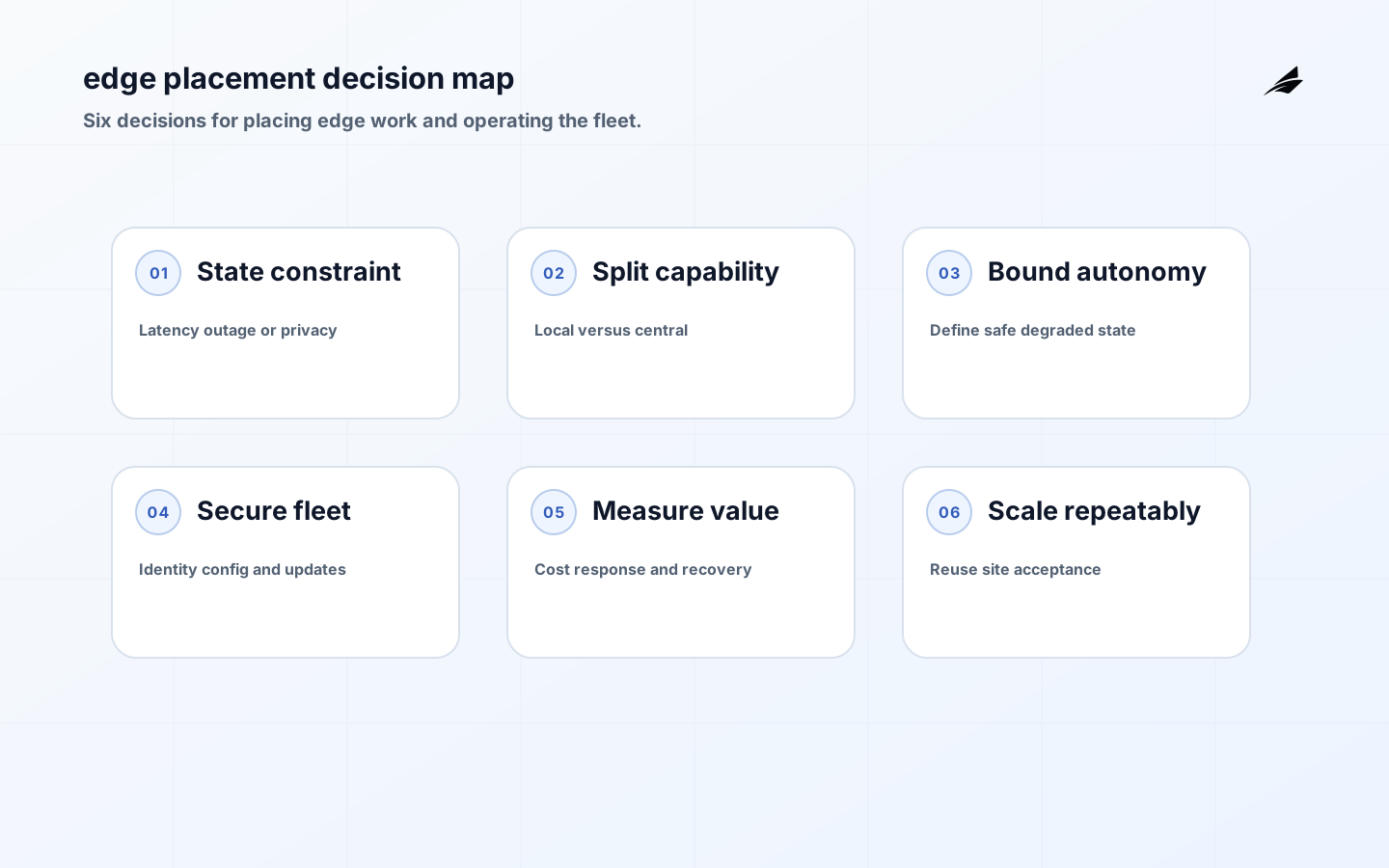
Edge computing earns its complexity only when a specific constraint justifies placing work near the process. That constraint may be response time, intermittent connectivity, data movement, local privacy, or a device integration that cannot rely on a central round trip. Before the first build, decide which functions require local authority, which need central history, how disconnected work is bounded, and how a replacement node becomes trustworthy. Those decisions are the architecture.
Place work by constraint
List each job in the system: safety or control logic, protocol translation, local buffering, operator visualization, anomaly detection, model inference, fleet configuration, historical analysis, and reporting. For each, state a maximum tolerable delay, outage behavior, data volume, privacy or sovereignty need, hardware dependency, and recovery owner. A local decision that prevents equipment damage has a different placement requirement from a weekly operations report. Conversely, duplicating a cloud data warehouse at every site can create a maintenance burden with little operational benefit. Edge computing earns its complexity when it makes a specific failure mode or performance constraint manageable, and when the team can operate the distributed software that results.
| Workload | Often placed near the process | Often centralized |
|---|---|---|
| Control and interlocks | When timing and safe operation require local execution | Policy, configuration, and audit history. |
| Protocol adaptation | When devices use local or legacy protocols | Fleet-level mapping standards and analytics. |
| Telemetry handling | Buffering and filtering during unreliable links | Long-term storage and cross-site analysis. |
| Analytics | Inference with bounded local inputs | Training, comparison, and model governance. |
Specify the disconnected state
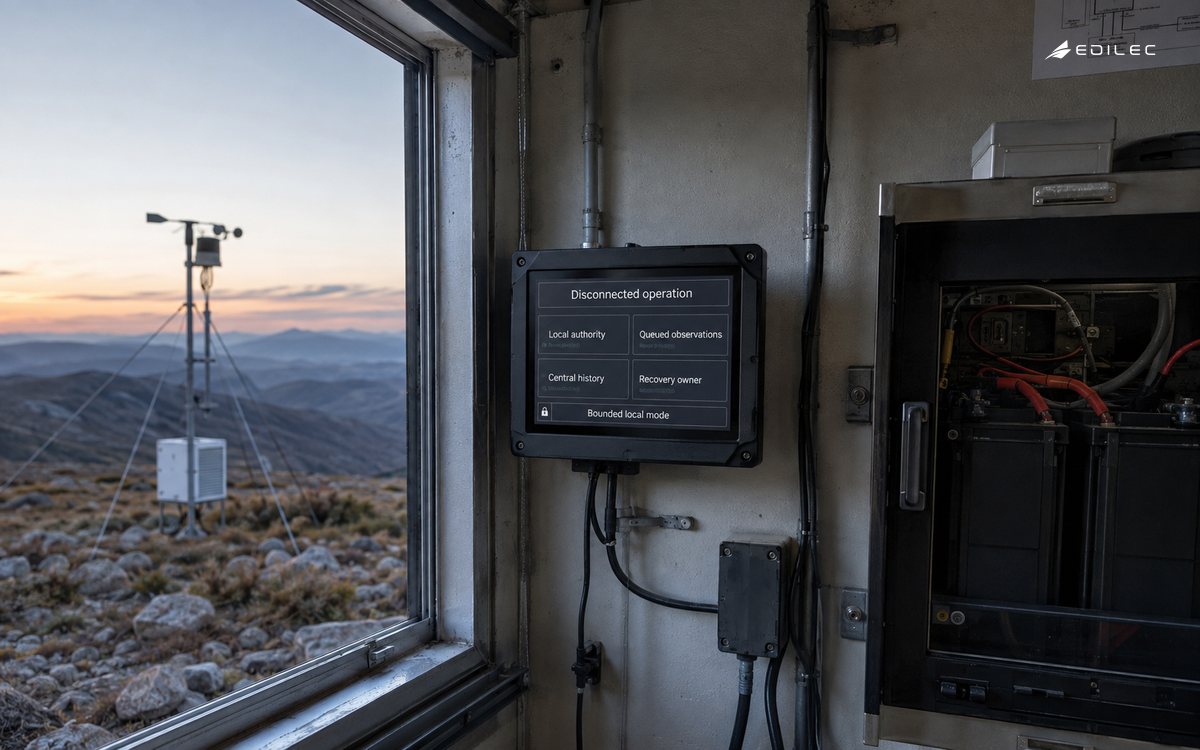
The edge design should explain what happens when the upstream service, local node, device, certificate, clock, or operator interface is unavailable. Define local authority, queued-data limits, replay order, configuration version, degraded mode, and the safe state for every consequential action. Do not assume a connection will return before storage fills or the next shift begins. NIST's OT security guide is relevant because availability and safety need deliberate treatment in operational environments. Exercise a realistic outage in a staging environment and, where safe, through an operational drill. The goal is not perfect autonomy; it is a predictable and observable response to ordinary disruption.
Secure the fleet, not just the node
An edge node is a managed asset with a physical location, operating system, credentials, data, and update path. Give it a unique identity, least-privilege service accounts, protected secrets, signed or verified software, secure configuration, and monitored health. NISTIR 8259A provides a practical baseline of IoT device capabilities that helps turn vague security requirements into procurement and integration questions. Also decide who can connect locally, how removable media is handled, and what happens if hardware is replaced. A technically impressive inference service is a liability if nobody can establish which version ran, revoke a credential, or recover the configuration after a failed update.
| Lifecycle concern | Design evidence | Operating signal |
|---|---|---|
| Identity | Node and workload identities are unique | Unknown nodes cannot enroll. |
| Configuration | Versioned desired state and approval path | Drift is detected and explained. |
| Data | Retention, encryption, and queue limits are defined | Backlog and loss indicators are visible. |
| Recovery | Replacement and rollback instructions are tested | A new node can rejoin without improvisation. |
Keep policy and observation central
Local execution does not require local governance. Keep a central view of approved configurations, software versions, certificates, health, and change history, while allowing the node to keep doing the work it is authorized to perform. NIST SP 800-207 is a useful reference for explicit, dynamic access decisions: make the connection between a node, its workload, its context, and its allowed resource clear. Central services should report an unknown or stale state honestly rather than presenting a green fleet view that is based on old heartbeats. This governance plane also supports a clean handoff between engineering and site operations.
Prove the economic case
Count the full lifecycle cost before committing to edge computing: hardware, spares, connectivity, image management, monitoring, security review, field access, support training, and decommissioning. Compare it with the quantified value of reduced latency, lower data transfer, continued local operation, privacy compliance, or a simpler device integration. Pilot one representative site and measure the constraint you intended to improve, such as end-to-end response under a simulated outage. The edge gateway implementation checklist is a useful companion for the physical and integration layer. Expand only when the operating model, not just the demonstration, has proven repeatable.
Make operations boring by design
The best edge system has an uneventful weekday operating model. A site technician should be able to identify the node, see its supported state, replace approved hardware, enroll it through a controlled process, and confirm that workloads and queues have recovered. A platform team should be able to answer which version is running at each site, why a node is unhealthy, whether a configuration change reached its target, and which local data has not yet been reconciled. Define those questions as acceptance criteria before adding sophisticated local analytics. Avoid hand-tuned site configuration, unique images, and undocumented firewall exceptions; each one turns a fleet into a collection of special cases. Where local storage is used, decide how the system behaves when capacity is nearly full and whether it sheds low-value data, pauses input, or escalates to an operator. Include clock synchronization and time uncertainty in the design because local and central event ordering becomes hard to reason about when timestamps drift. Routine replacement, controlled updates, and clear support boundaries are not secondary operations work; they are the architecture that lets edge computing remain useful after the pilot team has moved on.
Manage data lifecycle at the edge
Data placement has a lifecycle as well as a latency requirement. Decide what raw inputs remain local, what is filtered or aggregated before transfer, what must be retained for troubleshooting, and what can be discarded after a durable central acknowledgement. Document the retention clock and the action taken when the node approaches storage limits. Encrypt and protect local stores according to the sensitivity of the records, but also make removal verifiable when hardware is repurposed or retired. A site may need a short local history to investigate an interruption while a central service needs a curated record for cross-site analysis; neither requirement justifies uncontrolled duplication. Include schema evolution in the plan, since a local queue can outlive a central data-model change. Version messages or adapters so a reconnecting node can be reconciled without hand editing stored records. Good lifecycle rules keep an edge deployment from becoming an unbounded archive at every physical location.
Key takeaways
- Assign every workload a latency, outage, data, and recovery constraint before choosing its location.
- Design the disconnected state as a normal operating mode, with bounded queues and clear local authority.
- Manage edge nodes as a fleet with identity, configuration, observability, and replacement procedures.
- Keep policy and audit visibility central even when execution is local.
- Pilot against a measurable constraint and include lifecycle cost in the decision.
Frequently asked questions
Is edge computing required for every IoT system? No. A cloud-first design is often simpler when latency, connectivity, and data movement are acceptable. Does edge eliminate cloud services? No. It commonly complements centralized governance, fleet management, and historical analysis. What should run locally during an outage? Only the functions with clear local authority and a safe degraded behavior; this must be explicit. How do teams avoid configuration drift? Use versioned desired state, controlled rollout groups, health reporting, and a tested replacement procedure rather than manual site-by-site changes.
Use a written site acceptance checklist: node identity confirmed, approved software applied, workload health visible, queue behavior bounded, time within tolerance, central reporting connected, and a local replacement procedure available. Repeating this small proof at every site reveals whether the architecture is genuinely deployable or still depends on specialist intervention. Record the evidence centrally and investigate any site that needs an informal workaround; that exception is a design signal, not merely a deployment inconvenience.
Choose placement by consequence
A practical placement example
For a machine-monitoring product, a safety interlock may need local execution because a remote round trip is unacceptable; feature extraction may run at the edge to reduce bandwidth; fleet policy, model training, and cross-site comparison may remain central. Write the boundary for each function: input, maximum delay, outage behavior, data retained locally, identity required, and recovery owner. This avoids the common mistake of placing an entire application at the edge when only one bounded capability needs local execution. It also makes the economic case measurable because each placement decision maps to a constraint.
Placement and Fleet Signals to Watch
During a pilot, compare end-to-end response, local queue growth during an outage, data transfer avoided, recovery time, update success, and the number of site-specific exceptions. Include the cost of spares, field access, certificates, monitoring, and decommissioning. If the system cannot show which version ran or which data remains unreconciled, the platform is not ready to scale even if the demo is fast. Use a central inventory to connect hardware, workload, configuration, and health evidence.
- Give every workload a latency and outage requirement.
- Keep central authority for policy, fleet identity, and historical comparison.
- Bound local autonomy and make the degraded state visible.
- Version data contracts and configuration across reconnects.
- Scale only when a new site can follow the same acceptance path.
References for Edge Placement and Fleet Control
Use NIST SP 500-325: Fog Computing Conceptual Model, NIST SP 800-82 Rev. 3: Guide to Operational Technology Security, IoT Device Cybersecurity Capability Core Baseline, NIST SP 800-207: Zero Trust Architecture as reference points for the control, data, accessibility, security, or operating semantics relevant to this decision. These references frame placement and fleet controls; the site constraint and acceptance contract decide what belongs at the edge. They help the team name assumptions, choose evidence, and make a review concrete enough that another person can verify what the system is expected to do — for the placement constraint.
Further Reading on Edge Deployment
For adjacent decisions, continue with Offline Sync Decisions That Matter before the First Build, Edge Gateways: An Implementation Checklist That Holds Up, Sensor Data Pipelines Checklist for Reliable Digital Operations, then compare the definitions, ownership boundaries, and recovery behavior before widening the implementation.
Conclusion
Edge computing is a placement decision with operational consequences. Make the constraints, disconnected behavior, ownership, and fleet lifecycle visible before choosing the architecture. A modest edge layer that a team can explain and recover is more valuable than a distributed platform built on assumptions about perfect connectivity.