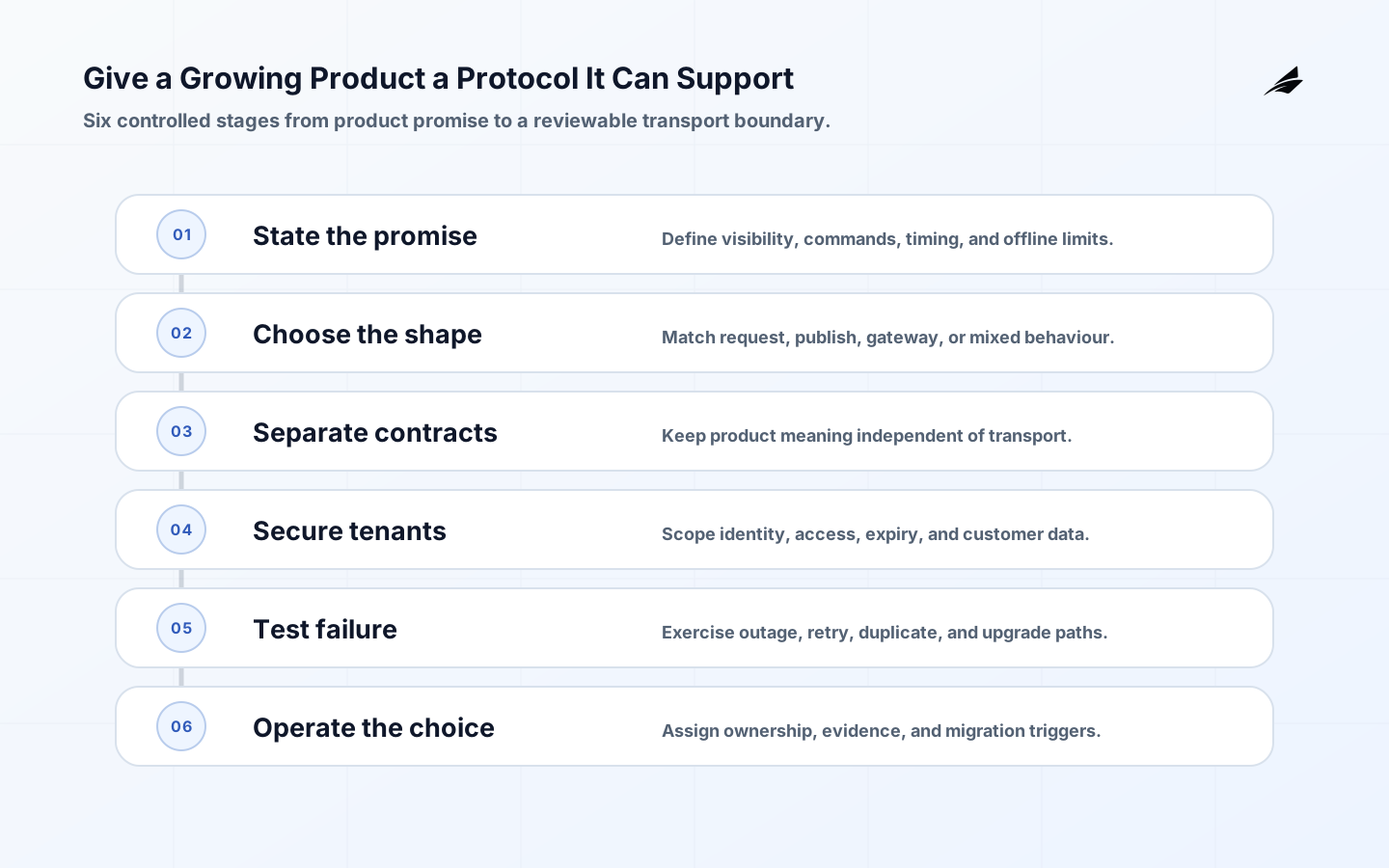
For a growing team, protocol selection is a product and operating decision at the same time. The first demo may work with a convenient HTTP endpoint or a broker client, but the choice becomes consequential when devices sleep, networks fail, customers share infrastructure, and a command must not be repeated. Founders do not need to predict every future integration. They do need to name the first promise, understand the failure modes, and preserve enough separation that a later change is affordable.
Begin with the promise
Write what the product promises to a user. Is it near-real-time visibility, a reliable command, a historical record, or a periodic report? Note the device count, connection pattern, power constraint, geographic spread, and consequence of delay. The protocol selection checklist turns that promise into explicit checks. A founder can keep the team aligned by requiring every protocol argument to reference a product promise or a failure consequence rather than personal familiarity. Broader protocol context sits in Connected-systems protocol guide and Protocol production choices.
| Product situation | Likely pressure | Decision to clarify |
|---|---|---|
| Battery devices | Radio time and payload cost | What can be buffered or sampled? |
| Many observers | Fan-out and subscription growth | Who owns routing and retention? |
| Commands | Duplicate or late action | What acknowledgement is meaningful? |
| Customer tenants | Isolation and lifecycle | How are identity and authority scoped? |
| Industrial site | Safety and local availability | What remains possible offline? |
Choose a communication shape
HTTP can be a good fit for straightforward service integration and widely available tooling. MQTT can reduce direct coupling when many consumers need device messages and session behaviour matters. CoAP can suit constrained request-response interactions. A gateway may translate a local protocol into a cloud-facing one so devices do not carry every integration concern. Read the precise MQTT Version 5.0 and CoAP specification, then test the communication shape on the actual network and hardware.
Separate the product contract from transport
Your application should know what a reading or command means without depending on a broker topic or a URL path as its only definition. Define event identity, asset identity, units, observed time, quality, schema version, and command idempotency separately. This creates room to add a gateway, support another client, or migrate a transport without rewriting the product semantics. Keep a small set of representative messages under version control and test them across every translation boundary.
- Use stable identities rather than customer-facing labels.
- Distinguish telemetry, state, command request, and command result.
- Record event time and receipt time separately.
- Make duplicate and retry behaviour explicit for every side effect.
- Define the minimum device and service observability needed for support.
Build security and tenant boundaries early
The first version should still have unique identities, encrypted transport, scoped permissions, credential rotation, and a retirement path. A customer-facing product must isolate tenants in topic or resource authority and in the data views that consume messages. NIST SP 800-207 supports an explicit policy approach: authenticate the participant, evaluate the request, and grant only the required access. Do not let a convenient shared device credential become a migration problem when customers or sites multiply.
| Control | Minimum founder decision | Evidence |
|---|---|---|
| Identity | Unique device and service identity | Bootstrap, expiry, and revocation exercise |
| Tenant scope | No cross-customer message access | Allowed and denied cases |
| Command safety | Idempotency and expiry | Repeated and late command exercise |
| Capacity | Rate and payload limits | Bounded rejection behaviour |
| Support | Diagnosable session state | Runbook and correlated logs |
Design for network failure
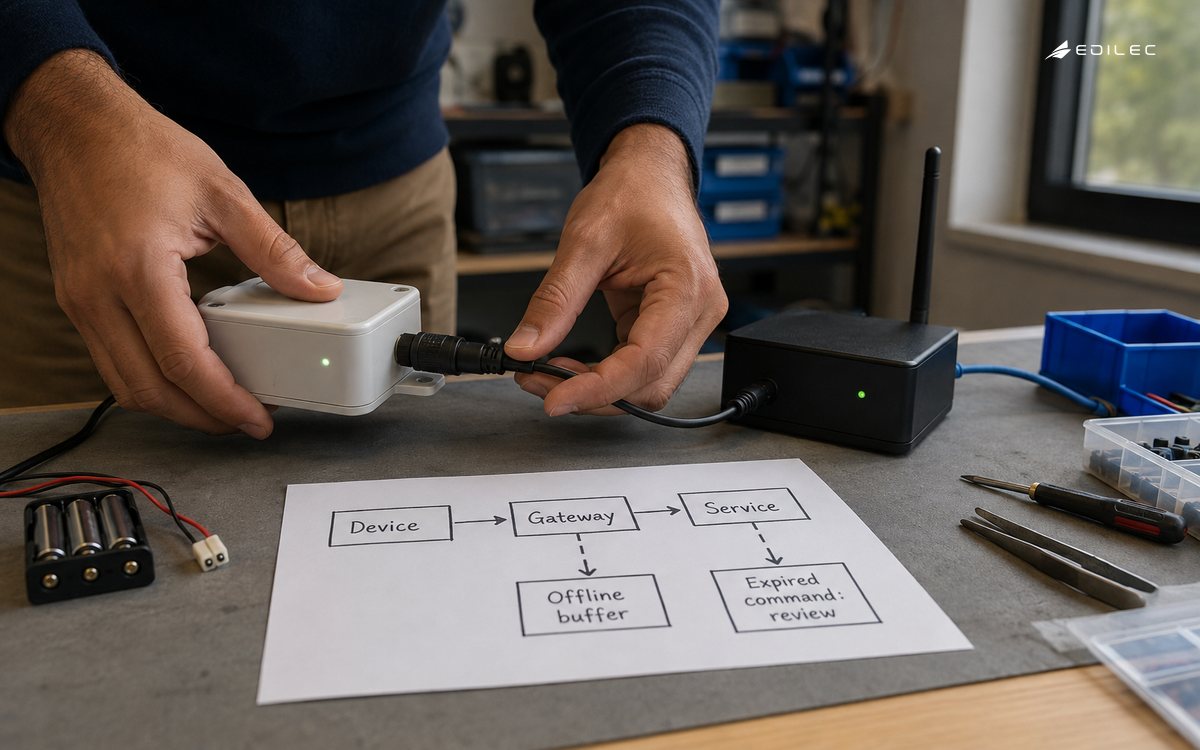
Assume the network will be unavailable at the least convenient time. Decide whether a device buffers locally, how much history fits, whether the product shows stale data, and how a backlog is released. If a command expires while disconnected, say whether it is discarded, queued for approval, or executed only after a new request. Test broker restart, gateway reboot, slow links, duplicate delivery, and a full queue. The result should be legible to a customer-support person, not only to the engineer who wrote the reconnect loop.
Measure the real cost
Protocol selection affects more than bandwidth. Measure connection churn, battery or CPU use, broker or gateway capacity, message latency, retries, duplicate rate, and support time. A protocol may be cheap per message but expensive to operate if errors are opaque. NIST SP 800-82 Rev. 3 is a useful reminder to include availability, maintenance, segmentation, and operational context. Keep measurements tied to the product promise so optimisation does not trade away the user outcome.
Release a bounded pilot
Use one device class, one customer or site profile, one message contract, and one end-to-end support path. Test onboarding, normal traffic, credential rotation, a malformed payload, a lost connection, and an upgrade. Document what the pilot proves and what it does not prove. The NIST Cybersecurity Framework can structure a lightweight risk review, but the release decision should rest on observed behaviour, named owners, and an explicit next step.
Review protocol choice as the product grows
Revisit the choice when the device mix, tenant model, command surface, retention needs, or support geography changes. Do not change protocol because a new product is fashionable; change when a stated constraint or failure pattern warrants it. Keep a translation boundary where it reduces risk, and keep contract tests so a migration can be staged. The choice should be explainable to a new engineer and a customer-facing operator six months later.
Use a founder's selection check
Before committing, ask whether the team can explain the selected protocol to a customer-facing operator in one page. The explanation should cover what a normal message means, what happens when the device is offline, how a command expires, how identity is revoked, and where to look when delivery fails. If the explanation requires protocol terminology with no operational translation, the design is not yet ready for scale.
Also ask what the product will refuse to promise. It may not promise instant state while a device is offline, exactly-once physical action, or historical completeness after an unbounded outage. Honest limits are useful product boundaries. They let the team choose a protocol and architecture that can meet its promise instead of compensating for an impossible one with increasingly complex retries.
Give the protocol an operating model
Founders should assign an owner for the protocol boundary even when the product team is small. That owner maintains client libraries, compatibility tests, credential policy, capacity limits, and the failure runbook. A protocol decision without an owner becomes tribal knowledge, and the first person who leaves takes the reasoning with them. Keep a short record near the application contract and review it when a new device, customer, or command type is introduced.
Design observability around the questions support will receive. Can the team tell whether a device is offline, authenticated but unauthorized, connected but unsubscribed, publishing malformed data, or being throttled? Can it connect a customer-visible gap to a gateway, broker, or service event? Use consistent identifiers and timestamps. A useful signal is not merely a metric with a high cardinality; it is evidence that helps a person choose the next safe action.
Be careful with abstraction. A shared client library can standardize identity, retries, timeouts, and message envelopes, but it should not hide behaviour that varies by consequence. A command client may need stricter expiry and acknowledgement than a telemetry client. Keep the common defaults safe, expose the intentional differences, and test the library with both normal and degraded cases. Convenience is valuable only when it leaves the important decisions visible.
Plan migration before it is urgent. Keep transport-specific code behind a boundary, version the application message, and use a translation or dual-publish period only when its duplication and ordering effects are understood. Define how consumers prove they have moved and how the old route is revoked. A staged migration is easier when the first protocol choice already has representative contract tests and a named owner.
| Operating concern | Small-team practice | Evidence |
|---|---|---|
| Ownership | Name one protocol boundary owner | Decision record and review date |
| Support | Document client and failure states | Runbook with sample traces |
| Abstraction | Share safe defaults, expose consequence-based differences | Library tests |
| Migration | Version messages and prove consumer movement | Dual-path comparison and cutover record |
A founder can keep the choice durable by writing one sentence about the intended future boundary: what the device, gateway, broker, and application each own. When the product adds another protocol or integration, the team can preserve that ownership and translate deliberately. This is less glamorous than choosing a library, but it prevents communication details from leaking into every feature and makes future growth easier to reason about.
Before a growing product commits, invite the connectivity buyer, field maintainer, customer-support lead, and incident responder to challenge the protocol choice. Their questions often expose hidden costs such as remote patching limits, credential rotation gaps, or retry patterns that duplicate work. Capture the constraints in acceptance tests and assign an owner to revisit them when the device, tenant, or command model changes. The chosen behaviour should be supportable by the whole team, not only demonstrable by the original engineer.
Founder protocol takeaways
- Start from the product promise and the consequence of delay or duplication.
- Keep domain messages independent from transport details.
- Make tenant, identity, command, capacity, and support controls explicit.
- Test network failure and lifecycle change in the first bounded pilot.
- Revisit the decision when the operating constraints change, not when a label becomes popular.
Founder protocol questions
Is HTTP enough for a growing connected product?
It can be, especially for modest request-response workflows with reliable connectivity. The question is whether the product can meet its latency, offline, fan-out, command, and support requirements with that model.
Is using more than one protocol a mistake?
Not necessarily. A local device protocol, gateway protocol, and service integration protocol can coexist if translation preserves identity, time, quality, authority, and error meaning.
Conclusion: supportable growth
Growing teams can make protocol selection manageable by tying it to the product promise. Define the communication shape, preserve the application contract, secure identity and tenant boundaries, rehearse offline behaviour, and measure support cost. A small, evidence-led decision record is a better foundation for growth than a premature claim that one protocol will fit everything.