The IoT requirements catalog, Azure IoT Edge module and offline guidance, and AWS IoT Greengrass reference ground the gateway discussion in device requirements, local handling, and disconnected operation. SP 800-213A: IoT Device Cybersecurity Requirements Catalog; Compose modules for Azure IoT Edge; Understand Azure IoT Edge offline capabilities; What is AWS IoT Greengrass?.
Edge Gateway: Define the Site Outcome
Frame the first gateway around a local operating need: continue collecting a condition during link loss, translate a legacy protocol through a controlled boundary, reduce a latency-sensitive calculation, or provide a technician with site context. Then state what the gateway does not become. A gateway that receives a control request should not silently invent new control authority because the cloud is unreachable. Give every local action an owner, a scope, an expiry or review condition, and an observation that confirms the physical or business outcome. This makes the edge a deliberate resilience mechanism instead of an opaque shadow platform.
| Local capability | Question before enabling | Evidence |
|---|---|---|
| Protocol translation | Which fields and commands cross the boundary | Allowlist, mapping, and negative test |
| Buffering | How much data and for how long can be stored | Capacity limit and reconciliation plan |
| Local rules | Which decisions are safe without central authority | Rule version, owner, and contingency path behavior |
| Remote support | Who can administer the unit and through which path | Time-bound session and audit record |
Edge Gateway: Set Local Authority
Classify work as local observation, local alerting, locally safe action, centrally authorized action, or prohibited action. The classification should be driven by consequence and data freshness, not by which service is easier to call. Preserve last-known facts with their age, stop decisions requiring current entitlement or policy, and make local queues bounded. When local state changes, include a stable identity, source time, sequence where available, and rule version. That gives central systems enough context to reconcile rather than treating every delayed upload as a new live event.
- Keep local authority narrow, named, and observable.
- Use durable identities for the hardware, hosted workloads, and remote administrators.
- Bound local storage and expose when buffers approach limits.
- Preserve source time, sequence, and configuration with buffered facts.
- Separate a requested command from evidence that it took effect.
- Test network loss, restart, replacement, and resynchronization before expansion.
Edge Gateway: Control the Device Lifecycle
A fleet needs a repeatable enrollment, configuration, software update, backup, replacement, and retirement workflow. NISTIR 8259A identifies configuration, logical access, software update, and cybersecurity-state awareness as core device capabilities. Translate that into a deployment record containing gateway identity, site, approved services, version baseline, certificates, data roles, and owners. Verify an update signature and health signal before marking the gateway current. A replacement should revoke the old identity, restore only approved configuration, and retain the prior unit’s event history for investigation.
Edge Gateway: Secure Local Access
Minimize installed services, use authenticated encrypted connections, and restrict management through a controlled path. NIST SP 800-207 argues for evaluating requests with identity and policy rather than relying on network location; that matters for a gateway deployed behind a familiar site firewall. Separate data-plane credentials from administrator credentials, rotate them, and remove vendor access when a support period ends. Document compensating controls for legacy interfaces that cannot meet the preferred standard. An undocumented exception is not a recovery strategy.
Edge Gateway: Reconcile Site and Cloud State
Synchronization must address duplicates, late facts, conflicts, and actions already completed locally. Use stable event or operation identities, explicit checkpoints, and a review path for conflicting state. Do not overwrite a central record without preserving the local fact and its time context. Define which system is authoritative for each state and when authority transfers. NIST Cybersecurity Framework 2.0 offers a useful operating cadence for this work: identify dependencies, protect changes, detect divergence, respond with an accountable decision, and recover with a retained record.
| Edge incident | Expected behavior | Verification |
|---|---|---|
| WAN outage | Local collection or approved local rule continues within limits | Buffer age, capacity, and local status visible |
| Gateway restart | Services recover in known order without duplicate action | Boot record, checkpoint, and health test |
| Central conflict | Both facts are retained for review | Authority decision and reconciliation log |
| Hardware replacement | Old credentials revoked and approved state restored | Inventory, identity, and data-path validation |
Edge Gateway: Run a Site Acceptance Exercise
Deploy a representative gateway at a test site and disconnect it from upstream services for long enough to exercise its intended local behavior. Verify which observations continue, which local rules may run, which actions are denied without central authority, and how the device communicates the age of its information. Restart the gateway during the outage, fill its buffer toward the stated limit, then restore the link. A reviewer should be able to identify the device, running configuration, local rule version, checkpoint, queued records, and exact reason for any discarded or delayed data. Do not accept a vague “it syncs later” claim where a consequential decision is involved.
Repeat the exercise with a configuration change and a hardware replacement. Confirm the previous identity is revoked, the replacement acquires only the approved role, and historical facts remain distinguishable from facts produced by the new unit. Simulate a central-state conflict so that the reconciliation path is practiced rather than assumed. Inspect remote access logs, update evidence, and the owner’s ability to take a gateway out of service safely. This gives founders and engineering teams a concrete view of the ongoing fleet work that accompanies local resilience, including the moment when an edge deployment should pause rather than scale.
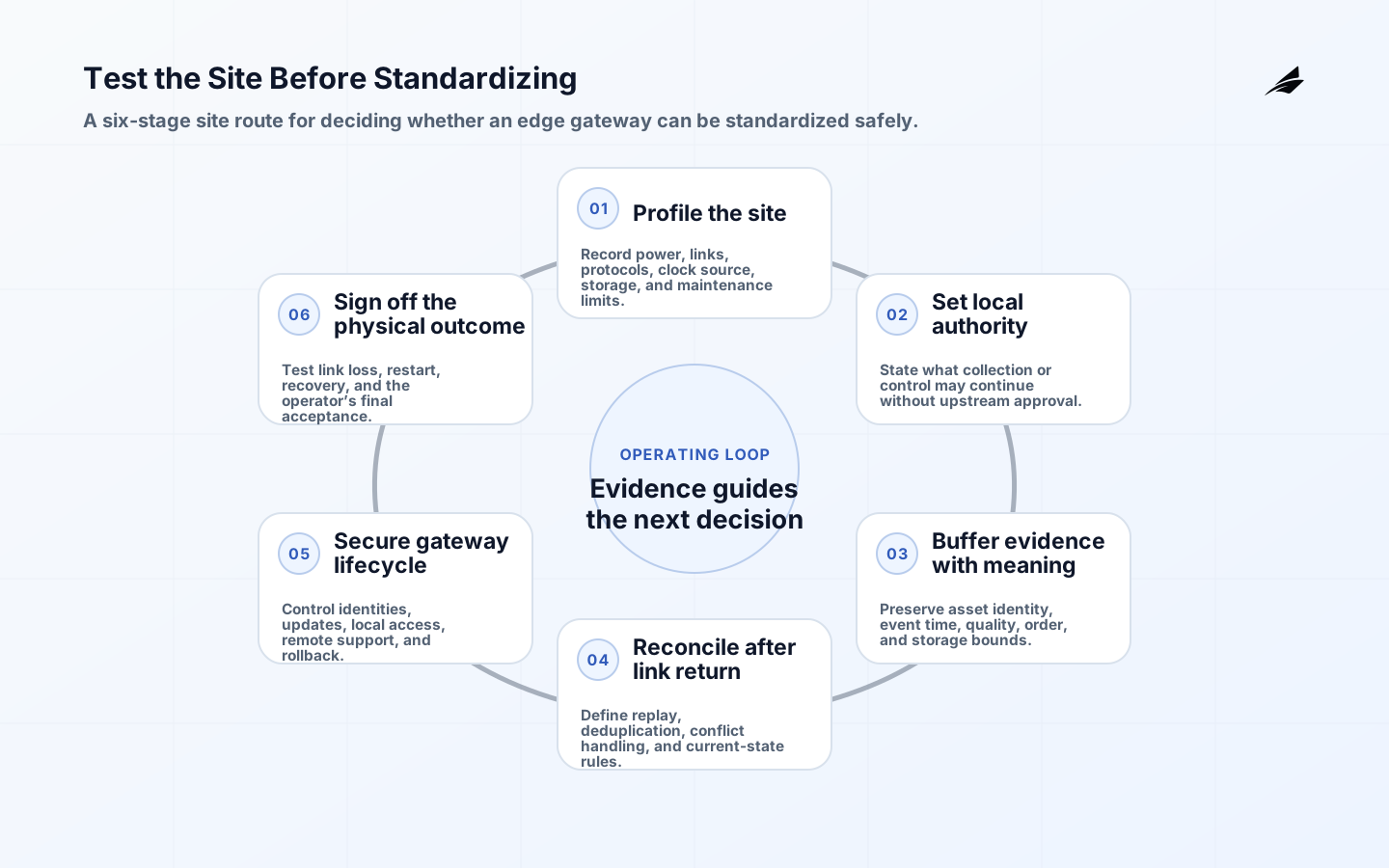
Test the Site Before Standardizing
Example: Accept a Gateway Through Link Loss
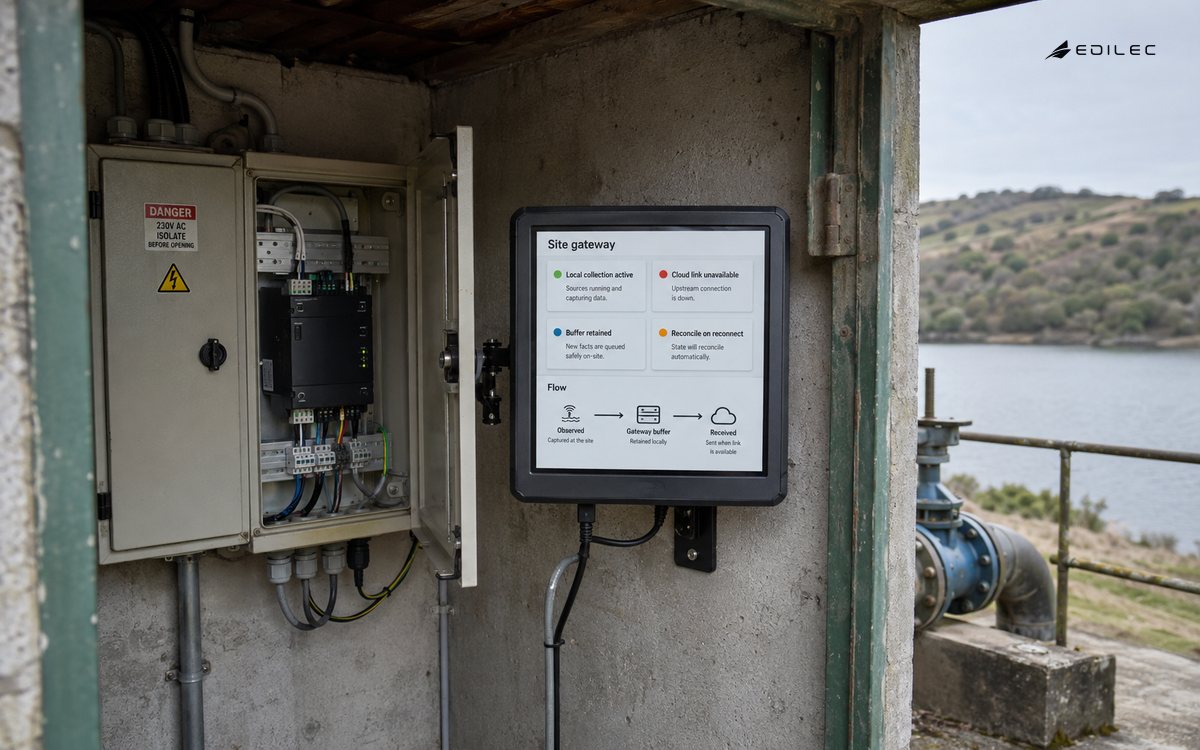
Use a representative site, not a laboratory network, for the first acceptance exercise. Record the gateway clock source, local storage headroom, protocol adapters, power behavior, maintenance path, and expected upstream outage. Then interrupt the link for a known period. The gateway should continue the explicitly approved local work, mark data with observed and received times, and make its backlog visible without pretending that central confirmation exists.
Reconnection is a reconciliation problem, not merely a retry loop. Decide whether records are replayed in order, deduplicated by event identity, summarized, or discarded after a documented limit. Make the policy visible to downstream consumers. A dashboard that jumps from stale to current without indicating the gap can create more confusion than a clearly marked delayed state.
The acceptance record should include a recovery owner and a physical check. If a gateway reports that a valve command was sent, the team still needs to know whether the equipment reached the expected state and who is authorized to intervene when it did not. This is where local authority, safety procedures, and remote support boundaries must meet.
NIST SP 800-213 frames IoT device cybersecurity requirements for acquisition; NISTIR 8259A describes baseline device capabilities; NIST SP 800-82 Rev. 3 addresses OT reliability and safety; and NIST SP 800-207 supports explicit access decisions across changing network conditions.
Readers can pair this field guide with the gateway practical guide, the offline-sync planning guide, and the production-readiness guide for a fuller site-to-service view. At the edge gateway, How Engineering Teams Should Think About Edge Gateways clarifies one boundary; Edge Gateways for Connected Systems: a Practical Guide adds a complementary operating pattern; and What Changes When Edge Gateways Move Into Production helps connect the decision to a wider connected-systems workflow.
Edge Gateway Key Takeaways
- Use an edge gateway for a stated local outcome, not as an undefined mini-cloud.
- Classify local actions by consequence and fresh authority requirements.
- Operate the fleet through enrollment, configuration, updates, and retirement records.
- Keep remote administration narrow, authenticated, and auditable.
- Synchronize with identities, checkpoints, and explicit reconciliation.
- Practice disconnected, restart, and replacement scenarios on real hardware.
For related site and lifecycle decisions, compare the gateway pattern with A Field Guide to Sensor Data Pipelines for Growing Teams, A Field Guide to Firmware Updates for Growing Teams, and MQTT Brokers Checklist for Reliable Digital Operations. A gateway earns standardization by proving that a real site can continue safe work locally and reconcile it honestly when the link returns.
Edge Gateway FAQ
- When should a gateway make a local decision? When its authority, inputs, safe failure behavior, and later reconciliation are all explicit and tested; low latency alone is not enough.
- Is buffering the same as offline capability? No. Buffering preserves facts. Offline capability also specifies what users or systems may safely do before those facts synchronize.
A fleet review should include physical and operational reality, not only cloud inventory. Confirm the gateway still sits at the recorded site, runs the expected workload, has the right network profile, can report health, and has a current local owner. Compare its resource headroom and buffer use with the original assumptions. Check that a field replacement can be performed by the people actually assigned to do it. These reviews find issues that remote monitoring alone cannot: an unrecorded wiring change, a device reused at another site, a disabled local display, or a support dependency on someone who has left the team.
Capacity planning at the edge should include more than CPU and memory. Estimate local storage growth during the longest credible disconnect, queue behavior under a reconnect storm, power-loss recovery, clock behavior, network failover, and the cost of physical service. Give each limit a signal and an action before it becomes a field outage. A gateway with no remaining buffer or update headroom is an operational warning even when its primary service still reports healthy.
Document the site commissioning checklist in the same system used for fleet operations. Include physical placement, power, network path, local owner, device identity, expected services, baseline, support route, and acceptance result. This makes a remote alert actionable because responders can see the context that often never reaches a central monitoring platform.
Define a support ownership handoff for every gateway class. It should include expected fault indicators, approved diagnostics, escalation contacts, replacement authorization, and an explicit point at which field work stops and an engineering investigation begins. This prevents remote teams from repeatedly changing a gateway configuration while local operators lose confidence in the connected service.
Review the gateway’s removal path before approving it for a critical site. The team should be able to isolate the unit, preserve necessary evidence, restore the operational path, and communicate the resulting status without relying on undocumented local knowledge.
Conclusion: Standardize Only After Site Evidence
An edge gateway is dependable when local resilience does not obscure central accountability. Follow with How Engineering Teams Should Think About Edge Gateways, Edge Gateways for Connected Systems, and What Changes When Edge Gateways Moves into Production.