Event streaming is the practice of recording facts as they happen and letting independent consumers react to those facts. For an IT manager, its value is not a fashionable broker. It is a way to stop every new dashboard, alert, mobile app, or partner integration from directly querying and coupling itself to an operational system. A useful first scope might publish a machine-state change, preserve who reported it and when, then let maintenance, analytics, and service tools consume that one record at their own pace. The hard part is deciding which facts deserve that durable shared history.
What Event Streaming Changes
A request-response interface answers a question now; an event says something already occurred. That distinction changes ownership. The producer owns the fact and its contract, while a consumer owns its own offset, retry behavior, and downstream action. A topic is therefore not a database table with a new transport. It is a public operational promise. If a device publishes temperature.changed, teams must agree on the device identity, measurement time, unit, quality flag, schema version, and whether a later correction is a new event. Keeping those details explicit prevents consumers from inventing conflicting interpretations.
| Choice | Good default | Failure prevented |
|---|---|---|
| Event key | Use the asset or tenant identity that needs ordered handling | Unrelated devices blocking each other or one device being processed out of order |
| Timestamp | Carry event time and ingestion time separately | Late connectivity being mistaken for a current physical state |
| Schema | Version an envelope and validate required fields | Silent consumer breakage after a producer change |
| Retention | Keep replayable history for an agreed business purpose | No way to rebuild a projection after a defect |
Design the Event Contract First
Write the contract alongside the operational scenario. For a cold-storage alert, include eventId, stable facilityId and unitId, observed time, value, unit, calibration or quality state, and producer version. Do not make a UI label or a mutable customer name the identifier. Choose a partition key that preserves the ordering a consumer truly needs, such as one refrigeration unit, rather than promising global order. Consumers should tolerate duplicate delivery because retries, failover, and at-least-once transport make duplicates normal rather than exceptional.
- Name a producer owner and a consumer owner for every production topic.
- Publish a sample event, schema compatibility rule, retention period, and privacy classification with the contract.
- Use an idempotency key or a consumer-side processed-event record before an event causes a bill, command, or ticket.
- Keep raw events separate from a read model used by a portal; projections can be rebuilt.
- Define whether a correction supersedes, compensates for, or annotates an earlier fact.
Make Delivery Recoverable
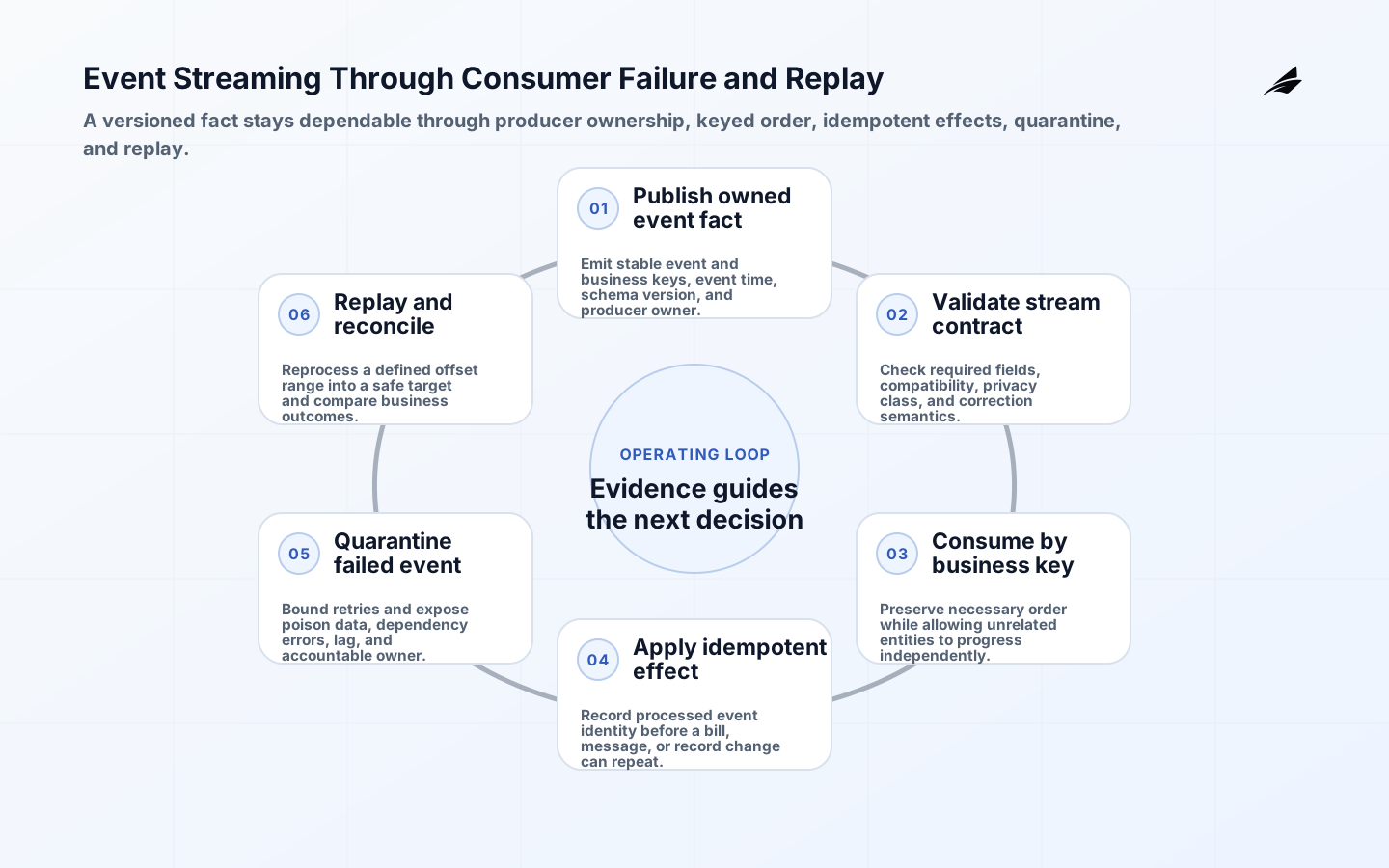
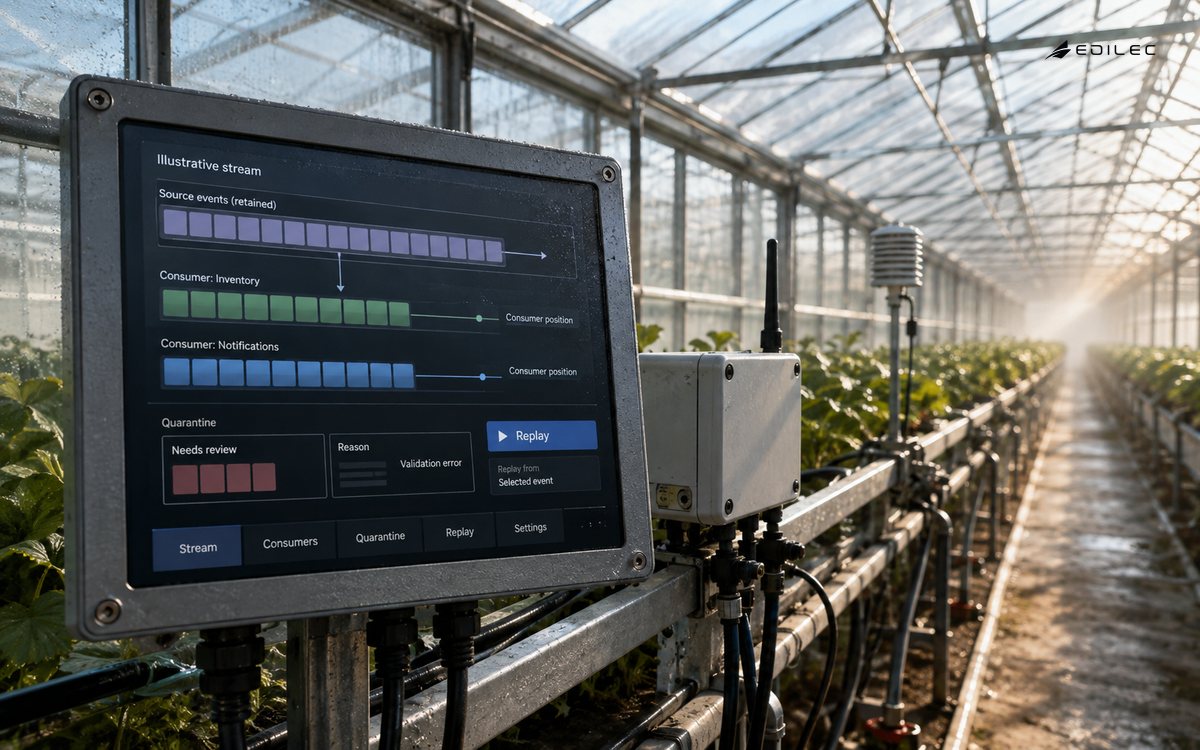
Exactly-once is often an incomplete description of a business outcome. A broker may avoid duplicate publication within a defined boundary, yet a consumer can still write to an external system and lose the acknowledgement. Design for replay instead: retain source events, commit a consumer position only after durable local work, and make downstream writes idempotent. Quarantine malformed or repeatedly failing records with the original payload, error reason, contract version, and a route for human review. A dead-letter queue without ownership merely hides a growing backlog.
| Situation | Consumer behavior | Evidence to retain |
|---|---|---|
| Temporary downstream outage | Pause or retry with bounded backoff; do not discard the event | Attempt count, dependency error, lag, and recovery time |
| Poison event | Quarantine after a controlled limit and alert the owner | Payload reference, validation failure, consumer version |
| Backfill after a bug | Replay a defined offset range into an isolated projection | Range, code version, reconciliation result |
| Duplicate event | Recognize the idempotency key and return the prior result | Event ID, target record, original decision |
Operate the Stream
Operational health is more than broker availability. Watch consumer lag by consumer group, oldest unprocessed event age, rejected schema counts, duplicate rate, partition skew, and the success of a representative business action. Correlate a device event through the broker, enrichment service, and work-order creation with a trace or shared correlation identifier. Alert on a condition that requires a decision: a consumer falling behind its recovery objective or a validation failure suddenly appearing after a release. Raw throughput alone rarely tells an on-call engineer what a customer experienced.
Introduce It in Slices
Start with one fact that currently travels through exports or manual reconciliation. Run the producer in shadow mode, compare its stream with the authoritative source, and let one non-critical consumer build a read-only view. Then test disconnection, late arrival, duplicate delivery, schema rejection, and replay before expanding. IoT telemetry provides the signal model behind those events, while sensor data pipelines covers the transformations that follow. The right pilot proves accountability and recovery, not just message volume.
Event Streaming FAQ
When is event streaming unnecessary?
A direct API or scheduled batch can be clearer when one caller needs one immediate answer, the data is small, and replay or independent consumers add no value. Use a stream when several consumers need a durable sequence of facts or when offline and asynchronous operation is intrinsic to the workflow.
How much ordering is needed?
Usually ordering is needed for one business key, not the entire estate. Preserve order for a device, account, or work item and explicitly resolve late or conflicting records. Global ordering is expensive and can needlessly reduce throughput and availability.
Key Takeaways
- Treat each event as a versioned business contract, not an implementation detail.
- Build replay, idempotency, and quarantine paths before adding high-consequence consumers.
- Measure lag and data quality in terms of the decision they delay.
- Give producers and consumers separate, named operating ownership.
Conclusion
Event streaming earns its place when it gives connected systems a dependable memory of operational facts. Choose a narrow event, define it rigorously, prove that a consumer can recover from failure, and only then add the next subscriber. The architecture becomes easier to change because the shared truth is explicit rather than buried in point-to-point integrations.
Run an Operational Review
Implementation Notes
Implement event streaming as a sequence of observable releases. In the first release, keep the producer or source, identity registry, validation rule, one consumer, and support view connected end to end. Capture a baseline before switching users over: current completion time, recurring error, number of manual reconciliations, and the records that are difficult to explain. During a limited rollout, compare the new path with that baseline and look for unexpected gaps between the digital record and the physical or operational reality. A release that makes uncertainty visible is safer than one that reports success because traffic is flowing.
Configuration deserves the same discipline as application code. Version thresholds, mappings, topic or route permissions, asset associations, and retention rules; review changes with the owner of the affected workflow; and record when the new configuration became effective. This protects event streaming from a common production failure: correct software interpreting a changed environment with an old assumption. Build a rollback that restores the previous known-good behavior, then test it with evidence that downstream consumers, users, and support tools see a coherent state.
Capacity planning is also a correctness concern. Estimate peak rather than average input, reconnect storms after a site outage, retained history, processing windows, and the time needed to catch up without making live work stale. Set quotas and backpressure behavior deliberately. If the system must shed load, define the least harmful data to defer and how an operator will know that it happened. Review cost alongside quality because an uncontrolled event streaming design may become so expensive that teams disable retention or diagnostics precisely when they are needed for an incident.
Finally, give users an honest interface to system state. Show whether the latest information is fresh, whether an action is pending or confirmed, and who owns the next exception. Do not represent a queued request as a completed business result. Provide a stable case or correlation identifier that lets a technician, analyst, and support engineer discuss the same occurrence without copying opaque payloads into chat. These details turn event streaming from infrastructure that only specialists can interpret into a dependable part of daily operations.
Event streaming deserves a scheduled operating review because production evidence changes the design assumptions made during delivery. Review a representative week of normal activity and one difficult incident with the people who own the asset, service, security, and data responsibilities. Trace a record from its first observation to its final use. Check identity, timestamps, configuration or schema version, access decision, retry history, and the person who handled the exception. This is where a team discovers that a technically successful message had no business owner, an alert reached the wrong queue, or a recovered device quietly produced an older configuration. Record each finding as a concrete change with an accountable owner and due date. For Event Streaming for IT Managers: An Operating Guide, that review is more valuable than a generic maturity score because it tests the actual route users depend upon.
Use a small scorecard that measures reliability and usefulness together. Count incomplete records, stale evidence, unassigned exceptions, manual workarounds, recovery time, and decisions later reversed because context was missing. Segment those measures by site, device class, software version, and workflow state so a broad average does not hide a troubled cohort. Then test a repair: replay an event or record, rotate an identity, restore a blocked integration, and confirm the person doing the work can explain the result. The aim is not perfect data or zero alerts. It is a event streaming service whose limitations are visible, whose failures have a practiced route, and whose next improvement is selected from evidence rather than anecdote.