For event streaming, event streaming is a way to publish facts that happened, such as a meter reading accepted, a device enrolled, or a work order closed, so several systems can react without one application calling every other application directly. At the stream boundary, that sounds simple, but an event stream is not merely a faster message queue. During a capacity review, it is a commitment to durable records, clear meanings, controlled access, and repeatable recovery. On the event delivery path, for connected systems, the useful first question is which decision becomes late or unreliable when a device change is trapped inside one application. For stream operators, the IoT telemetry guide helps define the signal; event streaming makes its downstream use manageable.
Within this telemetry workflow, for event streaming, see IoT telemetry guide, sensor pipeline fixes, and network segmentation scaling guide when capacity planning meets telemetry, pipeline, and network behavior.
For event streaming, this guide uses Apache Kafka documentation: design, CloudEvents specification, OpenTelemetry Logs Data Model, NIST Cybersecurity Framework 2.0 to connect the implementation boundary with authoritative evidence, operating checks, and a visible correction path. For event streaming, at this checkpoint, the references are applied to the concrete decisions, records, and failure cases discussed below.
Event streaming: start with a decision and a boundary
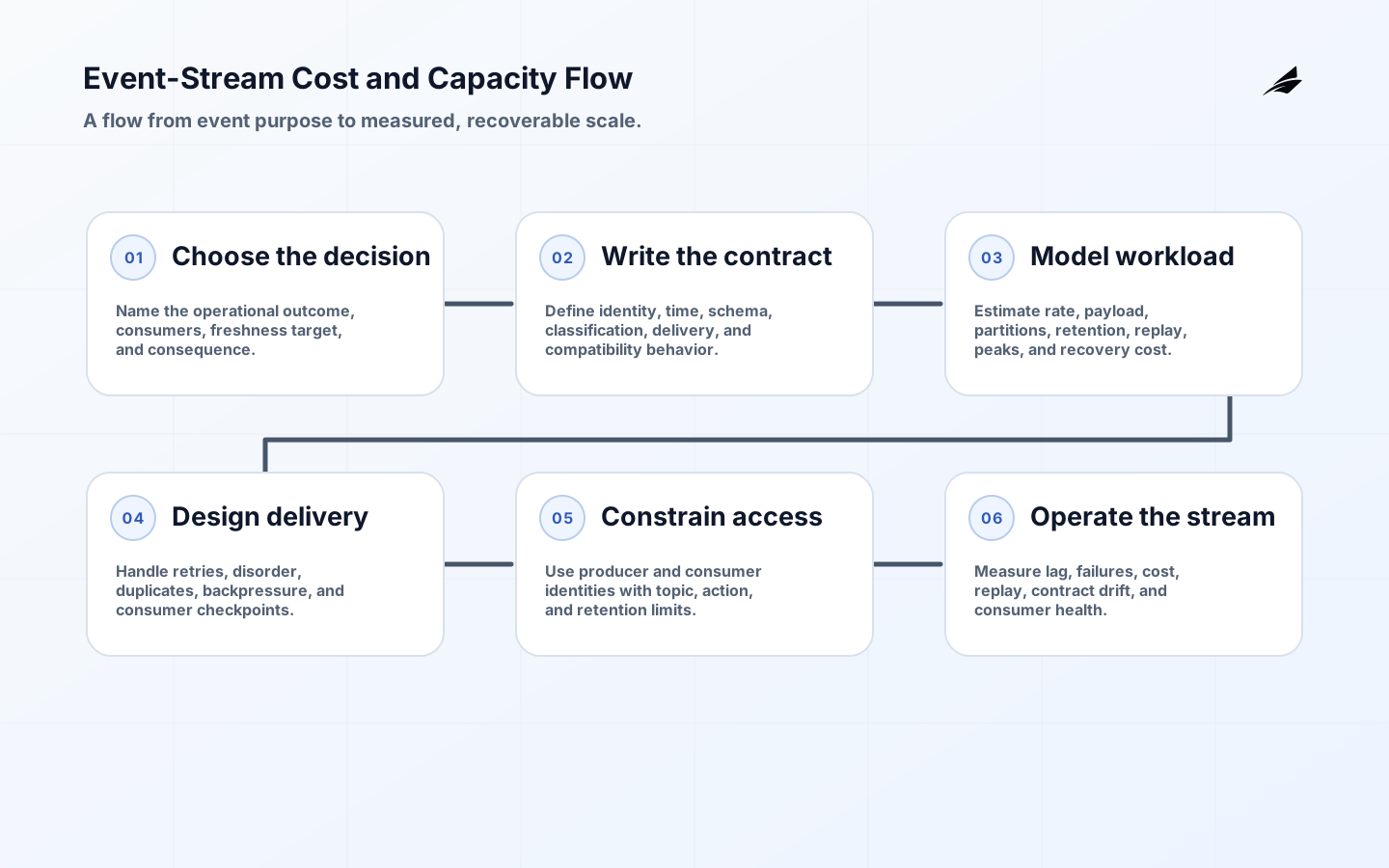
Choose one operational flow before choosing a streaming platform. At the stream boundary, a credible first flow might notify service planning when a refrigerator crosses a sustained temperature threshold, while preserving the raw reading elsewhere. During a capacity review, name the producer, the business event, the consumer decision, the maximum useful delay, and the consequence of a duplicate or missing event. Do not label every database update an event. On the event delivery path, a change is worth publishing when another domain needs to know that it occurred, not when an internal table happened to be written. For stream operators, this boundary prevents the stream from becoming an accidental copy of every application schema and gives teams a way to reject low-value traffic.
Event streaming: treat the event contract as a product
Within this telemetry workflow, a good event contract names the event type, stable identifier, occurrence time, producer, payload version, data classification, and delivery expectations. For event streaming, keep the envelope small and predictable; consumers should not need hidden knowledge of the producer database to interpret it. At the stream boundary, a reading's observed time and its arrival time are different facts, especially after an intermittent connection. Define which is authoritative for the decision. During a capacity review, version deliberately: add optional fields when possible, publish a replacement event type for incompatible meaning, and retain examples plus validation rules. On the event delivery path, cloudEvents offers a useful common envelope model, but the operational ownership of each field still belongs to the team that creates the fact.
| Contract choice | Why it matters | Practical evidence |
|---|---|---|
| Stable event identifier | Allows consumers to reject a repeated delivery | Consumer records the identifier with its outcome |
| Observed and received time | Separates sensor chronology from transport delay | Dashboard can display freshness and late arrival |
| Schema version | Makes compatible change explicit | Producer and consumer compatibility test |
| Classification and owner | Controls sensitive fields and support escalation | Catalog entry names steward and retention rule |
Event streaming: design for replay, disorder, and partial failure
For stream operators, networks disconnect, producers retry, and a consumer can fail after changing its own database but before marking a message complete. Within this telemetry workflow, therefore design consumers to be idempotent: applying the same event twice should not create two work orders or two commands. For event streaming, ordering is usually meaningful only within a chosen key, such as a device or asset, not across the entire fleet. At the stream boundary, partitioning by that key preserves useful local order while allowing throughput to grow. Retention is also a business choice. During a capacity review, keep enough history to rebuild a derived view, investigate an incident, and meet stated obligations; do not assume an infinite log is free or appropriate for personal or safety-relevant data.
Event streaming: estimate cost from behavior, not device count
For stream operators, a million quiet devices can be less demanding than ten thousand devices publishing high-frequency payloads with long retention. Within this telemetry workflow, model average and peak events per second, payload size after encoding, replication, retention, consumer lag, cross-region traffic, and the storage needed for recovery. For event streaming, then add the people cost: contract review, access administration, incident response, and data lifecycle decisions. At the stream boundary, measure the peak around reconnect storms, scheduled reporting windows, and software releases rather than only the daily average. During a capacity review, a capacity plan should explain which workload is protected first when a shared platform is constrained. On the event delivery path, that is more useful than a single headline throughput number because it ties spending to operational consequence.
| Scaling pressure | Preferred response | Poor shortcut |
|---|---|---|
| One device class reconnects together | Use bounded backoff and staggered reconnect | Add partitions without addressing the storm |
| A consumer falls behind | Monitor lag, protect retention, and scale its processing | Delete old messages before diagnosis |
| New consumers need history | Provide documented replay window and isolated read capacity | Let each team copy production topics |
| Payloads grow unpredictably | Set size limits and store large objects by reference | Increase broker limits for every producer |
Event streaming: make access narrow and auditable
For stream operators, separate producer and consumer credentials, authorize them to specific topics or streams, and avoid broad wildcard permissions for operational data. Within this telemetry workflow, encrypt transport, protect credentials in managed stores, and identify which payload fields require minimization or tokenization before publication. For event streaming, administrative access deserves the same care: a person who can alter retention, topic permissions, or connector configuration can change evidence and availability for many teams. Keep audit logs for contract changes, access grants, and connector deployments. At the stream boundary, the network segmentation guide is relevant here because broker reachability and authorization are complementary controls; a valid credential should not make every route reachable.
Event streaming: operate the stream as a service
During a capacity review, a production stream needs named owners for the platform, every event contract, and each critical consumer. On the event delivery path, alert on unavailable producers, abnormal publish failures, consumer lag, authorization denials, storage pressure, and expired credentials. For stream operators, establish a review cadence for unused topics, stale consumers, schema changes, and recovery drills. Trace context and correlated logs help a responder follow a condition from gateway through stream to a downstream decision; OpenTelemetry documentation describes the signal types that make this correlation practical. Within this telemetry workflow, the aim is not to page people for every fluctuation but to make material loss, delay, or unauthorized use visible before a backlog becomes a business surprise.
Event streaming: implement one recoverable path
For event streaming, pilot with a single producer and one consumer whose current handoff is painful but understandable. Capture representative normal, late, duplicate, malformed, and unauthorized events. At the stream boundary, define a dead-letter or quarantine procedure that preserves evidence without silently dropping data, then prove a corrected event can be replayed. During a capacity review, release consumer changes before producer changes when compatibility requires it, and use a canary producer for new schema versions. Document the rollback point for both platform and application changes. On the event delivery path, once the team can explain the current lag, replay a chosen window, and recover the consumer from a deliberate failure, add the next use case instead of widening the first one prematurely.
Scale the stream by protecting the useful signal
For stream operators, event streaming costs rise when every producer sends every field at maximum frequency and every consumer keeps an indefinite copy. Within this telemetry workflow, start with the decision that needs the event, then set a schema, retention period, delivery expectation, and acceptable loss or duplication behavior. For event streaming, for a temperature alert, a one-minute summary may be enough for operations while raw readings are retained briefly for diagnosis. At the stream boundary, separate those paths and measure the cost of storage, egress, processing, and replay rather than optimizing only broker throughput.
CloudEvents gives event producers and consumers a common envelope, while Kafka design documentation helps frame partitions, retention, and delivery choices. OpenTelemetry documentation supports the observability side, and the NIST Cybersecurity Framework 2.0 is a useful control lens for protecting the stream as an operational service. During a capacity review, put a budget beside the stream contract: event rate, average size, peak rate, retention, consumer count, and replay window. Revisit it after a product or device change. On the event delivery path, a stream is healthy when consumers can detect delay, duplication, or schema drift and operators can recover the required history without paying to preserve every possible detail forever.
Event streaming: event-stream checks to carry forward
- For stream operators, publish events that represent meaningful cross-domain facts, not every internal update.
- Version and own the contract before many consumers depend on it.
- Within this telemetry workflow, plan for duplicate delivery, late arrival, replay, and restricted retention from the first release.
- For event streaming, size the service with peak behavior, replication, and support effort, not device count alone.
- Treat lag, access changes, and recovery evidence as operating signals.
Event streaming: questions before adding a consumer
Is event streaming only for very large systems? No. At the stream boundary, it is useful when several consumers need a durable fact and point-to-point integrations are becoming fragile. During a capacity review, Should every event be retained forever? No; choose retention from rebuild, investigation, privacy, and cost needs. Can consumers rely on global ordering? Usually they should not. On the event delivery path, design a meaningful ordering key and make decisions tolerant of cross-key concurrency. For stream operators, What is the first reliability test? Stop a consumer after it receives an event but before it records completion, then prove the recovered consumer produces one correct business result.
Conclusion: scale meaning before volume
Within this telemetry workflow, event streaming earns its complexity when it turns a fragile handoff into a durable, inspectable operational fact. For event streaming, start with a bounded decision, write the contract carefully, and prove recovery under ordinary failure. At the stream boundary, with those habits in place, capacity and new consumers can grow around an understandable record instead of a collection of hidden integrations.
During a capacity review, before approving a new stream, maintain a short decision record that names the event owner, consumers, classification, retention window, replay authority, and decommission condition. On the event delivery path, review it when a consumer asks for an incompatible field, a producer changes the source behavior, or an incident exposes a gap. For stream operators, this record gives a new engineer enough context to decide whether the right response is a compatible evolution, a new event, a temporary exception, or removal. Within this telemetry workflow, it also turns the cost of an otherwise invisible integration into a visible operating commitment.
Keep producer and consumer test fixtures alongside the contract. For event streaming, a fixture should include a normal event, a late event, a duplicate, an older compatible version, an incompatible candidate, and a record that violates classification or size rules. At the stream boundary, run the fixture in continuous integration and again against the deployed endpoints before enabling a release cohort. During a capacity review, this protects a system from changes that are syntactically valid yet operationally harmful, such as a field whose timezone or decimal precision changes. On the event delivery path, when an incident requires a replay, retain the exact filter, timestamp range, and consumer version used, then reconcile the result against an expected count. For stream operators, these details make recovery a bounded operation instead of a stressful, irreversible rerun.