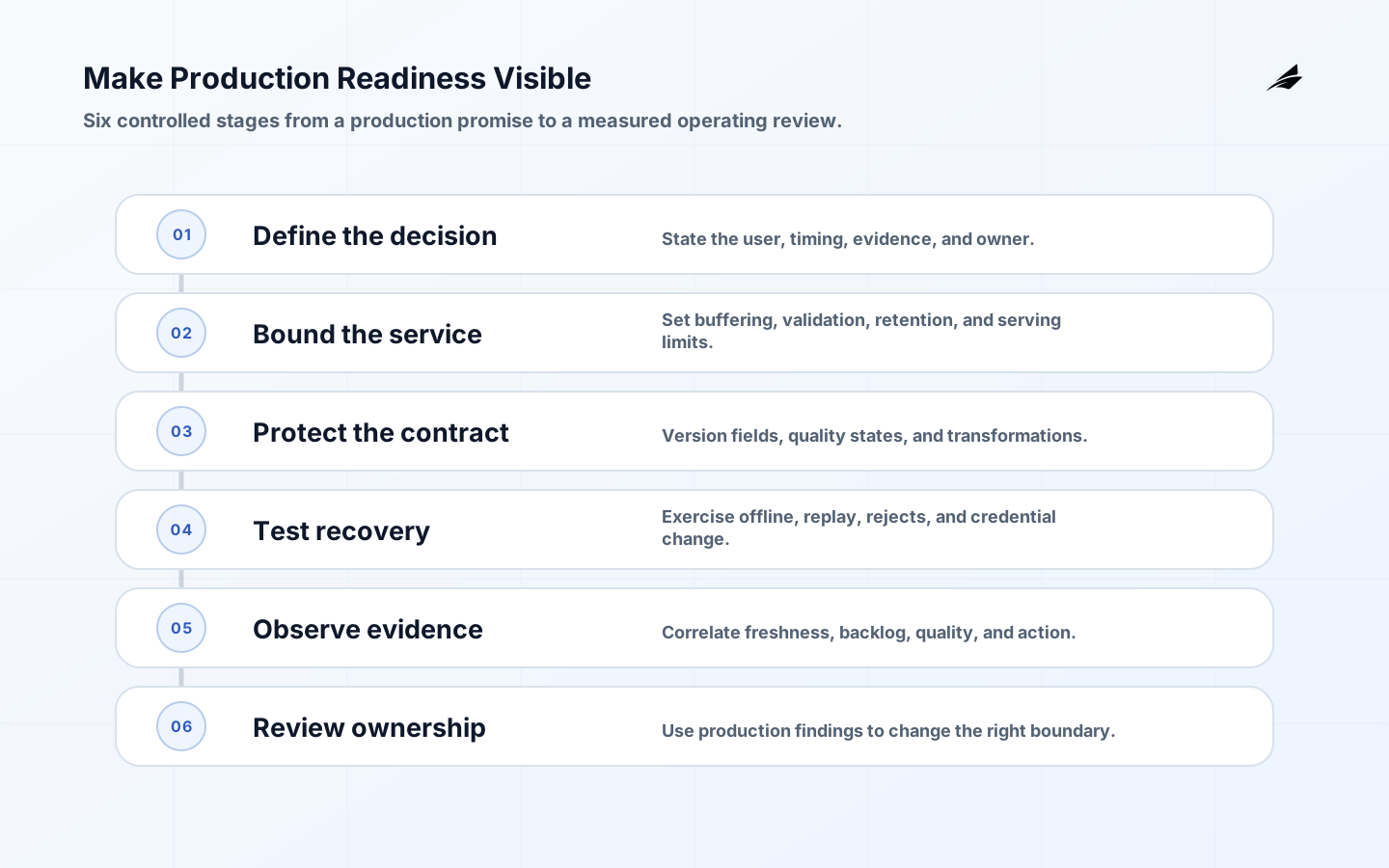
A sensor data pipeline changes character when it moves into production. In a prototype, an engineer can inspect a notebook, restart a consumer, or ask the device owner what a field means. In production, the service must keep its promises while people, sites, credentials, schemas, and network conditions change. The central question becomes operational: what decision does the pipeline support, how quickly must the answer arrive, and what evidence proves that the answer is still trustworthy?
Define the production decision
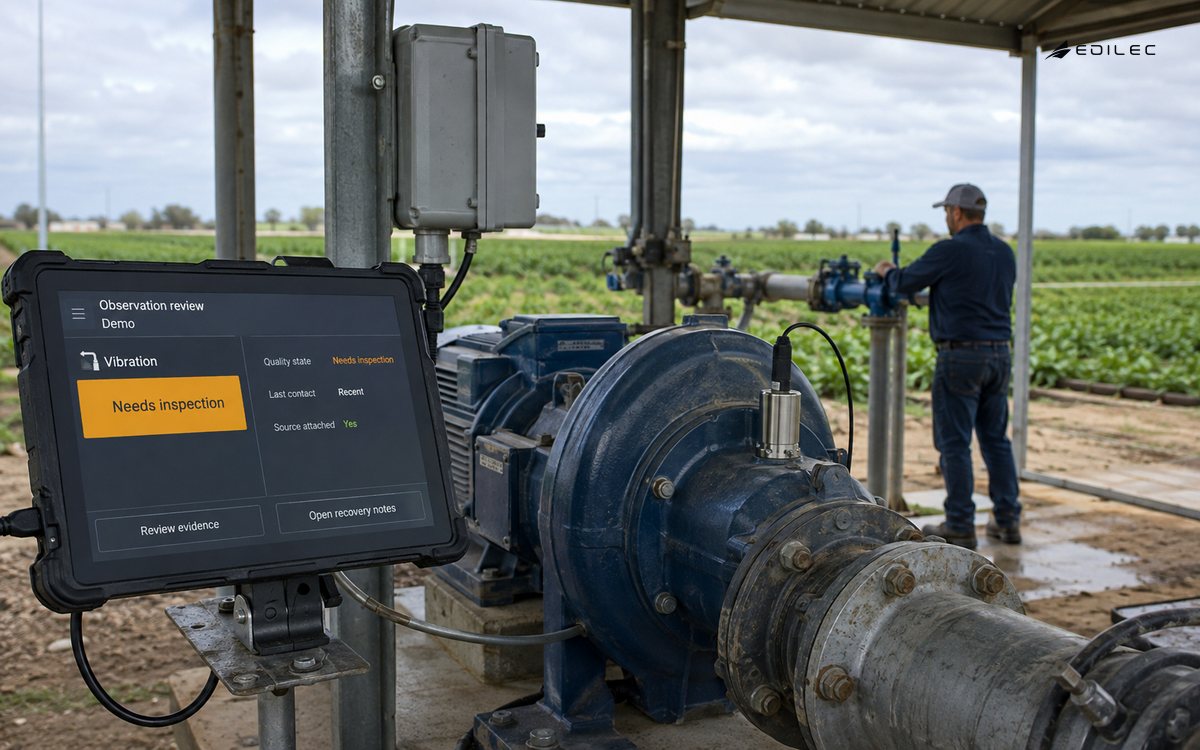
Write a production statement before discussing scale. For example: maintenance receives a reviewable indication when vibration is persistently abnormal, with the source asset, observation window, quality state, and last successful contact attached. This statement is stronger than a promise to ingest a number of messages per second because it names the user, timing, evidence, and action. IoT telemetry from device signal to decision clarifies the difference between receiving data and making it useful. Turn the statement into acceptance checks and name the owner who may change it. For failure and provisioning contrasts, see Pipeline failure patterns and Provisioning in production.
| Production dimension | Prototype shortcut | Production decision |
|---|---|---|
| Ownership | The builder is the default owner | Name service, data, and incident owners |
| Freshness | A manual refresh looks adequate | Set thresholds by operational consequence |
| Recovery | Restart until it works | Define replay, backlog, and safe resume behaviour |
| Change | Modify a field in place | Version contracts and test consumers |
| Evidence | Keep console output | Retain correlated logs, metrics, and decisions |
Set the service boundary
Production needs a boundary around ingestion, buffering, validation, raw retention, transformation, and serving. State which stage owns ordering, deduplication, quality classification, and schema rejection. Decide what happens if a gateway is offline for two hours or a central store is unavailable for ten minutes. An edge buffer may preserve observations, but it must have a capacity policy and a visible overflow outcome. The pipeline should never quietly discard the oldest evidence while dashboards continue to look healthy. NIST operational technology security guidance is a useful reminder that availability and safe degraded operation belong in the design.
Protect the production contract
A production contract describes identity, units, precision, timestamps, quality, schema version, retention, privacy, and allowed transformations. Keep an example payload and a compatibility test beside it. Reject malformed records with a reason that an operator can act on; do not turn every invalid value into a generic system error. If a field must change, introduce a version, run both forms during migration, and identify the consumer that still depends on the old form. MQTT Version 5.0 gives transport-level options, but the product team remains responsible for the contract users actually need.
- Give every production source a stable identity and an explicit lifecycle state.
- Keep received time distinct from observed time so latency is measurable.
- Record schema and transformation versions with derived records.
- Make quarantine, retry, and discard decisions visible to the support team.
- Document the maximum safe backlog and the conditions for releasing it.
Test recovery before scale
Run recovery exercises with the same seriousness as a throughput test. Disconnect a gateway, stop a consumer, fill a buffer, publish duplicates, introduce an invalid schema, and rotate a credential. Observe whether the pipeline preserves evidence, reports its state, and resumes without double-triggering business actions. A successful reconnect is not enough: the team must know how many records were delayed, dropped, duplicated, or reclassified. Define a reconciliation step for every physical or financial action that could be repeated after retry.
| Exercise | Pass condition | Owner evidence |
|---|---|---|
| Gateway offline | Bounded buffering and visible stale state | Buffer depth, oldest observation, recovery time |
| Consumer outage | Replay without duplicate side effects | Checkpoint, idempotency result, backlog age |
| Bad payload | Quarantine with actionable reason | Sample, schema version, disposition |
| Credential rotation | Only intended identity reconnects | Authorization log and device status |
| Storage outage | Safe local behaviour and clear warning | Loss estimate, recovery run, operator acknowledgement |
Operate from correlated evidence
Production support needs a path from a user-visible anomaly to the source record and the infrastructure condition that caused it. Use a shared event or correlation identifier where possible. Track source connectivity, ingestion lag, validation rejects, quarantine age, transformation latency, consumer lag, and serving freshness. OpenTelemetry's specification provides a common model for telemetry signals; use it to connect rather than merely increase the number of dashboards. Logs should answer who changed a contract, which version processed a record, and what recovery action was taken.
Set release gates that reflect risk
A release gate can be small and still meaningful. Require a contract compatibility check, a representative replay, an authorization test, a stale-data display, and an operator sign-off for a high-consequence workflow. For lower-risk analytics, a documented rollback and freshness measurement may be sufficient. Avoid a single universal percentage for every pipeline. The right threshold depends on the decision: a daily report can tolerate a different delay than an automated protective response. Record exceptions and their expiry date so a temporary shortcut does not become the permanent operating model.
Measure the first production month
Review the first month by decision quality, not just infrastructure usage. Compare expected and observed freshness, missing intervals, duplicate rate, quarantine causes, operator acknowledgements, and recovery time. Ask which alerts were actionable and which were technically correct but operationally useless. NIST log management guidance supports treating logs as evidence that must be generated, protected, retained, and reviewed. Use the review to change thresholds, contracts, or ownership rather than adding another dashboard by default.
Review the production contract
A production contract should include the answer to four support questions: what was observed, when was it observed, what changed while it travelled, and who may rely on the result. Keep a sample for each important device class and a test that checks the fields, units, quality states, and version. If the contract is updated, show whether consumers can continue, need a migration period, or must stop. This makes a release review concrete and gives the support team a quick way to distinguish bad data from a bad display.
Review ownership after the first incident. The infrastructure owner may restore a queue, the data owner may decide whether a derived view can be rebuilt, and the operational owner may decide whether an alert or work order is safe to resume. Record these roles and the evidence each one needs. A pipeline is more resilient when recovery decisions are distributed to accountable people rather than hidden in a single platform team.
Close the production operating details
Production ownership should include a clear service boundary and an escalation path for data-quality incidents. The team that owns infrastructure may not be the team that understands whether a delayed reading is safe to use. Write a handoff that names both responsibilities. Include the first diagnostic questions, the permitted mitigation, the evidence to capture, and the person who may decide that a workflow is safe to resume. This avoids the common pattern in which an engineer restarts a process successfully while the business still lacks confidence in the resulting data.
Capacity planning should include failure capacity. A normal rate is not enough when a disconnected site reconnects and releases a backlog, or when a consumer retries after a central outage. Estimate the largest expected backlog, its age, the time to drain it, and the effect on downstream systems. Put a limit on catch-up so a recovery action cannot overwhelm the service it is trying to restore. Monitor the oldest unprocessed observation, not only queue length, because a small but old backlog can be more harmful than a large fresh one.
Production security also includes change and evidence protection. Restrict who can alter parsers, retention, routing, and device permissions; record the old and new values; and make emergency changes expire or receive a later review. Protect logs and quality decisions from casual deletion because they may be needed to explain a customer impact. The NIST log management guide is especially relevant when teams decide what to collect, retain, and review during a pipeline incident.
A useful operating review follows one incident from the source to the user-facing result. Check the physical observation, gateway state, receipt time, validation outcome, transformation version, serving view, alert or report, and operator action. Ask where uncertainty was visible and where the system implied more confidence than it had. Convert the findings into one contract change, one monitoring change, or one runbook improvement. Small, named changes are easier to verify than a broad promise to improve reliability.
| Production review | Evidence to inspect | Decision |
|---|---|---|
| Backlog recovery | Oldest record and drain rate | Set safe catch-up limit |
| Quality incident | Reject reason and consumer impact | Change contract or quarantine rule |
| Access change | Actor, scope, and expiry | Approve, revoke, or remediate |
| Operator handoff | Runbook and acknowledgement | Clarify ownership or escalation |
Production readiness takeaways
- Production is an operating promise, not a deployment label.
- Define boundaries for buffering, validation, retention, transformation, and serving.
- Exercise offline, malformed, duplicate, outage, and credential-change conditions before expansion.
- Make freshness, backlog, quality, and recovery visible to the people who act on the data.
- Use a proportionate release gate and revisit it with real evidence.
FAQ: production operation
When is a sensor data pipeline ready for production?
It is ready when the supported decision, data contract, owner, access rules, recovery path, and evidence are testable. High message volume alone does not demonstrate readiness.
What should teams monitor first?
Start with source connectivity, freshness, validation rejects, backlog age, serving freshness, and recovery outcomes. Add cost and capacity signals as usage grows, but keep the first set tied to the operational promise.
Conclusion: production readiness
Moving sensor data pipelines into production means making invisible assumptions explicit. Define the decision, contract, boundary, recovery behaviour, release evidence, and owner before scale makes each omission expensive. A pipeline that can explain its current state and recover without inventing certainty is ready to become a dependable service.