What Changes When Edge Gateways Move into Production is a practical guide for engineering teams. An edge gateway prototype demonstrates translation or local analytics. A production gateway has identity, configuration, update eligibility, offline behavior, replacement, and retirement. After the first hundred units, the hard questions are which version is at a site, which configuration produced a decision, and whether a node can retain a bounded local function during upstream loss. The aim is a capability people can operate, investigate, and improve, rather than a favorable demonstration.
Production gateway operations — Define the edge gateways in production decision and boundary
Define edge authority: what the gateway may read, transform, store, and command; what waits for the central platform; and what occurs without connectivity. Record model, modules, image, software, site, interfaces, certificates, and owner. A nearby device should not become an undocumented mini-server.
| Decision area | Question to settle | Evidence to retain |
|---|---|---|
| Outcome | Which decision does edge gateways improve? | Scenario, owner, delay limit, and success measure. |
| Production authority | Who may change or override the path? | Role rule, escalation route, and audit record. |
| Data | Which record is authoritative? | Identity, time rule, quality state, and lineage. |
| Production recovery | What happens when a dependency fails? | Production recovery path, reconciliation rule, and support owner. |
Production gateway operations — Design a dependable edge gateways in production contract
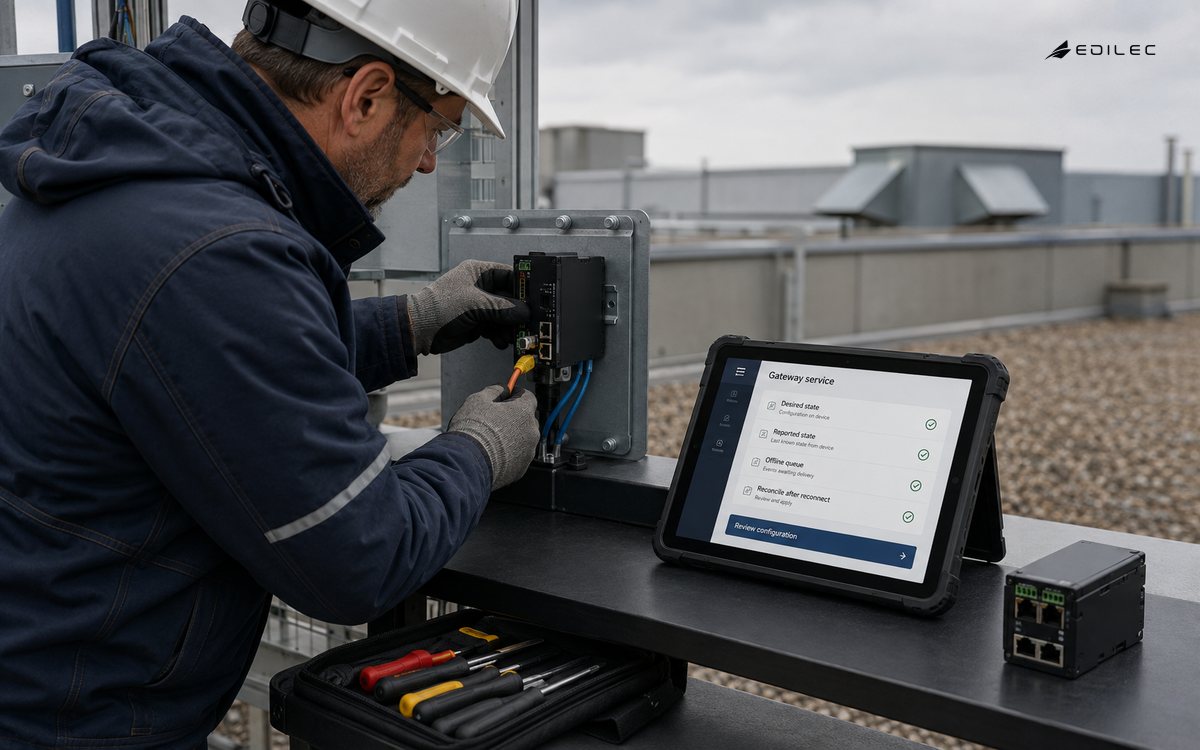
Treat configuration as versioned, integrity-protected data. Separate fleet management from workload traffic and avoid secrets in images. Define offline queue size, retention, clock behavior, and reconciliation. Where local action is needed, constrain it to a safe envelope and show desired and reported state.
| Design choice | Practical rule | Operating signal |
|---|---|---|
| Identity | Use stable IDs instead of display names or shared credentials. | Duplicate, unmatched, or unauthorized records. |
| Production time and state evidence | Preserve time and explicit quality or status. | Late, stale, unknown, and conflicting items. |
| Change | Version policy, interfaces, and configuration. | Compatibility errors and drift. |
| Production evidence | Keep source and reason near consequential decisions. | Traceability from a view to source data. |
Production gateway operations — Implement edge gateways in production as a thin, testable path
Use rollout rings that represent hardware, networks, and criticality. Prove image verification, disk pressure, power interruption recovery, certificate renewal, rollback, and replacement before broad release. Bind hardware to site and policy through controlled enrollment and capture acceptance evidence.
- Write the edge gateways contract in plain language, including delayed and disputed states.
- Assign operational and technical ownership before release.
- Use representative devices, sites, and network conditions in a controlled rollout.
- Capture configuration and approval evidence with stable identifiers.
- Test recovery from a missing dependency.
- Review the first production operating cycle with the people who act on its result.
Production gateway operations — Protect the edge gateways in production operating boundary
Use unique identities, protected management, least-privilege services, patch and vulnerability processes, and accurate inventory. Minimize internet exposure and do not use a field gateway as a convenient remote-access bridge. Vendor support should be brokered, monitored, approved, and time bounded.
Production gateway operations — Operate edge gateways in production with evidence
Monitor configuration, image, certificate expiry, storage, resource saturation, queue age, failed jobs, reboot reason, and restore time. Deployment as a file copy creates unknown variance; automatic rollback without verification creates a second fault. Rehearse rollback and verification operationally.
Production gateway operations — Create a decision record for edge gateways in production
Before expanding edge gateways in production, write the decision record that a shift lead, engineer, and support owner can all read. In the case of a gateway at a remote site continuing a bounded local function during a cloud outage, state the trigger, the person or service allowed to assess it, the evidence needed before action, the latest useful time for that action, and the safe response when evidence is missing. The record should identify physical unit, site, unique identity, approved image, desired configuration, local queue state, and last reconciliation. This is more than documentation: it prevents a dashboard label or integration default from quietly becoming policy. Ask each owner to explain what they would do with a late, contradictory, or unavailable input. Where their answers differ, resolve the rule before automating it. The resulting boundary gives product, operations, and security teams a shared basis for testing change instead of relying on a successful happy-path demonstration.
Production gateway operations — Work through a realistic edge gateways in production example
Use a gateway at a remote site continuing a bounded local function during a cloud outage as a rehearsal, not as a story that remains in a planning document. Trace the identifier from the physical asset or source through the service that evaluates it, the interface where a person sees it, the action record, and the later evidence that confirms or disputes the outcome. Decide which facts may be cached, which must be current, and which user may make a temporary override. Make the screen state match the system state: queued is not accepted, stale is not current, and an acknowledgement is not proof that the underlying condition is resolved. This exercise exposes ambiguous names, missing handoffs, and incompatible time assumptions early. It also provides concrete acceptance tests that a delivery team can repeat at every release.
Production gateway operations — Release and recover edge gateways in production deliberately
A production release should declare its compatibility assumptions, rollout cohort, rollback condition, and evidence owner. For edge gateways in production, start with a representative set of sites, devices, or users rather than a convenient set of friendly testers. Verify that the record still preserves physical unit, site, unique identity, approved image, desired configuration, local queue state, and last reconciliation after normal processing, degraded connectivity, a restart, and a version change. Rehearse the failure case in which an unrecorded configuration difference makes one site behave differently after an update or rollback. The recovery path needs a visible queue or case, a named decision-maker, and a rule for retrying, repairing, or rejecting the item. Do not use deletion to make monitoring look clean; preserve a safe diagnostic record and the reason for the outcome. This practice turns incidents into bounded operational work rather than a hunt through disconnected logs.
Production gateway operations — Review edge gateways in production on an operating cadence
Review edge gateways in production with the people who carry its consequences, using desired-versus-reported state, image version, certificate expiry, storage pressure, queue age, and reboot reason. Compare the signals with real cases rather than looking only at averages — in production gateway operations. A low fleet-wide error rate can hide one site, firmware version, customer workflow, or technician route that repeatedly fails. Include changes, manual workarounds, unresolved exceptions, and near misses in the review. Decide whether each finding needs a contract change, better validation, a training update, a capacity adjustment, or no action, and record the decision. This cadence is how a connected capability remains understandable as assets, integrations, and responsibilities change. It also gives leadership evidence of whether the work is reducing uncertainty and rework, rather than merely producing more data.
Production gateway operations — Key takeaways for edge gateways in production
- Start edge gateways with a defined decision, not a generic platform objective.
- Preserve identity, time, ownership, and quality where meaning changes.
- Make exceptions and recovery visible to people who resolve them.
- Release in cohorts and test adverse conditions.
- Restrict authority to the smallest useful scope.
- Use operating signals to improve the contract, not merely a dashboard.
Production gateway operations — edge gateways: frequently asked questions
Production gateway operations — What should teams define first?
Define the operational decision, authoritative record, owner, acceptable delay, and safe recovery path before expanding edge gateways.
Production gateway operations — How should changes be released?
Edge-gateway releases should combine a compatible hardware cohort, a defined maintenance window, and a demonstrated recovery path image. After each ring, compare desired configuration, reported configuration, local queue state, and recovery evidence before promoting the release.
Production gateway operations — What makes the service trustworthy?
Edge-gateway trust means operators can identify the physical node, its approved image and configuration, its local authority during an outage, and the result of its last reconciliation. A gateway is not healthy merely because it responds to a ping.
Production gateway operations — Conclusion: make edge gateways in production reviewable
Reliable edge gateways in production comes from explicit boundaries and routine evidence. Build one path that retains context, assigns authority, and survives delay, change, and recovery. Once the team can explain that path without guessing, expansion becomes an informed operational choice.
Production gateway operations — Authoritative sources for edge gateways in production
This guidance is informed by NISTIR 8259A: IoT Device Cybersecurity Capability Core Baseline, NIST SP 800-213: IoT Device Cybersecurity Requirements, NIST SP 800-82 Rev. 3: Guide to Operational Technology Security, CISA Internet Exposure Reduction Guidance. Use current source material and the requirements that apply to the equipment, sector, and jurisdiction when finalizing an implementation.
Production gateway operations — Production Changes the Production evidence Burden
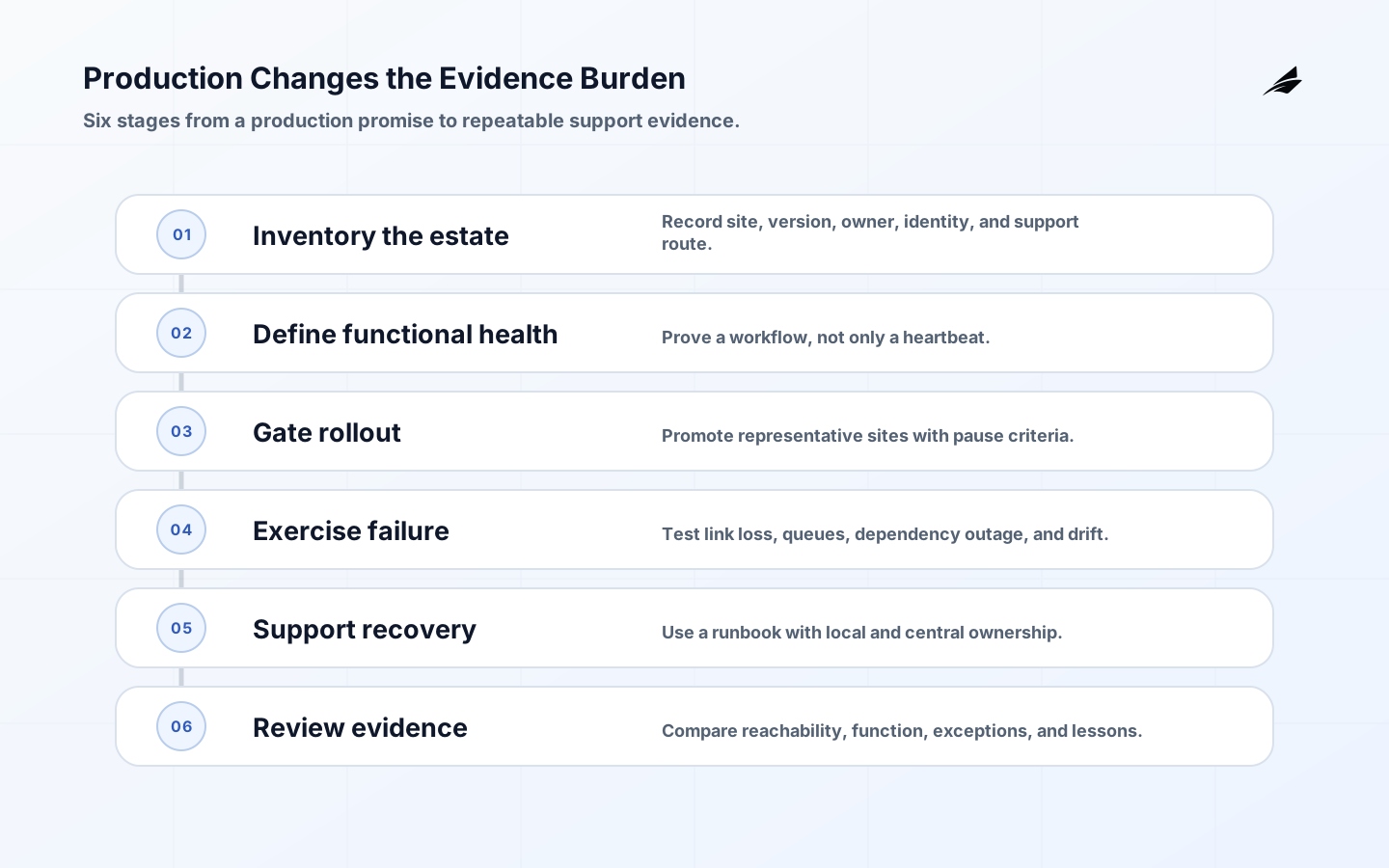
Moving edge gateways into production changes the question from “can it connect?” to “can the organization operate the connection across ordinary work, maintenance, failure, and ownership changes?” A production gateway needs a release record, a site inventory, a support route, and a clear answer when the central service is unavailable. Record model and software version, protocol adapters, local storage limits, credential expiry, maintenance window, and the person allowed to approve a bypass. The record should be useful to a technician at the site, not only to the team that built the first prototype.
| Production gate | Pass condition | Evidence retained |
|---|---|---|
| Inventory | Every gateway has owner, site, model, version, and support route. | Versioned asset record |
| Functional health | A representative workflow completes, not merely a heartbeat. | Workflow result and trace |
| Failure handling | Link loss, queue pressure, and dependency outage are visible. | Exercise record and alert |
| Change control | Rollback or local recovery is rehearsed before broad rollout. | Approved change and test log |
Use a staged rollout that separates technical reachability from functional health. A gateway may check in while a protocol adapter is failing, the local clock is drifting, or the queue is silently discarding old records. NIST SP 800-213 frames cybersecurity requirements as procurement and engineering inputs; CISA exposure-reduction guidance reinforces the need to reduce unnecessary reachable paths. In practice, promote one representative site, inspect its evidence with support staff, rehearse link loss and credential replacement, then expand only when the runbook describes the degraded state and the recovery owner.
Selected references for this topic include NISTIR 8259A: IoT Device Cybersecurity Capability Core Baseline, NIST SP 800-213: IoT Device Cybersecurity Requirements, NIST SP 800-82 Rev. 3: Guide to Operational Technology Security, CISA Internet Exposure Reduction Guidance. The selected publications anchor production gateway operations; apply them with site procedures and deployment obligations.
For adjacent operating patterns, compare IoT Telemetry Explained: From Device Signal to Decision, MQTT Brokers: Architecture Guide for Connected Products, Edge Gateways: An Implementation Checklist That Holds Up. The neighboring references connect what changes when edge gateways move into production to its wider operating context.