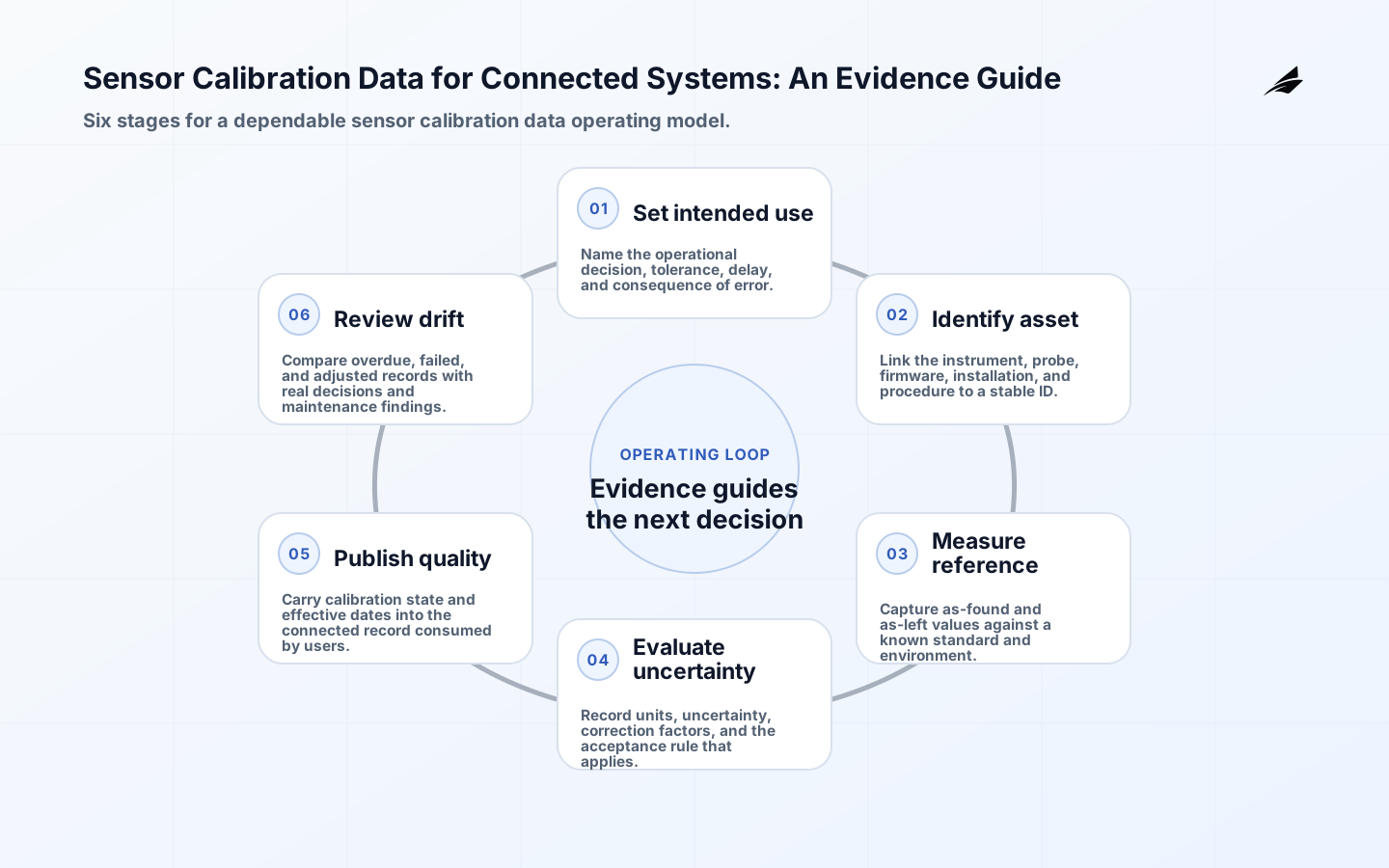
Sensor calibration data is useful only when a team can explain what was measured, against which reference, under what conditions, with what uncertainty, and for which decision. A passed check is not a permanent guarantee that every later reading is fit for use. Connected systems add another layer: calibration context must travel with identity, firmware, installation, units, timestamps, quality state, and the rule that consumes the reading.
Define the sensor calibration data decision and boundary
Begin with the decision, required range, tolerance or uncertainty, and consequence of a wrong result. Link sensor, probe, transmitter, firmware, installation, procedure, reference standard, and effective dates using a stable asset ID. A passed calibration is evidence at a moment, not proof that every later observation is good.
| Decision area | Sensor-calibration question | Sensor-calibration evidence |
|---|---|---|
| Outcome | Which decision does sensor calibration data improve? | For sensor calibration, retain scenario, owner, delay limit, and success measure. |
| Authority | For sensor calibration, answer this question: Who may change or override the path? | For sensor calibration, retain role rule, escalation route, and audit record. |
| Data | For sensor calibration, answer this question: Which record is authoritative? | For sensor calibration, retain identity, time rule, quality state, and lineage. |
| Recovery | For sensor calibration, answer this question: What happens when a dependency fails? | Contingency, reconciliation rule, and support owner. |
Design a dependable sensor calibration data contract
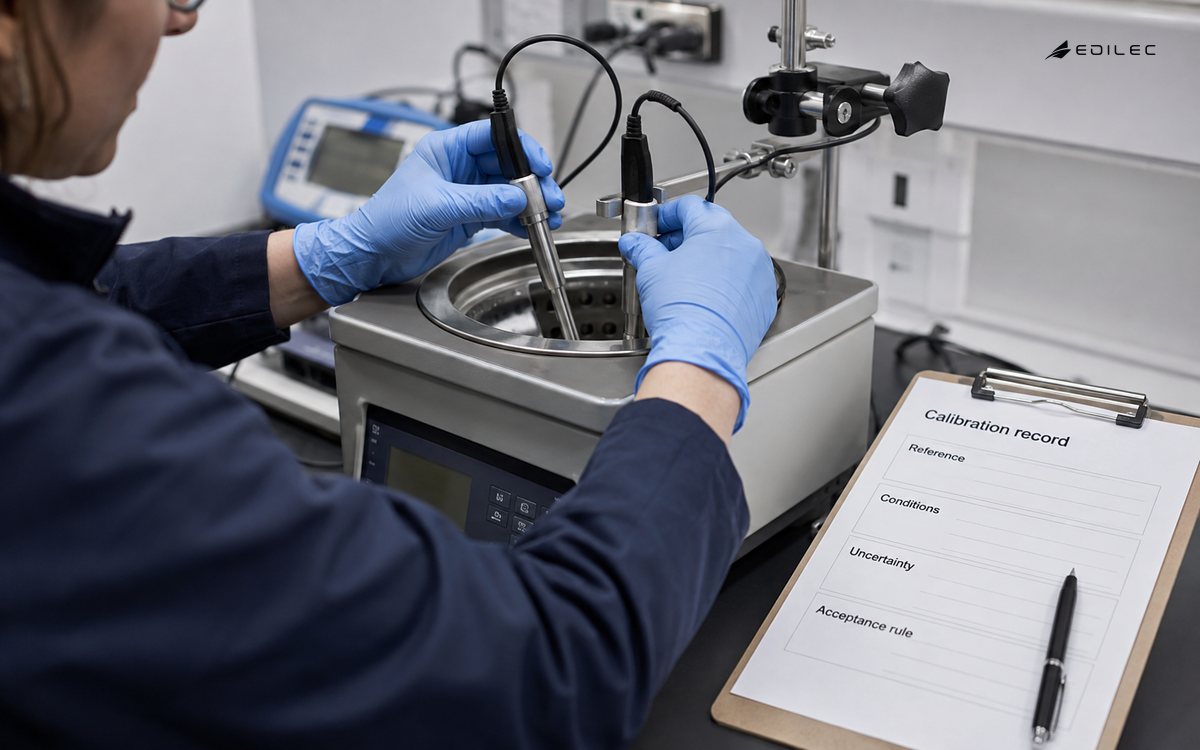
Model calibration as time-bounded metadata. Retain as-found and as-left results, units, environmental conditions, reference equipment, uncertainty, acceptance result, and procedure version. Version correction factors and preserve source values where practical so an investigation can reproduce a result.
| Design choice | Practical rule | Operating signal |
|---|---|---|
| Identity | In sensor calibration, use stable IDs instead of display names or shared credentials. | For sensor calibration, define duplicate, unmatched, or unauthorized records. |
| For sensor calibration, retain time and state. | For sensor calibration, preserve time and explicit quality or status. | For sensor calibration, define late, stale, unknown, and conflicting items. |
| Change | For sensor calibration, retain version policy, interfaces, and configuration. | For sensor calibration, define compatibility errors and drift. |
| Evidence | For sensor calibration, keep source and reason near consequential decisions. | For sensor calibration, retain traceability from a view to source data. |
Implement sensor calibration data as a thin, testable path
Make the field workflow work offline. A technician should select the exact asset, capture reference and observed values, attach the approved procedure, and see acceptance status. On synchronization, validate units and ranges, keep capture time, and route conflicts to a quality owner.
- Write the sensor calibration data contract in plain language, including delayed and disputed states.
- For sensor calibration, assign operational and technical ownership before release.
- In sensor calibration, use representative devices, sites, and network conditions in a controlled rollout.
- In sensor calibration, capture configuration and approval evidence with stable identifiers.
- For sensor calibration, test recovery from a missing dependency.
- In sensor calibration, review the first operating cycle with the people who act on the result.
Protect the sensor calibration data operating boundary
Separate the ability to record calibration evidence from authority to approve an out-of-tolerance disposition. Retain change history and protect attachments without forcing technicians back to informal notes. Keep evidence systems distinct from direct control functions.
Operate sensor calibration data with evidence
Watch overdue intervals, adjustments, failed checks, missing reference information, and time to disposition. Storing only a next-due date and PDF is a common failure: it cannot show which readings were affected, which procedure applied, or whether a correction changed interpretation.
Create a decision record for sensor calibration data
Before expanding sensor calibration data, write the decision record that a shift lead, engineer, and support owner can all read. In the case of a temperature probe whose reading determines whether sensitive stock may be released, state the trigger, the person or service allowed to assess it, the evidence needed before action, the latest useful time for that action, and the safe response when evidence is missing. The record should identify sensor and probe identity, procedure, reference equipment, environmental conditions, as-found and as-left values, uncertainty, and effective dates. For a calibration record, this is more than documentation: it prevents a dashboard label or integration default from quietly becoming policy. For a calibration record, ask each owner to explain what they would do with a late, contradictory, or unavailable input. For a calibration record, where their answers differ, resolve the rule before automating it. For a calibration record, the resulting boundary gives product, operations, and security teams a shared basis for testing change instead of relying on a successful happy-path demonstration.
Work through a realistic sensor calibration data example
Use a temperature probe whose reading determines whether sensitive stock may be released as a rehearsal, not as a story that remains in a planning document. For a calibration record, trace the identifier from the physical asset or source through the service that evaluates it, the interface where a person sees it, the action record, and the later evidence that confirms or disputes the outcome. For a calibration record, decide which facts may be cached, which must be current, and which user may make a temporary override. For a calibration record, make the screen state match the system state: queued is not accepted, stale is not current, and an acknowledgement is not proof that the underlying condition is resolved. For a calibration record, this exercise exposes ambiguous names, missing handoffs, and incompatible time assumptions early. For a calibration record, it also provides concrete acceptance tests that a delivery team can repeat at every release.
Release and recover sensor calibration data deliberately
For a calibration record, a production release should declare its compatibility assumptions, rollout cohort, rollback condition, and evidence owner. For sensor calibration data, start with a representative set of sites, devices, or users rather than a convenient set of friendly testers. Verify that the record still preserves sensor and probe identity, procedure, reference equipment, environmental conditions, as-found and as-left values, uncertainty, and effective dates after normal processing, degraded connectivity, a restart, and a version change. Rehearse the failure case in which a calibration adjustment is applied without preserving the prior evidence or affected measurement period. For a calibration record, the recovery path needs a visible queue or case, a named decision-maker, and a rule for retrying, repairing, or rejecting the item. For a calibration record, do not use deletion to make monitoring look clean; preserve a safe diagnostic record and the reason for the outcome. For a calibration record, this practice turns incidents into bounded operational work rather than a hunt through disconnected logs.
Review sensor calibration data on an operating cadence
Review sensor calibration data with the people who carry its consequences, using overdue checks, out-of-tolerance results, missing references, adjustment trends, and disposition age. For a calibration record, compare the signals with real cases rather than looking only at averages. For a calibration record, a low fleet-wide error rate can hide one site, firmware version, customer workflow, or technician route that repeatedly fails. For a calibration record, include changes, manual workarounds, unresolved exceptions, and near misses in the review. For a calibration record, decide whether each finding needs a contract change, better validation, a training update, a capacity adjustment, or no action, and record the decision. For a calibration record, this cadence is how a connected capability remains understandable as assets, integrations, and responsibilities change. For a calibration record, it also gives leadership evidence of whether the work is reducing uncertainty and rework, rather than merely producing more data.
Calibration data operating contract
For calibration records, define the measurement owner, reference standard, acceptance rule, uncertainty treatment, effective interval, and disposition authority before connecting another device or dashboard. A reviewer should be able to follow one value from asset identity to procedure, environmental conditions, as-found and as-left results, and the decision that consumed it. Use NIST Sensor Science Division calibration services, NIST Technical Note 1297, and NIST OT security guidance to ground the evidence model. Related Edilec context is available in the sensor-calibration checklist, device-identity guide, and IoT telemetry guide.
Rehearse a calibration record with a real instrument, a known reference, a late upload, an out-of-tolerance result, and a changed correction factor. Preserve the original observation beside the interpreted value so a quality reviewer can reconstruct what was known at the time. Check that technicians, approvers, and downstream consumers see the same asset identity and quality state. The useful measure is not the number of records captured; it is the speed and confidence with which the team can decide whether a reading remains fit for use.
| Decision area | Sensor-calibration question | Sensor-calibration evidence |
|---|---|---|
| Purpose | For sensor calibration, answer this question: Which real decision does the system change? | For sensor calibration, record the scenario, owner, and acceptance example. |
| Boundary | For sensor calibration, identify what is allowed, and what is deliberately excluded? | For sensor calibration, retain policy, identity, and version details. |
| Failure | For sensor calibration, identify what happens when data, network or dependency fails? | For sensor calibration, retain a contingency test and visible status. |
| Change | For sensor calibration, answer this question: Who can alter rules, mappings or access? | For sensor calibration, retain approval, diff and rollback point. |
| Review | For sensor calibration, answer this question: What shows the design remains useful? | For sensor calibration, retain outcome, exception and correction record. |
Calibration takeaways that matter most
- Start sensor calibration data with a defined decision, not a generic platform objective.
- In sensor calibration, preserve identity, time, ownership, and quality where meaning changes.
- In sensor calibration, make exceptions and recovery visible to people who resolve them.
- For sensor calibration, release in cohorts and test adverse conditions.
- For sensor calibration, restrict authority to the smallest useful scope.
- In sensor calibration, use operating signals to improve the contract, not merely a dashboard.
FAQ: questions for calibration and quality teams
Which calibration facts must be defined first?
Define the operational decision, authoritative record, owner, acceptable delay, and safe contingency before expanding sensor calibration data.
How should calibration changes reach production?
Calibration-data changes require metrology review when they affect units, uncertainty treatment, correction factors, or record retention. Release new forms and calculations alongside a sample of prior records, then confirm that a quality owner can reconstruct both the old decision and the new one.
What lets a reviewer trust a calibration record?
Sensor-calibration-data trust means a quality reviewer can follow a measurement from its displayed value to the applicable calibration record, procedure, reference standard, uncertainty, and disposition. That evidence must remain intelligible after an instrument is adjusted, replaced, or relocated.
Conclusion: keep calibration evidence usable
Reliable sensor calibration data comes from explicit boundaries and routine evidence. For a calibration record, build one path that retains context, assigns authority, and survives delay, change, and recovery. Feed repeated adjustment, environmental, and installation findings back into maintenance and instrument-selection decisions. For a calibration record, once the team can explain that path without guessing, expansion becomes an informed operational choice.
Authoritative sources for sensor calibration data
The calibration references include NIST Sensor Science Division calibration services, NIST Technical Note 1297, NIST SP 800-82 Rev. 3, and the NIST Cybersecurity Framework 2.0 publication. Apply the requirements that fit the equipment, sector, and jurisdiction when finalizing an implementation.