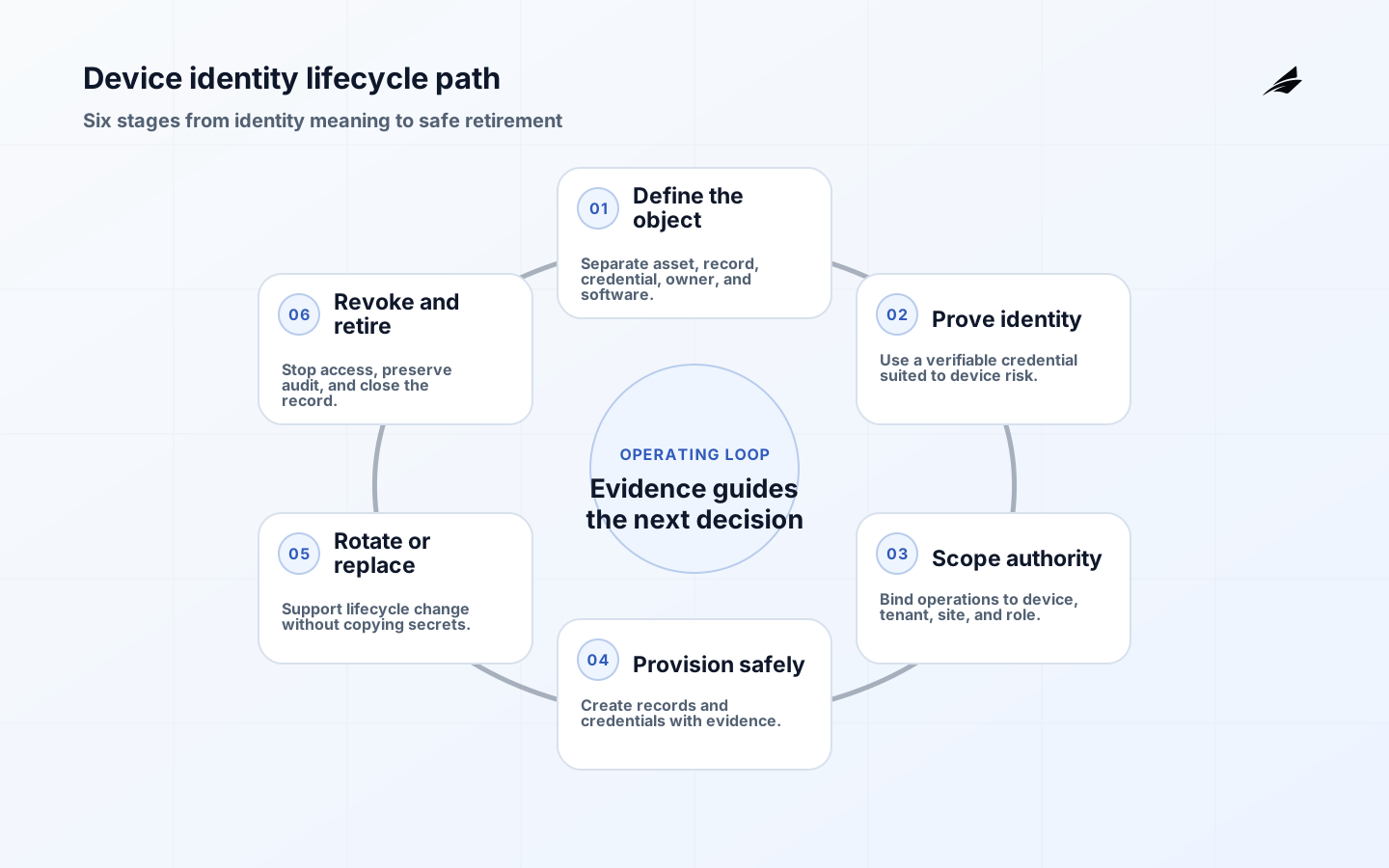
Device identity is the answer to a deceptively simple question: which physical or virtual device is allowed to do this, here, now, and under whose authority? An identifier printed on a label is useful for inventory but not sufficient for authentication. Production identity must be verifiable, scoped, observable, rotatable, and revocable. NISTIR 8259A treats device identification as a core capability alongside configuration, data protection, software update, and cybersecurity state awareness. Use that baseline as a starting point, then adapt it to the product’s risk, manufacturing path, field support model, and retirement process. Identity should be designed before the first device connects, not discovered during an incident.
Define What the Identity Represents
Separate the physical asset, logical device record, credential, owner, site, and current software version. One physical gateway may represent many sensors, while a replacement board may inherit the business asset’s history but require a new credential. Write the relationships down. A device identifier should be stable enough for inventory and support, while a credential identifier can change on rotation. Keep tenant or site association out of identifiers when it would make moves, resale, or privacy controls difficult. Link to device provisioning security review when manufacturing and onboarding are still open. The useful boundary is the one support, security, and product teams can all query without guessing.
| Identity object | Purpose | Can it change? |
|---|---|---|
| Asset ID | Names the physical or business asset. | Usually stable through service life. |
| Device record | Stores capabilities, site, owner, and status. | Yes, under audited workflow. |
| Credential | Authenticates a connection or request. | Yes; rotate or revoke. |
| Firmware identity | Explains behavior and exposure. | Yes, on approved update. |
Choose How Devices Prove Identity
Authentication may use unique X.509 certificates, hardware-backed keys, secure elements, tokens, or another mechanism suitable for the device and deployment. The choice should answer how the secret is generated, where it is stored, how the server validates it, and what happens when it is lost. Avoid a shared fleet credential unless the risk is consciously accepted and the blast radius is bounded. AWS IoT documentation describes X.509 certificates and multiple provisioning paths; its device provisioning guide is a useful reference for comparing pre-installed certificates, trusted-user onboarding, and fleet provisioning. Treat the reference as a pattern to evaluate, not as a reason to copy a cloud-specific architecture.
Keep Authentication Separate from Authority
A verified device is not automatically allowed to publish every topic, read every command, or act for every site. Define permissions by device type, tenant, operation, resource, and state. A temperature sensor may publish readings but should not subscribe to actuator commands. A gateway may read local devices but should not gain unrestricted access to a neighboring tenant. Record policy version and decision context so an access failure can be explained. Use NISTIR 8259 Revision 1 to review identification, logical access, data protection, and state-awareness requirements together. Least privilege is a lifecycle property: review it when capabilities or ownership change.
| Actor | Allowed action | Guardrail |
|---|---|---|
| Sensor | Publish its measurement topic. | Device-scoped identity and rate limit. |
| Gateway | Forward registered device data. | Explicit device list and tenant boundary. |
| Operator | Inspect or suspend a device. | Strong user identity and audited action. |
| Provisioner | Create initial records and credentials. | Short-lived authority and approval record. |
Make Provisioning a Controlled Transition
Provisioning is not just creating a row in a registry. It binds an asset to a credential, product type, owner, site, capabilities, policy, and support record. Decide which facts are established in manufacturing, which are established during installation, and which require a human approval. Use a temporary claim only when its scope and expiry are clear. AWS describes fleet provisioning where a device uses a claim certificate to obtain a permanent certificate; its documentation also stresses protecting claim credentials and monitoring misuse. Test a duplicate serial number, an interrupted registration, a device shipped to the wrong site, and an installer who loses connectivity halfway through the flow.
Plan Rotation and Replacement
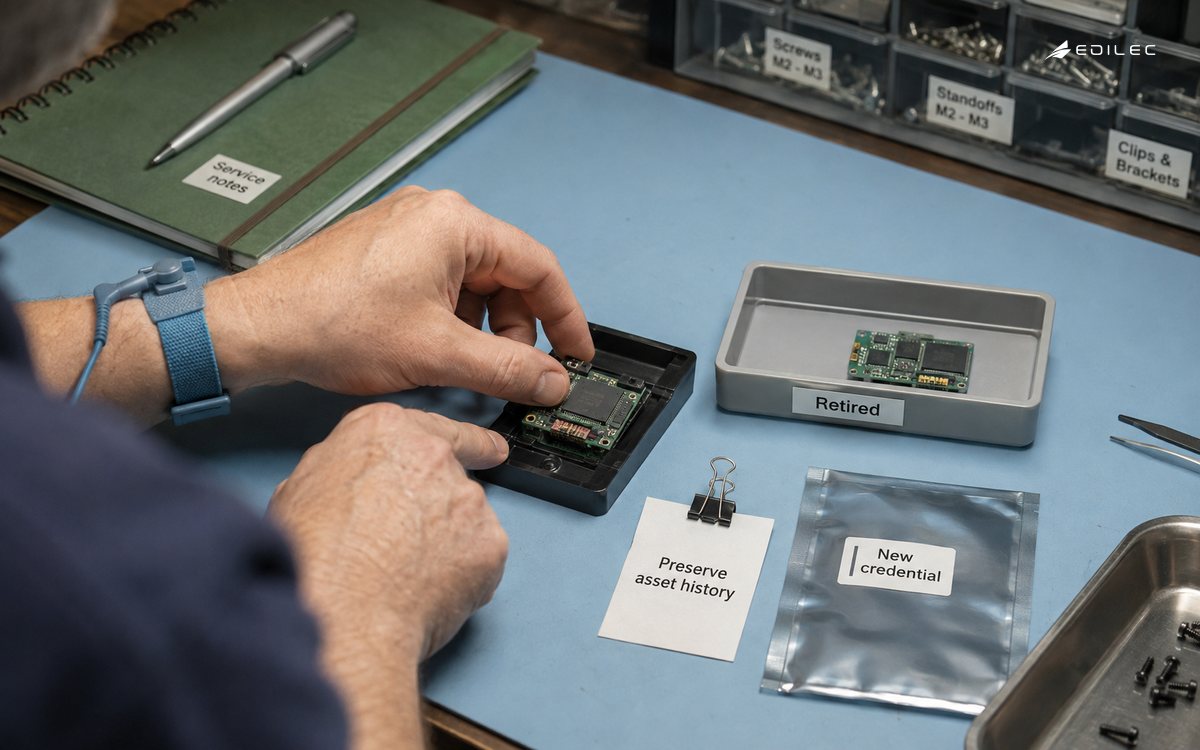
Credentials expire, secrets leak, boards fail, and ownership changes. A rotation plan should work without a maintenance visit whenever the device and risk permit it, but it should also have a safe manual path. Support overlapping credentials during a bounded transition, verify the new credential before disabling the old one, and record the event against the asset. Replacement is a separate case: decide whether the new device inherits configuration, history, or only a business relationship. Never copy a private key from a failed device to its replacement. The identity system should show old, current, and pending credentials without treating all of them as equally active.
Design Revocation for Pressure
Revocation must be fast enough for the threat and precise enough to avoid taking down an entire fleet unnecessarily. Define who can suspend a credential, what evidence is required, how the device is quarantined, and what happens to buffered data and commands. AWS IoT security best practices emphasizes protecting the connection and certificate lifecycle; your local operating model should add the human decision path. Test stolen devices, leaked claim credentials, repeated failed authentication, and a false positive. A revocation that exists only in a console and has no alert, audit record, or recovery procedure is not a complete control.
Observe Identity State
Track active, pending, suspended, revoked, retired, and unknown devices. Measure last successful connection, authentication failures, policy denials, certificate age, provisioning completion, firmware version, and unexpected site or topic behavior. A device that is silent may be offline, powered down, incorrectly provisioned, or blocked by policy; identity telemetry should help distinguish those states. Do not expose private credential material in logs. Instead, log stable references, reason codes, policy versions, and correlation identifiers. These signals support operations teams as much as security teams, because a clear identity state shortens diagnosis when a customer reports that a device disappeared.
Keep Identity Data Useful and Minimal
The registry needs enough context to authorize and support the device but should not become an ungoverned copy of every business system. Store capabilities, ownership reference, site or zone, lifecycle state, certificate references, last-seen information, software version, and relevant compliance or service dates. Keep customer data and secrets elsewhere when possible, joined through controlled references. Define retention for retired assets and the evidence required to prove deletion or archival. Link to network segmentation for connected systems when identity and network placement must reinforce each other.
Pilot the Lifecycle End to End
A useful identity pilot covers manufacture or staging, installation, first connection, normal operation, rotation, suspension, replacement, support inspection, and retirement. Include a device with poor connectivity and one with a deliberately invalid credential. Verify that policy decisions are narrow, logs are actionable, and operators can recover without direct database edits. Compare the intended lifecycle diagram with actual handoffs between engineering, field service, security, and support. Roll out by device family or site, preserving a clear quarantine path. Scale only after the team can answer which device is affected, what it may do, who last changed it, and how to stop it safely.
A useful identity review follows one device through every handoff: manufacturing, staging, installation, first connection, normal use, ownership change, key rotation, support inspection, replacement, and retirement. At each step, record who can act, what evidence is created, and which system is authoritative. This catches gaps that a login test misses, such as a replacement device inheriting a stale site policy or a retired credential remaining valid in a secondary service.
Keep identity failures diagnosable without revealing secrets. A support engineer should be able to see that a certificate was expired, a policy denied a topic, a device was suspended, or a registration was incomplete. They should not need the private key or a broad administrative role to learn that fact. This separation improves both security and resolution time.
Keep the identity lifecycle legible to support and security together. A stable asset record should point to current and historical credentials without exposing secret material, and every lifecycle action should have a reason, actor, timestamp, and resulting state. This gives incident response enough context to stop harm while preserving a clean customer history. See firmware updates operations playbook for the adjacent lifecycle dependency.
Include retirement in the first identity diagram. A device that is powered down but still authorized is different from a credential that is revoked and an asset that is archived. Distinguishing those states gives support, security, and compliance teams a common answer when someone asks whether the device can still act.
Practical Takeaways
- Distinguish asset, device record, credential, owner, site, and software identity.
- Use unique, verifiable credentials and scope authority separately from authentication.
- Make provisioning a controlled transition with human and automated evidence.
- Support rotation, replacement, suspension, and retirement without copying secrets.
- Observe lifecycle state, policy decisions, failures, and unexpected behavior.
- Test the identity lifecycle under interruption before scaling the fleet.
FAQ: Device Identity
Can a serial number alone prove device identity?
A serial number is useful for inventory but not proof that a connection comes from the device that owns the number. Pair an asset identifier with a cryptographic credential or another verifiable mechanism, then authorize its operations separately.
What should happen when a device is replaced?
Retire or suspend the old credential, issue a new credential to the replacement, and preserve the business history through an explicit asset relationship. Copying the old private key or silently reusing its identity weakens auditability and makes incident response harder.
Conclusion
Device identity is durable only when it remains useful across the whole lifecycle. Define what the identity represents, how it proves itself, what it may do, how it changes, and how it is stopped. Those decisions give connected products a smaller blast radius, clearer support work, and a defensible foundation for growth.