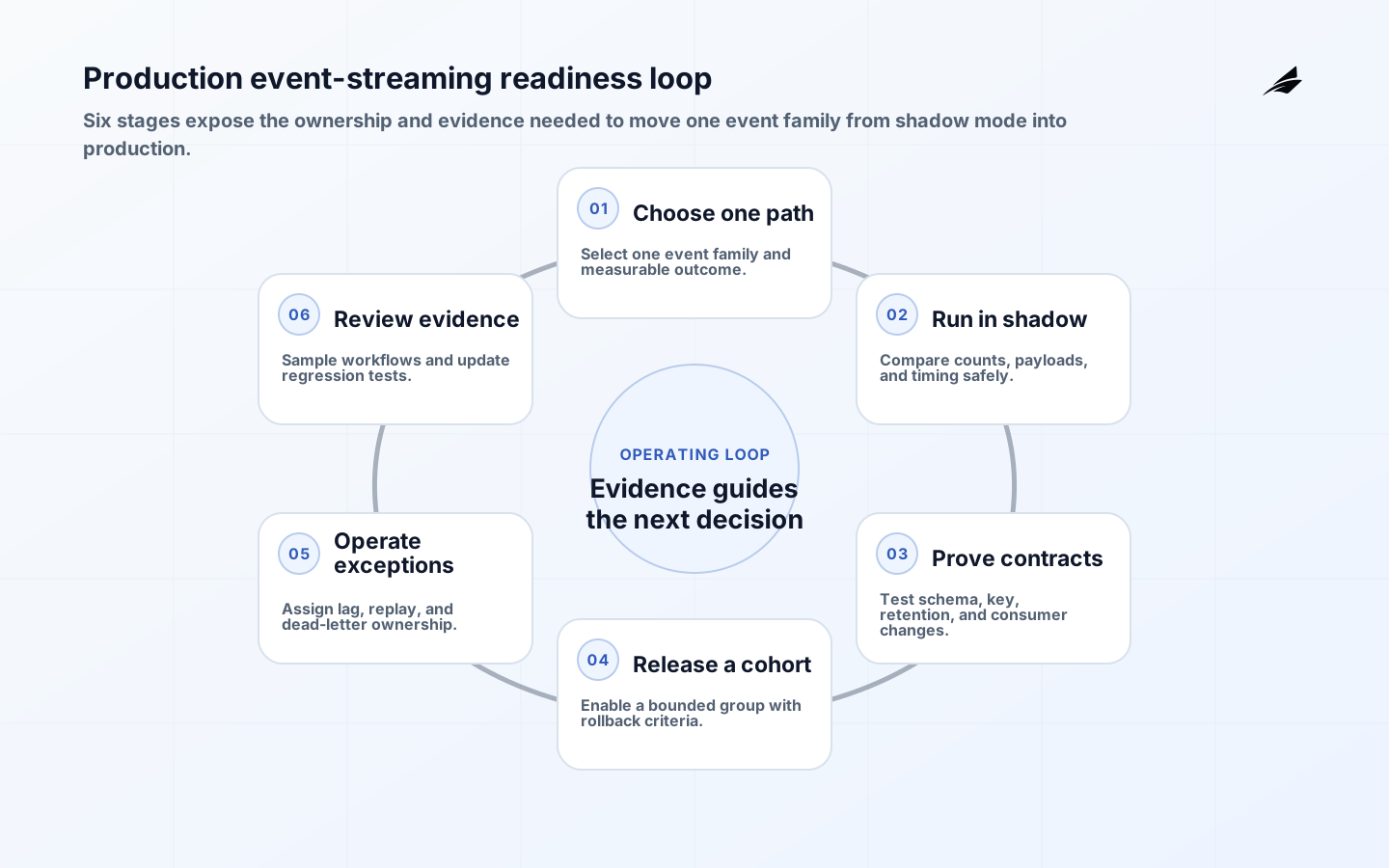
Event streaming changes character when it moves into production: a prototype becomes a service that people depend on during ordinary work and difficult recovery. The production boundary is the first event family whose delay, duplication, or loss changes a real decision.
Prove production readiness with a bounded consumer
The move into production is a change in accountability, not only a change in throughput. A prototype can tolerate a developer restarting a consumer or inspecting a payload by hand; a production service needs a named responder, a bounded recovery window, and a record of what happened while the path was degraded. Choose one event family and one consumer whose result can be compared with an existing system of record. Run the stream in shadow mode, compare counts and representative payloads, and keep a short evidence set for normal, delayed, duplicated, rejected, and replayed records. The result should answer a simple question: can the operations team make the intended decision without guessing whether the stream is current?
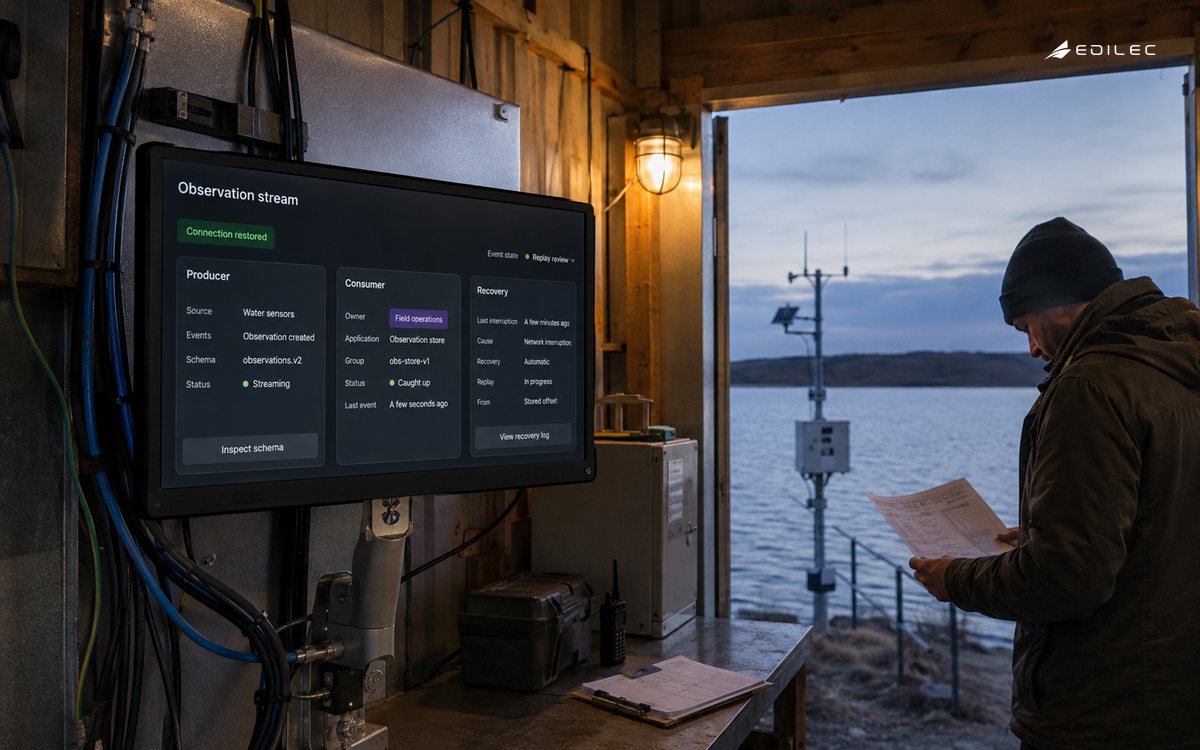
For production rollout planning, compare What Changes When Gateway Security Moves into Production Operations, Edge Gateway Scope Decisions Before the First Build, Protocol Selection Decisions That Matter before the First Build; together they frame production rollout, ownership, and recovery without asking the reader to infer the operating boundary.
- Select one event family with a measurable business outcome.
- Compare shadow results with an authoritative record before enabling action.
- Test compatibility, duplicate effects, blocked consumers, and bounded replay.
- Give operations a clear owner, runbook, and recovery deadline.
Production event streaming takeaways for operators
- Start event streaming with one accountable decision, not a broad platform promise.
- Preserve identity, time, source, quality, and ownership wherever facts cross a boundary for production rollout.
- Test degraded conditions and recovery before expanding the rollout.
- Measure whether people can make and later explain the intended decision for production rollout.
Define the decision boundary for event streaming
Start by naming the event owner and the business fact each record represents. A temperature observation is not the same as an alert, and an order-created event is not the same as an authorization to ship. Record a stable event identifier, producer, subject, occurrence time, schema version, and correlation identifier. The CloudEvents project makes these portable context attributes explicit, while Apache Kafka documentation explains why keys, partitions, retention, and consumer offsets are operational choices rather than incidental defaults.
| Question | Decision to document | Evidence in operation |
|---|---|---|
| Purpose | Which action or review does this capability support? | Named owner and an observable outcome. |
| Authority | Which system or person may change the relevant state? | Actor, source, time, and policy record. |
| Failure | What is safe when required evidence is missing? | Visible pending, rejected, or manual-review state. |
| Recovery | How is an exception resolved and closed? | Case history and reconciliation result. |
Build an architecture that preserves meaning — production consumer ownership
Use a durable log for facts that more than one independently operated consumer needs, then make consumers idempotent. A partition key should preserve the order that a particular workflow needs, not create a hot partition around the busiest customer or device. Keep commands on a separately governed route: an event can describe that a controller reported a state; it should not silently authorize a controller to take a physical action. Define retention, replay authority, and a dead-letter investigation process before traffic becomes valuable.
Apply controls that fit the operating risk — production consumer ownership
The principal failure modes are duplicated delivery, late arrival, malformed schema, poisoned consumer state, and a producer that keeps publishing after its business meaning has changed. Validate at the producer boundary and again at a consumer boundary that can reject safely. Encrypt transport, scope producer and consumer identities to named topics, and retain audit evidence for privileged replay. NIST guidance on operational technology is useful when a stream crosses into equipment-facing work because availability and safety constraints can outweigh a convenient retry.
| Control area | Practical implementation | Review signal |
|---|---|---|
| Identity | Use unique, scoped identities for people, devices, and services. | Unexpected access, expired credentials, or orphaned accounts. |
| Change | Version schemas, configuration, and release approvals. | Rollback, incompatibility, or unreviewed drift. |
| Resilience | Define degraded behavior, buffering, and manual recovery. | Delayed work, queue age, or unresolved exceptions. |
| Evidence | Record material actions and data-quality status. | Ability to reconstruct a consequential decision. |
Release event streaming in bounded stages
Begin with one event family and one consumer that can be checked against an existing record. Run it in shadow mode, compare counts and representative payloads, and deliberately replay a bounded period. Add schema compatibility checks in delivery, consumer lag alerts that identify the affected group, and a documented response for a blocked partition. Only then add more consumers; fan-out is easy to enable and difficult to govern after the fact.
Measure the operating path, not just availability — production consumer ownership
Measure end-to-end usefulness, not only broker throughput. Track producer rejection rate, publish-to-consume delay by event family, consumer lag, duplicate handling, schema-version adoption, replay duration, and the age of unresolved dead-letter items. Review a small sample from a completed workflow each week: it reveals whether identifiers, timestamps, and outcomes still let an operator reconstruct what happened.
Set acceptance criteria for event streaming
An implementation for event streaming should have acceptance criteria that an operator, engineer, and accountable owner can all inspect. Start with the stated outcome and write normal, degraded, and recovery examples before configuring production services for production rollout. A practical acceptance test publishes a versioned event alongside a simulated duplicate, a late record, and an unavailable consumer. The test passes only when the final workflow state is correct and the investigation trail identifies why each nonstandard record was treated as it was. This checks business semantics, not merely whether a producer and broker exchanged bytes.
Keep the first release deliberately narrow. It is easier to compare a bounded path with its prior process, correct an unclear ownership rule, and teach a support team a real response for production rollout. Expansion should be based on evidence from the representative workflow, including exceptions, rather than on a count of integrated assets or enabled accounts for production rollout. For event streaming, this means choosing the smallest path that still exposes the relevant ownership, failure, and recovery conditions.
Assign ownership across the lifecycle — production consumer ownership
Product owners should own the definition of an event, engineers should own compatibility and recovery mechanics, and operations should own the response to lag or loss. When these responsibilities are merged into one vague platform role, changes can be technically valid but operationally surprising.
Use a change record for payload additions, partition-key changes, retention changes, and new consumers. It should name affected workflows, compatibility evidence, rollback options, and the owner who accepts downstream impact.
Prepare for the event-streaming cases that change meaning
A late event is not automatically bad data. A device may have been disconnected, a batch producer may have flushed after a maintenance window, or a clock may be wrong. Preserve both occurrence and ingestion time, then let consumers decide which time governs their workflow. For a dispatch board, a late location update may be informative but not eligible to reassign work; for an audit record, it remains evidence. Make that distinction explicit in consumer contracts.
Run event streaming as a shared service
Give producers ownership of schema evolution and consumers ownership of their recovery behavior, while a platform team owns broker capacity, baseline security, and shared observability. A lightweight change review should ask which consumers are affected, how compatibility was tested, and whether retention or privacy classification changed. This is more useful than a central gate that sees every payload but lacks domain accountability.
Keep decision evidence usable — production consumer ownership
For event streaming, a decision record should include the event identifier, producer version, partition or routing key, consumer group, processing result, and the business record affected. During an incident, this lets a team distinguish a missing publication from an unprocessed event, a duplicate from a legitimate retry, and a replay from a new action. Keep this evidence queryable for the period in which operational disputes can reasonably arise, then review whether retention and access remain proportionate.
Production event-streaming questions operators should answer
What changes when an event stream enters production?
Accountability moves from the prototype team to named owners for schema compatibility, consumer recovery, lag, replay, retention, security, and incident response.
Can a stream replace the transactional system of record?
Usually no. Keep the database or domain service authoritative for constrained transactions, and publish a durable event that consumers can process and reconcile.
Conclusion: keep production rollout explainable
Reliable event streaming comes from a defined decision, explicit authority, controlled change, and evidence that survives a difficult day. Start with a delay-sensitive dispatch board and audit trail, prove the path under normal and adverse conditions, and use the findings to make the next release more dependable. That produces a capability that operations, security, and engineering can improve together instead of a system that only works while its original builders are nearby for production rollout.
Next review: examine event schemas and consumer behavior after a real business change, not only after broker maintenance. A product change that adds a new state, identifier, or timing rule can be more consequential than a capacity change. Keep a small set of representative event traces as regression evidence for that review.
Primary references for production event streaming
Use these references to test production event-streaming decisions: Apache Kafka Design Documentation, CloudEvents Specification v1.0.2, NIST SP 800-82 Rev. 3, and NIST SP 800-61 Rev. 3. Confirm the resulting controls against local safety, sector, and jurisdiction obligations.