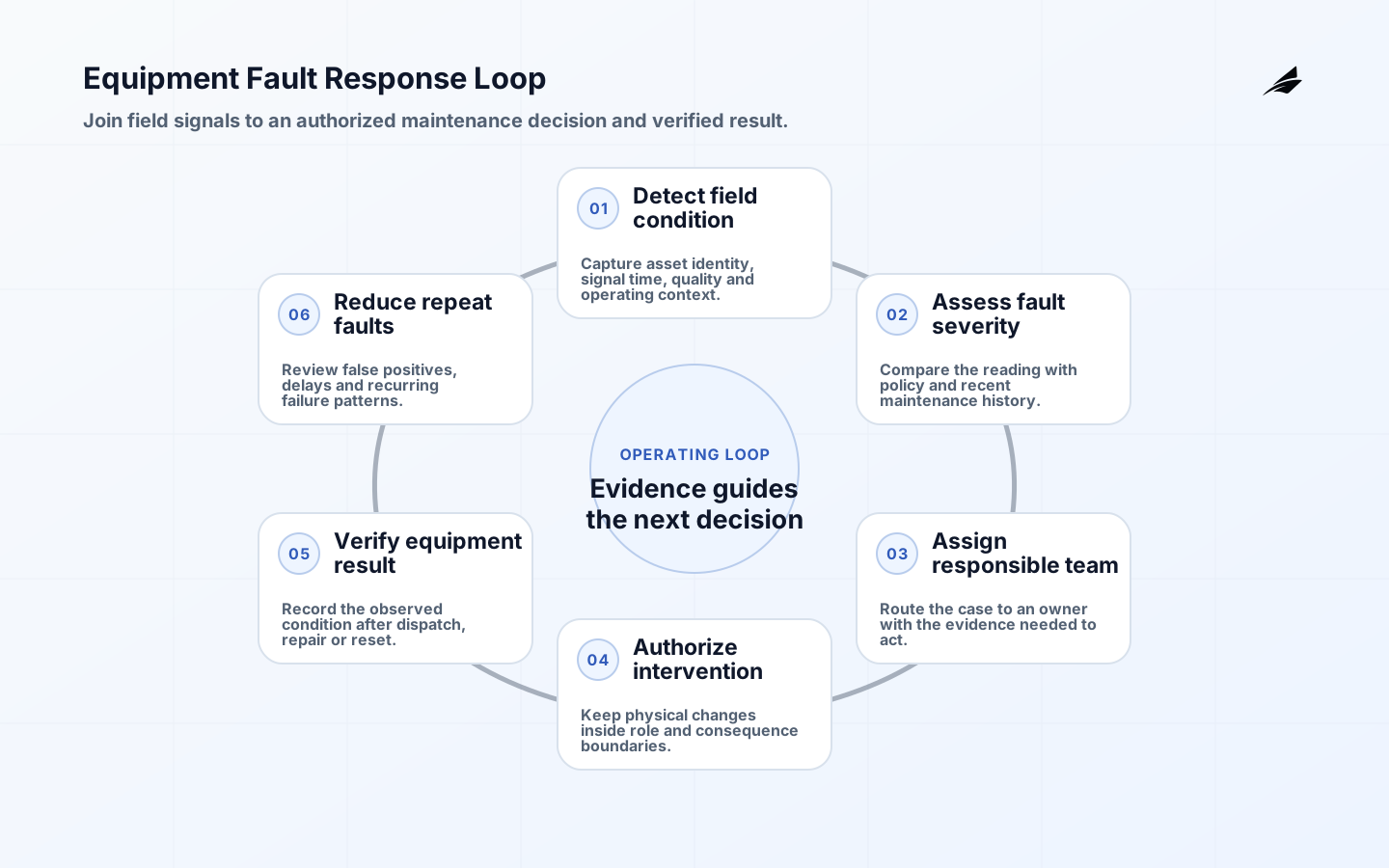
Connected operations is the practice of joining signals from equipment and processes to the people who must decide and act. It is not simply an IoT dashboard, and it is not a promise to automate every exception. The useful result is a shorter, more reliable loop: observe an operational condition, understand its context, choose an owner and response, record what happened, and learn whether the response worked. Operations leaders should start from a recurring decision with a cost: an avoidable site visit, a missed maintenance window, a long investigation, an energy anomaly, or an unsafe manual handoff.
Start With One Operational Loop
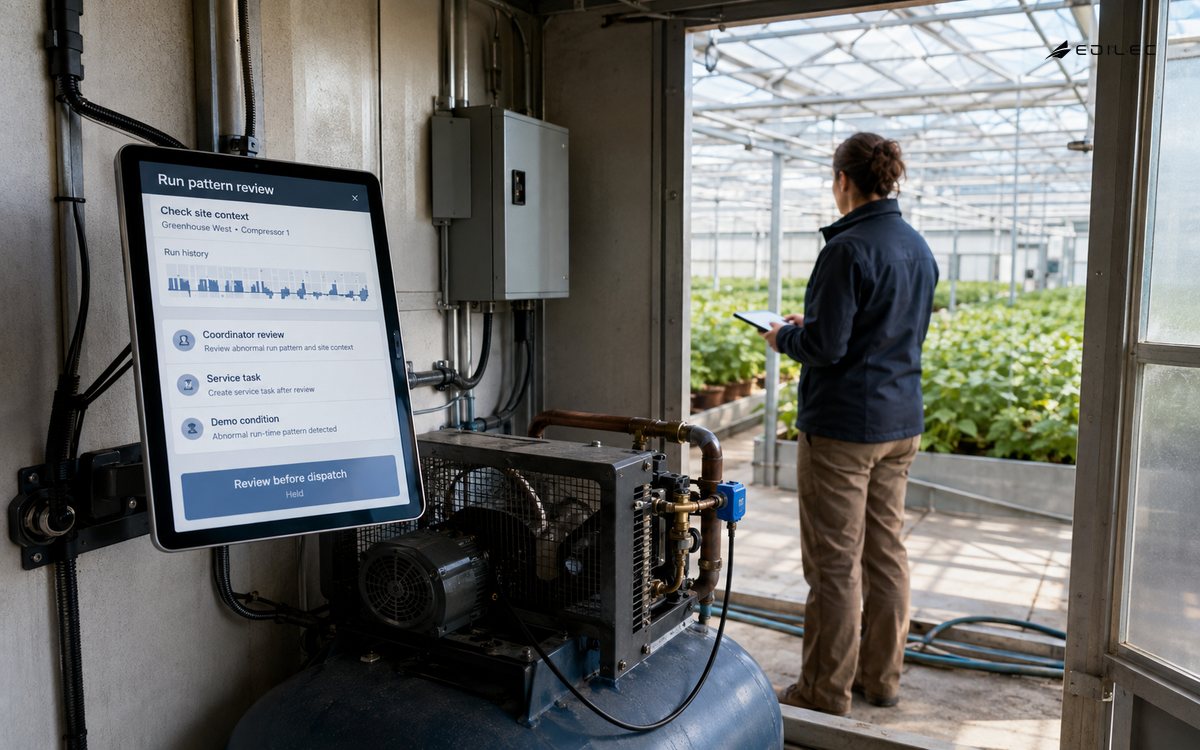
Describe the current loop in plain language before selecting a platform. Who notices the condition now? Which record do they trust? How is severity assessed? Who may authorize action? Where is the outcome recorded? A connected release should improve one of those steps without obscuring the rest. For example, use a compressor's abnormal run-time pattern to create a review task for a reliability coordinator, who checks site context before dispatching service. The first release does not need autonomous maintenance; it needs a clear handoff and a way to measure whether the right work was initiated sooner.
| Loop element | Question to answer | Evidence of readiness |
|---|---|---|
| Signal | What condition is detected and how fresh is it? | Source, timestamp, quality state, and threshold are visible |
| Context | What changes the meaning of that signal? | Asset, operating mode, planned downtime, and recent work can be found |
| Decision | Who chooses the next action? | Role, approval limit, and escalation are documented |
| Outcome | How will the team know the response helped? | Work result and metric can be joined to the initiating condition |
Govern the Operational Record
Connected operations requires several records to agree without pretending they are one database. The asset registry may own equipment identity, a historian may own high-rate measurements, a maintenance system may own work orders, and a portal may own technician observations. Name those boundaries. Carry stable identifiers and timestamps through integrations, and label derived status so users can distinguish a source event from a calculated risk score. When definitions change, version the rule and retain the old result long enough to explain a historical decision. Trust is lost quickly when yesterday's alert changes meaning without trace.
- Assign a steward for asset identity, signal semantics, work status, and business metric definitions.
- Make planned downtime, communication loss, and maintenance mode first-class states.
- Use data-quality indicators to block or qualify actions when evidence is stale or incomplete.
- Limit operational commands to approved roles and current context, not just a visible button.
- Keep a review route for people to correct a bad association or unsupported recommendation.
Design for Human Control
Automation should be proportional to consequence and reversibility. It can route a fault to the right queue, enrich a case with recent history, or suggest a standard procedure. Before it changes a physical setting, closes a safety-related task, or creates a costly dispatch, it needs a policy boundary, current-state check, and often a human decision. Provide the reviewer with evidence, not a black-box confidence score: contributing signals, source times, asset state, and the reason the workflow chose that route. This protects both operators and the system from acting on a stale or misidentified record.
| Automation level | Appropriate example | Required safeguard |
|---|---|---|
| Inform | Show a detected trend on an asset view | Freshness and quality labels |
| Recommend | Suggest a maintenance inspection | Evidence, owner, and dismiss reason |
| Route | Create a triage task for an eligible team | Assignment policy and queue monitoring |
| Act | Apply a reversible low-risk configuration change | Authorization, current-state check, audit, and rollback |
Make the Loop Visible
Build a review that follows a condition from signal to outcome. Watch detection-to-review time, unassigned exception age, false-positive rate, time spent waiting for context, repeat faults, and the share of actions later reversed. Those measures expose whether the connected loop reduces work or creates another alert channel. IoT telemetry is the evidence layer; field service portals are often where that evidence becomes completed field work.
Scale After the First Loop Proves Itself
Pilot one asset family and one decision with the team that already carries the consequence. Compare the new route with the old one using actual cases, including planned shutdown, network loss, a bad sensor value, and a disputed work completion. Then decide whether to add more signals, sites, or automation. The first loop should leave behind reusable components: an identity model, event contract, permission policy, notification rule, and review cadence. Scaling those foundations is safer than copying a dashboard to every site and discovering later that each team uses different states and thresholds.
Connected Operations FAQ
What is the best first use case?
Choose a frequent, costly, and observable decision with a willing owner. It should be narrow enough to test end to end and important enough that the team can measure a changed outcome, such as avoided repeat visits or faster review of a known fault class.
Does connected operations require AI?
No. Clear identity, data quality, workflow routing, and human accountability usually create more value before predictive models enter the picture. Use advanced analysis only when the underlying evidence and response path are dependable.
Key Takeaways
- Start with a costly decision, not an inventory of available sensor data.
- Keep source records, derived states, and people accountable for them distinct.
- Match automation authority to consequence and reversibility.
- Measure the whole decision loop through its real operating outcome.
Conclusion
Connected operations succeeds when data helps a named person make a better, timely decision and leaves a trustworthy record of the outcome. Begin with one loop, make its evidence and limits visible, and grow from proven behavior. That discipline creates operational improvement rather than an expensive collection of disconnected signals.
Run an Operational Review
Implementation Notes
Implement connected operations as a sequence of observable releases. In the first release, keep the producer or source, identity registry, validation rule, one consumer, and support view connected end to end. Capture a baseline before switching users over: current completion time, recurring error, number of manual reconciliations, and the records that are difficult to explain. During a limited rollout, compare the new path with that baseline and look for unexpected gaps between the digital record and the physical or operational reality. A release that makes uncertainty visible is safer than one that reports success because traffic is flowing.
Configuration deserves the same discipline as application code. Version thresholds, mappings, topic or route permissions, asset associations, and retention rules; review changes with the owner of the affected workflow; and record when the new configuration became effective. This protects connected operations from a common production failure: correct software interpreting a changed environment with an old assumption. Build a rollback that restores the previous known-good behavior, then test it with evidence that downstream consumers, users, and support tools see a coherent state.
Capacity planning is also a correctness concern. Estimate peak rather than average input, reconnect storms after a site outage, retained history, processing windows, and the time needed to catch up without making live work stale. Set quotas and backpressure behavior deliberately. If the system must shed load, define the least harmful data to defer and how an operator will know that it happened. Review cost alongside quality because an uncontrolled connected operations design may become so expensive that teams disable retention or diagnostics precisely when they are needed for an incident.
Finally, give users an honest interface to system state. Show whether the latest information is fresh, whether an action is pending or confirmed, and who owns the next exception. Do not represent a queued request as a completed business result. Provide a stable case or correlation identifier that lets a technician, analyst, and support engineer discuss the same occurrence without copying opaque payloads into chat. These details turn connected operations from infrastructure that only specialists can interpret into a dependable part of daily operations.
Connected operations deserves a scheduled operating review because production evidence changes the design assumptions made during delivery. Review a representative week of normal activity and one difficult incident with the people who own the asset, service, security, and data responsibilities. Trace a record from its first observation to its final use. Check identity, timestamps, configuration or schema version, access decision, retry history, and the person who handled the exception. This is where a team discovers that a technically successful message had no business owner, an alert reached the wrong queue, or a recovered device quietly produced an older configuration. Record each finding as a concrete change with an accountable owner and due date. For Connected Operations: A Practical Guide for Operations Leaders, that review is more valuable than a generic maturity score because it tests the actual route users depend upon.
Use a small scorecard that measures reliability and usefulness together. Count incomplete records, stale evidence, unassigned exceptions, manual workarounds, recovery time, and decisions later reversed because context was missing. Segment those measures by site, device class, software version, and workflow state so a broad average does not hide a troubled cohort. Then test a repair: replay an event or record, rotate an identity, restore a blocked integration, and confirm the person doing the work can explain the result. The aim is not perfect data or zero alerts. It is a connected operations service whose limitations are visible, whose failures have a practiced route, and whose next improvement is selected from evidence rather than anecdote.