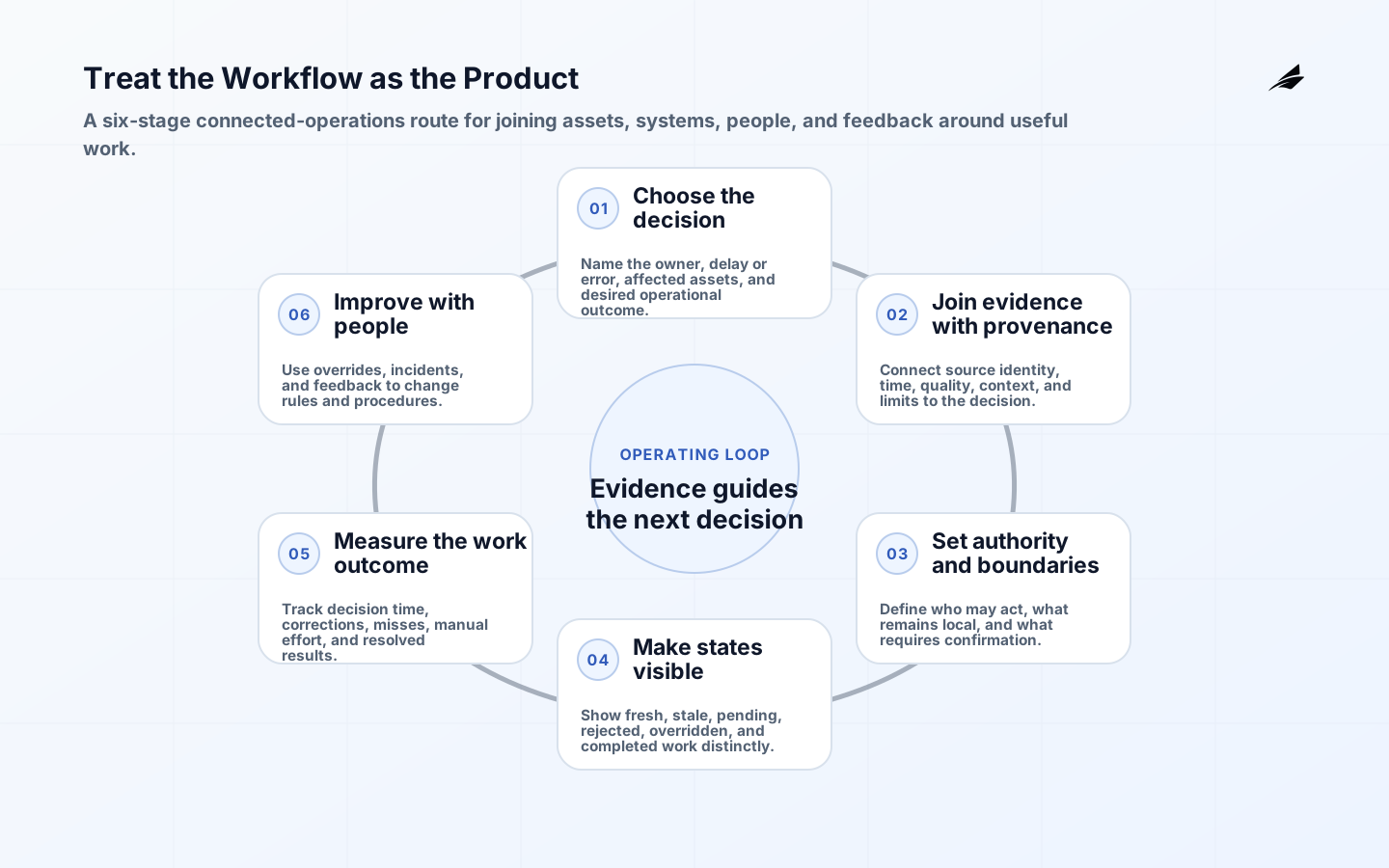
A connected-operations practice is the deliberate use of connected assets, systems, and people to make daily work more visible and responsive. It is not the same as placing sensors on equipment or giving leaders another dashboard. A connected operation defines a decision, brings together the evidence needed for that decision, makes the next owner clear, and learns from the result. That may be a planner deciding which asset to inspect, an operator responding to a workflow deviation, or a service team verifying that a repair restored performance. Technology helps only when it strengthens that chain.
Connected Operations: Start With a Decision
The right opening question is: which repeated decision is currently slow, uncertain, or difficult to audit? A broad ambition to connect everything produces a broad collection of signals with no accountable use. A narrower question such as whether a field technician should be dispatched after repeated gateway dropouts has an actor, evidence, time window, and cost of being wrong. It can be tested against current practice. It also reveals the records that need to be trustworthy: asset identity, connection events, service history, location, and the authority to create work.
Write the workflow in human terms before selecting a platform. Identify the trigger, the person or service that assesses it, the action choices, required approval, record of outcome, and what happens when data is missing. This protects the work from a common failure: a highly automated alert that reaches a person who lacks the context or authority to act. Connected operations in practice can help teams turn one decision into a bounded first release.
| Workflow question | Good answer | Evidence |
|---|---|---|
| What changes? | A named operational decision or handoff. | Current workflow map and owner. |
| What informs it? | A small set of attributable records. | Source, freshness, quality, and access rules. |
| Who acts? | A role with authority and a contingency path. | Assignment and escalation route. |
| How do we learn? | Outcome compared with the original signal. | Closure reason and review metric. |
Connected Operations: Join Evidence With Meaning
Data from devices, enterprise systems, and field observations has different strengths. Telemetry can show a pattern at a high frequency; a technician can identify an installation condition the sensor cannot see; a work order can show what was changed but may be closed late. A good design preserves those differences. Put source, observed time, received time, quality, and asset relationship near the value. This allows users to reason about disagreement rather than treating a combined record as a mysterious truth.
Master data deserves early attention. If a gateway is named one way in the monitoring system, another way in the maintenance system, and a third way on a site drawing, the join will eventually fail at the moment an operator needs it. Establish an asset identity policy, ownership for mappings, and a controlled workflow for replacements and moves. Integration should make those changes visible, not silently reconcile them with a loose text match.
Connected Operations: Give Each Boundary an Owner
The architecture should separate sensing, local control, transport, storage, decision support, and command paths according to consequence. A dashboard may tolerate delayed replication; a safety-relevant control must not depend on an unavailable reporting service. Define where a decision can be made locally, what can be queued during a network outage, and how records reconcile afterward. This is why connected operations means as much about graceful degradation as it is about integration.
Security boundaries follow the same reasoning. Give a service only the data and action authority it needs; keep observation and command capabilities distinct; and ensure administrative changes are attributable. NIST's operational technology guidance is particularly relevant when availability and safety can outweigh the normal IT preference for immediate patching or remote intervention. Test controls with the people who need to maintain the system so that secure practice does not get bypassed during routine work.
| Layer | Primary responsibility | Failure behavior |
|---|---|---|
| Edge | Collect or act close to equipment. | Use a defined local-safe mode. |
| Transport | Move records between zones. | Queue, retry, and expose delivery state. |
| Operations service | Correlate evidence and route work. | Defer or escalate when evidence is insufficient. |
| Human review | Approve exceptions and learn from outcomes. | Record decision rationale and follow-up. |
Connected Operations: Measure Decision Quality
Avoid treating device count, dashboard count, or data volume as proof of operational value. Measure the result that matters: time to acknowledge a real exception, percentage of work orders with usable evidence, false-positive rate of a triage rule, repeated manual bypasses, and time to restore an impaired service. Pair quantitative signals with interviews. An apparent reduction in alert volume may mean better filtering, or it may mean that people stopped trusting the system and muted it.
Set review cadences where operators can challenge a rule. When an alert did not produce a useful action, inspect the source quality, threshold, routing, and procedure rather than merely changing the color on a dashboard. When a technician repeatedly overrides a recommendation, capture why. That feedback is the operating asset: it improves the data contract, service design, and training together instead of blaming one component in isolation.
Connected Operations: Sequence the Delivery
Choose one workflow that crosses enough boundaries to teach the team something, but not so many that no one can own it. Establish baseline performance, deliver a thin vertical slice, operate it alongside the existing workflow, and compare outcomes. Then formalize support, access review, change control, and recovery before widening scope. A successful pilot is not a prototype with a good demo; it is a small service that survives shift change, maintenance, and a bad day.
- Name one repeated decision and the accountable decision-maker.
- Document source, freshness, quality, and identity for every consequential input.
- Separate local-safe action from cloud-based coordination.
- Keep human overrides visible and review them for learning.
- Measure outcome quality, not technology activity alone.
- Expand only after the first workflow has support and recovery ownership.
Treat the Workflow as the Product
Example: Improve Maintenance Dispatch With Evidence
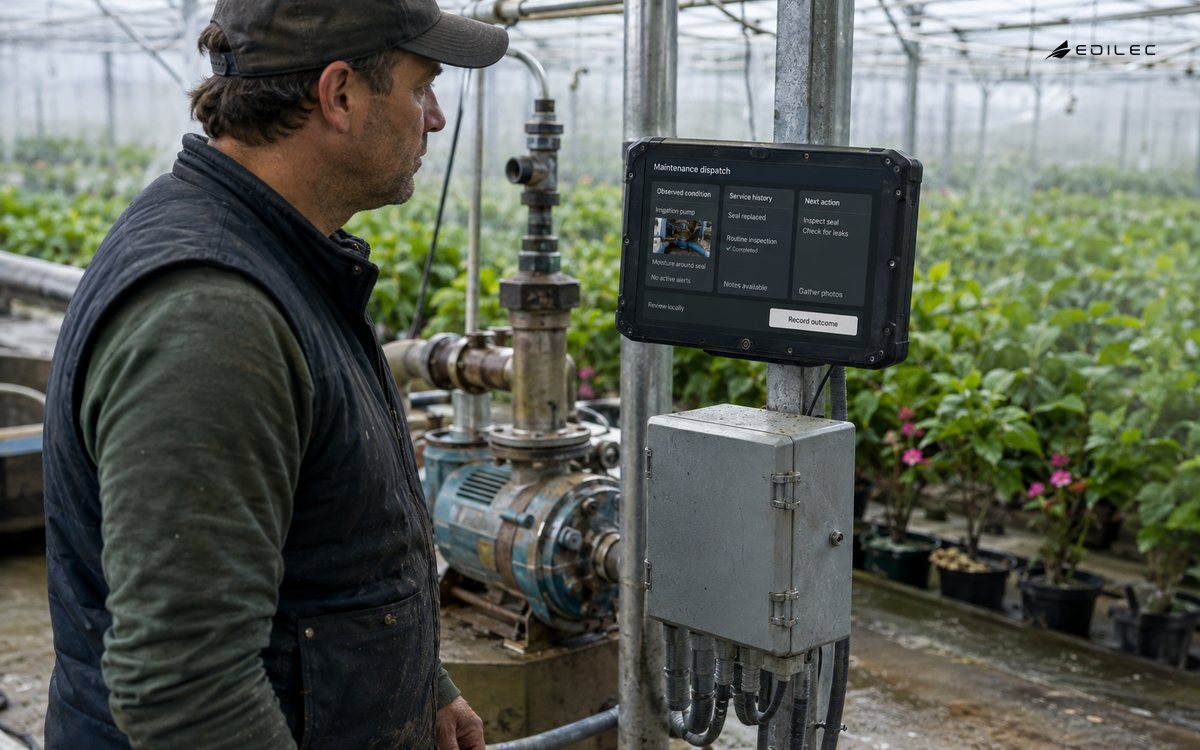
Take maintenance dispatch as a concrete workflow. A gateway dropout, abnormal vibration reading, and recent service history can help a planner decide whether to send a technician. The connected operation is not the dashboard; it is the chain from observed condition to triage, authorized work, completion evidence, and review. Define what evidence is required before a dispatch, what can be estimated, and what happens when the asset record and the sensor identity disagree.
Make the workflow resilient to people and systems changing. A new technician should be able to understand why a work item was created, which signal triggered it, and which evidence closed it. A temporary manual override should have an owner and expiry. If a site loses connectivity, the system should show whether the decision is delayed, locally handled, or waiting for confirmation. Those states are part of the operating design rather than exceptions to hide.
Measure outcome quality, not just connectedness. Track time to a confident decision, false dispatches, missed conditions, manual corrections, stale evidence, and the share of work with a recorded outcome. Review those signals with the people doing the work; their explanations often reveal whether a missing field, poor threshold, or authority gap is the real constraint.
Systems-security engineering, controlled-information protection, Web of Things architecture, and EPCIS provide complementary foundations for connected workflows, evidence boundaries, and interoperable event meaning. SP 800-160 Vol. 1 Rev. 1: Systems Security Engineering; SP 800-171 Rev. 3: Protecting Controlled Unclassified Information; Web of Things (WoT) Architecture 1.1; EPCIS and CBV 2.0.0.
The connected-operations practical guide, the edge-gateway guide, and the alert-routing guide add useful detail about evidence, site boundaries, and human response. In connected operations, Connected Operations for Connected Systems: A Practical Guide clarifies one boundary; What Changes When Connected Operations Moves into Production adds a complementary operating pattern; and IoT Telemetry: Explained from First Principles helps connect the decision to a wider connected-systems workflow.
Connected Operations Key Takeaways
- Connected operations should be treated as a decision-and-feedback system, not a device inventory.
- Different evidence sources should retain their provenance and limits.
- Architecture must define degraded behavior before relying on remote coordination.
- Security and operating practice need to work together in the field.
- The useful metric is a better, more accountable operational outcome.
Organizational design matters as much as integration design. Connected work crosses operations, engineering, IT, security, and suppliers, so the workflow needs a shared decision owner rather than a committee that approves every interface in isolation. Establish a short operating forum that reviews outcomes, data-quality issues, unresolved exceptions, and proposed changes. Give it authority to clarify a rule or retire an unused signal. This prevents the system from becoming a passive data layer owned by nobody and makes the cost of each new sensor, mapping, or dashboard requirement visible against the decision it improves.
For connected-system implementation context, compare this workflow model with IoT Telemetry: Explained from First Principles, Industrial Dashboards: Engineering Notes for Reliable Operations, and Field Service Portals: Hands-on Planning Guide. A connected-operations practice becomes valuable when evidence changes a work decision and the outcome feeds a better rule, record, or procedure.
Connected Operations FAQ
Which Connected-Operations Project Should Start?
Pick a recurring exception where an owner already wants better evidence, such as repeated connectivity loss or a maintenance condition with known cost. It should have a bounded asset group, an existing baseline, and a safe way to run the new workflow alongside current practice.
Does Connected Operations Require AI?
No. Rules, clear records, and reliable routing often create the first measurable improvement. Predictive models can be useful later, but they depend on the same fundamentals: trusted source data, usable feedback, known decisions, and ownership for exceptions.
Conclusion: Connect Work Around a Decision
A connected-operations practice becomes real when evidence changes a decision and the outcome improves the next one. Begin with a small decision that matters, make sources and authority visible, and design the failure path as carefully as the happy path. That gives the organization a reliable pattern for connecting the next workflow.
Connected Operations Source Notes
Use NIST SP 800-82 Rev. 3 for OT security context, NISTIR 8259A for IoT capabilities, NIST SP 800-207 for access principles, and NIST SP 800-213A for lifecycle requirements.