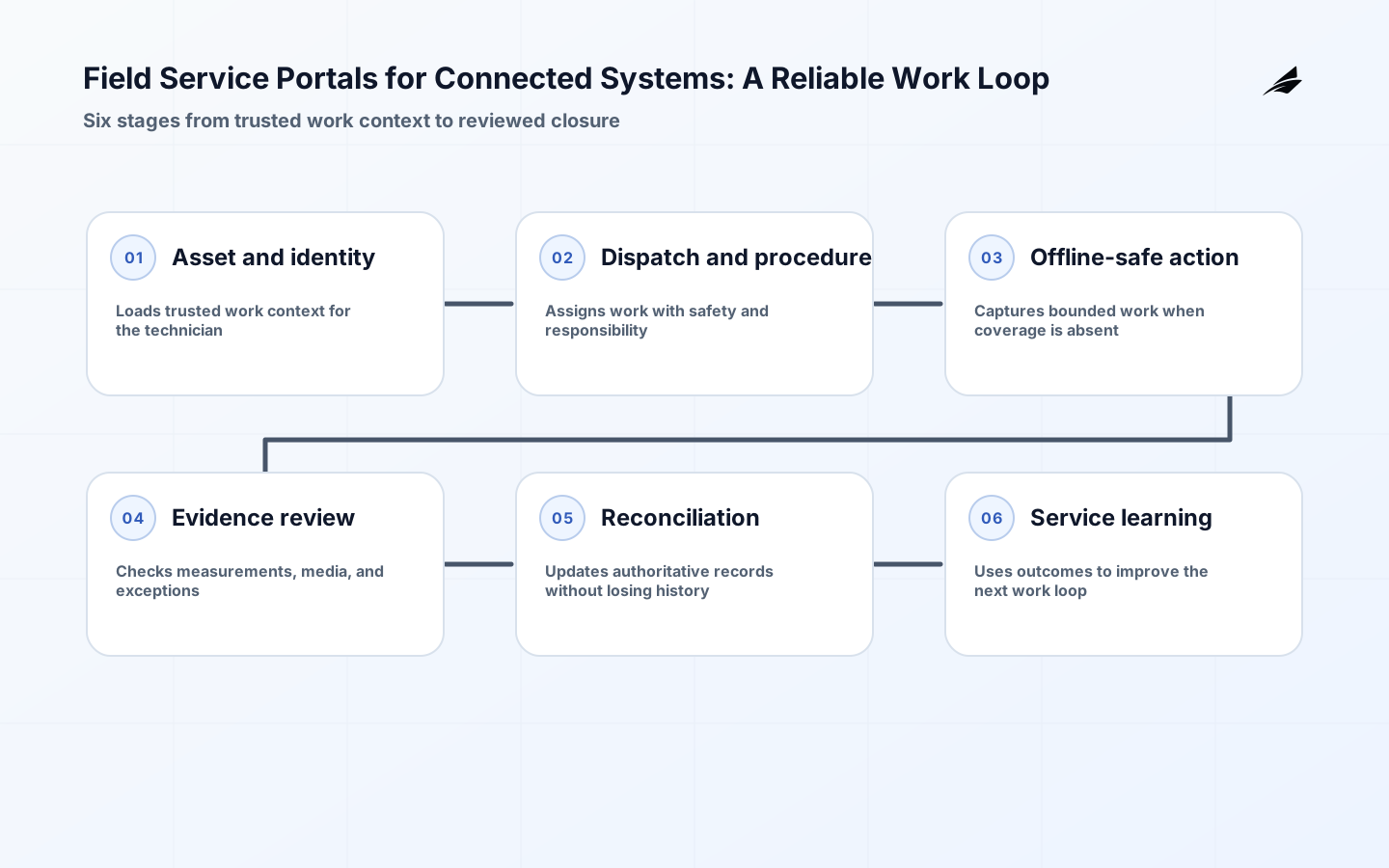
Field Service Portals for Connected Systems: A Practical Guide is a practical guide for product teams. A field service portal should reduce the distance between an asset problem and a safe, accountable repair. At a remote pumping station, a technician needs assigned work, authoritative asset identity, procedure, hazards, and a durable way to capture results when coverage disappears. It should not be a mobile mirror of every database table. The aim is a capability people can operate, investigate, and improve, rather than a favorable demonstration for field service operations.
Define the field service portals for connected systems decision and boundary
Choose one journey, such as responding to a health alert requiring onsite inspection. Define monitoring-to-dispatch handoff, work-order source, technician authority, closure rule, and the record that proves the result. Telemetry explains why work began; service records document people, parts, measurements, approvals, and next actions.
| Decision area | Question to settle | Evidence to retain |
|---|---|---|
| Outcome | Which decision does field service portals improve? | Scenario, owner, delay limit, and success measure during a technician work loop. |
| Authority | Which field-service role may change or override this path? | Role rule, escalation route, and audit record during a technician work loop. |
| Data | Which record is authoritative? | Identity, time rule, quality state, and lineage during a technician work loop. |
| Recovery | What happens when a dependency fails during a technician work loop? | Safe degraded path, reconciliation rule, and support owner. |
Design a dependable field service portals for connected systems contract
Design around the asset with clear status, model, hazards, and service history. Make cached and authoritative data visibly different. Package assigned work and approved documents for offline use, not the entire service database. Display requested remote actions, approvers, and outcomes explicitly.
| Design choice | Practical rule | Operating signal |
|---|---|---|
| Identity | Use stable IDs instead of display names or shared credentials during a technician work loop. | Duplicate, unmatched, or unauthorized records during a technician work loop. |
| Time and state | Preserve time and explicit quality or status during a technician work loop. | Late, stale, unknown, and conflicting items during a technician work loop. |
| Change | Version policy, interfaces, and configuration during a technician work loop. | Compatibility errors and drift. |
| Evidence | Keep source and reason near consequential decisions during a technician work loop. | Traceability from a view to source data during a technician work loop. |
Implement field service portals for connected systems as a thin, testable path
Give every work item a stable ID and make updates idempotent. Show queued, accepted, and conflicted state after reconnection. Test expired authorization, mismatched asset barcode, duplicate completion, and mandatory safety evidence without a network. Support should be able to resolve each state.
- Write the field service portals contract in plain language, including delayed and disputed states.
- Assign operational and technical ownership before release during a technician work loop.
- Use representative devices, sites, and network conditions in a controlled rollout during a technician work loop.
- Capture configuration and approval evidence with stable identifiers during a technician work loop.
- Test recovery from a missing dependency during a technician work loop.
- Review the first operating cycle with the people who act on the result during a technician work loop.
Protect the field service portals for connected systems operating boundary
Enforce role and assignment checks at the service boundary. Use strong identity, short-lived sessions, device protection, and approval logs. Do not embed controller credentials or broad remote-access tokens in a field interface; high-risk actions need an explicit route.
Operate field service portals for connected systems with evidence
Measure assignment-to-arrival time, first-time fix rate, reopened work, sync conflict rate, missing evidence, and safety-critical work age. A portal fails when it becomes a second system of record or loses evidence offline. Name the master record for every critical field and expose conflict resolution.
Create a decision record for field service portals for connected systems
Before expanding field service portals for connected systems, write the decision record that a shift lead, engineer, and support owner can all read. In the case of a technician investigating a pump alert at a site with unreliable connectivity, state the trigger, the person or service allowed to assess it, the evidence needed before action, the latest useful time for that action, and the safe response when evidence is missing. The record should identify work-item ID, asset identity, assignment, safety evidence, action history, queued changes, and authoritative completion state. This is more than documentation: it prevents a dashboard label or integration default from quietly becoming policy for field service operations. Ask each owner to explain what they would do with a late, contradictory, or unavailable input for field service operations. Where their answers differ, resolve the rule before automating it while keeping the technician record authoritative. The resulting boundary gives product, operations, and security teams a shared basis for testing change instead of relying on a successful happy-path demonstration for field service operations.
Work through a realistic field service portals for connected systems example
Use a technician investigating a pump alert at a site with unreliable connectivity as a rehearsal, not as a story that remains in a planning document. Trace the identifier from the physical asset or source through the service that evaluates it, the interface where a person sees it, the action record, and the later evidence that confirms or disputes the outcome for field service operations. Decide which facts may be cached, which must be current, and which user may make a temporary override for field service operations. Make the screen state match the system state: queued is not accepted, stale is not current, and an acknowledgement is not proof that the underlying condition is resolved for field service operations. This exercise exposes ambiguous names, missing handoffs, and incompatible time assumptions early for field service operations. It also provides concrete acceptance tests that a delivery team can repeat at every release for field service operations.
Release and recover field service portals for connected systems deliberately
A production release should declare its compatibility assumptions, rollout cohort, rollback condition, and evidence owner for field service operations. For field service portals for connected systems, start with a representative set of sites, devices, or users rather than a convenient set of friendly testers. Verify that the record still preserves work-item ID, asset identity, assignment, safety evidence, action history, queued changes, and authoritative completion state after normal processing, degraded connectivity, a restart, and a version change. Rehearse the failure case in which the portal records a local completion that is assumed final although the work-order system rejected it. The recovery path needs a visible queue or case, a named decision-maker, and a rule for retrying, repairing, or rejecting the item for field service operations. Do not use deletion to make monitoring look clean; preserve a safe diagnostic record and the reason for the outcome for field service operations. This practice turns incidents into bounded operational work rather than a hunt through disconnected logs for field service operations.
Review field service portals for connected systems on an operating cadence
Review field service portals for connected systems with the people who carry its consequences, using assignment-to-arrival time, first-time fix rate, reopened work, sync conflicts, and missing mandatory evidence. Compare the signals with real cases rather than looking only at averages while keeping the technician record authoritative. A low fleet-wide error rate can hide one site, firmware version, customer workflow, or technician route that repeatedly fails for field service operations. Include changes, manual workarounds, unresolved exceptions, and near misses in the review for field service operations. Decide whether each finding needs a contract change, better validation, a training update, a capacity adjustment, or no action, and record the decision for field service operations. This cadence is how a connected capability remains understandable as assets, integrations, and responsibilities change for field service operations. It also gives leadership evidence of whether the work is reducing uncertainty and rework, rather than merely producing more data for field service operations.
Make the field-service work loop dependable
A field service portal earns trust when it preserves the technician's context under pressure. For a pump inspection, the work item should carry the asset identity, location, safety notes, last known condition, assigned responsibility, and the exact evidence required for closure. The portal can make the next action easier without becoming the authority for every record. It should show whether a reading came from live telemetry, a cached value, or a technician entry, because those states lead to different decisions.
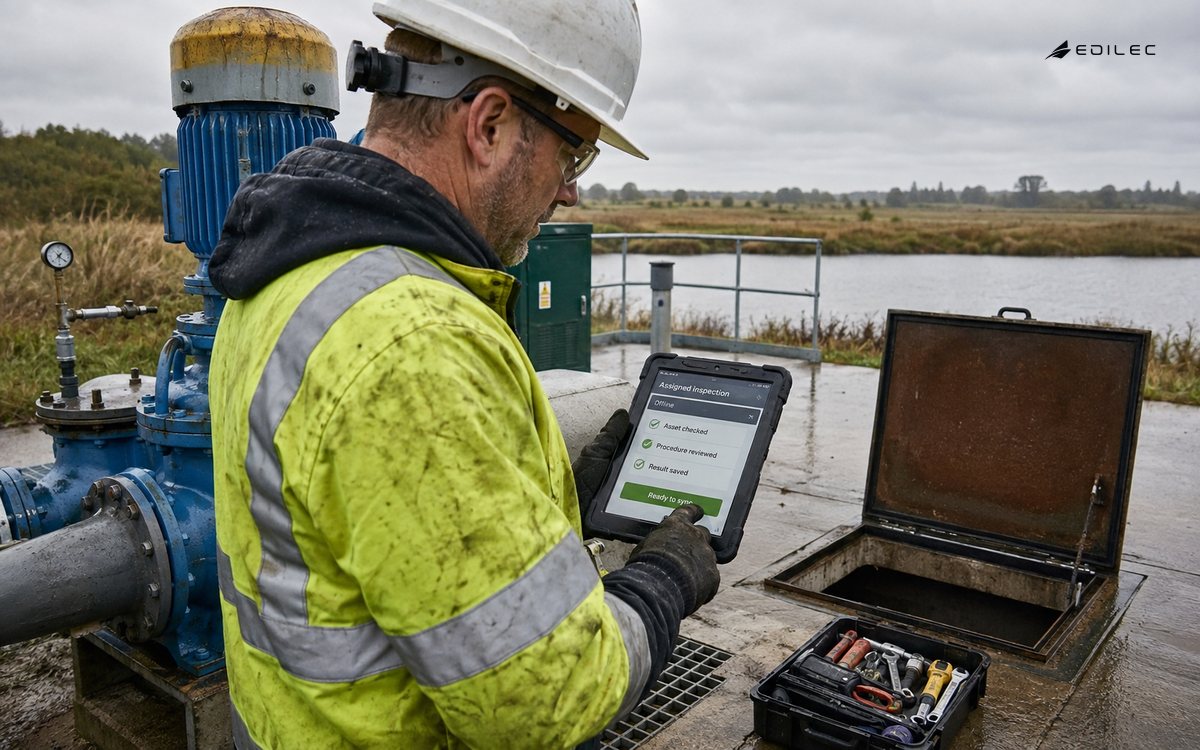
Design the first release around one complete work loop: alert or request, triage, dispatch, onsite action, evidence capture, review, and closure. Test the loop with poor connectivity, a reassigned job, a missing asset record, an expired credential, and a rejected photo or measurement. The product is ready when the exception is visible and owned, not when the happy path looks polished. A durable portal also gives supervisors a way to correct a record without erasing the original evidence.
| Work-loop checkpoint | Evidence to retain | Failure question |
|---|---|---|
| Dispatch | Assigned asset, person and priority | What if the job is reassigned? |
| Onsite action | Procedure version and captured result | What if the device is offline? |
| Review | Exception reason and approver | Who can reject or reopen? |
| Closure | Final state and time of acceptance | How is duplicate work prevented? |
Standards for field-service controls
Use NIST SP 800-63B when deciding how technicians authenticate and recover access, OWASP ASVS for application verification, NIST SP 800-82 Rev. 3 for operational consequences, and the NIST Cybersecurity Framework 2.0 for ownership and response. Apply the guidance to the actual workforce, assets, and safety conditions.
For related context, compare event streaming costs, event streaming for IT managers, and IoT telemetry, with the technician record authoritative in mind. Use those perspectives to test the boundary described here while keeping the operating decision and owner in view while keeping the technician record authoritative.
Key takeaways for connected field service
- Start field service portals with a defined decision, not a generic platform objective.
- Preserve identity, time, ownership, and quality where meaning changes during a technician work loop.
- Make exceptions and recovery visible to people who resolve them during a technician work loop.
- Release in cohorts and test adverse conditions during a technician work loop.
- Restrict authority to the smallest useful scope during a technician work loop.
- Use operating signals to improve the contract, not merely a dashboard during a technician work loop.
Field-service portal questions from the field
What should teams define first?
Define the operational decision, authoritative record, owner, acceptable delay, and safe degraded path before expanding field service portals.
How should changes be released?
Field-portal releases should be tried with technicians who face weak signal, gloves, shift pressure, and asset ambiguity. Verify that an offline capture remains associated with the right work item after sync, and that the acceptance state is visible before the technician leaves site.
What makes the service trustworthy?
Field-service-portal trust means technicians and dispatchers agree on whether work is assigned, in progress, queued for sync, accepted, or reopened. The portal earns confidence when it preserves photos, readings, and approvals with the correct asset and never mistakes a local draft for an authorized completion.
Conclusion: preserve the technician work loop
A reliable field-service portal comes from explicit boundaries and routine evidence. Build one path that retains context, assigns authority, and survives delay, change, and recovery for field service operations. Once the team can explain that path without guessing, expansion becomes an informed operational choice for field service operations.
Authoritative sources for field service portals for connected systems
The control choices use NIST SP 800-63B: Digital Identity Guidelines, OWASP Application Security Verification Standard, NIST SP 800-82 Rev. 3: Guide to Operational Technology Security, NIST Cybersecurity Framework 2.0. Use current source material and the requirements that apply to the equipment, sector, and jurisdiction when finalizing an implementation while keeping the technician record authoritative.