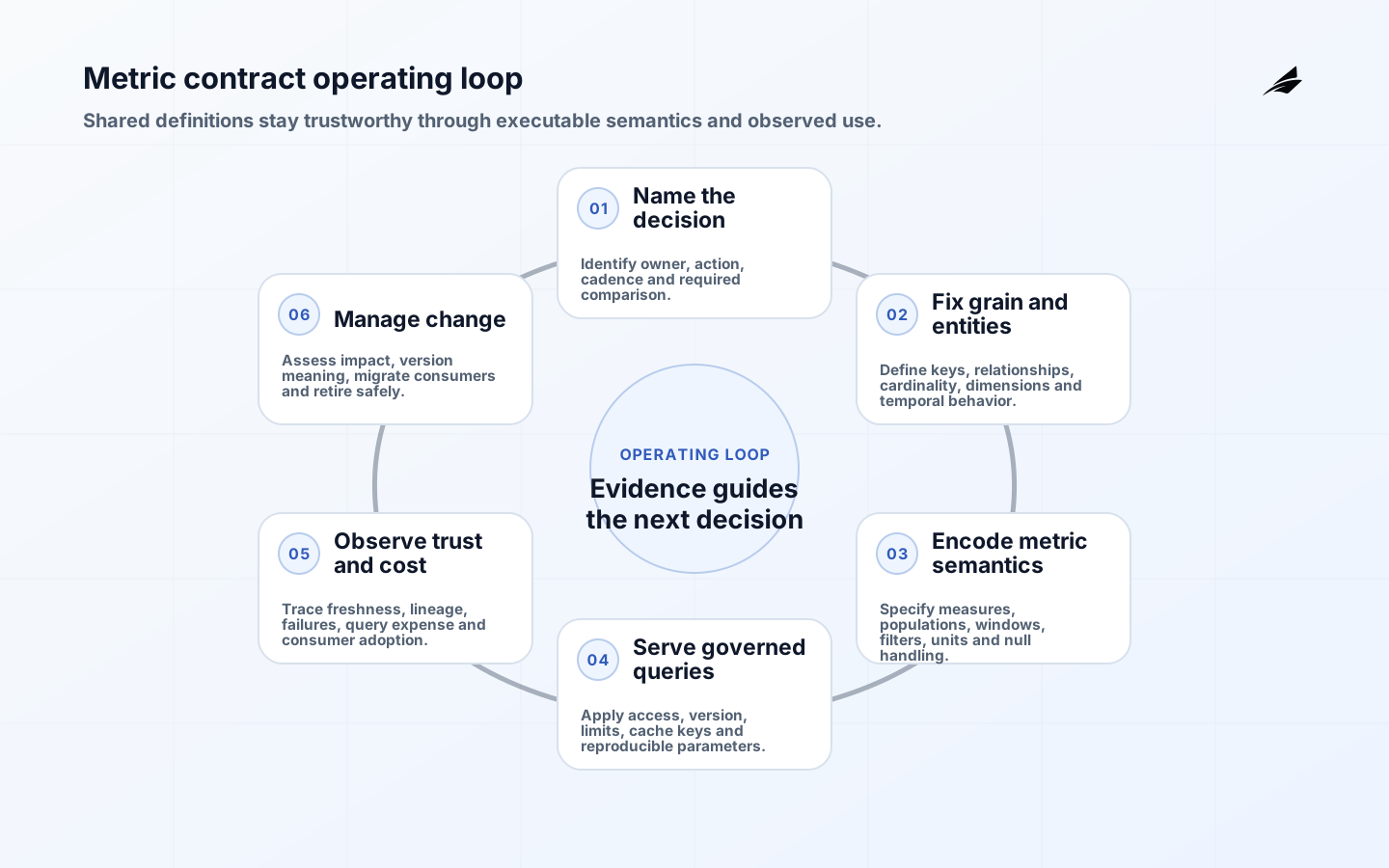
Metric layers give engineering teams a governed way to define business measures once and serve them consistently across dashboards, notebooks, applications and AI tools. They are not a substitute for clean warehouse models or accountable decisions. A useful layer makes grain, entities, dimensions, time, filters, ownership and access executable. This guide explains how to design that contract, integrate it with data systems and operate it as a production service.
The semantic layers planning guide covers broader adoption. Pair it with data contracts engineering notes for producer-consumer boundaries and the BI dashboard guide for decision-focused consumption. Dashboard scaling concerns are covered in the dashboard adoption guide.
Start with decisions, not a metric inventory
Choose recurring decisions where inconsistent calculation creates cost or risk: acquisition investment, service capacity, retention work or revenue reporting. For each, identify owner, cadence, action and comparison. Then define the smallest set of measures needed. A catalog of every existing dashboard expression preserves disagreement. A migration should surface competing definitions and require a decision, not silently rename them into apparent consistency.
A metric contract states business meaning, owner, base model, entity, grain, expression, valid dimensions, time dimension, default period, filters, null behavior, currency or unit, freshness, access and change policy. Include examples and known exclusions. The primary output is a trusted query interface whose results can be explained from source to calculation. Friendly descriptions alone do not prevent invalid joins or time comparisons.
| Contract field | Engineering question | Failure prevented |
|---|---|---|
| Entity and grain | What does one row or event represent? | Double counting after joins |
| Measure expression | Which records and operations produce the value? | Dashboard-specific formulas |
| Dimensions | Which attributes can safely group or filter? | Invalid many-to-many analysis |
| Time semantics | Event, processing or snapshot time; which timezone? | Misaligned periods and late-data surprises |
| Ownership and freshness | Who responds and how current must data be? | Trusted-looking stale metrics |
| Access policy | Who can query which rows and attributes? | Semantic interface bypassing data controls |
Design entities, grain and joins explicitly
Begin with modeled facts at stable grains such as one order line, account-day or support case. Define entity keys and uniqueness tests. Expose dimensions through relationships whose cardinality and join path are known. Avoid allowing arbitrary joins between facts. Where a metric crosses grains, use an intentional bridge, allocation or pre-aggregation and document the consequence. The layer should reject or constrain combinations that cannot produce meaningful results.
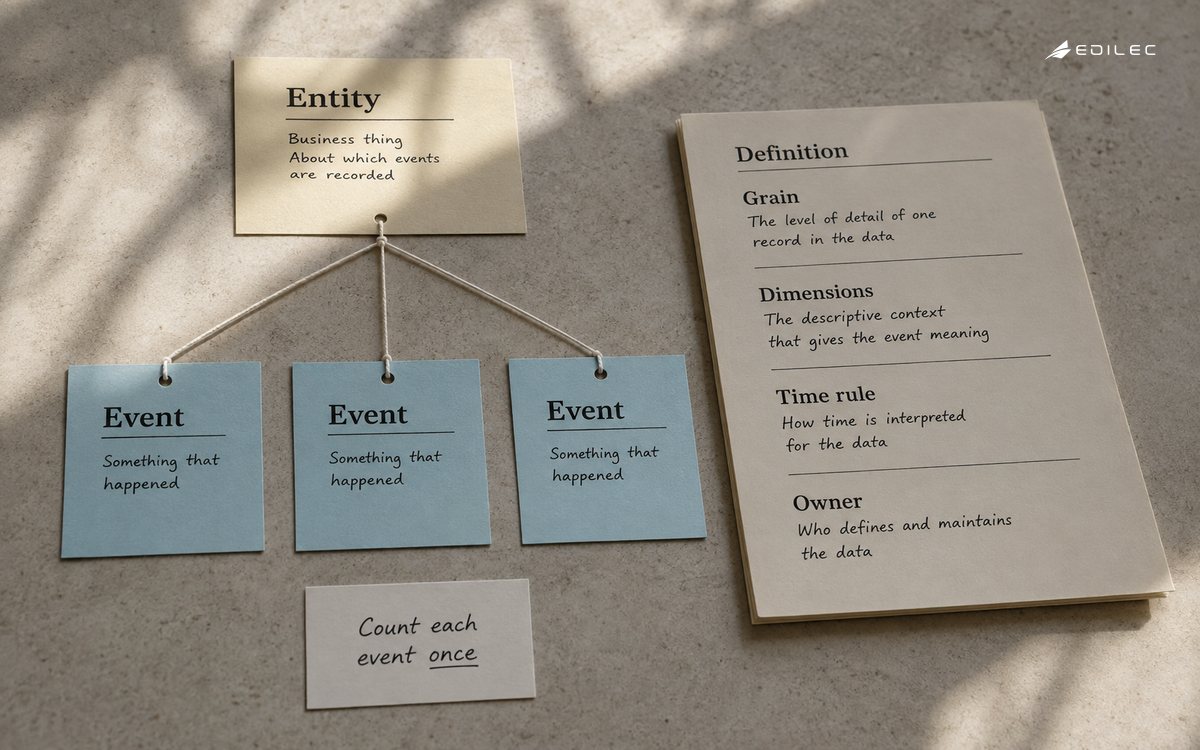
dbt's official semantic model documentation describes semantic models over data-platform models, with entities, dimensions and measures. The implementation detail matters: a semantic model should reference a tested, consumer-ready relation and identify its defaults. Keep heavy cleansing and business-state construction in warehouse transformations; keep reusable metric aggregation and governed slicing in the semantic layer. This boundary makes both layers testable.
Make time behavior unambiguous
Every metric needs a declared time dimension and timezone. Distinguish event time, ingestion time, update time and snapshot validity. Define week start, fiscal calendar, partial-period behavior and whether late records revise history. For ratios, ensure numerator and denominator use compatible populations and windows. For cumulative metrics, define reset and starting state. A monthly active customer calculation is incomplete without activity event, identity rule, calendar and exclusion policy.
Snapshots and slowly changing dimensions require temporal joins. A customer's current segment should not automatically rewrite the segment used for an earlier decision. State whether analysis uses attributes as observed then or as known now. Define data latency and restatement. Consumers need a way to tell whether yesterday is complete and whether a backfill changed a published period. Expose freshness and version metadata beside values where the interface allows.
Implement metric types and compositions carefully
A simple metric aggregates a measure; a ratio divides compatible metrics; a derived metric combines existing metrics; cumulative and conversion metrics add ordering or window behavior. The dbt metrics overview documents such reusable definitions and time-grain behavior. Use composition to preserve one authoritative base definition. Guard division by zero, define null output and test filters at each component. Do not hide materially different populations behind a shared name.
Metric layers are implemented differently across products. Snowflake semantic views represent semantic concepts inside the platform, while Microsoft Power BI semantic models can import data, query sources directly or combine modes and support row-level security. Evaluate query engines, APIs, version control, access enforcement, caching, BI compatibility, portability and operating ownership rather than assuming the term semantic layer implies identical behavior.
| Architecture option | Strength | Tradeoff to test |
|---|---|---|
| Warehouse-native semantics | Governance and execution close to data | Portability and client compatibility |
| Transformation-repository layer | Definitions reviewed with analytics code | Runtime availability and tool integration |
| BI semantic model | Rich report behavior and analyst familiarity | Reuse outside the BI ecosystem |
| Independent metrics service | Consistent API across many consumers | New service reliability, cache and access boundary |
| Application-owned metrics | Close to operational product behavior | Duplication and analytics reconciliation |
Test definitions, queries and access
Test upstream model grain, key integrity, accepted values, freshness and business invariants. Compile representative metric queries in continuous integration and compare results against small known datasets. Test valid and invalid dimension combinations, empty periods, late records, timezone boundaries, currency, slowly changing attributes and ratio filters. Reconcile critical measures with an independent authoritative record. Snapshot expected results for carefully chosen cases, not entire volatile tables.
Access tests are part of correctness. Verify that row and column policy remains effective through every API, cache, export and BI connection. Test service accounts and user delegation separately. A semantic service should not elevate a broad warehouse identity for convenience. Record metric, definition version, query parameters, caller and policy decision with privacy-aware identifiers. Rate limits and query complexity controls protect both cost and availability.
Serve metrics as a reliable data product
Define supported interfaces: SQL generation, REST or GraphQL API, BI connection, notebook client or embedded application. Publish semantic version, deprecation policy, query limits, freshness and incident contact. Cache only when keys include every security and semantic parameter. Use deterministic request identifiers and return the effective definition, time range and filters where feasible. Consumers should be able to reproduce a result without reverse-engineering a dashboard.
Observe request success, latency, warehouse scan, cache behavior, concurrency, query rejection, stale results and top consumers. Trace generated queries to warehouse jobs and model versions. The OpenLineage documentation describes an open framework for lineage metadata around jobs, runs and datasets. Whether that standard or another mechanism is used, connect source transformations and semantic definitions so an incident can identify affected metrics and consumers.
Govern definition change without freezing it
Assign a business owner and technical steward. Changes begin with reason, affected decisions, examples and impact analysis. Additive dimensions may be compatible; a changed population or time rule is usually semantic breaking change even if the API schema is unchanged. Version materially different definitions, run old and new in parallel, identify consumers and publish a transition date. Preserve historical definition metadata for audit and reproducibility.
Use a lightweight review with domain owner, analytics engineering and material consumers. Automate dependency discovery and query tests, but keep meaning as a human decision. Measure adoption, duplicate calculations, support demand, query cost and time to change. Retire unused metrics after confirming dependencies. A large certified catalog is not success if teams continue calculating key measures elsewhere.
Implementation example: net revenue retention
A subscription company has three net revenue retention calculations. Engineering defines account-month grain, recurring revenue components, base cohort, currency conversion date, cancellation treatment and acquisition exclusions. The base revenue measures live over a tested account-month model. The ratio uses opening recurring revenue as denominator and closing revenue from the same cohort as numerator. Region and plan are valid dimensions as observed at cohort start.
Known-case tests cover expansion, contraction, churn, reactivation, plan change, zero opening revenue and late invoice correction. The API returns metric version and period completeness. Dashboard and planning workbook migrate in parallel, and old calculations remain visible for one close cycle. A restatement changes prior months only after owner approval and consumer notification. Query telemetry shows one expensive daily segmentation, leading to a governed aggregate without changing the contract.
Key takeaways
- Build the layer around decisions and resolve conflicting meaning explicitly.
- Make grain, entities, joins, dimensions and time executable parts of the contract.
- Keep source cleansing in modeled data and reusable aggregation in semantics.
- Test known values, invalid combinations, temporal edges and access paths.
- Operate metric queries with reliability, cost, lineage and consumer visibility.
- Version semantic changes and measure whether consumers actually reuse definitions.
Metric layer FAQ
Is a metric layer the same as a semantic layer? A semantic layer may include entities, relationships and business concepts beyond metrics. A metric layer emphasizes governed measure calculation. Products use the terms differently, so inspect capabilities.
Should all metrics be centralized? Centralize measures requiring cross-team consistency. Local exploratory metrics can remain local until they influence shared decisions. Promotion needs ownership and tests.
Can the layer fix poor source data? No. It can expose freshness and rules, but stable grain, identifiers and business state must be produced upstream. Otherwise reuse multiplies the defect.
Who owns a metric? A business owner decides meaning and use; a technical steward implements and operates it. Critical metrics also need source and platform owners for incidents.
Conclusion
Engineering teams should treat metric layers as production contracts, not naming catalogs. Start from an owned decision, build on tested grains, encode valid query behavior, enforce access and operate the service visibly. Publish limitations and effective versions with important results, and preserve a path for consumers to challenge meaning or report divergence. Review query cost and adoption so governance does not become an unused parallel system. When definitions can change through controlled evidence and every result remains explainable, the layer becomes dependable shared infrastructure for decisions.