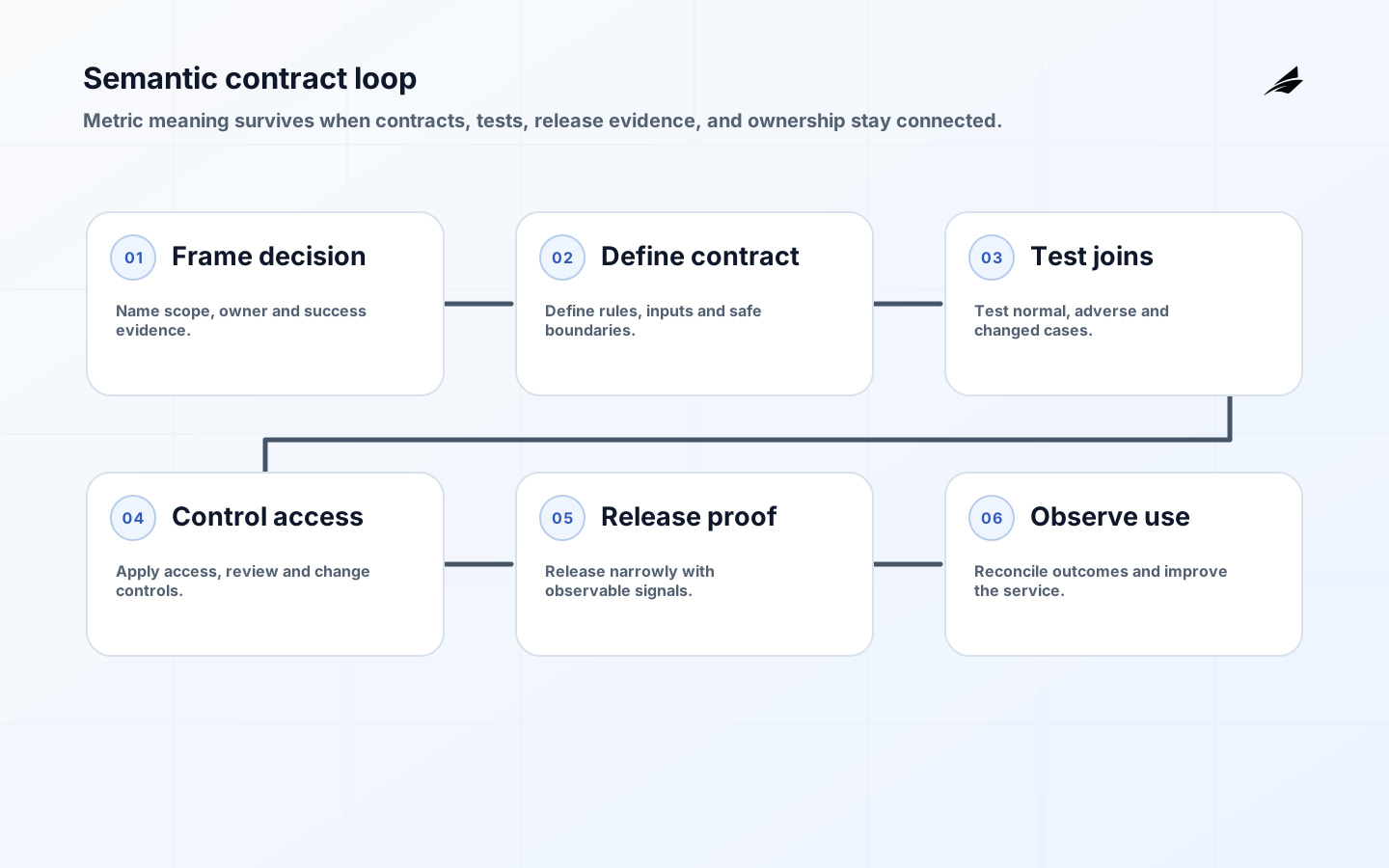
A semantic layer is a governed translation between raw data structures and the business concepts people need to ask about. It can define entities such as customer or order, measures such as net revenue, dimensions such as region, and the joins or time logic that make those concepts consistent. Engineering teams should not mistake it for a magic vocabulary service. The layer is valuable because it captures decisions that otherwise live in dashboard formulas, notebook queries, and tribal knowledge. It earns its place when the same metric must be reused across BI, embedded analytics, and operational tools without each consumer rebuilding the logic.
Current platforms express the idea differently. The dbt Semantic Layer uses governed metric definitions, and MetricFlow models measures, dimensions, entities and metrics. Power BI semantic models combine relationships, calculations and security for reuse. OpenLineage supplies an open model for jobs, runs and datasets that can connect a published metric to upstream change evidence.
A semantic layer is valuable when it makes a decision more consistent across tools, not when it merely renames warehouse columns. Pair this engineering guide with the semantic-layer planning guide, production semantic-layer guide and metric-layer implementation checklist for rollout and operating detail.
Find the semantic problem first
Start with a disagreement that affects decisions. “Active customer” may mean anyone who signed in, anyone with a paid subscription, or anyone who completed a transaction in the last 30 days. Each definition can be legitimate for a different question. The failure is using the same label for all three. Collect the key measures, their consumer decisions, their grains, their time treatment, and the sources that have authority when records conflict. KPI governance guidance can help leadership set ownership; engineering then turns that agreement into versioned, testable logic.
| Semantic object | Definition concern | Implementation evidence |
|---|---|---|
| Entity | What identifies one customer across systems? | Stable key and matching policy |
| Measure | What is counted or summed, and at what grain? | Formula, filters, and test cases |
| Dimension | How can results be grouped safely? | Allowed values and relationship to entities |
| Time rule | Which timestamp governs attribution? | Timezone, calendar, and late-change policy |
Model for reuse, not maximum abstraction
Treat grain and join paths as public behavior. A measure that is correct at order grain can double count when joined to line items; a customer dimension may require a point-in-time rule rather than the latest profile. Declare entities, cardinality, time semantics, default filters, null behavior, currency conversion and allowed dimensional combinations. Test representative queries and adversarial joins before publishing a metric to broad self-service use.
Release definitions through review and compatibility checks. A corrected metric may still be a breaking change for a target, alert or financial narrative. Publish effective dates, identify downstream consumers through lineage and run old and new definitions in parallel where consequence warrants it. The owner should decide whether to version, restate history or announce a prospective change; the tool cannot make that business decision.
Begin with a narrow set of high-value concepts rather than attempting to abstract every warehouse table. The semantic model should make common questions easy and unusual questions possible without pretending they are equivalent. Specify default aggregations, valid joins, required filters, and time dimensions. Guard against fan-out by testing relationships and measures at their intended grain. Where a metric depends on a business exception, preserve that exception visibly rather than burying it in an opaque generated query. Consumers need a definition they can inspect, while maintainers need tests that reveal when source changes alter the result.
- Use business names that are stable enough for readers, but retain links to the physical models and source systems.
- Define every measure with its grain, aggregation, filters, and valid dimensions or joins.
- Make timezone, fiscal calendar, and currency conversion choices explicit for time-based or financial metrics.
- Test representative queries and reconciliations before allowing a metric in broad self-service use.
- Version meaningful definition changes and explain the before-and-after effect to consumers.
Operate the semantic layer
A semantic layer is an interface, so it needs interface discipline. Give concepts owners, code review, release notes, compatibility rules, and a request path for consumers. Track which tools and dashboards depend on a measure, especially before changing its default time logic or filters. The layer should surface lineage and data freshness where possible, but it must not become a source of false certainty: a well-defined measure can still reflect a late source. Pair semantic tests with data quality checks and incident communication. That gives users enough context to decide whether to wait, investigate, or temporarily use another source.
| Change | Risk to consumers | Release practice |
|---|---|---|
| Rename a measure | Broken queries and confusing comparisons | Provide an alias and a deprecation date |
| Alter default filter | Historical trend appears to shift | Publish impact analysis and version if material |
| Add a relationship | Double-counted aggregates through fan-out | Test cardinality and constrained joins |
| Change calendar logic | Period comparisons no longer align | Document calendar and reconcile sample periods |
Draw the right boundary
Not every transformation belongs in the semantic layer. Heavy preparation, deduplication, and historical normalization are often better handled in durable warehouse models. The layer should expose dependable concepts, not conceal unstable staging logic. Equally, it should not try to replace a data catalog, an authorization system, or a BI tool's presentation layer. Clear boundaries make it easier to reason about performance and ownership: the warehouse produces trusted modeled facts; the semantic layer standardizes analytical meaning; consuming tools handle exploration and communication. This division supports reuse without requiring a single giant model for every team.
Work through a practical case
Suppose product and finance both report monthly recurring revenue. Product wants a daily operational indicator of active subscriptions; finance needs a close-ready measure that handles credits and currency conversion. The semantic layer should not force one number to serve both needs. It can publish separately named measures, each with a clear owner and time policy, and make their relationship discoverable. A dashboard asking for product momentum uses the operational measure with a freshness label. The finance package uses the close-ready measure and reconciliation detail. The difference is intentional, reviewable, and far safer than a shared chart title with hidden formulas.
Plan the next review
Schedule semantic-layer review around the concepts that are changing fastest, such as customer state, revenue, entitlement, or geography. Bring a business owner and a representative consumer to review actual queries and dashboard outputs, not only model code. Ask whether the names still match the decision language, whether allowed dimensions prevent known misinterpretations, and whether current lineage and freshness are visible where users need them. Look particularly at requests for workarounds: a repeated custom calculation can signal a valuable concept that deserves promotion, while an obscure one-off query may not. Document the reasoning for each addition or deprecation so future maintainers can understand why the layer exposes a particular distinction.
- Review queries that use unsupported joins or exports to identify missing guardrails or unmet needs.
- Compare a sample of shared measures across consuming tools after every material semantic release.
- Ask owners to confirm which definitions are certified for operational, financial, or exploratory use.
- Set a deprecation date and replacement guidance before removing a popular concept.
- Keep a small catalogue of intentional differences so readers do not mistake them for defects.
Performance is part of the semantic design too. A definition that is correct but impractical to query will drive consumers back to local extracts and copies. Profile the most common query shapes, constrain expensive ambiguous paths, and explain where a request needs a prepared warehouse model instead of an ad hoc semantic join. Keep this performance work connected to the business question: a fast answer that uses an invalid relationship is still wrong. The target is a small, predictable interface whose common concepts remain both understandable and usable at the scale readers require. Record expected query behaviour for certified concepts so a sudden slowdown can be investigated as an operational change, not dismissed as an unavoidable property of analytics in production.
Review one metric as a public contract
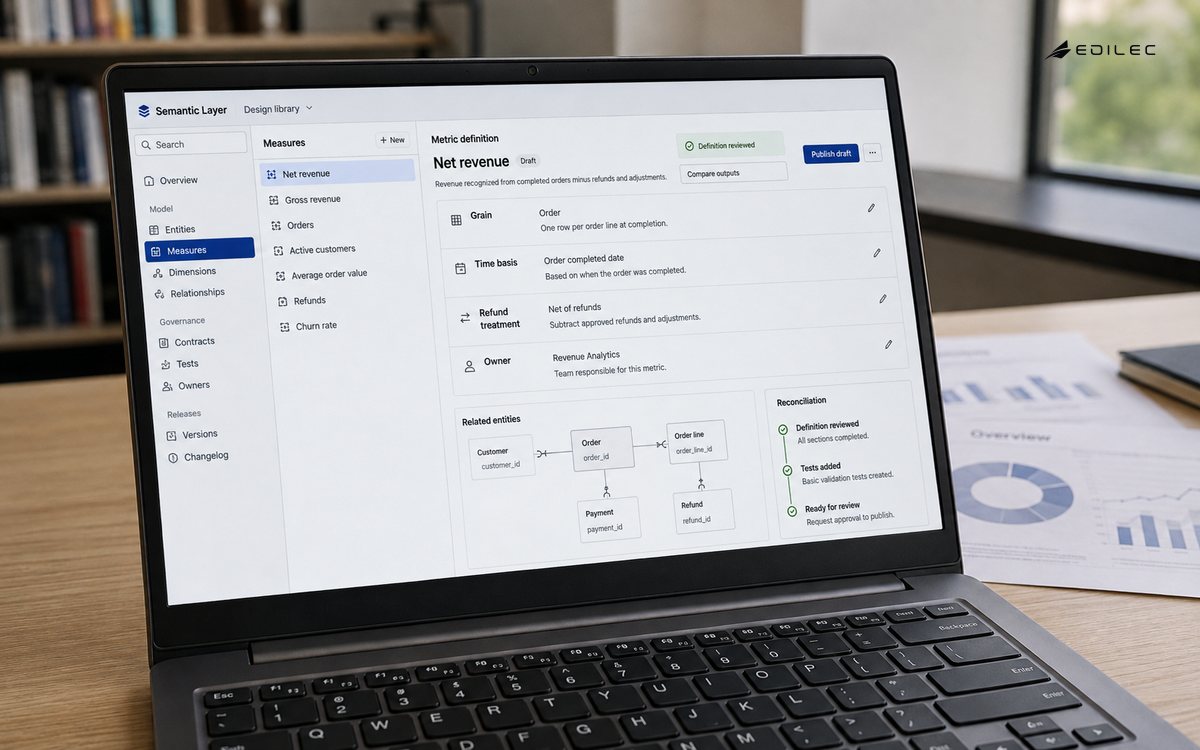
Trace net retained revenue from business decision to generated query. Record population, grain, accepted states, currency treatment, effective date, valid dimensions, and reconciliation total. Run identical cases through the warehouse model, semantic interface, and one consuming tool. Explain every difference rather than assuming one output is authoritative. This review tests terminology, join cardinality, access, compatibility, and query behavior where a person actually makes a decision.
Use this review with the article tables and linked Edilec guides. Sample completed records as well as exceptions, retain the rule and source versions that produced each outcome, and assign every corrective action to a policy, data, interface, integration, security, or operating owner. Metrics indicate where to investigate; representative cases reveal what must change. Before scope expands, repeat the exercise with an unavailable dependency, a delayed message, an unauthorized user, and a correction after the nominal process has finished. This review is specific to semantic contracts and analytical consumers.
- State owner, grain, filters, and time rule.
- Test fan-out and invalid dimensional cuts.
- Verify access with consumer roles.
- Compare versions across closed periods.
- Publish impact and rollback.
- Profile query cost and latency.
Key takeaways
- Build a semantic layer around recurring business disagreements and reusable decisions.
- Define entities, measures, dimensions, joins, and time treatment at the grain users actually need.
- Treat semantic definitions as versioned interfaces with owners, tests, and release communication.
- Keep preparation logic and presentation concerns in their appropriate layers.
- Expose freshness and lineage so a clean definition is not mistaken for current data.
FAQ
Does a semantic layer replace a warehouse model? No. Warehouse models prepare and preserve data; a semantic layer makes agreed concepts reusable across consumers. Can one metric have several definitions? It can have several valid measures, but they should be explicitly named for their different purposes. Ambiguous reuse of one label is the problem. A metric request should therefore ask which decision, population, grain, and time rule it is intended to support.
Conclusion
Engineering teams should use semantic layers to make business meaning reusable and inspectable. Focus on consequential concepts, encode their rules visibly, test the query paths that consumers rely on, and release changes as carefully as an API change. That discipline reduces duplicate calculations while leaving room for legitimate differences between operational and financial views of the same business. The layer should grow from proven reuse, not from an ambition to model the entire organization at once. Keep an intake path for requests, but require each request to state the reader, decision, grain, and expected dimensions. This turns vague requests for “one source of truth” into reviewable design work. When an old definition is retired, preserve its history and explain the replacement; otherwise a trustworthy semantic layer can become another source of unexplained trend shifts. Consistent meaning comes from maintained choices, not from a one-time modelling exercise.