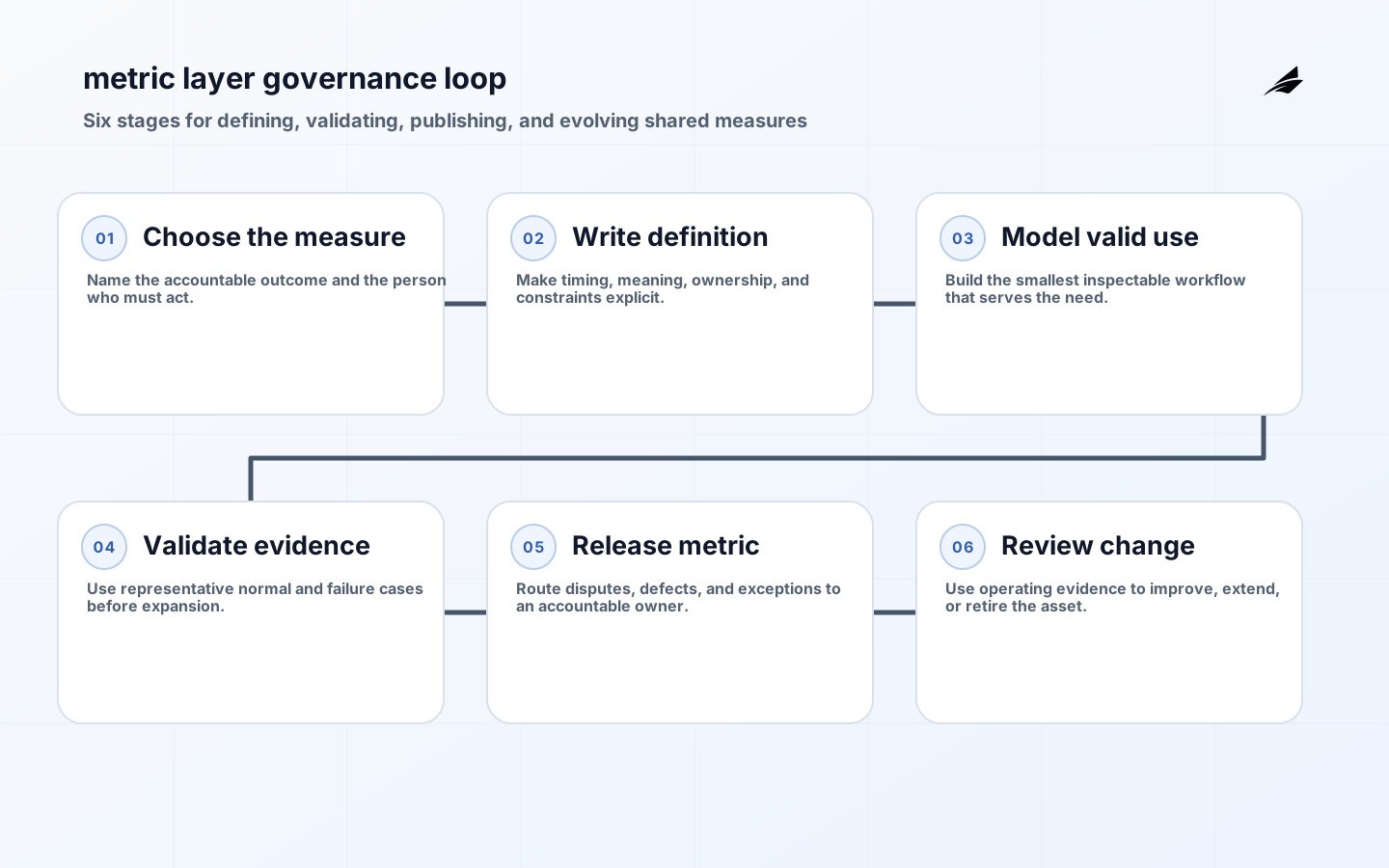
A metric layer provides one governed place to define and serve measures that appear in more than one analytical experience. Its purpose is not to make every business question look the same. Its purpose is to stop a core measure from acquiring several hidden formulas as it moves across dashboards, spreadsheets, and embedded tools. A useful metric layer lets a user understand what is counted, which records qualify, how time is handled, which dimensions are valid, and who decides when the rule changes. That combination makes reuse safer and makes legitimate differences visible instead of accidental.
Choose the metrics that matter
Metric layers are worth building when the same measure is calculated repeatedly across dashboards, notebooks, and operational tools, producing costly arguments about which result is right. Choose a measure with a concrete decision consequence, then document its grain, formula, filters, period logic, valid dimensions, owner, and source dependency. MetricFlow documentation provides a practical example of keeping metric definitions close to semantic modeling so different consumers can request consistent calculations. The NIST data governance profile is a reminder that technical reuse still needs accountable stewardship. Validate representative queries with people who understand the underlying business process. A metric that reconciles at the total but breaks when filtered by region, plan, or cohort is not ready for self-service. Publish the definition with its freshness and version so a reader knows whether a variance is a business event, a timing effect, or a changed rule.
Start with metrics that are repeatedly used to make decisions or that have produced costly disagreement. A delivery business might prioritize on-time completion, available capacity, and unassigned work; a subscription product might prioritize active paid accounts, expansion, and retention. For each candidate, write the decision it informs, the accountable owner, grain, population, time rule, source precedence, and material exclusions. Do not elevate an exploratory calculation into a governed metric merely because it is popular for a month. The metric layer should reduce confusion around durable concepts while still leaving analysts room to explore new hypotheses.
| Metric component | Question | Example |
|---|---|---|
| Name | What stable business concept is being measured? | on-time delivery rate |
| Grain | What is one eligible observation? | one completed delivery |
| Formula | How is the value calculated? | on-time completed deliveries divided by eligible completed deliveries |
| Time policy | Which timestamp and calendar apply? | completion date in local operating timezone |
Make definitions testable
A good metric definition can be tested with small, representative examples. Create cases for normal records, cancellations, duplicates, late updates, missing values, and boundary times. Assert the relationships and filters the metric depends on, then reconcile a sample against the accountable source or a reviewed calculation. Testing does not prove the business rule is wise; it proves the implementation matches the stated rule. Keep the rule in plain language beside the technical expression, because a reviewer should not need to read generated SQL to discover that refunded orders are excluded. When an exception is deliberate, name it and explain the decision it protects.
- Give each governed metric a business owner and a technical maintainer with distinct responsibilities.
- Specify numerator, denominator, grain, filters, dimensions, time basis, and unit or currency treatment.
- Test representative edge cases and relationships before exposing a metric to self-service tools.
- Reconcile samples after source, model, or calendar changes and retain the review evidence.
- Publish material limitations such as delayed sources, incomplete regions, or provisional classifications.
Operate the metric layer
Metric layers should be run as products with release discipline. Requests need a clear purpose; changes need an impact assessment; consumers need notice when a trend will move because the rule changed. Track usage and dependencies so the team can find dashboards and applications affected by a deprecation. Use compatibility periods where possible, especially for a renamed measure or revised attribute. Do not silently overwrite history just to make a chart smooth. Sometimes a restatement is appropriate, but it should be labelled with the reason and effective date. This is how metric governance supports trust without freezing improvement.

| Situation | Metric-layer response | Reader outcome |
|---|---|---|
| New business rule | Review definition and sample impact | Clear effective date and comparable periods |
| Late source data | Expose freshness or provisional status | Reader knows whether to wait or act |
| Dimension becomes invalid | Restrict unsupported query or map deliberately | No accidental misleading breakdown |
| Metric is retired | Deprecate with replacement guidance | Consumers migrate without a broken report |
Keep the interface understandable
The metric layer should lower cognitive load, not impose a second hidden language. Use names familiar to business readers, clear descriptions, sensible defaults, and discoverable links to models and source status. Restrict invalid joins or aggregations rather than allowing a convincing but wrong number. At the same time, resist an overly rigid interface that blocks real analysis. Provide a clear distinction between certified measures, candidate measures, and raw exploration. That tells users what can drive an operational commitment and what still needs validation. It also helps an engineering team prioritize the next definition based on actual demand.
Work through a practical case
A marketplace wants a common measure for fulfilled order value. The metric owner defines one fulfilled order as an order with a completed delivery, excludes test orders and fully refunded orders, and uses the fulfillment date in the marketplace timezone. Finance uses a close-ready counterpart that also accounts for adjustments after delivery. The metric layer names the two measures separately, tests cancellation and partial-refund cases, and allows product dashboards to group the operational measure by region and acquisition channel. When a new delivery partner sends events late, the dashboard shows provisional status until the scheduled reconciliation. The layer clarifies a legitimate difference instead of hiding it.
Plan the next review
Review a metric layer using real consumer questions and disputed results. Select a certified measure, run it through its common dimensions, and compare it with the expected source evidence for a known period. Inspect the definition, query path, freshness context, and downstream dashboards together. Ask whether the measure's name still matches the business language and whether requests for custom logic indicate a useful new metric or an attempt to bypass a constraint. Include finance or operations when the metric affects their decisions, because a technically consistent calculation can still be wrong for a changed business policy. Capture the outcome as a release, deprecation, or clarified scope so the next reader sees a maintained contract rather than an unexplained formula.
- Review the top-used metrics and the top-disputed metrics separately; popularity and risk are not the same.
- Validate default filters and time logic against a short approved set of example questions.
- Inspect dependency lists before a definition change so downstream communication is targeted.
- Decide whether a repeated custom calculation is exploratory, a missing certified metric, or an unsafe workaround.
- Publish a comparison when a release changes historical trend interpretation or supported dimensions.
Metric ownership must include a route for challenge. Readers should be able to report an unexpected result with the selected period, filters, and supporting record, and the owner should be able to distinguish an implementation defect from a valid but surprising rule. Track those questions because they reveal where a definition, dimension restriction, or freshness label is not doing enough work. Responding visibly to a challenge strengthens the metric layer more than quietly changing a formula, since it teaches consumers how the shared concept is maintained. A short public resolution note is often enough to prevent the same ambiguity from reappearing in another report or planning meeting.
Connect the practice to the wider data system
Metric layers depend on good data shape and good governance. Metric layers field guidance explains the broader concept, KPI governance helps assign decision rights, and semantic layers provides the reusable relationships and dimensions that keep a measure from being misapplied.
Key takeaways
- Govern metrics that drive recurring decisions or repeated disagreement first.
- Make grain, formula, filters, time, ownership, and limitations explicit and testable.
- Release metric changes with impact analysis, dependency awareness, and consumer communication.
- Prevent invalid breakdowns and joins while preserving a route for exploratory work.
- Use certification to state supported scope, not to imply universal truth.
FAQ
What is the difference between a metric layer and a semantic layer? A metric layer focuses on governed measures and the dimensions or calculations needed to query them. A semantic layer is broader and may also model entities, relationships, and reusable business concepts. Do metric layers eliminate analyst work? No. They make common, high-confidence measures reusable so analysts can spend more time on new questions, validation, and interpretation rather than recreating a baseline formula.
Conclusion
A metric layer is a practical way to make important analytical measures reliable across tools and teams. Start where inconsistent numbers create real decision cost, define the measures in language and tests, and operate them as versioned interfaces. That creates consistency without flattening legitimate business distinctions, which is exactly the balance a growing analytics practice needs. Protect the layer from uncontrolled growth by making certification a deliberate decision. A candidate metric can be useful, but it should not receive the same assurance or broad distribution as a measure reviewed for a recurring operational or financial purpose. Track requests, adoption, disputes, and downstream dependencies so the team knows which concepts deserve ongoing maintenance. When a certified metric no longer has a decision owner or dependable source, deprecate it openly rather than letting an old number continue to shape new work. Good metric governance remains responsive to the business while clear about what has been verified.