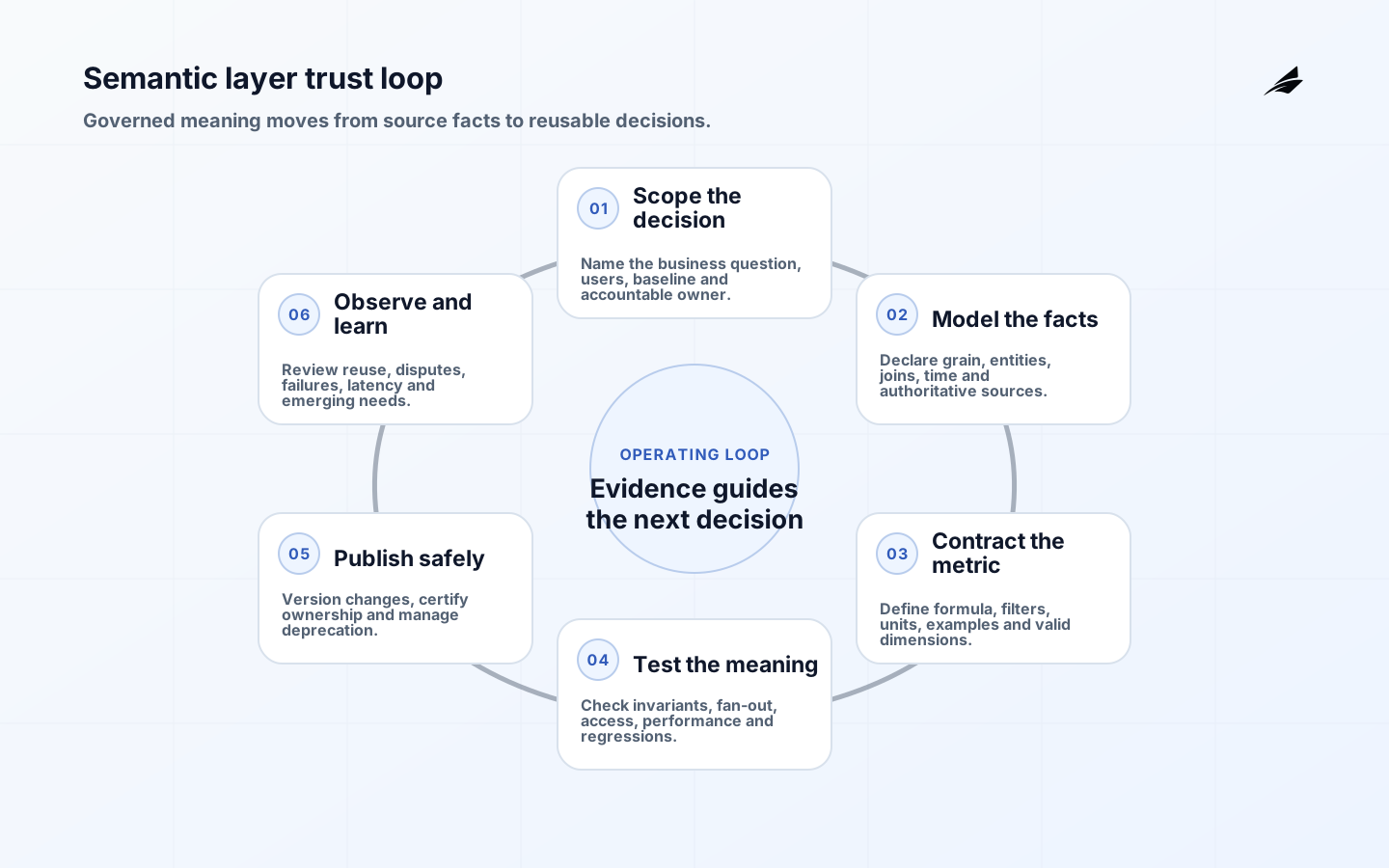
Semantic layers give analytical data a governed business vocabulary. They define measures, dimensions, entities, relationships, time behavior and access rules once so dashboards, notebooks, embedded analytics and AI assistants do not each invent their own version of revenue or active customer. The technology matters, but the real outcome is organizational: a person can inspect a metric, understand what it means and reproduce the result.
Growing teams usually feel the need after duplicated SQL has already spread. Two dashboards disagree because one uses invoice date and another uses payment date; a join multiplies order value; a regional filter silently excludes a new market. A semantic layer can stop that drift only when the team treats definitions as maintained data products rather than labels in a catalog.
Use this guide alongside Edilec's metric layer field guide, KPI governance guide, and metric layer operations checklist. Together they connect modeling choices with ownership and release discipline.
Key takeaways
- Start with a small decision domain, not an enterprise-wide metric dictionary.
- Define grain, filters, time semantics and allowed dimensions for every important measure.
- Keep the warehouse model authoritative for durable data logic and the semantic layer authoritative for reusable analytical meaning.
- Test generated queries and business invariants before publishing a changed metric.
- Measure reuse, disagreement, query performance and owner response time after launch.
What a semantic layer should own
A useful boundary separates physical preparation from analytical meaning. Source ingestion, deduplication, slowly changing dimensions and durable fact construction generally belong in the transformation layer. The semantic layer should expose business entities, measures, dimensions, relationships, calendars, formatting, descriptions and policy-aware access. This keeps consumer tools simple without forcing every warehouse concern into a query-time abstraction.
Product implementations differ. LookML models dimensions, aggregates, calculations and relationships used to generate SQL. Microsoft's Power BI semantic models can import data, query sources directly or combine modes. The dbt Semantic Layer centers governed metrics defined from models. Evaluate these designs by the decisions your consumers make, not by feature-list symmetry.
| Concern | Best primary home | Semantic-layer responsibility | Failure signal |
|---|---|---|---|
| Source correction | Ingestion or transformation | Expose corrected fields after validation | Different tools patch the same source differently |
| Business entity grain | Warehouse model plus semantic contract | Declare entity keys and valid joins | Measures inflate after a dimension is added |
| Metric formula | Semantic layer | Define aggregation, filters, units and owner | Equivalent reports use different SQL |
| Presentation | Consumer tool | Apply layout and audience-specific narrative | Core definitions are hidden inside charts |
| Access policy | Identity and data platforms | Apply or inherit policy consistently | A reused metric reveals unauthorized rows |
Write a complete metric contract
A metric name and formula are not enough. Record the business question, numerator, denominator, inclusion and exclusion rules, source facts, entity grain, default time dimension, timezone, currency treatment, late-arriving behavior, null policy, owner, certification state and effective date. Add examples at boundaries. For monthly recurring revenue, explain upgrades, downgrades, refunds, free plans, contracts that begin mid-month and historical restatements.
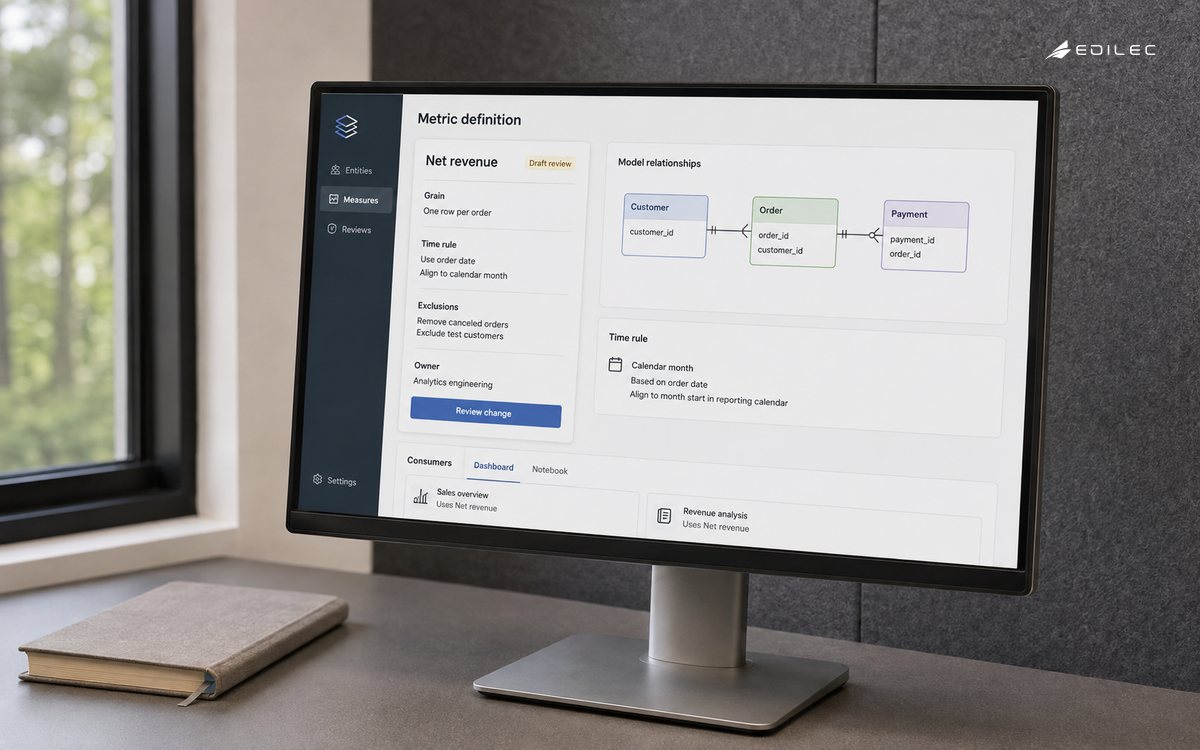
Separate a measure from a KPI target. Net revenue can be a reusable measure; a quarterly net-revenue target belongs to a planning process with a period, scenario and accountable owner. Combining both in one field makes history difficult to interpret. Also distinguish event-time metrics from processing-time service metrics. An order placed yesterday but loaded today should not move between periods merely because a pipeline was late.
Model joins, time and dimensions deliberately
Join safety is the hardest semantic problem for many teams. Declare entity relationships and cardinality explicitly. Test one-to-one, many-to-one and many-to-many paths with adversarial fixtures: customers without orders, orders with several payments, duplicate source keys and facts that arrive before their dimension. If a query can fan out a measure, either aggregate before the join, expose a safe relationship or refuse the unsupported combination.
Time needs the same precision. Choose event timestamps, reporting calendars, timezone conversion and period-comparison behavior. A retailer may need fiscal weeks while finance reports calendar months; support both as named dimensions rather than letting report authors improvise. For semi-additive measures such as account balance, define whether users may sum across entities but must take the last observation across time.
Release semantic changes like software
Keep model definitions in version control, require owner and technical review, and run compilation plus query tests in a representative environment. A pull request should show changed definitions, affected metrics, generated SQL, performance impact and downstream consumers. LookML metadata illustrates the value of inspecting how modeled objects are used; lineage should inform reviewers before they rename or remove a field.
Use compatibility windows for breaking changes. Publish a replacement, identify consumers, compare old and new results, communicate the reason and remove the old definition only after an agreed date. Certification is a state, not a decorative badge: a certified metric should have an active owner, tests, documentation, freshness expectations and a support route. Automatically withdraw or flag certification when those conditions expire.
| Test | Fixture or comparison | Release condition | Owner |
|---|---|---|---|
| Formula | Hand-calculated representative cases | Every expected value matches | Metric owner |
| Join safety | Duplicate and missing keys across paths | No unintended fan-out or silent loss | Analytics engineer |
| Time behavior | Period edges, timezones and late facts | Results follow the documented calendar | Data product owner |
| Access | Users from each policy group | Rows and fields match entitlement | Security owner |
| Regression | Certified dashboard and API queries | Explained deltas within tolerance | Analytics platform team |
| Performance | Common slices at expected concurrency | Latency and warehouse cost meet budget | Platform owner |
Roll out through one decision domain
Choose a domain where disagreement is costly and the source data is sufficiently stable, such as subscription growth or fulfillment. Inventory existing definitions, select five to ten measures, name a business owner and identify three real consumers. Rebuild one dashboard and one self-service workflow against the layer. Parallel-run the new results, explain every material difference and capture questions that the model cannot yet answer.
For example, a software company might define activated accounts, paid seats, recurring revenue, gross retention and support burden around the customer entity. The pilot succeeds when finance and product can use those measures across their preferred tools while tracing the same definition. It does not require migrating every dashboard. Expand only after owners can review changes and the platform can observe usage and failures.
Semantic layer operating checklist
- Name the business decision and authoritative fact for each metric.
- Document grain, keys, cardinality, default time and valid dimensions.
- Provide descriptions and at least two boundary examples.
- Test business invariants, generated SQL, policies and performance.
- Publish lineage, freshness and certification state to consumers.
- Log queries and identify unused, slow or failing definitions.
- Review owner coverage and deprecation plans every quarter.
- Keep an escalation route for disputed numbers during critical reporting.
Measure trust and operating value
Adoption alone can reward forced migration. Track the share of important reports using governed metrics, duplicated definitions retired, time needed to answer a metric question, unexplained result disputes, failed queries, p95 query latency and warehouse cost by metric. Survey whether users can find the right measure and understand its limitations. A trustworthy layer reduces reconciliation work without making exploration brittle.
Watch concentration risk as well. A layer used by every tool becomes critical infrastructure. Define availability objectives, cache behavior, query limits, deployment recovery and a way to communicate degraded freshness. Microsoft's guidance on shared semantic models emphasizes controlled reuse and discoverability; the same operating idea applies regardless of platform.
Prepare semantic meaning for AI consumers
Natural-language analytics raises the cost of ambiguous metadata. An assistant may generate syntactically valid queries that combine an additive measure with an invalid dimension or interpret a label differently from the business owner. Expose descriptions, synonyms, units, valid join paths, default filters and examples through governed interfaces. Limit the assistant to certified domains first, enforce the requesting user's permissions and return the metric definition and data freshness with every answer.
Evaluate AI-generated analytical answers separately from the semantic model. Use representative questions with known queries, ambiguous wording, adversarial requests and access-boundary cases. Score metric selection, filter interpretation, arithmetic, citation of definitions and refusal when the model cannot answer safely. Log the generated semantic query and result reference, not hidden reasoning. A semantic layer makes reliable AI analytics more possible, but it does not remove the need to test the translator and user experience.
Semantic layer FAQ
Does a semantic layer replace the data warehouse?
No. The warehouse or lakehouse still stores and prepares durable analytical data. The semantic layer supplies reusable meaning and query behavior above it. Pushing source cleanup and complex state reconstruction into the semantic layer usually creates slow, hard-to-test queries.
Is a data catalog the same thing?
A catalog helps people discover and understand assets. A semantic layer also participates in query execution by defining measures, dimensions and relationships. The two should exchange ownership, lineage and certification metadata, but they solve different parts of the problem.
How many metrics should the first release include?
Use the smallest set that supports a real decision across more than one consumer. Five to ten related measures are often enough to test modeling, governance, performance and adoption without creating an unreviewable enterprise dictionary.
Conclusion
Semantic layers earn trust when definitions are complete, joins are safe, changes are reviewable and owners answer disputes. Start with one decision domain, prove reuse across tools, observe the service in production and expand through evidence. The result is not merely consistent terminology; it is a dependable route from analytical data to accountable business decisions.