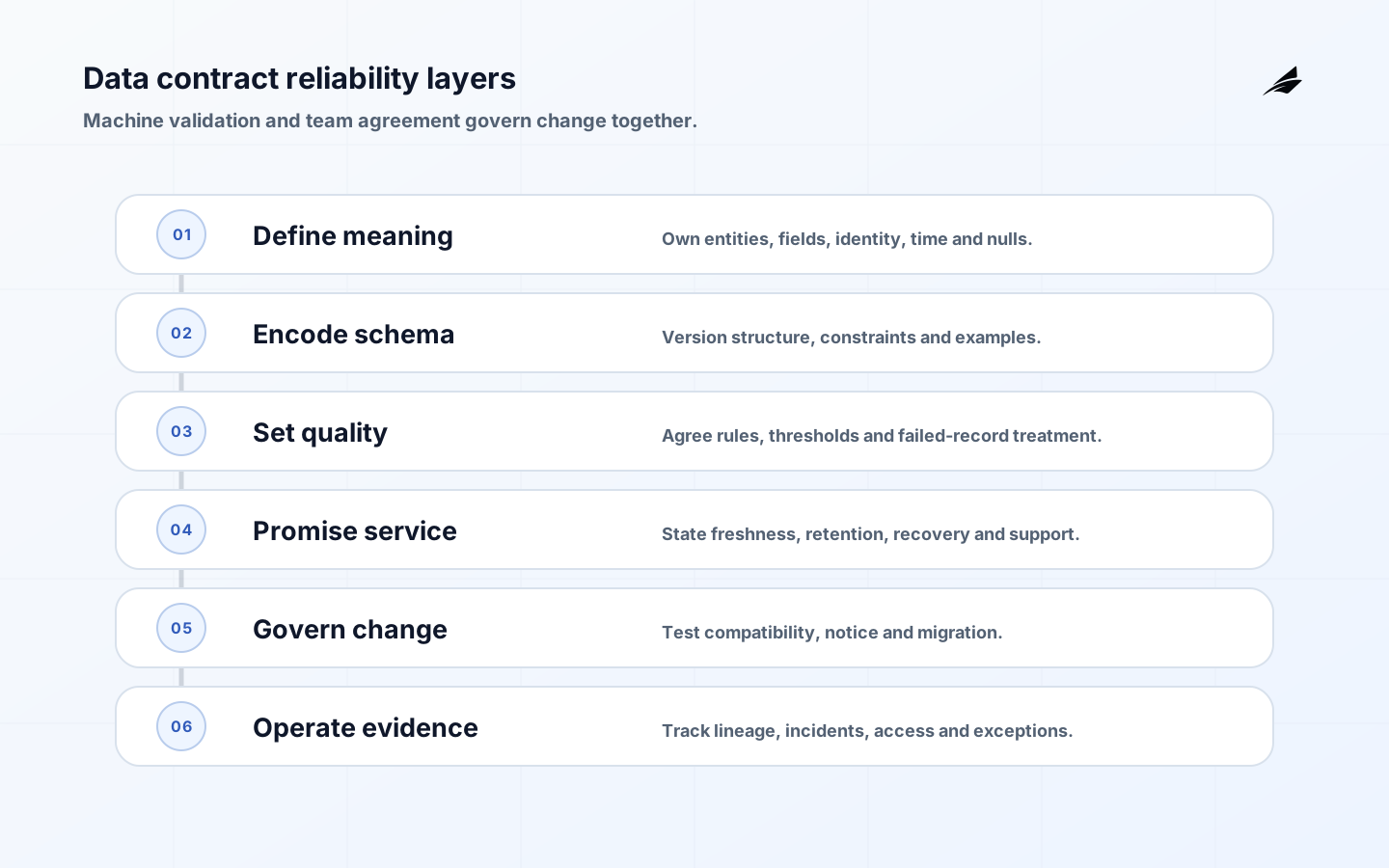
Data contracts are versioned agreements between producers and consumers about what data means, how it is represented, how reliably it arrives, how it may be used and how change is managed. A schema is part of the agreement, but a field can remain syntactically valid while its units, timing, population or authority changes. Engineering value comes from making those assumptions reviewable and testable before a release becomes a downstream incident.
Teams implementing data contracts need an operating pattern, not another definition. These engineering notes cover APIs, events, tables and files without requiring one registry product. The data contracts in production guide explores operating behavior, while the pre-build decision guide helps select the first boundary.
Choose a narrow, consequential boundary
Start where a producer change regularly creates expensive consumer work or where an incorrect interpretation affects a business decision. Name the producer, supported consumers, transport, dataset or event, environment and owner. Record unsupported uses honestly. A contract for every internal table creates paperwork without leverage; a contract around a customer, order, payment, inventory or regulated record can prevent material disruption.
State whether the interface is an API response, event occurrence, current-state feed, file delivery or analytical product. Define its authority. A contract can promise a derived view without making it the source of truth. Describe how consumers discover status, request access, report a defect and learn about change. Use one accountable producer owner and named consumer contacts; a registry entry cannot negotiate an ambiguous business definition.
| Contract dimension | Minimum statement | Example test | Failure owner |
|---|---|---|---|
| Meaning | Entity, field definition, unit and valid lifecycle | Golden examples and business assertions | Domain owner |
| Structure | Type, required status, constraints and encoding | Schema validation | Producer engineering |
| Identity and time | Keys, event time, timezone and correction rules | Duplicate and boundary-time cases | Producer and consumer |
| Quality | Completeness, uniqueness and reconciliation thresholds | Boundary and aggregate checks | Data product owner |
| Service | Freshness, availability, retention and recovery | Delayed delivery and replay exercise | Platform or service owner |
| Change | Compatibility, notice, migration and retirement | Consumer examples against candidate version | Change authority |
Write meaning before machine syntax
Define each important field in domain language: what it represents, who sets it, when it can change, unit, precision, timezone, null meaning and valid combinations. Distinguish unknown, not applicable, redacted and not yet available rather than encoding all as null. Define identifiers and whether they can be reused. For events, explain the occurrence, not merely the payload. For aggregates, state population, grain, window and inclusion rules.
Include positive, negative and boundary examples. Show the minimum valid record, a representative full record, a correction, a deletion or tombstone where applicable and values that must fail. Consumer examples are particularly valuable because they expose assumptions the producer did not know existed. Keep prose and examples beside the machine definition and version them together. Review definitions with business stewards as well as engineers.
Encode structure with appropriate specifications
Use a standard schema language supported by the interface. The JSON Schema specification defines core and validation vocabularies for JSON. The OpenAPI Specification describes HTTP APIs and their operations and schemas. Choose an explicit specification or dialect version, because validators can behave differently when version is implicit. Validate examples and generated code in the actual toolchain, not only an online editor.
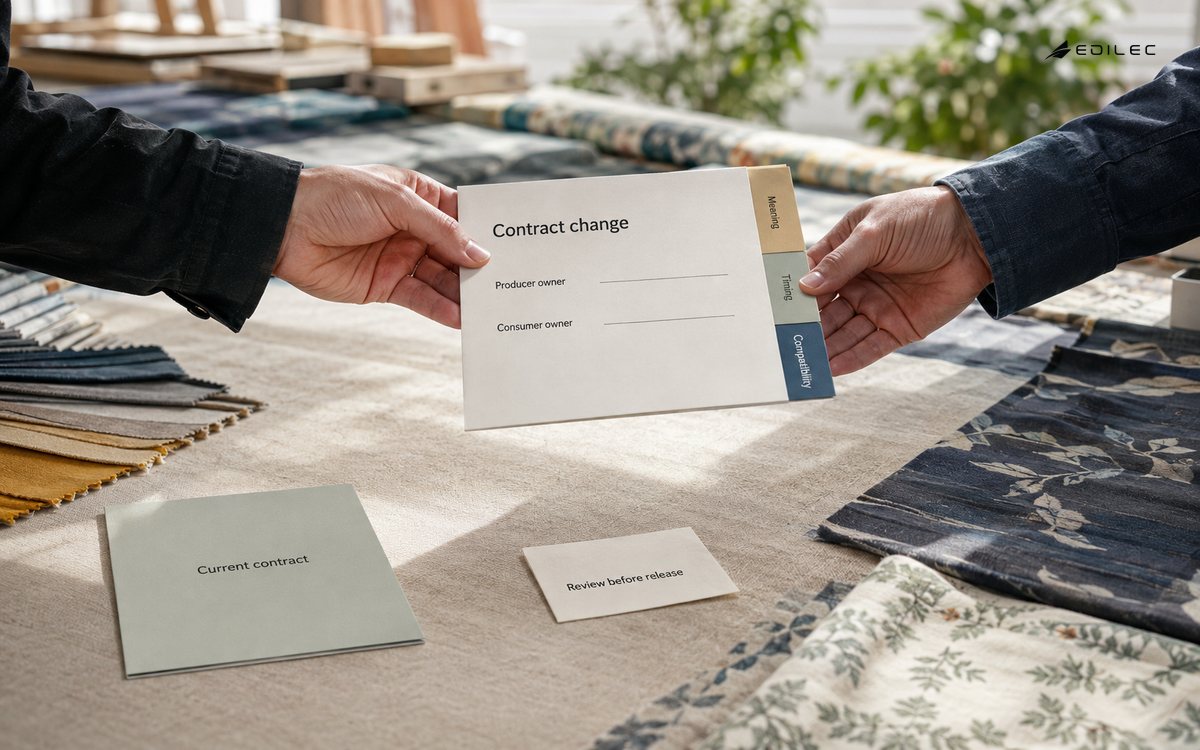
For events, separate event context from domain data. The CNCF CloudEvents specification standardizes context attributes such as source, identifier and type across transports, while leaving domain payload and its evolution to producers and consumers. Adopt only what improves interoperability. A standard envelope cannot define whether an order was accepted, cancelled or merely observed; that remains a domain contract.
Contract quality and service behavior
Define quality at the boundary the producer can own. Measures may include required-field completeness, key uniqueness, allowed transitions, referential consistency, value range and reconciliation totals. Set thresholds and disposition: reject delivery, quarantine records, publish with warning or stop a downstream product. A threshold needs an owner and review period. Repeated tolerated defects should become producer work rather than a permanent consumer cleanup pipeline.
Service terms should state expected cadence or freshness, availability window, support hours, retention, backfill, replay and recovery objectives. Explain what consumers see during degradation: previous successful version, partial data, explicit stale status or no publication. A contract should not promise what the underlying source cannot support. Measure from the consumer-visible boundary and publish incidents and corrections through a known channel.
Define compatibility from consumer behavior
Backward and forward compatibility depend on serialization, validators and consumer code. Adding an optional field may be structurally compatible but break a strict decoder or downstream selection. Changing an enum, precision or meaning can break behavior without changing type. Publish allowed changes, required notice and a route for exceptions. Run candidate producer output against declared consumer examples and supported client versions before release.
Use additive change where possible and provide an overlap period for breaking change. Version at the smallest useful boundary and avoid embedding version numbers everywhere without a retirement model. Record migration owner, consumer status, deadline and rollback. Discover consumers through both registration and observed lineage or access because undeclared dependencies still create operational risk. Decide whether to support, migrate or explicitly reject each hidden use.
| Proposed change | Likely risk | Required evidence | Release treatment |
|---|---|---|---|
| Add optional field | Strict decoders or unexpected selection | Consumer examples pass | Ordinary compatible release |
| Make field required | Old producers or historical data fail | Backfill and producer rollout complete | Coordinated migration |
| Change enum values | Exhaustive consumer logic fails | Unknown-value behavior tested | Notice and overlap |
| Change unit or meaning | Silent analytical corruption | New field or version and reconciliation | Breaking semantic release |
| Change key | Duplicates and lost joins | Identity migration and dual mapping | Controlled cutover |
| Reduce retention or freshness | Consumer recovery or decision fails | Impact approval and updated objective | Governed service change |
Automate contract checks in delivery
Store the contract, examples and policy in version control. On producer change, validate syntax, schema, compatibility policy, golden examples and business rules. Test representative consumer examples where practical. Generate a readable change summary and require approval from the accountable owner for semantic or service changes. Publish the accepted version and immutable evidence, then observe actual data. Pre-release checks cannot detect every source-quality problem.
Keep exceptions explicit with reason, scope, consumer impact, approver and expiry. Do not let teams bypass a failed contract by weakening global validation. Improve false or excessively rigid rules at the correct layer. The data contracts operations checklist helps teams review registries, alerts, ownership and recovery after initial automation.
Operate ownership, privacy and provenance
The producer owns the reliability and meaning it publishes; consumers own compliant use and resilient handling; platform teams own shared tooling; domain and governance leaders resolve policy and authority. Review access, sensitivity, permitted use, regional constraints, retention and deletion. The NIST Privacy Framework can help organizations identify and manage privacy risk. A contract should minimize collection and expose purpose, not legitimize unnecessary data.
Preserve lineage from source through transformation to contracted output and material consumers. The W3C PROV-O recommendation offers concepts for entities, activities and agents that can structure provenance. Record contract version, transformation revision, source position or snapshot, run identifier, quality result and publication. During an incident, this evidence should identify affected intervals and consumers quickly enough to act.
Introduce contracts without blocking delivery
Pilot one producer and two or three willing consumers around a consequential boundary. Capture current incidents and manual coordination as the baseline. Write the smallest useful semantic and service agreement, automate a few high-value checks and rehearse one breaking change. Measure avoided defects, detection time, migration effort and exception burden. Improve templates and tooling from observed use before expanding to other domains.
Provide paved paths for common API, event, table and file patterns while allowing justified domain additions. Keep contract review close to product delivery and use central governance for shared policy and dispute, not every field description. The earlier data contracts engineering guide can provide historical context, but each active contract should point to the current authoritative source and owner.
Measure adoption through outcomes: breaking changes caught before release, consumer migration time, freshness incidents, expired exceptions and time to identify affected consumers. Registry entry count is not a success measure. Sample active contracts to confirm that owners respond, examples still run and service promises match observed data. Retire contracts when their products end so discovery does not become a catalog of abandoned assurances.
Key takeaways
- Begin with a consequential producer-consumer boundary and named owners.
- Contract domain meaning, identity, time and null semantics before syntax.
- Combine schema, examples, quality, service levels and change policy.
- Judge compatibility through supported consumer behavior, not schema shape alone.
- Automate high-value checks and keep exceptions scoped, owned and expiring.
- Preserve privacy decisions and lineage so incidents and corrections are actionable.
Data contracts FAQ
Are data contracts the same as schemas? No. Schemas describe machine structure and validation. Contracts also cover meaning, ownership, quality, service behavior, permitted use and change.
Who should approve a contract? The accountable producer owner approves promises, consumers validate important behavior, and domain, privacy or governance owners approve issues within their authority.
Must every consumer sign? Not necessarily, but supported consumers and obligations should be visible. Observed undeclared consumers need a support, migration or rejection decision.
Can contracts prevent all incidents? No. They reduce ambiguity and detect known incompatibility. Runtime quality, source failure, hidden consumers and novel semantic errors still require monitoring and response.
Conclusion: make change discussable and testable
Data contracts turn hidden producer-consumer assumptions into an owned engineering interface. Start narrowly, write meaning, encode structure, define quality and service behavior, test real consumer examples and govern migration. The useful outcome is not a large registry; it is a change process in which teams can see impact, act before breakage and recover with evidence when reality differs from the agreement.