Semantic Layers in Production: Consistent Meaning for Analytics
Semantic layers becomes a production capability when people rely on it for a recurring decision, not when a first chart, model, schema, or job has been delivered. Consider a revenue metric shown in a sales review, board pack, and customer-success workspace that must mean the same thing. The team needs more than a plausible output: it needs a shared definition of meaning, a clear statement of how current the result is, an owner who can act, and an explanation when the result changes. This boundary turns semantic layers from a project artifact into an operating capability and focuses investment on a particular uncertainty rather than another place where people must hunt for answers.
The first useful question is, “what would a responsible person do differently if this result were available?” For semantic layers, the answer determines grain, latency, access pattern, and control level. A reliable design starts with booking date, recognised revenue rule, account identifier, product line, currency, and fiscal calendar. It gives those inputs accountable owners, preserves enough context to explain the output, and makes the exception route visible. Platform choice matters, but an output without a correction path can make a decision faster and less defensible at the same time.
Why semantic layers changes in production
Early semantic layers work optimises for discovery: can a source be queried, can a result be produced, can a transformation run? Production introduces more demanding questions. Can a new teammate understand the decision boundary? Can the result be reconstructed after a source correction? Can a material change be reviewed before it alters an established workflow? Can users see assumptions, last successful update, and next action? These are design questions rather than paperwork. They decide whether the capability retains credibility after launch and can be safely handed to the people who run the work.
official implementation guidance is a useful technical reference for this subject, while the related provenance and validation references explain complementary controls. The practical inference is organisational: a documented mechanism becomes dependable only when its assumptions appear in delivery checks and daily work. For semantic layers, the aim is not to eliminate every edge case. It is to give normal work, degraded conditions, and recovery distinct, understandable behaviour. Users should know when to trust an answer, when to pause, and who should investigate.
The operating model: decisions, ownership, and change
Give the business owner authority over meaning and priority; give the technical owner responsibility for implementation, observability, and recovery; and give consumers a clear route to report ambiguity. This prevents the familiar stall where everyone sees a questionable result but no one can decide whether it is wrong, late, or merely unexpected. Review semantic layers with real evidence: recent exceptions, material changes, unanswered questions, and a sample of decisions. This cadence exposes gaps before they become an expensive redesign. The owner should explain both intended value and the cost of an incorrect or unavailable result.
| Operating question | Decision | Evidence |
|---|---|---|
| Who relies on it? | Name user and recurring decision. | Audience, cadence, action owner. |
| What is trusted? | Set source, definition, and timing. | Version, lineage, tests, last run. |
| What happens on failure? | Choose visible degraded state. | Alert owner and reconciliation. |
| How does it change? | Review material changes. | Impact assessment and effective date. |
A production architecture for semantic layers
Separate source evidence, controlled logic, publication, and observation. Retain booking date, recognised revenue rule, account identifier, product line, currency, and fiscal calendar close to where they can be validated. Publish only the decision-ready result and context the audience needs, while preserving an authorised route back to supporting detail. The central risk is teams producing plausible but conflicting commercial numbers. A practical safeguard is a declared owner, explicit expected state, and traceable correction record. This does not demand a large platform on day one. It demands boundaries: an input can be quarantined, an output can declare itself stale, and a repair can be traced rather than silently overwritten. Those properties make investigation possible when a decision is challenged.

| Layer | Responsibility | Failure signal |
|---|---|---|
| Source evidence | Capture identity, time, business context. | Missing keys or unexpected volume. |
| Controlled logic | Apply agreed definition and checks. | Failed test or reconciliation gap. |
| Published result | Present decision-ready context. | Stale result or unavailable detail. |
| Operations | Observe delivery and recovery. | Unowned alert or recurring dispute. |
A practical rollout path for semantic layers
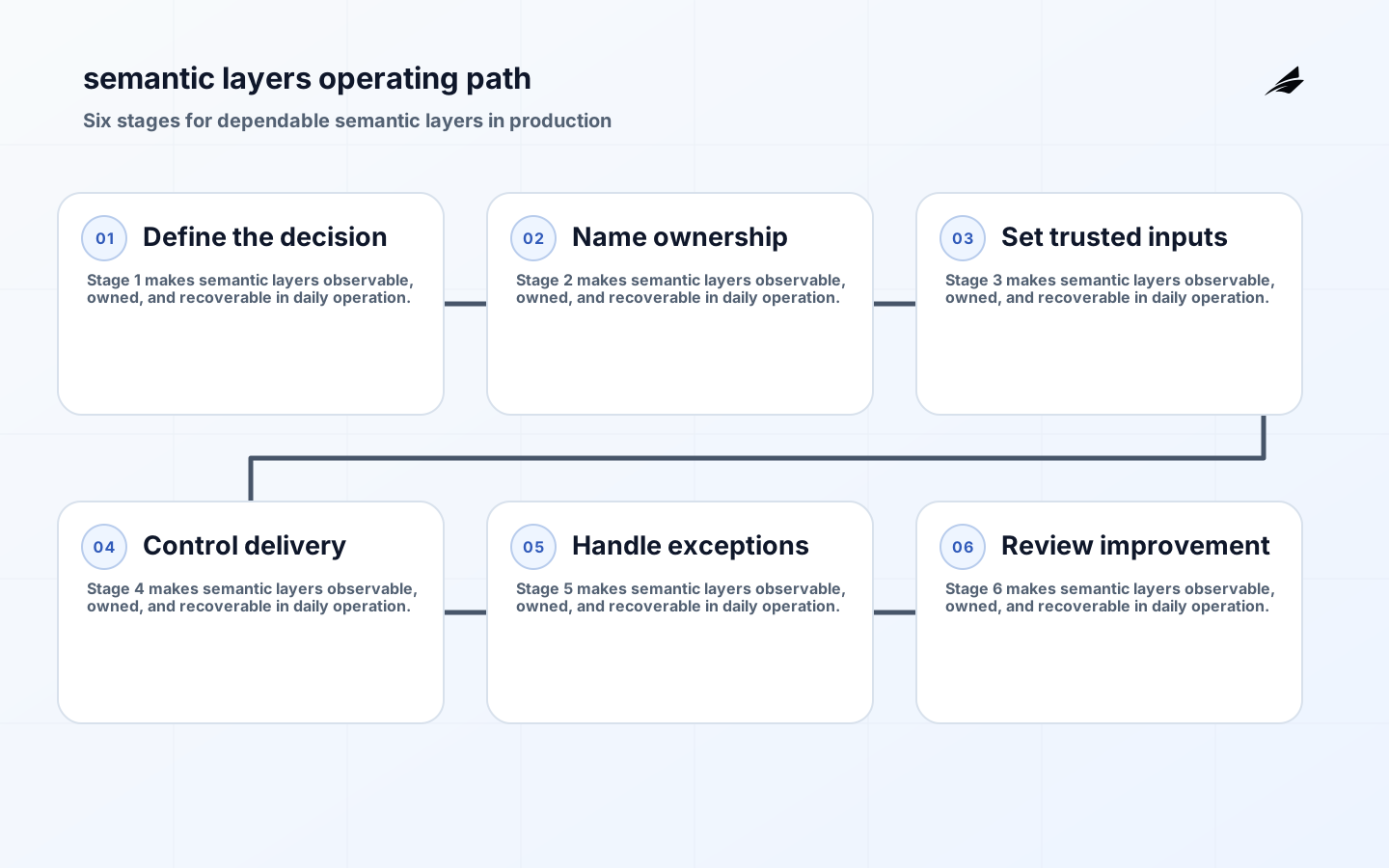
Start with one decision frequent enough to expose real conditions but limited enough to supervise closely. Use representative historical cases and recent live cases; compare the new result with the current method, including uncomfortable exceptions. Before widening access, ask an intended user to locate the explanation, source context, and next action without help from the delivery team. A disciplined semantic layers rollout produces a named baseline, release record, support contact, and recovery exercise. That evidence is more valuable than a long feature list because it tests whether the operating agreement works under pressure.
- Write the decision statement for semantic layers and agree it with the action owner.
- Model the smallest useful path using booking date, recognised revenue rule, account identifier, product line, currency, and fiscal calendar, including incomplete cases.
- Make expected state, last update, and exception path visible.
- Test access, definition, and recovery before routine use.
- Compare the pilot with the prior process and record delay or rework.
- Expand only after the owner can explain detection, communication, and correction.
Signals that show whether semantic layers is operating
Measure semantic layers through behaviour and reliability together. Track fewer metric disputes and faster reuse of approved definitions; delivery or freshness; the count and age of unresolved exceptions; definition or access questions; and time from detection to a corrected, explained result. Add a qualitative check by asking users which decision they changed recently and what evidence they used. A high view count, query volume, or job-success rate can be useful context, but cannot prove the capability improves work. A short-lived rise in questions can even be healthy when it exposes definitions that were assumed rather than agreed.
Key takeaways
- Semantic layers should begin with a decision and accountable user, not tool selection.
- Treat meaning, timing, and correction as visible parts of the experience.
- Keep source evidence and changes traceable enough to explain a contested result.
- Pilot one consequential workflow, rehearse its unhappy path, then use observed behaviour to choose scope.
Frequently asked questions about semantic layers
What is the first production milestone for semantic layers?
The first milestone is a supervised, repeatable decision path: a named user can obtain the result, see context, follow an exception to a responsible owner, and compare it with underlying evidence. For semantic layers, this is stronger than a proof of concept because it exercises definition, access, timing, and support together. Keep scope narrow enough for the owner to review every surprising outcome during the first operating cycle.
Do we need a new platform before putting semantic layers into production?
Usually not. First establish whether current tools can record required inputs, apply agreed rules, expose the result safely, and leave an auditable correction path. A new platform is justified when it removes a concrete reliability, scale, access-control, or maintainability limit. The official implementation guidance helps evaluate implementation choices, but it cannot replace a decision about ownership and operating requirements. For semantic layers, prioritise a platform only when it can preserve shared metric meaning and controlled access across the tools that consume those measures.
How often should the team review semantic layers?
Review it at the cadence of the decision and whenever a material upstream or business rule changes. A daily workflow may need a weekly exception review; a monthly planning product may need a monthly review plus release checks. Do not let a fixed calendar substitute for signals. Repeated exceptions, metric disputes, missed deadlines, or parallel spreadsheets are reasons to investigate immediately. Review semantic layers when a metric definition, fiscal calendar, or supported dimension changes. Log disputes and compare old and new values before a revised definition becomes the default.
Semantic-layer evidence should include examples of approved and unsupported questions. This prevents a well-defined revenue or activation measure from being applied at a grain it cannot support. Short examples make governance practical: users can recognise when a new request needs a new metric, a new dimension, or an explicitly documented limitation.
Conclusion: make semantic layers dependable before making it broad
A semantic-layer evidence pack should make a measure intelligible without exposing every implementation detail. For a revenue measure, record the grain, recognised-revenue rule, fiscal calendar, currency treatment, exclusions, supported dimensions, owner, and effective date. Compare the result in the sales review, board pack, and customer-success workspace using identical filters. If the numbers differ, trace the difference to an approved context or stop publication until the conflict is resolved. Changes deserve the same discipline: assess affected consumers, show before-and-after values for priority periods, and publish a clear effective-date note. This lets founders distinguish a legitimate change in meaning from a defect. It also protects analysts from rebuilding familiar metrics in local tools, where hidden filters and time rules quickly create competing truths.
The durable version of semantic layers is not the largest implementation. It is the one that helps founders make a specific decision with known meaning, current-enough evidence, accountable ownership, and a credible correction route. Begin with a revenue metric shown in a sales review, board pack, and customer-success workspace that must mean the same thing. Establish controls and measurements that make this path inspectable. Then extend the capability only after the first workflow can survive change, error, and scrutiny without relying on the people who originally built it.