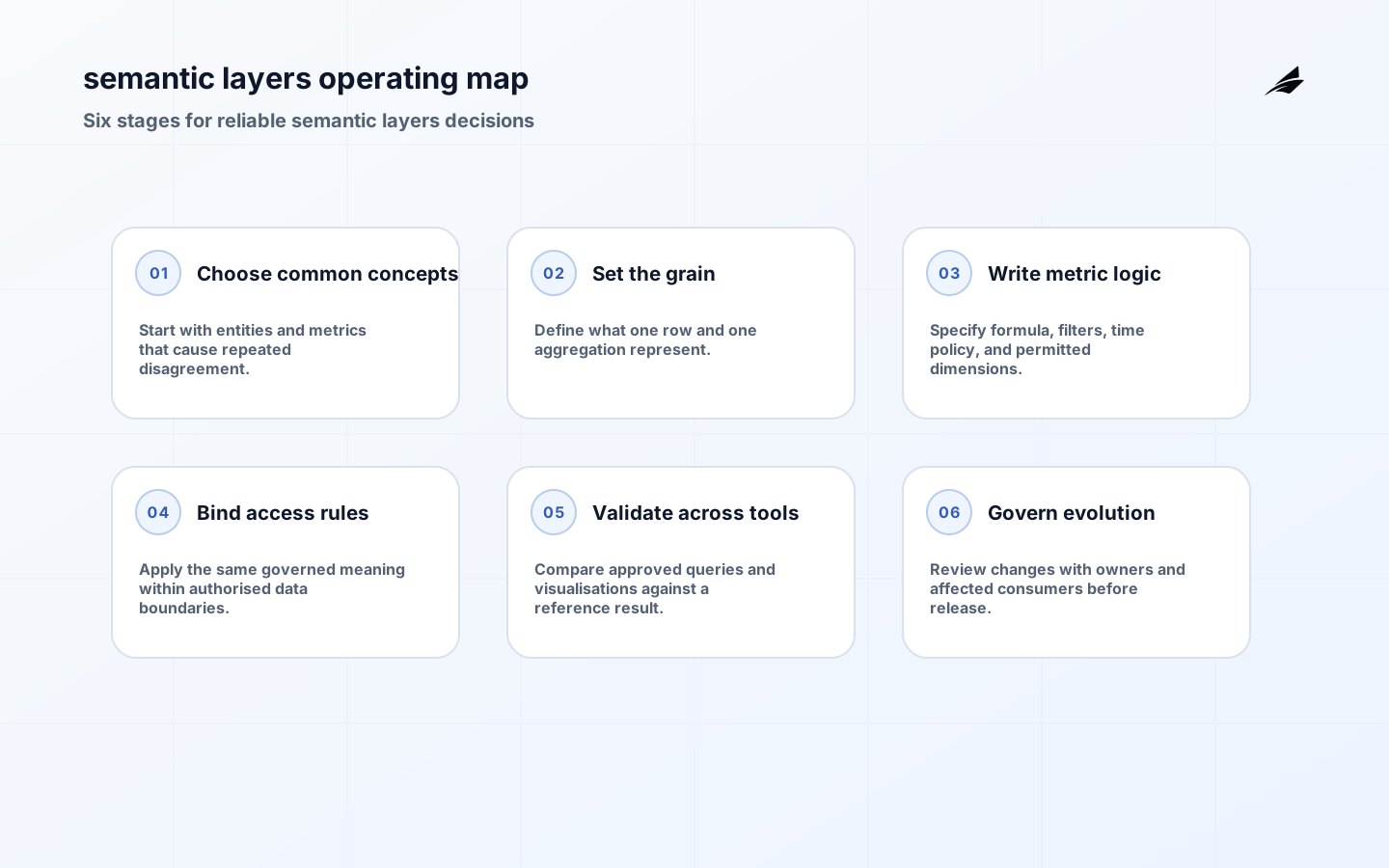
Semantic layers become valuable when they help the analyst or application that needs a consistent business definition make a better decision, not when they merely add another technical artifact. The practical question is whether separate tools can calculate a core metric without creating competing answers. Begin with a metric name, formula, grain, dimensions, filters, and time semantics. dbt Semantic Layer documentation, PROV-DM, Data Quality Vocabulary, Power BI solution planning, and Snowflake semantic views provide specific contexts for governed definitions, provenance, quality, consumption, and implementation. None removes the need for a local contract. Revenue can mean booked, invoiced, recognised, or collected. A semantic layer does not choose one definition for every conversation; it gives each a clear name, formula, grain, owner, and allowed dimensions specifically for semantic metric contracts. That precision lets a sales view and a finance view coexist without pretending they answer the same question specifically for semantic metric contracts.
Start with a decision that needs shared meaning
Treat a semantic layer as a service around a recurring decision. Write down who acts, what they can change, which population is included, which clock applies, and what consequence follows if the information is wrong or late, in the semantic metric contracts context. The service boundary should also say what it does not promise. For semantic layers, the relevant inputs are governed models, entity relationships, dimensions, metric formulas, access rules, and calculation context. This is more useful than a generic requirements list because it lets a reviewer ask whether each input has a known owner, an expected arrival pattern, and an understandable exception state, in the semantic metric contracts context. The immediate aim is a small, observable path that earns trust before the scope expands specifically for semantic metric contracts.
| Decision question | Specific answer to record | Evidence to retain |
|---|---|---|
| Who acts? | Name the role with authority to change the outcome. | Owner, escalation route, and review cadence. |
| What is true? | State the grain, time policy, inclusion rules, and known exclusions. | Definition, examples, and version history. |
| When is it usable? | Declare freshness or latency expectations and correction behavior. | Status signal, run evidence, and incident notes. |
| What happens on doubt? | Offer a safe challenge, containment, or fallback path. | Ticket, decision log, and correction record. |
Write the metric contract readers can inspect
A semantic contract connects business language to a metric definition that engineers can test. For semantic layers, capture governed models, entity relationships, dimensions, metric formulas, access rules, and calculation context. Then name the metric owners and record which consumers and comparisons a change will affect. Avoid vague claims such as “single source of truth” unless scope and authority are explicit: several sources can coexist when each has a defined purpose. Define identifiers, expected values, ownership, and compatible change rules where consumers can inspect them. Centralising labels while leaving the calculation ambiguous or tool-specific only moves the dispute downstream. Clear contracts make handoffs calmer because a new analyst or responder can see which result answers a particular question and which result remains provisional.
- Name a business owner and a technical owner for semantic layers; either role alone is insufficient.
- Record the entity or event grain before publishing aggregate metrics or summaries specifically for semantic metric contracts.
- Put freshness, completeness, access, and known limitations near the result people use specifically for semantic metric contracts.
- Make material changes reviewable, dated, and understandable to affected readers.
- Keep an auditable exception route instead of silently correcting surprising records.
- Use realistic failure cases as acceptance criteria, not only a successful happy path specifically for semantic metric contracts.
Readers who need the surrounding operating context can compare the analytics documentation guide, the data quality production guide, and the real-time analytics production guide. Each link highlights a different dependency that a semantic contract must make visible.
Separate definitions without creating silent forks
The first design choice is how the asset changes without surprising its consumers specifically for semantic metric contracts. Break work into a declared input boundary, transformation or interpretation step, published result, and feedback route, in the semantic metric contracts context. A change should be assessed for meaning, access, performance, and downstream effect before it is released, in the semantic metric contracts context. Revenue can mean booked, invoiced, recognised, or collected. A semantic layer does not choose one definition for every conversation; it gives each a clear name, formula, grain, owner, and allowed dimensions in the worked semantic metric contracts example. That precision lets a sales view and a finance view coexist without pretending they answer the same question in the worked semantic metric contracts example. metric layers in production are often part of the dependency story, so their contract and recovery behavior deserve the same attention as the final interface. Prefer a small release with measured use over a broad launch. It produces evidence about confusion, latency, and missing context while the cost of correction is still low, in the semantic metric contracts context.

Test late data, corrections, and access boundaries
A production test is a question about behavior under conditions that actually occur specifically for semantic metric contracts. Verify that two approved interfaces return the same answer for the same definitions, filters, and time window. Test the normal path, but also test empty input, changed definitions, delayed delivery, access denial, partial completion, and correction after publication, in the semantic metric contracts context. Use a small set of representative records or fixtures whose expected outcome is understood by both a domain reviewer and an engineer, in the semantic metric contracts context. This makes a discrepancy informative: it points to a rule, a contract, or a source rather than a vague claim that “the data looks wrong.” Where an action has financial, customer, or compliance consequences, make the safer fallback explicit and ensure the support team can invoke it, in the semantic metric contracts context.
| Operating moment | Control | Useful signal |
|---|---|---|
| Before release | Review definitions, ownership, permissions, and consumer impact. | Approval and test evidence linked to the change. |
| Normal operation | Publish status with the result and monitor declared checks. | Freshness, completion, quality, and usage trend. |
| Exception | Contain impact, preserve evidence, notify readers, and correct safely. | Time from detection to understandable status. |
| After correction | Explain material movement and improve the failed control. | Repeat incident rate and unresolved follow-up. |
Operate the semantic layer through change review
After launch, the work shifts from construction to stewardship. Monitor metric reuse, definition disputes, failed semantic tests, adoption by approved consumers, and change lead time. These measurements should support a conversation, not become targets detached from the decision specifically for semantic metric contracts. A low error count can mean a reliable service, or it can mean users have stopped reporting problems because the route is unclear, in the semantic metric contracts context. Review a sample of real decisions: did the reader understand the time boundary, did the evidence change the action, and could the owner explain a discrepancy, in the semantic metric contracts context. Keep a brief incident record that captures affected consumers, source state, containment choice, and durable fix, in the semantic metric contracts context. That record turns operational noise into design input for the next release specifically for semantic metric contracts.
Measure whether consumers can trust a change
Adoption and reliability are complementary. Usage without trust produces ritual; reliability without use produces an unused asset specifically for semantic metric contracts. Establish a baseline before changing the workflow, then compare observed behavior after release specifically for semantic metric contracts. For semantic layers, watch metric reuse, definition disputes, failed semantic tests, adoption by approved consumers, and change lead time. Segment those signals by audience and use case, because an executive reader, an operator, and an analyst may need different latency, detail, and correction policies, in the semantic metric contracts context. Pair quantitative evidence with short interviews or support reviews. The strongest improvement candidates are the places where users repeatedly leave the service, create a shadow calculation, or ask the same interpretation question, in the semantic metric contracts context.
Scenario: revenue differs across finance and sales
Take a net revenue metric used by a sales forecast and a finance close. The contract should name the entity grain, currency conversion date, treatment of refunds, exclusion of test accounts, and the status of late invoices. The sales consumer may need an intraday estimate, while finance needs a settled period and an auditable correction path. Those are different service expectations, not permission to publish two unnamed formulas. Give the definitions distinct names, show the effective date, and link each result to the model version and source status that produced it.
Test the contract with four records: a normal invoice, a refund posted after month end, a multi-currency order, and an invoice arriving after the declared cutoff. Ask both consumers to predict the output before running the query. If their answers differ, decide whether the metric should split into two governed measures or whether one interpretation is authoritative. Record that decision with examples that can be rerun in the semantic layer and in downstream tools. This is more durable than a promise of a single source of truth because it shows exactly which questions the shared definition can answer.
Key Takeaways
- Semantic layers start with a named decision and a clear boundary, not a tool choice.
- Definitions, ownership, freshness, and exceptions are part of the product the reader receives specifically for semantic metric contracts.
- Production readiness includes recovery, communication, and change control as well as a working build, in the semantic metric contracts context.
- Test representative failure modes and preserve evidence so corrections are explainable.
- Measure trusted use and decision quality alongside technical delivery signals.
Reference checkpoints for semantic metric contracts: Use dbt Semantic Layer to check semantic metric contracts at definition time. Use PROV-DM: The PROV Data Model to check semantic metric contracts at release time. Use Data on the Web Quality Vocabulary to check semantic metric contracts at review time. Use Power BI solution planning to check semantic metric contracts at exception time. Use Snowflake semantic views to check semantic metric contracts at recovery time.
Frequently Asked Questions
Use these questions to test whether shared metrics remain named, versioned, and explainable across consumers.
Conclusion
A dependable semantic layer earns its place when finance, sales, and product users can distinguish definitions without rebuilding the metric in separate tools. Put the grain, time policy, owner, access boundary, and correction route beside each governed measure. Test late facts, restatements, and permission failures before widening consumption, then use disputes as evidence for the next contract revision. The result is a shared analytical service whose differences are intentional, named, and explainable.
For a semantic layer, durability is the ability to explain a measure across tools without hiding differences in grain, timing, or source status. Keep the contract versioned, the owner visible, and the late-data rule explicit so consumers know when to use, qualify, or reject a result.
Compare a revenue measure in a finance report and a sales dashboard after a late invoice arrives. The semantic layer should expose the definition, cutoff, source status, recalculation rule, and owner; the review should state whether the two views answer different questions or whether one is wrong.