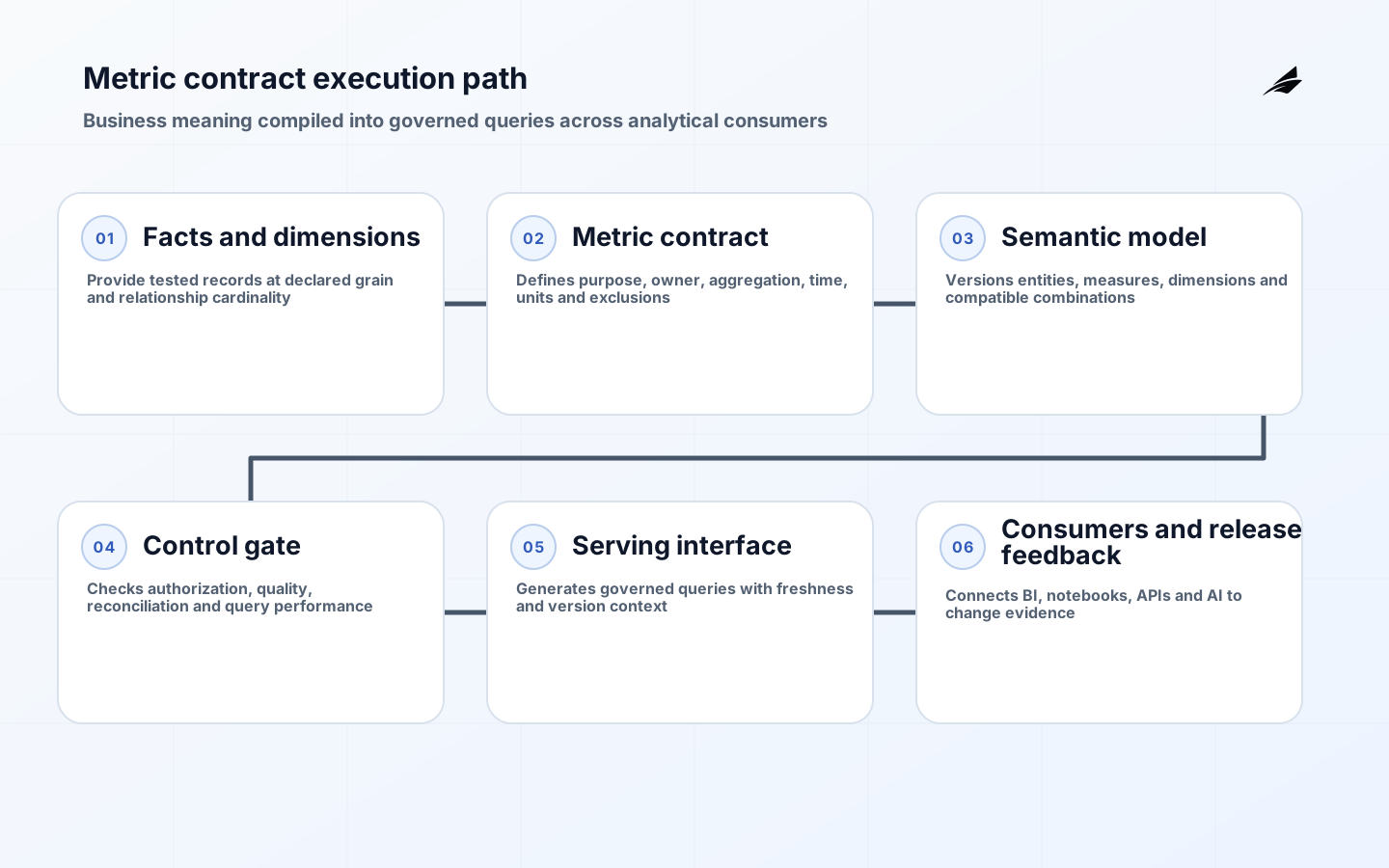
A metric layer gives many analytical tools a shared, executable definition of business measures. It can reduce duplicated SQL and conflicting dashboards, but only when definitions, grain, ownership and release behavior are explicit. Installing a semantic-layer product does not resolve whether an active customer means a login, a paid account or a qualifying event. Implementation therefore combines business design, dimensional modeling, query behavior, testing and governance. This checklist treats the layer as a production interface whose consumers include dashboards, notebooks, embedded analytics, APIs and sometimes AI systems.
Confirm the problem and implementation boundary
Collect examples of disagreement before selecting technology. Compare the SQL, filters, date windows, joins and exception rules behind numbers that share a label. Identify the decisions harmed by inconsistency and the consumers that need a common definition. A metric layer is a good fit when the same measures recur across tools and teams, model-ready data exists or can be built, and owners will govern definitions. It is a weak substitute for repairing unstable source data, discovering basic business policy or replacing every exploratory calculation.
Set the first boundary around a coherent domain such as subscriptions, orders or support. Choose a handful of measures that exercise real complexity: additive and non-additive behavior, time windows, currency, slowly changing dimensions and access restrictions. Name what remains outside the release. Confirm how each consumer will connect and whether its query patterns are supported. The goal is an end-to-end proof of consistent answers, not the largest possible catalog. Record the current numbers and worked examples before implementation so reconciliation has an independent reference.
| Readiness question | Evidence required | Stop signal |
|---|---|---|
| Is there repeated metric disagreement? | Conflicting calculations tied to a real decision | Only labels differ; calculations already agree |
| Are facts modelable at a declared grain? | Keys, event timing and source authority documented | Unstable identifiers or unexplained duplication |
| Will tools consume the layer? | Tested connection and supported query patterns | Critical consumer requires unsupported semantics |
| Are owners available? | Business approver and technical maintainer named | Definitions have no decision authority |
| Can change be controlled? | Version, test and communication path agreed | Production edits are informal and unreviewed |
Write a complete metric contract
Every production metric needs more than a formula. Record its purpose, business owner, technical owner, base measure, aggregation, entity, grain, dimensions, filters, time semantics, null behavior, currency or unit, exclusions and valid use. Include examples that can be checked by a human. Distinguish event time from processing time and specify the reporting time zone. For ratios, define numerator and denominator separately. For distinct counts, explain the identity and window. For snapshots, state whether values may be summed across time. These details prevent plausible but invalid queries.

Model entities and relationships conservatively. A join that changes fact cardinality can inflate a measure while still producing syntactically valid results. Declare primary entities, foreign entities and relationship types, then test fan-out behavior with representative records. Keep reusable dimensions close to their authoritative domain and expose only combinations with defined meaning. When multiple calendars, currencies or attribution models are legitimate, represent them explicitly rather than silently selecting one. A semantic model should make valid analysis easier and invalid analysis harder; it should not conceal ambiguity behind friendly labels.
Design serving, caching and access deliberately
Map the request path from consumer to semantic query, generated SQL, warehouse result and cache. Decide where authentication and authorization occur and how user identity reaches the data platform. Row- and column-level restrictions must remain effective through every consumer and cache. Do not assume a dashboard's permissions protect a metric API used by another tool. Separate metadata visibility from data access when appropriate. Log metric name, requester, model version, parameters, execution status and query identity without capturing sensitive result sets unnecessarily.
Performance design begins with real workloads. Test common filters, high-cardinality groupings, long date ranges and concurrent dashboard refreshes. Use aggregate tables, materialization or caches only with explicit freshness and invalidation rules. A fast stale answer is still wrong for a time-sensitive decision. Expose freshness and model version to consumers, and avoid caching across authorization boundaries. Establish warehouse workload controls so an expensive semantic query cannot starve ingestion or operational jobs. Include generated SQL inspection in support tooling because responders need to distinguish modeling errors from platform capacity problems.
| Control | Implementation check | Failure it catches |
|---|---|---|
| Grain test | One row or event per declared fact key | Duplicate facts and fan-out |
| Reconciliation | Compare metric to approved examples and prior reports | Formula, filter and join drift |
| Dimension compatibility | Allow only meaningful metric-dimension combinations | Invalid slicing |
| Time test | Exercise boundaries, late data and time zones | Window and cutoff errors |
| Authorization test | Query as representative roles through each client | Policy bypass and cache leakage |
| Performance test | Run realistic concurrent parameter sets | Runaway queries and unstable latency |
| Change test | Compare outputs before and after model revision | Unexpected downstream movement |
Treat metric changes as production releases
Store definitions as version-controlled code or governed metadata. Require review by the business owner for semantic changes and by technical maintainers for modeling, performance and compatibility. Continuous integration should parse the model, validate references, run data and semantic tests, compile representative queries and compare important outputs. Promote through non-production environments with stable fixtures. Tag releases so an observed value can be connected to a model version and warehouse state. Avoid direct production edits that leave no review record or reproducible artifact.
Classify changes. Documentation corrections may be backward compatible; a new optional dimension can be additive; altered filters, entity logic or time windows can change historical results. For breaking changes, publish a new metric or version, run both definitions for an agreed period and give consumers a migration date. Maintain a consumer registry from query logs and explicit ownership, but do not assume logs reveal exported spreadsheets or external reports. Deprecation requires communication, query monitoring and eventual removal; permanent aliases keep ambiguity alive.
Implement and prove a narrow domain
- Inventory disputed and frequently reused measures, their consumers and source queries.
- Select one bounded domain and write metric contracts with worked examples.
- Build conformed facts, dimensions, entities and relationships at explicit grain.
- Configure authentication, authorization, serving and observability for each client path.
- Automate semantic, data, security, compatibility and performance tests.
- Reconcile outputs with owners and pilot in one real decision workflow.
- Publish definitions, status and change notes, then retire duplicate calculations deliberately.
During the pilot, compare answers across at least two consuming tools and direct warehouse queries. Investigate differences rather than rounding them away. Observe whether users understand dimensions, freshness and limitations without asking the implementation team. Exercise late-arriving data, corrected source records, an access change and a model rollback. Capture query cost and latency under realistic concurrency. The release is ready to expand when definitions are accepted, supported combinations return reconciled results, policies hold through every path and responders can diagnose failures from logs and lineage.
Operate the layer as a shared interface
Assign an operational owner for availability and performance and a business owner for meaning. Monitor failed semantic queries, warehouse errors, latency, cache behavior, freshness, test failures and use by metric version. Provide a status route and incident playbook. When a source incident affects a metric, show the impact and last successful period to users rather than leaving a polished but stale chart. Review the catalog periodically for duplicate, unused or ownerless definitions. A smaller trusted set is more valuable than a large directory whose certification labels no longer mean anything.
Measure adoption and quality together. Query volume can reveal active consumers but may also reflect wasteful refreshes. Track the proportion of priority reports using governed definitions, unresolved reconciliation issues, definition-change lead time, deprecated-version use, freshness compliance and support incidents caused by semantic ambiguity. Do not publish a universal target. Establish a baseline and improve the failure modes that motivated the layer. Survey decision owners about confidence, while validating that confidence against objective tests; popularity cannot make an incorrect metric trustworthy.
Key takeaways
- Use a metric layer to operationalize agreed meaning, not to avoid the work of agreeing.
- Specify grain, entities, aggregation, time, filters, units and valid dimensions in every contract.
- Verify authorization through all clients and caches, not only in the warehouse or BI tool.
- Test reconciliation, join cardinality, time boundaries, compatibility and realistic query performance.
- Version breaking changes and retire old calculations with consumer evidence.
Frequently asked questions
Does a metric layer replace warehouse modeling?
No. It depends on stable facts, dimensions, keys and source behavior. The layer expresses governed analytical semantics and generates queries; it cannot reliably compensate for duplicated events, missing history or unknown grain underneath. Model and test the warehouse foundation as part of implementation.
Should the layer be tied to one BI tool?
That can be appropriate when one tool is the durable consumption standard. When several tools, embedded products or APIs need the same definitions, assess interoperability, identity propagation, supported semantics and exit options. Prove each required client rather than assuming a connector preserves behavior.
What makes a metric certified?
Certification should mean a named owner approved the contract, automated tests pass, worked examples reconcile, lineage and freshness are visible, access is controlled and changes follow a release process. Define the term internally and revoke the label when ownership or evidence lapses.
Can AI systems safely use metric-layer definitions?
They can benefit from constrained, governed definitions, but the integration still needs authorization, allowed-query boundaries, context about freshness and limitations, output validation and monitoring. Do not let generated queries bypass semantic compatibility rules or expose data the requesting user could not retrieve directly.
Conclusion
A successful metric layer is a controlled interface between business meaning and analytical computation. Its value comes from explicit contracts, sound dimensional models, protected serving paths, reproducible releases and visible operations. Start with a disputed, reused set of measures in one domain and prove consistent answers across real consumers. Expand only when owners can govern changes and responders can explain each result. That approach turns central metrics from a branding exercise into dependable infrastructure for decisions.