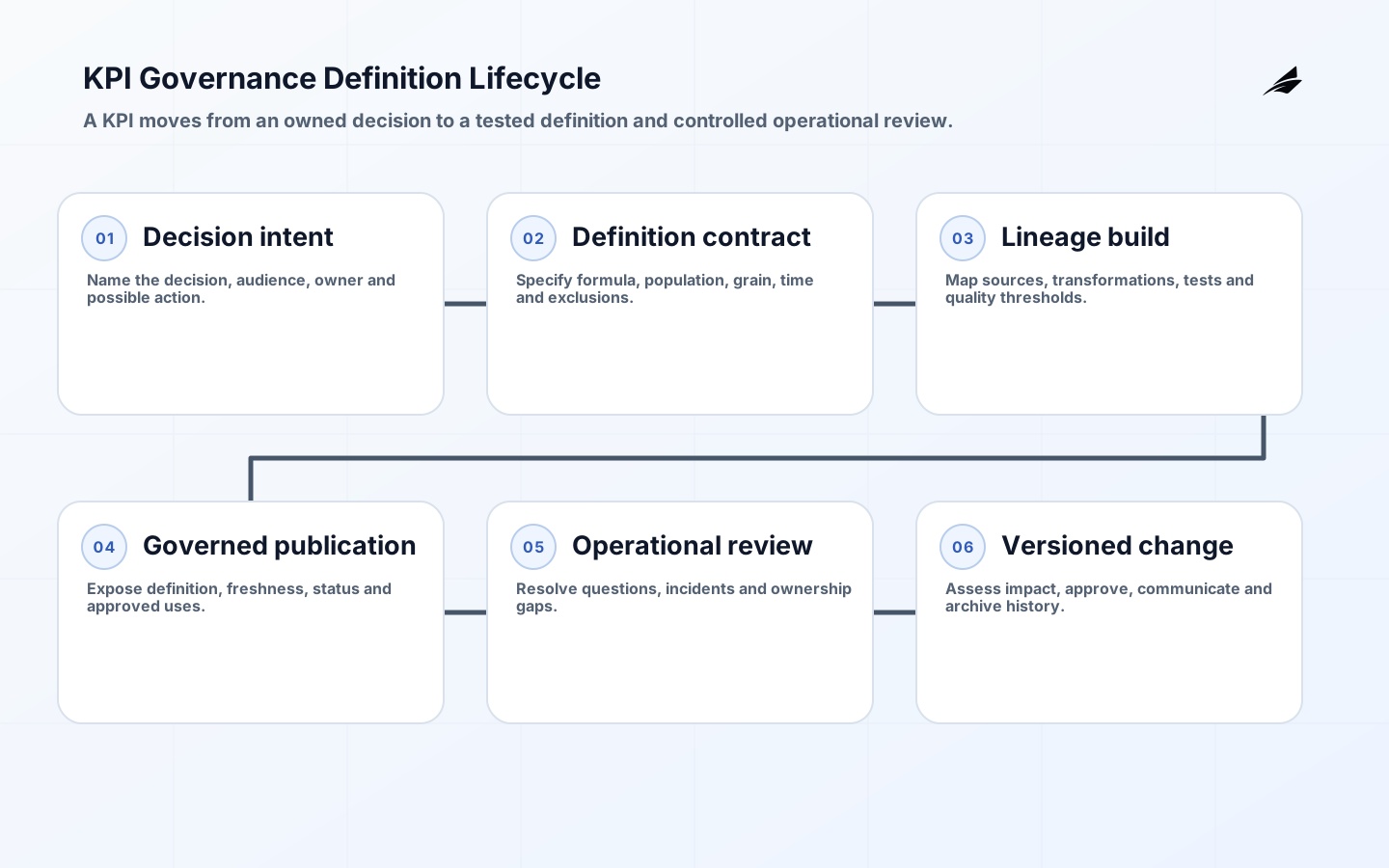
KPI governance is the system of decision rights that makes a key performance indicator understandable and dependable over time. It answers who owns the business meaning, who owns the data, how the calculation works, where the number may be used, and what happens when reality or source systems change. Without those answers, teams can publish identical labels for incompatible measures and spend reviews debating arithmetic instead of deciding what to do.
This guide treats kpi governance from first principles: definitions, ownership and decision rights as a set of decisions that can be reviewed and tested. The aim is not to prescribe one vendor or promise a universal result. It is to help business and technical owners define boundaries, preserve evidence, expose failure behavior and decide when the work is ready to expand.
Distinguish goals, indicators, measures and targets
A strategic goal states a desired outcome. An indicator signals progress toward it. A measure is a quantity produced from defined observations, while a target is a chosen reference value. A KPI is therefore not merely a prominent chart; it is a governed indicator considered important to a decision.
Write the decision first, then identify the smallest set of indicators that can inform it. Avoid promoting every available measure to KPI status, because importance depends on accountability and action, not dashboard placement.
| Contract field | Question it answers | Example evidence |
|---|---|---|
| Business intent | Why does this indicator exist? | Named decision, audience and action threshold |
| Formula and grain | What is calculated over which population? | Executable logic and approved examples |
| Time semantics | Which period and clock apply? | Event date, window, time zone and late-data rule |
| Lineage and quality | Can the value be traced and trusted? | Source map, tests, freshness and exception status |
| Ownership | Who approves meaning and repairs delivery? | Business owner, steward and engineering owner |
Ask a reviewer to explain what decision changes when the KPI moves, what comparison is valid, and which conditions make the value incomplete or misleading.
Turn "Distinguish goals, indicators, measures and targets" into a working control by naming one accountable owner, one maintained artifact and one review forum. The exit standard for this part of kpi governance from first principles: definitions, ownership and decision rights is concrete: Ask a reviewer to explain what decision changes when the KPI moves, what comparison is valid, and which conditions make the value incomplete or misleading. For this part of the system, name the accountable owner, supporting evidence, exception route, and next measurable check.
Create a metric definition contract
A useful contract includes business name, plain-language intent, formula, numerator, denominator, unit, grain, population, exclusions, time window, time zone, source fields, owner, steward, refresh rule and quality status. Examples should cover edge cases.

Version the definition separately from a dashboard. Record effective dates and whether historical values will be restated. Preserve aliases so users can find a renamed measure without treating the old and new definitions as equivalent.
Recalculate approved examples in an independent query or worksheet, trace sampled records to source, and verify that empty populations, late events and corrections follow the contract.
Turn "Create a metric definition contract" into a working control by naming one accountable owner, one maintained artifact and one review forum. The exit standard for this part of kpi governance from first principles: definitions, ownership and decision rights is concrete: Recalculate approved examples in an independent query or worksheet, trace sampled records to source, and verify that empty populations, late events and corrections follow the contract. Within this evaluation, name the accountable owner, supporting evidence, exception route, and next measurable check.
Assign decision rights across business and data roles
The business owner approves meaning, target and acceptable use. A data steward maintains metadata and quality rules. Engineering owns reliable implementation, while a governance forum resolves conflicts that cross functions. Consumers remain responsible for using the KPI in context.
Use a lightweight approval path for local operational measures and stronger review for executive, financial, regulatory or incentive-linked KPIs. Governance should scale with consequence, not force every chart through one committee.
Turn "Assign decision rights across business and data roles" into a working control by naming one accountable owner, one maintained artifact and one review forum. The exit standard for this part of kpi governance from first principles: definitions, ownership and decision rights is concrete: Evidence includes named owners, response expectations, unresolved issue queues and meeting decisions. A KPI without an active owner should be marked provisional or retired rather than silently inherited. When implementing this data handoff, name the accountable owner, supporting evidence, exception route, and next measurable check.
Connect lineage and quality to interpretation
Lineage should show the route from source events through transformations and semantic definitions to each published surface. Quality is contextual: completeness, timeliness, validity and consistency thresholds should reflect the decision the metric supports.
Expose freshness and quality state near the KPI. Do not let a successful pipeline imply that the underlying business records are complete, and do not conceal backfills or restatements behind an unchanged label.
Sample source-to-report traces, reconcile totals across approved surfaces, monitor late-arriving data and investigate changes in nulls, duplicates or population coverage.
Turn "Connect lineage and quality to interpretation" into a working control by naming one accountable owner, one maintained artifact and one review forum. The exit standard for this part of kpi governance from first principles: definitions, ownership and decision rights is concrete: Sample source-to-report traces, reconcile totals across approved surfaces, monitor late-arriving data and investigate changes in nulls, duplicates or population coverage. Before releasing this evaluation, name the accountable owner, supporting evidence, exception route, and next measurable check.
Change KPIs without rewriting history invisibly
A source migration, policy revision, product redesign or fiscal-calendar change can alter a KPI. Classify the change as presentation-only, implementation-preserving, definition-changing or target-changing, because each category requires different communication and validation.
Require an impact note listing affected reports, alerts, incentives, forecasts and downstream extracts. Decide whether to backfill, dual-run, annotate a break or preserve both versions for a defined period.
Before release, compare old and new series at record and aggregate levels. Approval should explain material differences instead of relying on a technically successful deployment.
Turn "Change KPIs without rewriting history invisibly" into a working control by naming one accountable owner, one maintained artifact and one review forum. The exit standard for this part of kpi governance from first principles: definitions, ownership and decision rights is concrete: Before release, compare old and new series at record and aggregate levels. Approval should explain material differences instead of relying on a technically successful deployment. While operating this part of the system, name the accountable owner, supporting evidence, exception route, and next measurable check.
| Change type | Required treatment | Reader communication |
|---|---|---|
| Presentation only | Visual regression and accessibility review | Release note when interpretation changes |
| Implementation preserving | Parallel calculation and reconciliation | Technical version in catalog |
| Definition changing | Business approval and impact assessment | Effective date and visible break annotation |
| Target changing | Owner rationale and approval | New target period and comparison rule |
| Retirement | Dependency check and archive | Replacement or reason for removal |
Review the KPI portfolio as a managed product
A metric catalog becomes useful when teams search it during planning, analysis and review. Keep status, owner, certification level, dependencies and common questions current; archive abandoned definitions so they cannot quietly return in spreadsheets.
Schedule operating reviews for incidents and quality, periodic definition reviews for relevance, and portfolio reviews for duplication. Retirement is a valid governance outcome when a KPI no longer informs an owned decision.
Track catalog searches, unresolved definition questions, duplicate labels, quality exceptions, ownership gaps and usage in governed decision forums. Activity alone is not proof of business relevance.
Turn "Review the KPI portfolio as a managed product" into a working control by naming one accountable owner, one maintained artifact and one review forum. The exit standard for this part of kpi governance from first principles: definitions, ownership and decision rights is concrete: Track catalog searches, unresolved definition questions, duplicate labels, quality exceptions, ownership gaps and usage in governed decision forums. Activity alone is not proof of business relevance. When changing this part of the system, name the accountable owner, supporting evidence, exception route, and next measurable check.
Introduce governance through a small decision domain
Start with one recurring review such as renewal health, fulfillment reliability or service capacity. Inventory the measures used there, identify disagreements, and govern the few indicators that materially affect actions.
Publish contracts, owners and quality states in the tools people already use. Connect dashboard labels to the catalog, establish a change request path, and train reviewers to challenge scope and freshness rather than memorize formulas.
A pilot succeeds when the same definition is used across approved surfaces, questions reach the right owner, changes are visible, and meeting time shifts from reconciliation toward decisions.
Turn "Introduce governance through a small decision domain" into a working control by naming one accountable owner, one maintained artifact and one review forum. The exit standard for this part of kpi governance from first principles: definitions, ownership and decision rights is concrete: A pilot succeeds when the same definition is used across approved surfaces, questions reach the right owner, changes are visible, and meeting time shifts from reconciliation toward decisions. During support for this decision boundary, name the accountable owner, supporting evidence, exception route, and next measurable check.
Key takeaways
- A KPI is a governed indicator tied to an owned decision, not simply a prominent number.
- Use versioned definition contracts with formulas, populations, time semantics and examples.
- Separate business ownership, data stewardship and technical implementation responsibilities.
- Show lineage, freshness and quality status where people interpret the metric.
- Treat changes and retirement as controlled product decisions with visible history.
Frequently asked questions
Who should own a KPI?
A business leader accountable for the decision should own meaning and target. Data and engineering roles can steward metadata and implementation, but they should not inherit business accountability merely because they build the dashboard.
How many KPIs should an organization have?
There is no universal correct count. Keep the set small enough that each indicator maps to an owned decision and review rhythm, while allowing supporting diagnostic measures beneath it. Remove indicators that no longer influence action.
Should historical KPI values be recalculated after a definition change?
Only after an explicit decision. Restatement can aid comparison but may erase what decision-makers actually saw. Record the rationale, version, effective date and whether prior periods were recomputed or intentionally preserved.
Is a data catalog enough for KPI governance?
A catalog stores definitions and lineage, but governance also requires decision rights, review, issue response and change control. A well-populated catalog with inactive owners still leaves the metric unmanaged.
Conclusion
KPI governance works when a person can move from a number to its meaning, source, owner, quality state and history without detective work. First principles keep the design honest: define the decision, specify the measure, assign rights, test interpretation and preserve changes. The result is not more metric bureaucracy; it is less ambiguity at the moment a team must act.