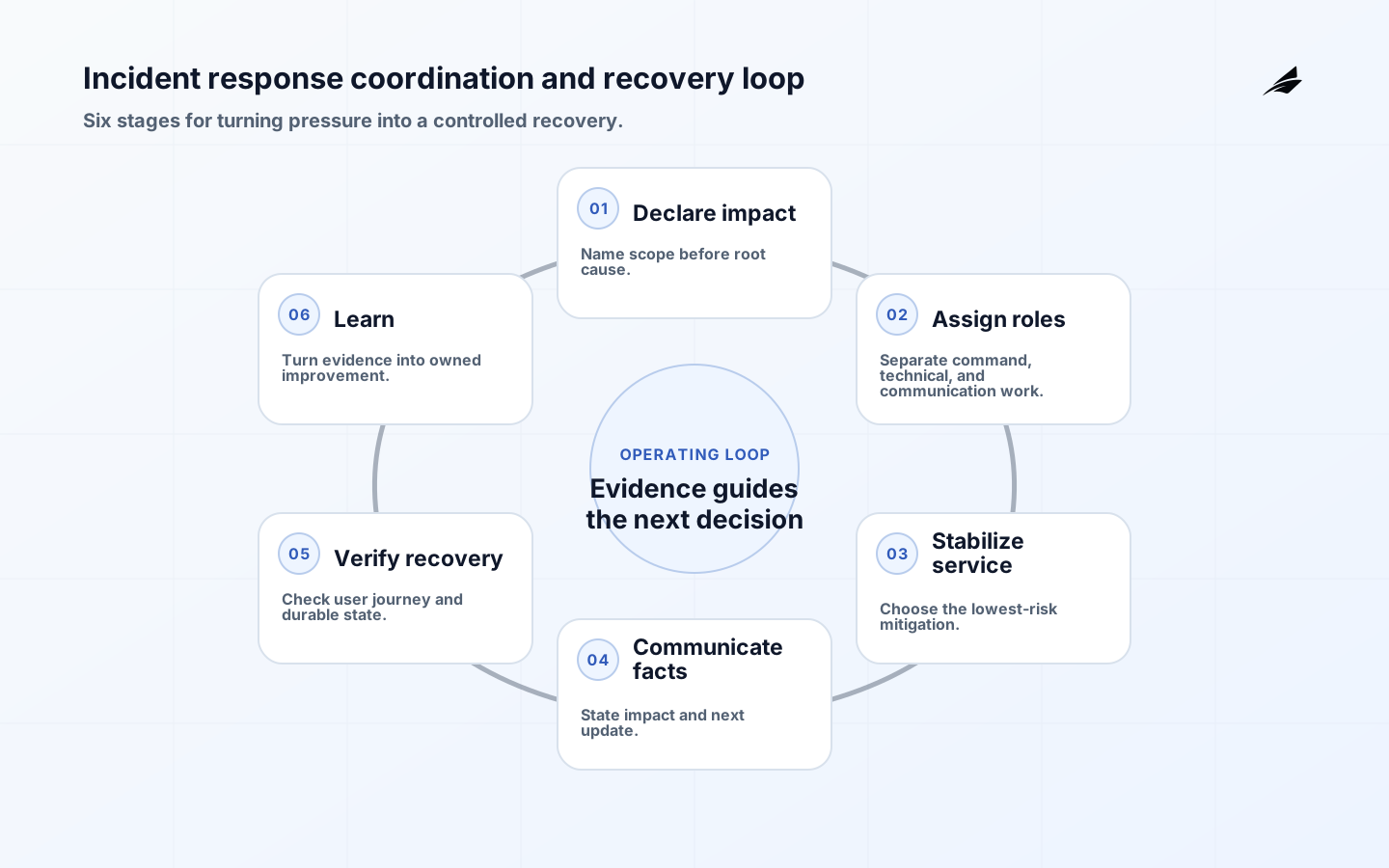
Incident response is the coordinated work of reducing harm from an unplanned service or security event, restoring a safe operating condition, and learning without turning the review into a trial. It is not a document opened after a crisis. A capable incident response process gives people a way to declare impact, assign decision roles, establish a reliable timeline, communicate what is known, make reversible changes, preserve evidence, and transfer follow-up work into normal planning. Google SRE’s incident guidance and NIST’s incident-response recommendations both emphasize preparation, coordination, and recovery as connected work. The incident response decisions guide and container security checklist extend the recovery boundary.
What incident response means in practice
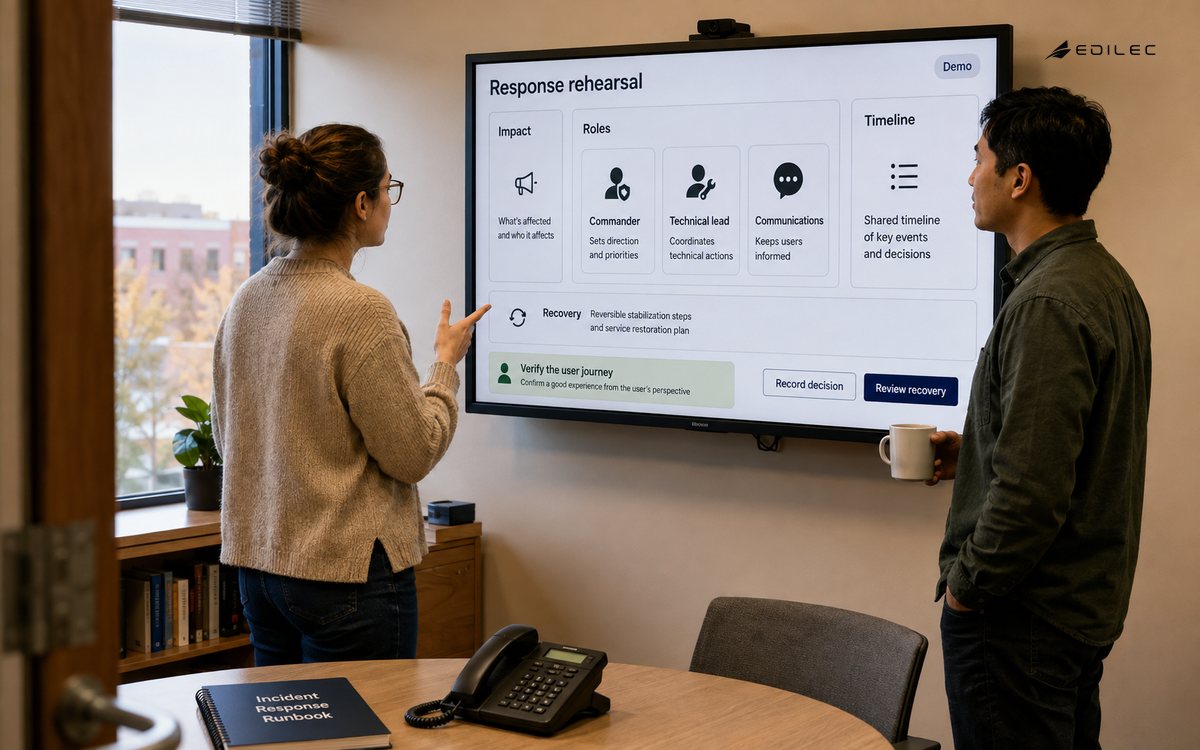
Define what qualifies as an incident by customer, business, safety, or security impact rather than by a vague feeling that something is wrong. At declaration, record the incident commander, technical lead, communications owner, affected service or journey, start time, known impact, and next update time. A busy room without named roles can create more confusion than it removes. The Google SRE managing incidents guidance treats coordination and communication as reliability work, not as administration separate from engineering.
| Role or record | Responsibility | Evidence |
|---|---|---|
| Incident commander | Set priorities, assign work, and decide escalation. | State, decisions, owners, and next review time. |
| Technical lead | Investigate hypotheses and propose bounded mitigation. | Facts, tests, changes, and observed effects. |
| Communications owner | Give stakeholders useful, timely updates. | Audience, message, impact, and next update. |
| Timeline | Keep a shared record of what happened and when. | Timestamps, facts, hypotheses, and actions. |
Build an operating model before the event
Prepare current service ownership, alert routing, protected communication channels, dashboards with known access, runbooks for high-risk operations, change history, and contact paths for vendors or business leads. Give responders least-privilege emergency access that is time-bounded and logged. Store runbooks near the systems they describe and test whether a new on-call engineer can follow them. Do not make a central wiki the sole dependency if its authentication or network path might be affected by the incident. The NIST Cybersecurity Framework is useful for connecting preparation, detection, response, and recovery to the organization’s broader risk work.
Separate incident coordination from technical investigation so the person making priority decisions is not forced to debug every subsystem. Use one shared record, distinguish facts from hypotheses, and set an update cadence even when there is little new information. For a security event, preserve relevant evidence and involve the designated security function early; for a service outage, protect customer communication and recovery verification. Events can overlap, so routes should coordinate rather than compete for ownership.
Follow a practical implementation path
Stabilization comes before root-cause certainty. Confirm impact, stop harmful automated changes where justified, and record the first known time and scope. Then choose the lowest-risk mitigation: rollback a new application revision, disable a feature, rate-limit an overload path, fail over a dependency, or restore a known configuration. Make one controlled change at a time when possible and watch the expected signal. A mitigation is not full recovery; verify the user journey, durable state, and dependency behavior before closing the incident.
| Phase | Decision | Common mistake |
|---|---|---|
| Declare | Is impact material enough to coordinate formally? | Waiting for root cause before naming the event. |
| Stabilize | What reversible action reduces harm now? | Making many untracked changes at once. |
| Recover | Has the service and user journey returned? | Closing on a green component metric alone. |
| Learn | What owned change reduces recurrence? | Writing a narrative without actionable follow-up. |
Make risks and controls explicit
Response itself can worsen an outage through uncoordinated changes, unclear escalation, credential sharing, or speculative communication. Protect the incident record from sensitive data and keep emergency access attributable. Define a stop rule for risky experiments. The NIST SP 800-61 Rev. 3 recommendations are helpful for integrating incident response into cybersecurity risk management; local teams should map the lifecycle to their actual authority, evidence, legal obligations, and service dependencies. A blameless review should still name owners and deadlines.
Use signals that show whether it is working
Measure time to detect, acknowledge, coordinate, mitigate, and restore, but do not reduce response quality to one duration. Review whether severity matched impact, roles were clear, the communication cadence was met, the timeline enabled investigation, and recovery was verified from the customer perspective. Track recurrence, alert quality, action-item completion, and near misses. A short incident with no usable evidence may be more costly than a longer incident that creates a repairable improvement. The SRE incident response workbook offers a practical reference for reviewing these behaviors.
Use an incident response checklist for the next change
Run a bounded simulation: a release raises errors for a high-value journey while one dashboard is unavailable. Ask the team to declare, assign roles, select a mitigation, communicate an update, preserve the timeline, and verify recovery. The exercise should expose missing access, stale runbooks, or ambiguous ownership rather than reward memorized procedure. Update the runbook with what made the next decision slow. Link this practice with the backup and restore guide when recovery depends on durable state.
A worked decision example
A checkout release raises payment errors during a traffic surge. The on-call engineer declares an incident from customer impact, assigns a commander, and records the first known time and error rate. The technical lead compares release and dependency signals while another responder disables the new path with a feature flag. A communications owner posts the next update time. After errors return to baseline, the team verifies a real checkout, preserves the timeline, and assigns the missing guardrail as follow-up work. The review separates release behavior, capacity pressure, and monitoring gaps instead of calling all three one root cause.
Phase adoption without creating ceremony
Start with one bounded service or workflow. Establish the owner, evidence record, access boundary, communications path, and stop rule before standardizing templates or automating escalation. After the team can explain why the controls exist and show a recovery outcome, reuse conventions that made decisions clearer. Do not expand because a process looks polished in a tabletop exercise; expand when a new service can apply it without private knowledge. Review a normal outcome, an unexpected outcome, and a manual exception each quarter or after a significant event.
Set communication expectations before the incident. Decide which audiences need an internal technical update, a customer notice, a security escalation, or a leadership brief. Keep the first message factual: state impact, time observed, current action, and next update. Avoid speculative cause and distinguish mitigation from recovery. Prepared language lowers pressure on responders while leaving room to adapt when the facts change. This boundary belongs in the service review record.
Evidence preservation should be proportionate and usable. Capture the incident state, relevant change history, commands or automated actions, alert context, and recovery verification. Protect sensitive data and record who accessed the material. If a security investigation requires a different retention or chain of custody, hand off deliberately rather than copying everything into an open incident room. The response record should help both immediate coordination and later improvement. This boundary belongs in the service review record.
Post-incident work needs a definition of done. An action is not complete because a ticket was opened or a runbook was edited; the team should show the control, test, owner, and signal that demonstrate improvement. Prioritize changes that reduce impact, shorten detection or recovery, improve evidence, or remove a repeated manual step. Close low-value narrative tasks so the review does not become a backlog nobody trusts. This boundary belongs in the service review record.
Run a small drill after meaningful change. During the incident exercise, alter one bounded input, follow the service’s documented containment path, and confirm that the expected customer behavior returns. Record where access, timing, or ownership was unclear. A successful exercise is one that reveals a practical weakness early enough to repair it, not one in which every participant follows an expected script. This boundary belongs in the service review record.
Set communication expectations before an incident. Decide which audiences need an internal technical update, customer notice, security escalation, or leadership brief, and give each one an owner, channel, and update cadence. Keep the first message factual about impact, observed time, current action, and next update; prepared language should support judgment rather than pretend the facts are settled.
Preserve incident evidence in a form responders can use. Capture the incident state, relevant change history, automated actions, alert context, and recovery verification, while keeping sensitive investigation material in a controlled location. If security requires different retention or chain of custody, hand off deliberately instead of copying everything into an open incident room.
Define post-incident work by the control it changes. A ticket or edited runbook is not completion unless the team can show the test, owner, signal, and expected improvement. Prioritize changes that reduce impact, detection or recovery time, improve evidence, or remove a repeated manual step; close low-value narrative tasks so the review remains trusted.
Run a small drill after meaningful change and alter one bounded input, such as a dependency response or release flag. Follow the documented containment path and confirm that expected customer behavior returns. A successful exercise reveals a weakness early enough to repair it; it does not require every participant to follow an ideal script.
Key takeaways
- Declare from impact, not from certainty about cause.
- Give coordination, technical investigation, and communication clear owners.
- Stabilize with bounded reversible action while preserving facts and evidence.
- Separate mitigation from verified recovery and communicate the difference.
- Measure decision quality, evidence, and recurrence as well as response time.
- Turn reviews and exercises into small owned improvements with deadlines.
Frequently asked questions about incident response
Is every incident a security breach? No. A service incident, security event, and breach have different routes, though they may overlap. Does blameless mean avoiding accountability? No. It means examining systems and conditions candidly while assigning corrective work. Should responders wait for root cause? No. Restore a safe state first and keep hypotheses separate from facts. How often should teams rehearse? Often enough that roles, access, communication, and recovery are familiar, especially after major architecture or ownership changes. Who owns the post-incident work? A named team or person for each action, with a due date and review path.
Conclusion
Incident response is a practiced coordination capability. Declare impact early, give people clear roles, stabilize before theorizing, record decisions, communicate what is known, and verify recovery from the user’s perspective. The calmest response is built long before the pager fires, through small exercises and evidence that make the next safe decision easier.